Global AI in Fintech Market Size, Share, Trends & Growth Forecast Report By Component (Solutions, Software Tools, Platforms, Services, Managed, Professional), Deployment Mode (Cloud, On-Premises), Application Area (Virtual Assistants, Business Analytics, Customer Behavioral Analytics, Fraud Detection, Credit Scoring, Algorithmic Trading, Personal Finance Management, Regulatory Compliance), End-Use Industry (Retail & Investment Banking, Stock Trading, Hedge Funds, Insurance, Wealth Management, FinTech, Mobile Payments, RegTech, Government Agencies, Crypto Exchanges), and Region – Industry Analysis, 2024 to 2033
Global AI in FinTech Market Size
The global AI in FinTech market is expected to grow from USD 13.3 billion in 2024 to reach USD 296.73 billion by 2033, at a CAGR of 41.2% from 2024 to 2033.
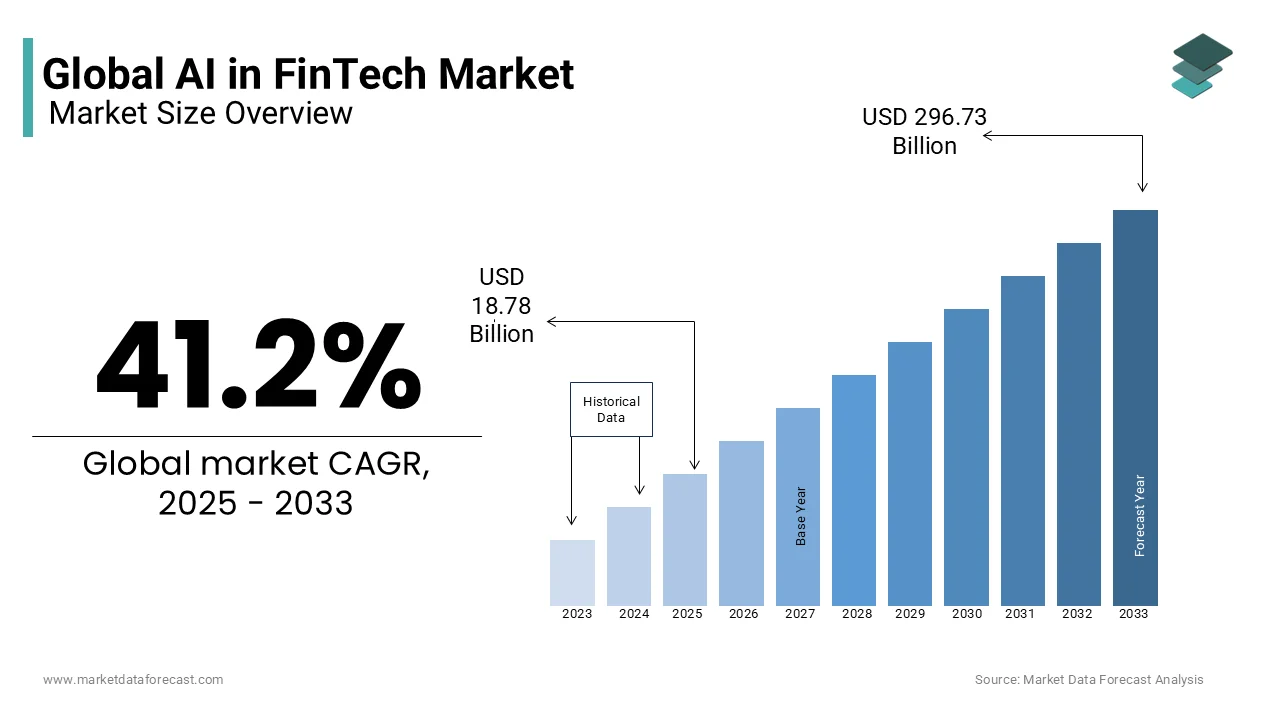
The integration of artificial intelligence within financial technology has redefined the architecture of modern financial ecosystems, transcending conventional automation to enable cognitive decision-making across banking, insurance, asset management, and regulatory operations. AI in Fintech encompasses machine learning algorithms, natural language processing, predictive analytics, and computer vision systems that facilitate real-time fraud detection, personalized wealth management, automated underwriting, and intelligent customer service.
MARKET DRIVERS
Escalating Demand for Real-Time Fraud Detection and Cybersecurity Enhancement
Financial institutions face an unprecedented surge in digital transaction volumes is escalating the growth of the AI in fintech market. As per the Financial Stability Board, global losses from payment fraud exceeded $40 billion in 2023, a 23% year-on-year increase, prompting urgent adoption of AI-driven anomaly detection systems. Machine learning models, particularly deep neural networks, analyze transaction patterns in microseconds, identifying deviations with over 95% accuracy, as demonstrated in JPMorgan Chase’s proprietary AI system, COiN. The system processes 12,000 contract documents annually while detecting suspicious activities across 70 million daily transactions.
Accelerated Adoption of Personalized Financial Advisory Services
The proliferation of robo-advisory platforms, powered by AI-driven behavioral analytics and portfolio optimization algorithms, is also accelerating the growth of the AI in fintech market. Platforms such as Betterment and Wealthfront leverage machine learning to tailor investment strategies based on individual risk profiles, spending behavior, and life-stage transitions, achieving client retention rates 35% higher than traditional advisory models, as noted in a 2023 McKinsey analysis. This scalability, coupled with declining costs of AI deployment, enables even mid-tier financial firms to offer hyper-personalized services, which is driving mass-market penetration and reshaping consumer expectations across geographies.
MARKET RESTRAINTS
Regulatory Fragmentation and Compliance Uncertainty Across Jurisdictions
The absence of harmonized global standards for AI governance in financial services impedes cross-border scalability and increases compliance complexity, which is hindering the growth of the AI in fintech market. As per the Financial Conduct Authority (FCA) of the United Kingdom, over 60% of AI-driven fintech firms face delays in product launches due to divergent regulatory interpretations across jurisdictions. The European Union’s AI Act imposes stringent transparency requirements for high-risk AI systems, including mandatory fundamental rights impact assessments, while the U.S. lacks a federal AI regulatory framework, leading to a patchwork of state-level rules. Additionally, the Basel Committee notes that 54% of global banks have suspended AI deployment in credit risk modeling due to uncertainty over model explainability standards.
Persistent Data Quality and Interoperability Deficiencies in Legacy Financial Systems
Many financial institutions remain constrained by outdated core banking infrastructures that generate siloed, inconsistent, or incomplete datasets is additionally degrading the growth of the AI in fintech market. As per a 2023 report by the Bank for International Settlements, approximately 68% of traditional banks in advanced economies still rely on COBOL-based legacy systems, which lack the API readiness required for seamless AI integration. This technological inertia results in data latency, with some institutions experiencing delays of up to 72 hours in transaction data synchronization, severely limiting the efficacy of real-time AI analytics. These deficiencies compromise model accuracy, with Gartner estimating that poor data quality contributes to 60% of AI project failures in financial services.
MARKET OPPORTUNITIES
Expansion of AI-Powered Credit Scoring in Financially Underserved Populations
Analyzing alternative data such as mobile phone usage, utility payments, and social connectivity to generate inclusive creditworthiness assessments is likely to promote new opportunities for the growth of the AI in fintech market. Similarly, India’s Reserve Bank noted that AI-enhanced credit scoring has increased loan approval rates for rural MSMEs by 38% between 2021 and 2023. These models, validated by the International Finance Corporation, demonstrate that non-traditional data can predict repayment behavior with up to 91% accuracy.
Integration of Generative AI in Regulatory Compliance and Reporting Automation
Regulatory reporting consumes an estimated 20% of compliance staff time in major financial institutions with manual processes prone to errors and delays is prompting the growth of the AI in fintech market. Generative AI, particularly large language models fine-tuned for financial regulation, offers a paradigm shift by automating the interpretation of complex legal texts and generating compliant documentation. For instance, HSBC deployed a generative AI system in 2023 that reduced the time required to draft regulatory submissions by 70%, as confirmed in internal audits reviewed by the Chartered Institute for Securities & Investment.
MARKET CHALLENGES
Algorithmic Bias and Erosion of Consumer Trust in AI-Driven Financial Decisions
AI models in fintech are increasingly scrutinized for perpetuating systemic biases in lending, insurance, and hiring practices, which impedes the growth of the AI in fintech market. A 2023 investigation by the U.S. Consumer Financial Protection Bureau revealed that certain AI credit scoring models exhibited a 15% higher denial rate for minority applicants with comparable financial profiles, stemming from historical data imbalances. Similarly, the European Banking Authority found that 41% of AI-based underwriting systems demonstrated statistically significant gender bias in small business loan approvals.
High Computational Costs and Energy Intensity of Large-Scale AI Model Training
The rising concerns about economic and environmental sustainability is also inhibiting the growth of the AI in fintech market. Training a single large language model for financial analysis can consume over 1,300 megawatt-hours of electricity, equivalent to the annual energy use of 130 average U.S. households, as calculated by the International Energy Agency in its 2023 Digitalization and Energy report. For mid-sized fintech firms, cloud computing costs for AI infrastructure can account for up to 35% of total operating expenses, according to a 2024 analysis by the Boston Consulting Group. This financial burden limits scalability, particularly in emerging markets where capital access is constrained.
REPORT COVERAGE
| REPORT METRIC | DETAILS |
| Market Size Available | 2024 to 2033 |
| Base Year | 2024 |
| Forecast Period | 2025 to 2033 |
| CAGR | 41.2% |
| Segments Covered | By Component, Deployment Mode, Application Area, End-Use Industry and Region |
|
Various Analyses Covered | Global, Regional & Country Level Analysis, Segment-Level Analysis, DROC, PESTLE Analysis, Porter’s Five Forces Analysis, Competitive Landscape, Analyst Overview on Investment Opportunities |
| Regions Covered | North America, Europe, APAC, Latin America, Middle East & Africa |
|
Market Leaders Profiled | Ant Financial, Square, Stripe, PayPal, Robinhood, Adyen, Revolut, Klarna, Wealthfront, Coinbase, Affirm, Betterment, SoFi, Plaid, ZestFinance, Kabbage, LendingClub, Fiserv, N26, and others. |
SEGMENTAL ANALYSIS
By Component Insights
The solutions segment was accounted in holding 38.2% of the AI in fintech market share in 2024 with the growing institutional demand for turnkey AI systems that integrate seamlessly into core financial operations without requiring extensive in-house development. Financial institutions increasingly prioritize ready-to-deploy fraud detection engines, automated underwriting modules, and risk assessment suites that reduce time-to-value.
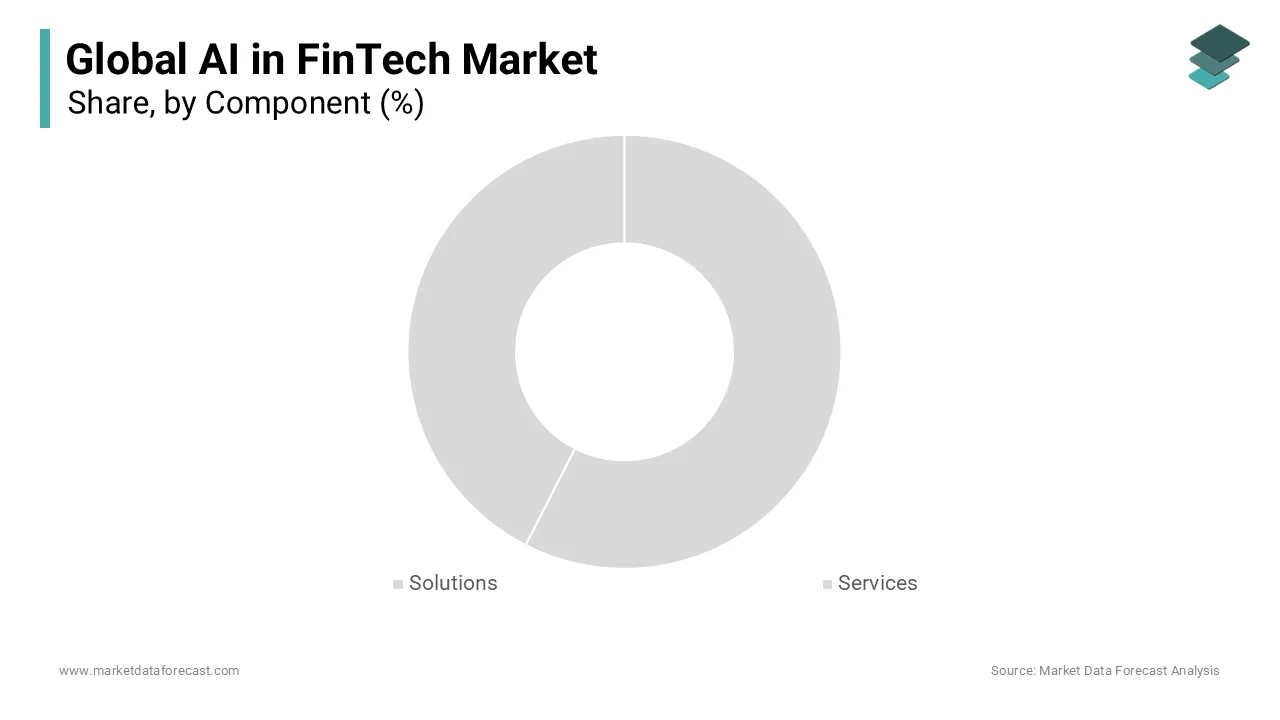
The professional services segment is projected to grow with an expected CAGR of 29.4% during the forecast period owing to the rising complexity of AI integration within legacy financial infrastructures, necessitating expert consultation, model validation, and change management. The Financial Conduct Authority (FCA) revealed that 62% of UK fintech firms engaged external AI advisory services in 2023 to meet the requirements of the Digital Regulation Cooperation Forum. Furthermore, the Basel Committee on Banking Supervision emphasized that 48% of global banks lack internal expertise to validate AI model fairness, fueling demand for specialized professional support.
By Deployment Mode Insights
The cloud deployment dominated the AI in fintech market by accounting for a significant share in 2024 with the cloud’s ability to deliver elastic computing power essential for processing high-frequency financial data and training resource-intensive machine learning models. Financial institutions are increasingly migrating AI workloads to cloud environments to leverage real-time scalability and avoid capital-intensive on-premises infrastructure.
The on-premises deployment segment is expected to grow with CAGR of 14.7% during the forecast period. Similarly, the Reserve Bank of India reported that 52% of public sector banks have rejected full cloud migration for AI due to regulatory restrictions on storing sensitive customer data offshore. Additionally, the U.S. Federal Reserve’s SR 11-7 guidance encourages controlled environments for high-impact AI models, reinforcing on-premises adoption in regulated functions. These institutional imperatives ensure sustained demand despite higher maintenance costs.
By Application Area Insights
The fraud detection segment was the largest by occupying 26.3% of the global AI in fintech market share in 2024, with the escalating sophistication of financial cybercrime and the imperative for real-time transaction monitoring. AI-driven fraud detection systems analyze millions of transactions per second, identifying anomalies with precision unattainable through rule-based methods.
The regulatory compliance segment is likely to grow with an expected CAGR of 31.8% in the coming years with the exponential rise in regulatory complexity and the need for automated, auditable compliance workflows. Financial institutions now face an average of 280 new regulatory updates per year, according to the Financial Stability Board, overwhelming traditional manual compliance teams. AI systems capable of parsing legal texts, extracting obligations, and generating compliance reports are increasingly deployed.
By End-Use Industry Insights
The retail and investment banking segment was accounted in holding 42.3% of the AI in fintech market share in 2024 with the sector’s vast customer base, high transaction volumes, and urgent need for digital transformation. Banks are deploying AI across customer service, credit assessment, anti-money laundering (AML), and portfolio management to enhance efficiency and competitiveness.
The crypto exchanges segment is expected to witness a CAGR of 34.2% during the forecast period, with the intrinsic complexity of blockchain data and the need for real-time surveillance in largely unregulated markets. AI models are being deployed to detect wash trading, market manipulation, and illicit fund flows across decentralized platforms. Moreover, the Financial Action Task Force (FATF) emphasized that 88% of virtual asset service providers now use AI to comply with Travel Rule requirements.
REGIONAL ANALYSIS
North America AI in Fintech Market Insights

North America was the top performer in the global AI in fintech market with 39.3% of share in 2024, with its robust technological infrastructure, deep venture capital penetration, and early regulatory clarity on AI deployment. Silicon Valley and New York serve as epicenters for innovation, with firms like Stripe and Plaid pioneering AI-driven payment routing and identity verification. The Office of the Comptroller of the Currency (OCC) has issued guidance on responsible AI use in banking, fostering institutional confidence.
Europe AI in Fintech Market Insights
Europe was the positioned second with 28.3% of the AI in fintech market share in 2024 with stringent regulatory frameworks and a focus on ethical deployment. As of 2023, 61% of German banks had implemented AI for SME credit scoring, according to Deutsche Bundesbank by reducing default rates by 18%. The UK is a hub with the FCA’s sandbox program supporting over 120 AI-based fintech trialsEurope’s balance of innovation and oversight positions it as a model for responsible AI scaling.
Asia Pacific AI in Fintech Market Insights
The Asia Pacific AI in fintech market growth is driven by digital leapfrogging in emerging economies and aggressive government-backed digitalization initiatives. China leads in AI patent filings for financial applications, with over 12,000 registered in 2023 alone, as documented by the World Intellectual Property Organization. Fintech giants like Ant Group and Tencent deploy AI at scale, serving over 900 million digital finance users. India’s Unified Payments Interface (UPI) processes 10 billion transactions monthly, with AI algorithms managing fraud detection in real time, as confirmed by the Reserve Bank of India. Meanwhile, Singapore’s Monetary Authority has launched the AI Verify Foundation to standardize testing protocols.
Latin America AI in Fintech Market Insights
Latin America AI in fintech market growth is likely to grow in the coming year with the rising digital banking penetration and the proliferation of neobanks. Brazil alone added 45 million new digital banking users between 2020 and 2023, according to the Central Bank of Brazil.
Middle East and Africa AI in Fintech Market Insights
The Middle East and Africa AI in fintech market growth is likely to have a steady pace in the coming years. However, pockets of innovation are emerging, particularly in the Gulf Cooperation Council (GCC) countries and South Africa.
KEY PLAYERS IN THE MARKET
Companies playing a leading role in the global AI in fintech market include Ant Financial, Square, Stripe, PayPal, Robinhood, Adyen, Revolut, Klarna, Wealthfront, Coinbase, Affirm, Betterment, SoFi, Plaid, ZestFinance, Kabbage, LendingClub, Fiserv, N26, and others.
TOP LEADING PLAYERS IN THE MARKET
Tencent Holdings Ltd.
Tencent has emerged as a pivotal force in the Asia Pacific AI in fintech market by leveraging its WeChat super-app ecosystem to integrate artificial intelligence into payments, lending, and wealth management. The company’s AI Lab has developed advanced natural language processing models that power customer service chatbots for WeBank, China’s first digital-only bank, enabling 24/7 multilingual support. In 2023, Tencent launched its Financial AI Engine, which provides real-time fraud detection for over 900 million users across Southeast Asia. The company has also partnered with central banks in Thailand and Indonesia to support digital currency infrastructure, embedding AI-driven transaction monitoring.
Alibaba Group (Ant Group)
Ant Group, an affiliate of Alibaba, has redefined AI-powered financial services in the Asia Pacific through its Zhima Credit and MYbank platforms. The company employs machine learning to analyze non-traditional data for credit scoring, extending microloans to over 50 million small businesses in China and Southeast Asia. In 2023, Ant launched its next-generation risk engine, AntBot 3.0, which reduced fraudulent loan applications by 68% across its partner banks. The company also introduced AI-driven cross-border payment routing on Alipay+, optimizing transaction success rates in 40+ markets. Collaborating with regulators in Singapore and Malaysia, Ant has helped shape AI governance frameworks for open banking.
Infosys Limited
Infosys has become an enabler of AI adoption in financial institutions across the Asia Pacific, offering end-to-end digital transformation services tailored to banking and insurance sectors. The company’s Infosys Topaz platform, launched in 2023, delivers generative AI solutions for regulatory reporting, customer insights, and claims processing, deployed in over 60 financial clients across India, Australia, and Japan. Infosys partnered with Standard Chartered Bank to co-develop AI models for real-time anti-money laundering detection, reducing false positives by 45%.
TOP STRATEGIES USED BY KEY MARKET PARTICIPANTS
Key players in the AI in fintech market are deploying strategic initiatives such as ecosystem partnerships, AI model specialization, regulatory collaboration, cloud-native platform development, and geographic expansion to consolidate their positions. Leading firms are forming alliances with banks, regulators, and telecom providers to access data and distribution networks, enhancing AI model accuracy and reach. Companies are also embedding explainability and auditability into AI systems to meet evolving regulatory demands. Cloud-based deployment models ensure scalability, particularly in emerging markets. Additionally, talent acquisition and upskilling programs to sustaining innovation.
COMPETITION OVERVIEW
The competition in the AI in fintech market is intensifying as technological convergence accelerates and barriers to entry diminish. Incumbent financial institutions, global tech giants, and agile startups are vying for dominance through innovation, scalability, and regulatory alignment. Differentiation increasingly hinges on the precision of AI models, speed of deployment, and ability to ensure ethical and transparent operations. Strategic collaborations between banks and AI firms are reshaping competitive dynamics, while venture capital continues to fuel disruptive entrants. The race to develop generative AI applications for compliance, customer service, and risk management has heightened rivalry.
RECENT MARKET DEVELOPMENTS
- In January 2023, Ant Group launched AntBot 3.0, an advanced AI-powered risk detection engine designed to identify fraudulent financial activities in real time by enhancing security across its Alipay ecosystem and partner institutions in Southeast Asia.
- In June 2023, Tencent partnered with the Bank of Thailand to integrate its AI-driven fraud monitoring system into the country’s PromptPay digital payment infrastructure, which is improving transaction safety for over 50 million users.
- In September 2023, Infosys introduced Infosys Topaz, a generative AI platform tailored for financial services by enabling banks and insurers across Australia and India to automate regulatory reporting and customer analytics.
- In February 2024, Alibaba Cloud launched Financial Brain 2.0, an upgraded AI suite for credit assessment and algorithmic trading, which is expanding its deployment to fintech firms in Malaysia, Indonesia, and South Korea.
- In May 2024, Ant Group collaborated with the Monetary Authority of Singapore to pilot a federated learning framework for cross-border credit scoring by allowing data privacy-preserving AI model training across regional financial institutions.
MARKET SEGMENTATION
This research report on the global AI in the fintech market has been segmented and sub-segmented based on component, deployment mode, application area, end-use industry, and region.
By Component
- Solutions
- Software Tools
- Platforms
- Services
- Managed Services
- Professional Services
By Deployment Mode
- Cloud
- On-premises
By Application Area
- Virtual Assistants (Chatbots)
- Business Analytics & Reporting
- Customer Behavioral Analytics
- Fraud Detection & Prevention
- Credit Scoring & Underwriting
- Algorithmic Trading
- Personal Financial Management
- Regulatory Compliance
By End-Use Industry
- Retail Banking
- Investment Banking
- Stock Trading Firms
- Hedge Funds
- Insurance Providers
- Wealth Management Firms
- Financial Technology Providers
- Mobile Payment Companies
- RegTech Vendors
- Government Regulatory Agencies
- Crypto Exchanges
By Region
- North America
- Europe
- Asia-Pacific
- Latin America
- Middle East and Africa
Frequently Asked Questions
What role does AI play in fraud detection and prevention within the global fintech ecosystem?
AI-powered fraud detection systems use machine learning algorithms to analyze transactional data in real-time, identifying suspicious activities and preventing fraudulent transactions across diverse financial services globally.
What challenges does the adoption of AI pose for regulatory compliance in the fintech sector globally?
Regulatory compliance becomes complex due to the opaque nature of AI algorithms and concerns regarding data privacy and security. Global fintech companies need to ensure transparency, fairness, and accountability in their AI systems to comply with evolving regulations.
How does AI enable predictive analytics for financial forecasting in the global fintech landscape?
AI algorithms analyze historical and real-time financial data to generate accurate forecasts and insights, helping fintech companies globally make informed decisions regarding investment strategies, risk management, and market trends.
What future trends can we expect in the intersection of AI and fintech on a global level?
Future trends include the integration of AI with blockchain technology for enhanced security and transparency, the expansion of AI applications in regulatory compliance and cybersecurity, and the emergence of AI-driven personalized financial planning services catering to diverse consumer needs worldwide.
Related Reports
Access the study in MULTIPLE FORMATS
Purchase options starting from
$ 2500
Didn’t find what you’re looking for?
TALK TO OUR ANALYST TEAM
Need something within your budget?
NO WORRIES! WE GOT YOU COVERED!
Call us on: +1 888 702 9696 (U.S Toll Free)
Write to us: sales@marketdataforecast.com