Europe Castor Market Size, Share, Trends & Growth Forecast Report Segmented By End Use (Pharmaceuticals, Lubricants, Paints, Soaps, Others), And Country (UK, France, Spain, Germany, Italy, Russia, Sweden, Denmark, Switzerland, Netherlands, Turkey, Czech Republic & Rest Of Europe), Industry Analysis From 2026 To 2034
Europe Castor Market Size
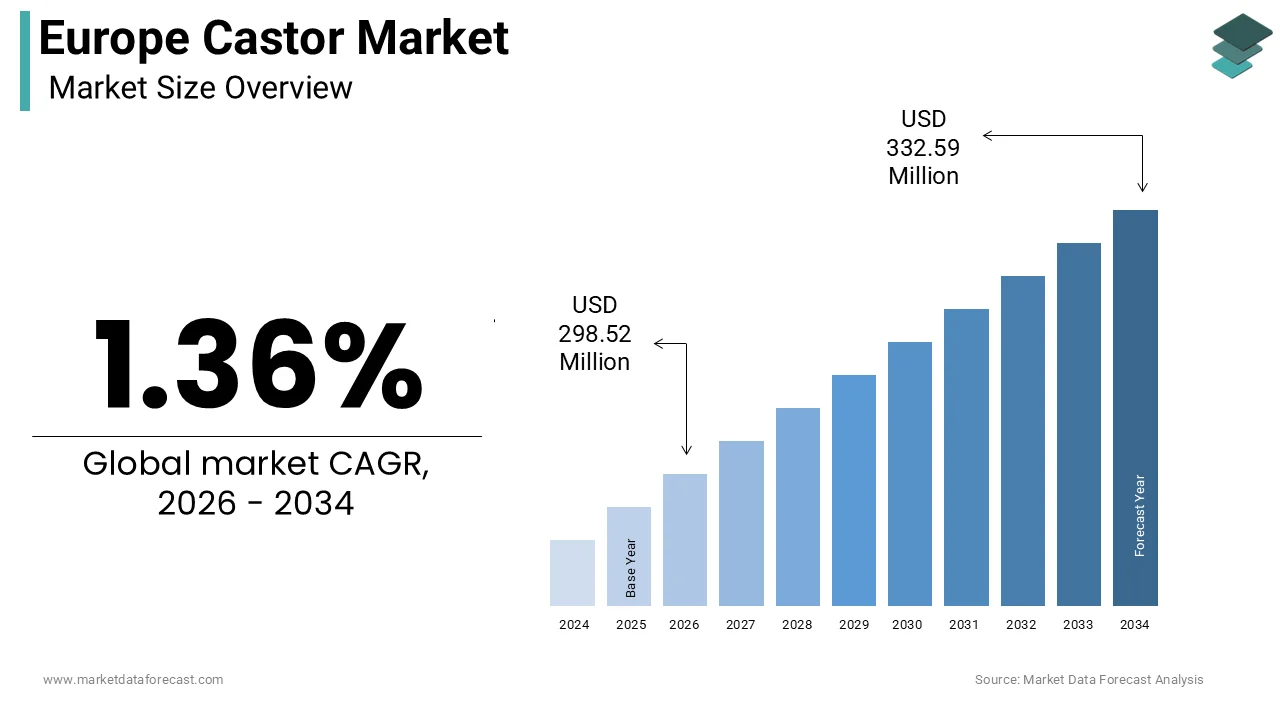
The Europe castor market size was calculated to be USD 294.51 million in 2025 and is anticipated to be worth USD 332.59 million by 2034, from USD 298.52 million in 2026, growing at a CAGR of 1.36% during the forecast period.
The castor is the import processing and distributor of castor oil and its derivatives, which are extracted from the seeds of the Ricinus communis plant. These versatile bio-based chemicals are integral to industries ranging from cosmetics and pharmaceuticals to lubricants and polymers. As per Eurostat data from 2024, the European Union imported approximately 180000 tons of castor oil and its fractions primarily sourced from India, Brazil, and China. The strategic importance of this market is underscored by the European Commission’s Industrial Strategy, which prioritizes the transition from fossil-based feedstocks to renewable alternatives. According to the European Chemicals Agency, castor derivatives are registered under the Registration, Evaluation, Authorization and Restriction of Chemicals regulation, ensuring their safe use in various applications. The shift toward green chemistry and sustainable manufacturing processes has elevated the status of castor oil as a critical raw material.
MARKET DRIVERS
Stringent Environmental Regulations Driving Bio-Based Adoption
The regulatory frameworks mandating the reduction of carbon footprints and the adoption of renewable resources are promoting the growth of `Europe castor market. The European Green Deal and its associated policies, such as the Circular Economy Action Plan, compel industries to substitute fossil-based ingredients with bio-based alternatives. Castor oil derivatives offer a viable solution due to their unique chemical structure and biodegradability. As per the European Commission, the target to reduce greenhouse gas emissions by 55% by 2030 has accelerated the procurement of sustainable raw materials across sectors. In the polymer industry, castor-based polyamides are increasingly used in automotive and electronics applications to meet sustainability criteria. The cosmetics sector also adheres to strict environmental standards, favoring natural and organic ingredients. Castor oil is a key component in many eco-certified personal care products. The REACH regulation encourages the use of substances with lower environmental impact, thereby boosting the appeal of castor derivatives. Manufacturers are reformulating products to align with these regulatory pressures, creating a steady demand for high-purity castor derivatives.
Growing Demand in the Cosmetics and Personal Care Industry
The expanding cosmetics and personal care industry is another attribute boosting the growth of Europe castor oil market. Castor oil is valued for its moisturizing, emollient, and thickening properties, making it a staple ingredient in skincare, haircare, and makeup products. Consumers are increasingly seeking products free from synthetic chemicals, driving manufacturers to incorporate plant-based ingredients like castor oil. Hydrogenated castor oil is widely used as a stabilizer and emulsifier in creams and lotions, while ricinoleic acid is utilized for its anti-inflammatory benefits. In 2024, sales of natural cosmetic products in Germany increased by 9% according to the German Cosmetic Toiletry Perfumery and Detergent Association. The trend toward clean beauty has further amplified the use of castor derivatives in premium skincare lines. Major brands are highlighting the origin and sustainability of their ingredients to attract conscious consumers. The versatility of castor oil allows it to be used in diverse product categories from lipsticks to shampoos. This broad application base ensures consistent demand.
MARKET RESTRAINTS
Dependency on Imports and Supply Chain Vulnerabilities
The heavy reliance on imports from a limited number of producing countries is restricting the growth of Europe castor market. Since castor is not grown commercially in Europe, the region depends almost entirely on supplies from India, which accounts for over 85% of global production. As per the International Trade Centre, any disruption in Indian agriculture due to monsoon variability or policy changes directly impacts European supply chains. This volatility causes price fluctuations and supply uncertainties for European processors. Geopolitical tensions and trade barriers can further exacerbate these issues, leading to delays and increased costs. The lack of local cultivation means that European companies have little control over raw material quality and availability. Logistics challenges such as port congestion and shipping delays also affect timely delivery. In 2024, freight costs for agricultural commodities from Asia to Europe remained elevated, according to the European Shippers Council. This dependency creates a fragile supply chain that is susceptible to external shocks. Diversifying sources is difficult due to the specialized agronomic requirements of castor.
Price Volatility of Raw Materials
The fluctuations in the prices of castor seeds and oil, by affecting profitability and budgeting for downstream manufacture, are additionally limiting the growth of Europe castor market. The price of castor oil is influenced by various factors, including crop yields, global demand, currency exchange rates, and speculative trading. As per the World Bank, commodity markets outlook, agricultural commodity prices experienced significant volatility in 2023, with castor oil prices fluctuating by up to 20% within a single year. This unpredictability makes it challenging for European buyers to secure long-term contracts at stable prices. Small and medium-sized enterprises are particularly affected as they lack the financial resilience to absorb sudden cost increases. Higher raw material costs are often passed on to consumers, which can dampen demand for end products. Additionally, the competition for arable land with other oilseeds, such as soybean and palm oil, influences planting decisions and supply availability. Currency fluctuations between the euro and the Indian rupee further complicate pricing dynamics. Manufacturers must constantly adjust their formulations or sourcing strategies to manage costs.
MARKET OPPORTUNITIES
Expansion into High-Performance Bio-Based Polymers
The development and adoption of high-performance bio-based polymers derived from castor oil is certainly to create new opportunities for the growth of Europe castor oil market. Castor-based polyamides and polyurethanes offer superior mechanical properties, thermal stability, and chemical resistance, making them suitable for demanding applications in automotive, aerospace, and electronics. As per European Bioplastics, the global production capacity of bio-based plastics is expected to grow by 15% annually through 2028, with Europe leading in innovation. Automotive manufacturers are increasingly using castor-based components to reduce vehicle weight and improve fuel efficiency. The aerospace sector also utilizes castor derivatives for lightweight interior parts. Research and development initiatives funded by the European Union are focusing on enhancing the performance of these materials. Companies are investing in advanced processing technologies to produce high-purity derivatives. The shift toward circular economy principles encourages the use of recyclable biopolymers. Castor-based materials can be recycled or composted, reducing environmental impact. This technological advancement opens new markets beyond traditional applications. The superior performance of castor polymers compared to petroleum-based alternatives drives adoption.
Innovation in Pharmaceutical and Medical Applications
The pharmaceutical and medical sectors, through the development of novel drug delivery systems and medical devices, are also creating new opportunities for the growth of Europe castor market. Castor oil derivatives, such as polyoxyethylated castor oil, are widely used as solubilizers and excipients in pharmaceutical formulations. As per the European Federation of Pharmaceutical Industries and Associations, the pharmaceutical industry in Europe invested 39 billion euros in research and development in 2023. The increasing prevalence of chronic diseases and the need for effective drug delivery mechanisms drive the demand for specialized excipients. Castor derivatives enhance the bioavailability of poorly soluble drugs, improving therapeutic efficacy. Additionally, castor oil is used in the production of medical devices such as catheters and tubing due to its flexibility and biocompatibility. The aging population in Europe increases the demand for healthcare products and medical devices. Regulatory approvals for new drug formulations containing castor derivatives create additional demand. Companies are exploring innovative applications such as targeted drug delivery systems using castor-based nanoparticles. The safety profile and versatility of castor oil make it an attractive option for pharmaceutical developers.
MARKET CHALLENGES
Climate Change Impact on Global Supply Stability
Climate change, by affecting the stability of global castor seed production, is a new challenge for the growth of Europe castor market. Castor plants are sensitive to weather conditions, particularly rainfall and temperature variations. As per the Intergovernmental Panel on Climate Change, extreme weather events such as droughts and floods are becoming more frequent, impacting agricultural productivity. In 2023, prolonged droughts in major producing regions reduced crop yields by 15% according to the Food and Agriculture Organization of the United Nations. These climate-induced disruptions lead to supply shortages and price spikes affecting European importers. The unpredictability of weather patterns makes it difficult to forecast supply levels accurately. European companies have limited ability to mitigate these risks as they do not control production sites. Adaptation strategies such as developing drought-resistant varieties are still in early stages. The long-term viability of castor cultivation in current regions is uncertain due to changing climate conditions. This instability threatens the reliability of the supply chain. Companies must invest in risk management strategies such as diversified sourcing and inventory buffering. However, these measures increase operational costs. The environmental impact of transportation from distant sources also conflicts with sustainability goals. Addressing climate-related supply risks requires collaborative efforts among producers, traders, and consumers.
Regulatory Compliance and Safety Standards
The navigation of complex regulatory compliance and safety standards also inhibits the growth of Europe castor market. Castor oil contains ricin, a toxic protein that must be completely removed during processing to ensure safety. As per the European Chemicals Agency, strict guidelines govern the purification and handling of castor derivatives to prevent contamination. Compliance with these regulations requires advanced processing technologies and rigorous quality control measures, which increase production costs. The REACH regulation mandates comprehensive documentation and testing for all chemical substances imported into the EU. This administrative burden is particularly challenging for small and medium-sized enterprises. Changes in regulatory frameworks require continuous monitoring and adaptation. The classification of certain castor derivatives under hazardous substance regulations can restrict their use in specific applications. Manufacturers must invest in research to develop safer alternatives or improve processing methods. The cost of compliance can be prohibitive for smaller players, limiting market entry. Additionally, varying national regulations within Europe add complexity to cross-border trade.
REPORT COVERAGE
| REPORT METRIC | DETAILS |
| Market Size Available | 2025 to 2034 |
| Base Year | 2025 |
| Forecast Period | 2026 to 2034 |
| CAGR | 1.36% |
| Segments Covered | By End Use, And Region |
| Various Analyses Covered | Global, Regional & Country Level Analysis; Segment-Level Analysis; DROC, PESTLE Analysis; Porter’s Five Forces Analysis; Competitive Landscape; Analyst Overview of Investment Opportunities |
| Regions Covered | UK, France, Spain, Germany, Italy, Russia, Sweden, Denmark, Switzerland, Netherlands, Turkey, and the Czech Republic |
| Market Leaders Profiled | Arkema S.A., Emery Oleochemicals GmbH, Croda International Plc, BASF SE, Alberdingk Boley GmbH, Italmatch Chemicals, Jayant Agro-Organics Ltd., NK Proteins Pvt Ltd, Adani Wilmar Ltd., Gokul Agri International Ltd. |
SEGMENTAL ANALYSIS
By End Use Insights
The pharmaceuticals segment was the largest by accounting for 35.4% of the Europe castor market share in 2025, with the indispensable role of castor oil derivatives as excipients, solubilizers, and active ingredients in various medicinal formulations. Polyoxyl castor oil and hydrogenated castor oil are widely used to enhance the solubility of poorly water-soluble drugs, thereby improving bioavailability and therapeutic efficacy. As per the European Federation of Pharmaceutical Industries and Associations, the European pharmaceutical industry invested 39 billion euros in research and development in 2023, with a significant portion allocated to novel drug delivery systems that utilize bio-based excipients. The increasing prevalence of chronic diseases such as cancer and cardiovascular disorders has spurred the development of complex drug formulations requiring high-performance solubilizers. Castor derivatives offer superior stability and compatibility with active pharmaceutical ingredients, making them the preferred choice for manufacturers. Regulatory approvals for new drugs containing castor-based excipients further sustain this demand. The aging population in Europe exacerbates the need for effective medications, driving continuous innovation in formulation technologies. Additionally, the shift toward natural and bio-based ingredients in over-the-counter medicines aligns with consumer preferences for safer alternatives.
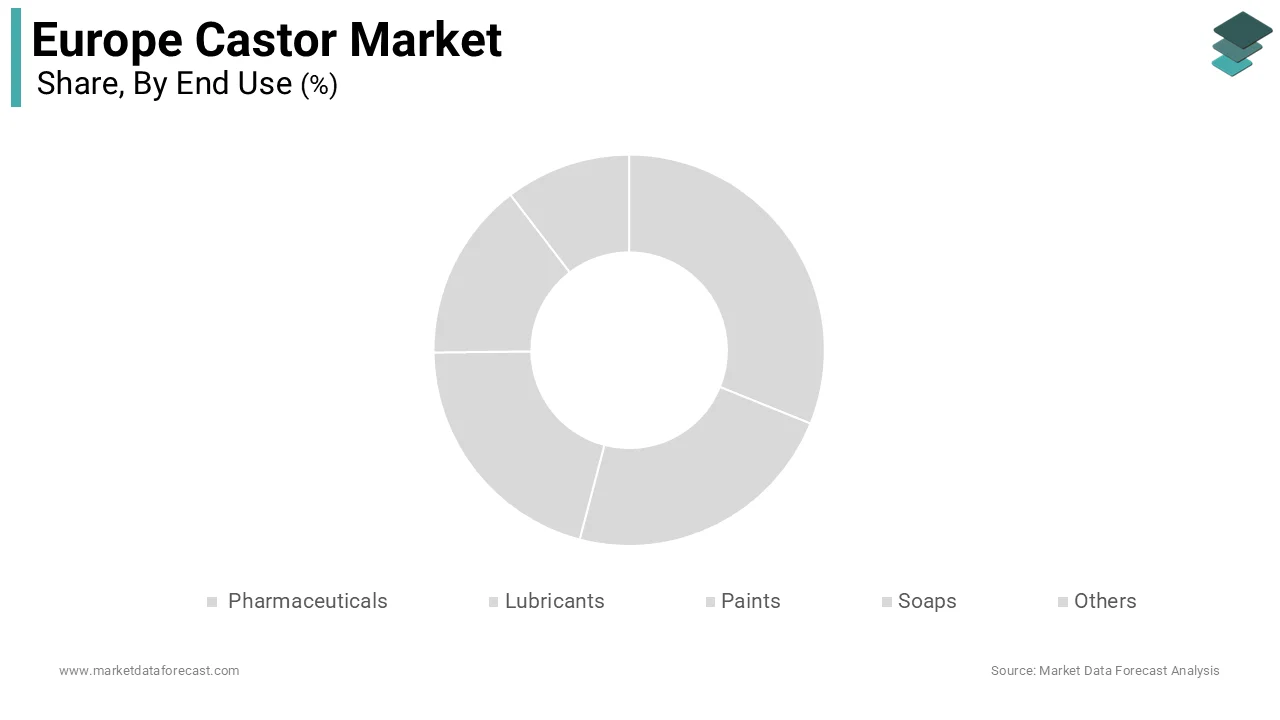
The lubricants segment is likely to witness the fastest CAGR of 6.5% from 2026 to 2034, with the industrial sector’s transition from mineral oil-based lubricants to bio-based alternatives to meet environmental regulations and sustainability goals. Castor oil possesses unique properties such as high viscosity index, thermal stability, and lubricity, making it an ideal base stock for high-performance industrial lubricants. Industries, such as manufacturing, mining, and construction, are adopting castor-based lubricants to reduce soil and water contamination risks. These fluids offer superior performance in extreme temperatures and pressures, enhancing machinery efficiency and lifespan. Government incentives for green manufacturing practices encourage companies to switch to renewable lubricants. Castor oil’s natural oxidation resistance reduces the need for synthetic additives, lowering production costs.
REGIONAL ANALYSIS
Germany Castor Market Analysis
Germany was the largest contributor to the Europe castor market by holding 22.4% of the share in 2025. The growth of the market is likely to be driven by the robust chemical and pharmaceutical industries, which are major consumers of castor derivatives. The strong regulatory framework supporting sustainable manufacturing encourages companies to replace fossil-based inputs with renewable alternatives. In 2024, imports of castor oil into Germany reached 40000 tons according to the Federal Statistical Office. The automotive industry also contributes significantly to demand through the use of bio-based lubricants and polymers. Research institutions collaborate with industry players to develop advanced castor based applications. The presence of major pharmaceutical companies ensures steady demand for excipients. Germany’s focus on environmental protection and resource efficiency sustains its leadership. Infrastructure for processing and distributing castor derivatives is well developed, facilitating efficient supply chains. The country’s economic stability supports long-term investments in sustainable technologies.
France Castor Market Analysis
France castor market was ranked second by holding 18.4% of the Europe castor market share in 2025. The strong cosmetics and personal care industry, which extensively uses castor oil for its emollient and thickening properties s escalating the growth of the market. The demand for natural and organic beauty products drives the procurement of high-quality castor derivatives. In 2024, the French cosmetic industry imported 30000 tons of castor oil, according to the French Customs Authority. The government’s support for bio-based economies through subsidies and tax incentives further boosts market growth. The National Low Carbon Strategy encourages industries to adopt sustainable materials, reducing carbon footprints. Collaborative projects between research centers and private companies foster innovation in castor applications.
Italy Castor Market Analysis
Italy castor market is expected to witness significant growth opportunities in the coming years. As per the Italian National Institute of Statistics, the pharmaceutical industry exported goods worth 60 billion euros in 2023, requiring substantial amounts of excipients. Castor oil is widely used in topical preparations and oral medications due to its safety profile. In 2024, Italy imported 25000 tons of castor oil primarily for pharmaceutical and cosmetic applications, according to the Italian Trade Agency. The country’s strong tradition in leather processing also utilizes castor oil as a finishing agent, enhancing product quality. Small and medium-sized enterprises dominate the market, focusing on niche high-value applications. Government initiatives promoting green chemistry encourage the adoption of bio-based materials. Italy’s strategic location facilitates efficient logistics and trade with other European countries. The demand for natural ingredients in personal care products continues to rise, driven by consumer awareness.
United Kingdom Castor Market Analysis
The United Kingdom castor market growth is likely to grow with a strong pharmaceutical sector and growing interest in sustainable industrial products. As per the Association of the British Pharmaceutical Industry, the UK pharmaceutical sector invested 5.5 billion pounds in research and development in 2023, driving demand for specialized excipients. Castor oil derivatives are essential for formulating complex drugs and vaccines. The cosmetics industry also contributes to consumption with a focus on clean beauty products. Government policies supporting net zero emissions encourage the use of bio-based lubricants and polymers. The UK’s advanced research capabilities facilitate the development of new castor based applications. Collaboration between academia and industry promotes innovation in sustainable materials. The service sector’s growth supports the demand for hygiene products containing castor derivatives.
Spain Castor Market Analysis
Spain's castor market growth is expected to grow with the growing cosmetics industry and increasing adoption of bio-based industrial products. Castor oil is a key ingredient in hair care and skincare products popular in the Mediterranean region. In 2024, Spain imported 18000 tons of castor oil according to the Spanish Tax Agency. The automotive industry also utilizes castor-based lubricants and polymers, supporting local manufacturing. Government incentives for renewable materials align with European Union sustainability goals. Spain’s strategic location serves as a gateway for trade with North Africa and Latin America. The tourism sector boosts demand for personal care and hygiene products containing castor derivatives. Local manufacturers are investing in sustainable production methods to meet international standards.
COMPETITION OVERVIEW
The competition in the Europe castor market is characterized by a mix of global producers, specialized distributors, and regional processors vying for dominance through quality and innovation. Major players compete based on product purity, supply reliability, and technical support rather than price alone. The market sees intense rivalry among suppliers who strive to differentiate themselves through sustainable sourcing and advanced derivative formulations. Established companies leverage their integrated supply chains to offer cost-effective solutions, while smaller niche players focus on specialized applications in pharmaceuticals and cosmetics. Regulatory compliance regarding safety and environmental standards serves as a significant barrier to entry, ensuring that only well-capitalized firms can thrive. Collaborative efforts between manufacturers and end users are common to develop custom solutions for specific industrial needs. The rise of bio-based alternatives adds another layer of competition, pressuring traditional chemical suppliers to innovate. Companies that successfully integrate sustainability and technical expertise gain a competitive edge.
KEY MARKET PLAYERS
A few major players of the Europe castor market include
- Arkema S.A
- Emery Oleochemicals GmbH
- Croda International Plc
- BASF SE
- Alberdingk Boley GmbH
- Italmatch Chemicals
- Jayant Agro-Organics Ltd
- NK Proteins Pvt Ltd
- Adani Wilmar Ltd
- Gokul Agri International Ltd
Top Strategies Used by Key Market Participants
Key players in the Europe castor market primarily employ vertical integration and product innovation to maintain a competitive advantage. Companies invest in securing raw material supplies through long-term contracts with growers to mitigate price volatility. This strategy ensures consistent quality and availability of castor oil for downstream processing. Another major strategy involves developing high-value derivatives such as bio-based polyamides and specialized excipients for niche applications. Manufacturers focus on research and development to create sustainable alternatives to petroleum-based products, aligning with environmental regulations. Strategic partnerships with end users in the automotive and pharmaceutical sectors help customize solutions and foster loyalty. Additionally, companies emphasize sustainability certifications to appeal to eco-conscious consumers and comply with strict European standards. These combined strategies enable key participants to differentiate their offerings and capture value in a competitive landscape.
Leading Players in the Europe Castor Market
- Arkema SA is a leading specialty chemicals company with a significant presence in the Europe castor market through its Rilsan polyamide 11 brand. The company contributes to the global market by providing high-performance bio-based polymers derived from castor oil for automotive, aerospace, and electronics applications. Arkema focuses on sustainable innovation and recently expanded its production capacity for bio-based materials in France. The company has invested in research and development to enhance the properties of castor based polymers, ensuring they meet stringent industry standards. Recent actions include partnerships with automotive manufacturers to develop lightweight components using Rilsan. These initiatives strengthen its market position by offering superior alternatives to petroleum-based plastics.
- Jayant Agro Organics Limited is a major global producer of castor oil and its derivatives with a strong distribution network in Europe. The company plays a vital role in the market by supplying high-quality castor derivatives to the pharmaceutical, cosmetic, and industrial sectors. Jayant Agro contributes to the global market by maintaining rigorous quality standards and sustainable sourcing practices. Recent actions include the expansion of its manufacturing facilities in India to increase the output of specialized derivatives such as sebacic acid. The company has also obtained various international certifications to meet European regulatory requirements. These efforts strengthen its market position by ensuring a reliable supply and consistent product quality. Jayant Agro focuses on customer-centric solutions and technical support to build long-term relationships.
- IMCD NV is a leading distributor of specialty chemicals and ingredients with a robust portfolio of castor derivatives in Europe. The company serves diverse industries, including personal care pharmaceuticals, and coatings, by providing tailored solutions and technical expertise. IMCD contributes to the global market by connecting producers with end users and facilitating innovation through application development. Recent actions include strategic acquisitions of local distributors to expand its reach in key European markets. The company has also invested in digital platforms to enhance customer experience and streamline supply chain operations. IMCD focuses on sustainability and responsible sourcing, aligning with European regulatory standards.
MARKET SEGMENTATION
This research report on the European castor market has been segmented and sub-segmented based on end use & region.
By End Use
- Pharmaceuticals
- Lubricants
- Paints
- Soaps
- Others
By Region
- UK
- France
- Spain
- Germany
- Italy
- Russia
- Sweden
- Denmark
- Switzerland
- Netherlands
- Turkey
- Czech Republic
- Rest of Europe
Frequently Asked Questions
1. What is driving the growth of the Europe castor market?
Growth is driven by rising demand for bio-based products, increasing use in pharmaceuticals, and expanding industrial applications.
2. What are the key applications of castor oil in Europe?
Major applications include lubricants, cosmetics, pharmaceuticals, coatings, biodiesel, and plastics.
3. What industries use castor oil the most?
Pharmaceutical, personal care, automotive, and chemical industries are the largest consumers.
4. How is castor oil used in the pharmaceutical industry?
It is used as a laxative, in drug formulations, and as an excipient in medicinal products.
5. What role does castor oil play in cosmetics?
Castor oil is widely used in skincare, haircare, and beauty products due to its moisturizing properties.
6. What are the major challenges in the Europe castor market?
Challenges include price volatility, dependence on imports, and supply chain disruptions.
7. Who are the key players in the Europe castor market?
Leading companies include Arkema S.A., Croda International Plc, BASF SE, Jayant Agro-Organics Ltd., and Adani Wilmar Ltd..
8. What are the key trends in the Europe castor market?
Trends include increasing use in bio-lubricants, green chemicals, and biodegradable products.
9. What is the role of castor oil in biofuels?
Castor oil is used as a feedstock for biodiesel production due to its high oil content.
10. What is the future outlook for the Europe castor market?
The market is expected to grow steadily, driven by rising demand for eco-friendly and renewable raw materials.
Related Reports
Access the study in MULTIPLE FORMATS
Purchase options starting from
$ 2000
Didn’t find what you’re looking for?
TALK TO OUR ANALYST TEAM
Need something within your budget?
NO WORRIES! WE GOT YOU COVERED!
Call us on: +1 888 702 9696 (U.S Toll Free)
Write to us: sales@marketdataforecast.com