Europe Commercial Drone Market Size, Share, Trends, & Growth Forecast Report By Type (Fixed Wing, Rotary Blade) Application (Filming and Photography, Inspection and Maintenance) End Use (Agriculture ,Delivery and Logistics) and Country (Germany, UK, France, Italy, Spain) – Industry Analysis from 2026 to 2034.
Europe Commercial Drone Market Summary
Europe commercial drone market was valued at USD 4.11B in 2024, estimated at USD 5.16B in 2025, and is forecast to reach USD 31.62B by 2033 (CAGR 25.43%, 2025–2033), driven by harmonized EU aviation rules, accelerating demand for infrastructure inspection, and rapid adoption in agriculture, energy, logistics, and public safety.
Market Highlights
2024 (actual): USD 4.11 billion
2025 (est): USD 5.16 billion
2033 (forecast): USD 31.62 billion
CAGR (2025–2033): 25.43%
Quick growth drivers
- EU-wide EASA harmonized drone regulations (EU 2019/947) enabling cross-border commercial drone operations.
- Massive demand for energy & transport infrastructure inspection (bridges, grids, railways, solar, wind).
- Precision agriculture expansion driven by CAP reforms and adoption of NDVI/multispectral analytics.
- Climate-driven rise in wildfire management needs, boosting adoption in public safety and environmental monitoring.
- U-space deployment enabling automated drone traffic management for BVLOS and urban operations.
- Workforce shortages in agriculture & inspection sectors, accelerating drone-based automation.
Principal restraints
- GDPR compliance barriers for aerial data (faces, license plates, property imagery) → legal risk + operational limits.
- Restricted access to controlled airspace in dense urban and airport zones; slow BVLOS approvals.
- Lack of specialized drone pilots and data analysts for advanced missions.
- Dependence on non-EU components & software, creating supply chain and data sovereignty vulnerabilities.
- Fragmented U-space rollout, limiting seamless automated operations across borders.
High-value opportunities
- Renewable energy asset management: solar thermography, turbine blade inspection, predictive maintenance.
- Precision agriculture compliance tools supporting CAP eco-schemes and chemical-use reduction requirements.
- Logistics & medical delivery corridors (BVLOS) using U-space digital traffic management.
- Digital twins of infrastructure integrating drone LiDAR/imagery into BIM & predictive models.
- Cultural heritage protection (Italy, Greece, France) via mapping, 3D reconstruction & structural monitoring.
- Urban safety & emergency response: wildfire mapping, search-and-rescue, flood monitoring.
- Scaling BVLOS operations across fragmented national implementations of U-space.
- Cybersecurity + GDPR alignment for cloud-based drone analytics platforms.
- Securing stable component supply chains (batteries, microelectronics, autopilots).
- Developing a continent-wide certified pilot workforce, especially in Eastern Europe.
- Ensuring safe integration with traditional aviation while traffic density increases.
Fastest-growing segments
- Hybrid drones (VTOL fixed-wing): 14.38% CAGR — long endurance + BVLOS capability.
- Energy sector applications: 12.74% CAGR — solar/wind expansion + predictive maintenance demand.
- Delivery & logistics: 16.2% CAGR — medical delivery, urban e-commerce, last-mile optimization.
- Precision agriculture: remains largest application at 34.3% — multispectral analytics & compliance mapping.
Regional leadership & dynamics
Germany (lead, 21.5%)
- Strong EASA compliance, highest adoption for grid & rail inspection, high operator registration.
- Early U-space corridor deployment; advanced industrial drone ecosystem.
France (17.3%)
- Precision agriculture powerhouse; centralized airspace authorization platform.
- Heavy use in wildfire response, public safety, and emergency mapping.
United Kingdom
- Advanced BVLOS trials, strong infrastructure inspection use-cases.
- Post-Brexit regulatory agility + national drone traffic management (Altitude Angel).
Italy
- Rapid renewable energy inspection demand + cultural heritage mapping.
- Strong uptake in wildfire surveillance and archaeological site protection.
Netherlands
- Europe’s most advanced drone logistics & U-space integration hub.
- Automated BVLOS medical delivery & port inspection corridors.
What wins commercially (competitive edge)
- EASA-aligned, GDPR-compliant platforms with secure, sovereign data processing.
- Long-endurance hybrid/BVLOS-ready hardware for infrastructure and energy missions.
- Integrated software ecosystems (digital twins, AI analytics, automated mapping).
- Local service centers + pilot training networks to meet operator certifications.
- Offline-capable, encrypted, data-sovereign drones (critical for government & utilities).
- Interoperability with U-space tools for automated workflow approval and flight planning.
Top strategic ask for executives
- Prioritize EASA compliance + GDPR-secure ecosystems to unlock public sector contracts.
- Invest in BVLOS-ready fleets, hybrid VTOL platforms, and edge-AI analytics.
- Partner with energy, agriculture & transport operators to embed drones into digital twin workflows.
- Build EU-based supply chain resilience for batteries, flight controllers, and cloud alternatives.
- Expand training programs to overcome the certified pilot shortage and accelerate deployment.
- Engage directly in U-space corridor pilots to secure early-mover advantage in urban operations.
Leading players
DJI · Parrot · Wingtra · Autel Robotics · AeroVironment · Intel · Griff Aviation · Draganfly · EHang
Europe Commercial Drone Market Size
The europe commercial drone market size was valued at USD 5.16 billion in 2025, is expected to have a 25.43% CAGR from 2026 to 2034, and be worth USD 39.61 billion by 2034 from USD 6.47 billion in 2026.

Commercial unmanned aerial vehicle (drones) refers to the remotely piloted aircraft systems deployed for non-military purposes across agriculture, infrastructure inspection, logistics, public safety, and environmental monitoring. These drones, ranging from multirotor platforms for short-range visual surveillance to fixed-wing systems for large area mapping, are regulated under a harmonized European Union Aviation Safety Agency (EASA) framework that classifies operations by risk and mandates technical and operational compliance. The European Union is experiencing a general shift in employment across sectors, with a long-established downward trend in the volume of agricultural labour input. Concurrently, there is an acceleration of unmanned aerial vehicle (drone) adoption across industries like construction, energy, and agriculture, driven by the need to enhance productivity and reduce human exposure to hazardous environments. Simultaneously, Europe is facing increasingly longer and more intense wildfire seasons, a trend driven by climate pressures and extreme heatwaves. This has led to a growing emphasis on proactive wildfire risk management strategies, including advanced surveillance and mapping technologies. The European Commission is actively funding the integration and deployment of digital and robotic technologies, including those applicable to smart agriculture and critical infrastructure management, through multi-year funding programs. Unlike recreational drones, commercial drones in Europe must adhere to strict airworthiness, remote identification, and data protection standards under Regulation (EU) 2019/947. These regulatory, environmental, and economic currents, not direct market metrics, frame a market where technology must align with safety, sustainability, and sovereignty to achieve scalable deployment.
MARKET DRIVERS
EU Harmonized Drone Regulations Enable Scalable Commercial Operations
The implementation of a unified regulatory framework by the European Union Aviation Safety Agency has become a key accelerator of the European commercial drone market. This drives the adoption of these drones across member states by replacing fragmented national rules with a standardized and risk-based operational model. EASA's Regulation (EU) 2019/947 established a consistent, risk-based operational framework across the EU, featuring open, specific, and certified drone categories that facilitate standardized, cross-border operations. The regulation became applicable in EU Member States from December 31, 2020, with a full transition period ending in January 2023 for most aspects, and certain articles effective from July 2019. This harmonization reduced licensing complexity. For instance, a German inspection firm can now deploy drones in France or Italy without re-certifying pilots or aircraft, accelerating service rollout. Regulatory bodies and industry sources indicate a significant and increasing trend in the number of registered commercial drone operators across the EU as the regulatory framework matures and the use of drones in various sectors expands. The open category permits routine operations like roof inspections or crop scouting without prior authorization, while the specific category uses a standardized risk assessment (SORA) for complex tasks such as power line monitoring. Additionally, the EU’s U-space initiative provides digital infrastructure for high-density drone traffic management in urban and industrial zones. Pilot programs and regulatory initiatives in locations such as Rotterdam are exploring ways to implement and scale up automated drone flights for essential services like port inspections, aiming for seamless integration into existing air traffic management systems. This regulatory coherence transforms drones from isolated tools into integrated components of Europe’s digital infrastructure ecosystem.
Growing Demand for Infrastructure Inspection in the Energy and Transport Sectors
The region’s aging energy and transport infrastructure is causing sustained demand for commercial drones as a cost-effective and safe alternative to manual inspection methods, which further boosts the expansion of the European commercial drone market. Existing large-scale bridges and transmission towers require regular structural assessment. Traditional assessment methods can be costly and pose safety risks, while uncrewed aerial vehicle (drone) inspections offer a more cost-effective method, significantly reducing data collection time. There is an increasing trend in the use of drones for monitoring overhead lines and inspecting railway lines, capturing detailed imagery, and identifying issues like overgrown vegetation and track deformation with high accuracy while systems remain operational. New requirements are emerging for incorporating drone-compatible digital models in future infrastructure developments. Facing tight budgets and non-negotiable safety rules, Europe's critical infrastructure operators are increasingly relying on drones as necessary tools for ensuring regulatory compliance and implementing predictive maintenance programs.
MARKET RESTRAINTS
Stringent Data Privacy and Cybersecurity Requirements Under GDPR
Strict application of the General Data Protection Regulation (GDPR) to aerial data collection, particularly in urban or sensitive environments, acts as a major obstacle to the European commercial drone market. As per the European Data Protection Board, any drone capturing images or sensor data that can identify individuals, such as faces, license plates, or private property layouts, is classified as processing personal data, requiring a lawful basis, purpose limitation, and data minimization. This complicates routine operations like construction progress monitoring or real estate photography, where incidental capture of neighboring residences may trigger compliance obligations. Data protection authorities are actively issuing penalties for a range of GDPR compliance failures, which reinforces the trend that inadequate data handling procedures can lead to significant financial sanctions for various organizations. Furthermore, the integration of cloud-based analytics platforms with drone operations requires developers to implement robust security measures and adhere to data location regulations, which influences software development practices and resource allocation. Many small operators lack legal expertise to navigate these requirements, leading to underreporting or avoidance of high-value urban applications. GDPR compliance currently impedes the scalable commercial deployment of drones in densely populated European regions, a barrier likely to persist until regulatory sandboxes or standardized anonymization protocols are widely adopted.
Limited Access to Advanced Airspace in Urban and Controlled Zones
The operators of these drones in the region contend with restricted access to controlled airspace near airports, military installations, and urban centers, despite regulatory harmonization, which severely limits service scalability for logistics and emergency response, and negatively impacts the expansion of the European commercial drone market. A significant portion of the European Union's land area is categorized as restricted or controlled airspace. While the U-space framework aims to automate approvals, full implementation remains partial. Only a limited number of EU member countries currently have operational U-space corridors in place. This fragmentation forces operators to rely on manual coordination with air traffic control, which can take days for a single flight permit. Airspace clearance processes can lead to operational delays, as evidenced by a medical delivery trial between hospitals in the Netherlands. Additionally, the lack of vertiport infrastructure and detect and avoid systems for beyond visual line of sight (BVLOS) operations constrains commercial viability. The majority of commercial uncrewed aerial vehicle (drone) flights within the EU continue to operate within the pilot's visual line of sight (VLOS), rather than beyond it (BVLOS). Airspace access limitations, driven by the current lack of continent-wide interoperability in digital air traffic management, are hindering the full potential of urban and high-density drone applications, rather than the capabilities of the drones themselves.
MARKET OPPORTUNITIES
Integration of Drones in Renewable Energy Asset Management
The rapid expansion of the continent’s renewable energy infrastructure gives a key growth opportunity for the European commercial drone market. This offers a new pathway for these drones in the operation and maintenance of solar and wind farms. The growth in solar and wind power capacity has created a large number of distributed assets requiring frequent inspection. Unmanned aerial vehicles (drones) equipped with thermal and multispectral cameras can scan many solar panels to identify issues like hotspots or microcracks that affect efficiency. Drone-based thermography can significantly reduce inspection time for solar installations, while drones with high-resolution imaging and stabilization are used for offshore wind turbine inspections, assessing blade erosion and lightning damage, which may decrease inspection costs. The EU’s Net Zero Industry Act, targeting domestic clean tech manufacturing by 2030, further institutionalizes drone use through digital twin mandates. The expansion of renewable energy capacity is driving the essential role of Drones in Europe, which are crucial for optimizing output, guaranteeing adherence to warranties, and reducing operational interruptions.
Adoption of Drone-Based Precision Agriculture Under CAP Reforms
The reform of the European Union’s Common Agricultural Policy (CAP) is opening fresh prospects for these drones, which drive the growth of the European commercial drone market. This is facilitated by incentivizing data-driven, sustainable farming practices that reduce chemical inputs and optimize resource use. The current EU agricultural framework supports various eco-friendly farming practices through dedicated funding. Drones play a critical role in this shift by generating high-resolution crop health maps using multispectral sensors that detect nitrogen deficiency, pest infestations, or irrigation stress before visible symptoms appear. Across Europe, many farms are utilizing technology, such as unmanned aerial vehicles (drones), to guide targeted agricultural applications, which has helped reduce the use of inputs like herbicides. The use of drones for activities like seeding cover crops has shown positive effects on soil health in certain regions. Drone operations in agriculture have achieved highly precise positioning for accurate field mapping, leveraging advanced satellite navigation technology. Drones are transitioning from mere yield optimization tools to crucial compliance mechanisms as CAP rules increasingly tie funding to quantifiable environmental protection and sustainable practices.
MARKET CHALLENGES
Shortage of Certified Remote Pilots and Technical Expertise
The acute shortage of certified remote pilots and data analysts capable of executing advanced operations such as beyond visual line of sight (BVLOS) missions or processing multispectral datasets poses a serious barrier to the European commercial drone market. The number of people holding remote pilot certifications for specific category operations is currently limited. Training bottlenecks persist. Becoming a certified drone pilot involves a course that typically requires a significant time commitment and associated costs. Moreover, advanced applications require cross-disciplinary skills in photogrammetry, GIS, and AI-based analytics—competencies rarely covered in basic certification programs. Many commercial operators face challenges with the availability of qualified pilots, which they identify as a major obstacle to expanding their services. In Eastern Europe, the gap is more severe. Pilot certification rates can vary significantly by region. The operational deployment of drones will remain constrained by a lack of skilled workers until EU-level vocational training initiatives and modular certification pathways are established.
Supply Chain Dependence on Non-EU Components and Software
The heavy reliance on non-EU-sourced components, particularly flight controllers, batteries, and navigation chips, and foreign software platforms for data processing, also slows down the expansion of Europe's commercial drone market. Commercial drones predominantly rely on autopilot systems derived from software developed in other regions. Lithium polymer batteries integral to these systems are primarily sourced from a few specific countries, and supply chain dependencies have been observed in the availability of key components such as microelectronics. Component shortages have previously led to delays in the delivery of drones, and procurement costs for drones experienced an increase during a period of supply chain disruption. More critically, reliance on non-EU cloud platforms for data analytics conflicts with GDPR data sovereignty requirements and raises cybersecurity concerns for sensitive infrastructure missions. The commercial use of European drone operating systems is still limited, despite funding for projects like FlytRadar, which aim to achieve sovereignty in the field. The European drone sector remains exposed to geopolitical instability, regulatory fragmentation, and strategic autonomy risks as long as it lacks a complete, resilient domestic technology base.
REPORT COVERAGE
| REPORT METRIC | DETAILS |
| Market Size Available | 2025 to 2034 |
| Base Year | 2025 |
| Forecast Period | 2026 to 2034 |
| Segments Covered | By Type, Application, End Use, and Country. |
| Various Analyses Covered | Global, Regional & Country Level Analysis, Segment-Level Analysis; DROC, PESTLE Analysis, Porter's Five Forces Analysis, Competitive Landscape, Analyst Overview of Investment Opportunities |
| Country Covered | UK, Germany, Italy, France, Spain, Sweden, Denmark, Poland, Switzerland, Netherlands, Rest of Europe. |
| Market Leader Profiled | AeroVironment, Inc., Autel Robotics, ESA Space Solutions, ModalAIDJId, and Intel Corporation. |
SEGMENTAL ANALYSIS
By Type Insights
The rotary blade drones segment dominated the European commercial drone market by holding a 58.1% share in 2025. The dominance of the rotary blade drones segment is driven by its unmatched maneuverability, vertical takeoff and landing capability, and adaptability to confined or urban environments—critical for inspection, mapping, and emergency response tasks across Europe’s dense infrastructure landscape. Multirotor platforms are widely used in commercial drone operations, favored for ease of piloting and stable hovering that supports high-resolution data capture. Rotary unmanned aerial vehicles are utilized in construction for exterior inspections of tall buildings, eliminating the need for traditional access methods such as scaffolding, and are standard agricultural equipment with multispectral sensors for monitoring crop health. Their compatibility with modular payloads, including thermal cameras, LiDAR, and gas detectors, further extends utility across energy, public safety, and environmental sectors. This operational versatility, combined with mature supply chains and pilot training ecosystems, solidifies rotary blade drones as the workhorse of Europe’s commercial drone fleet.
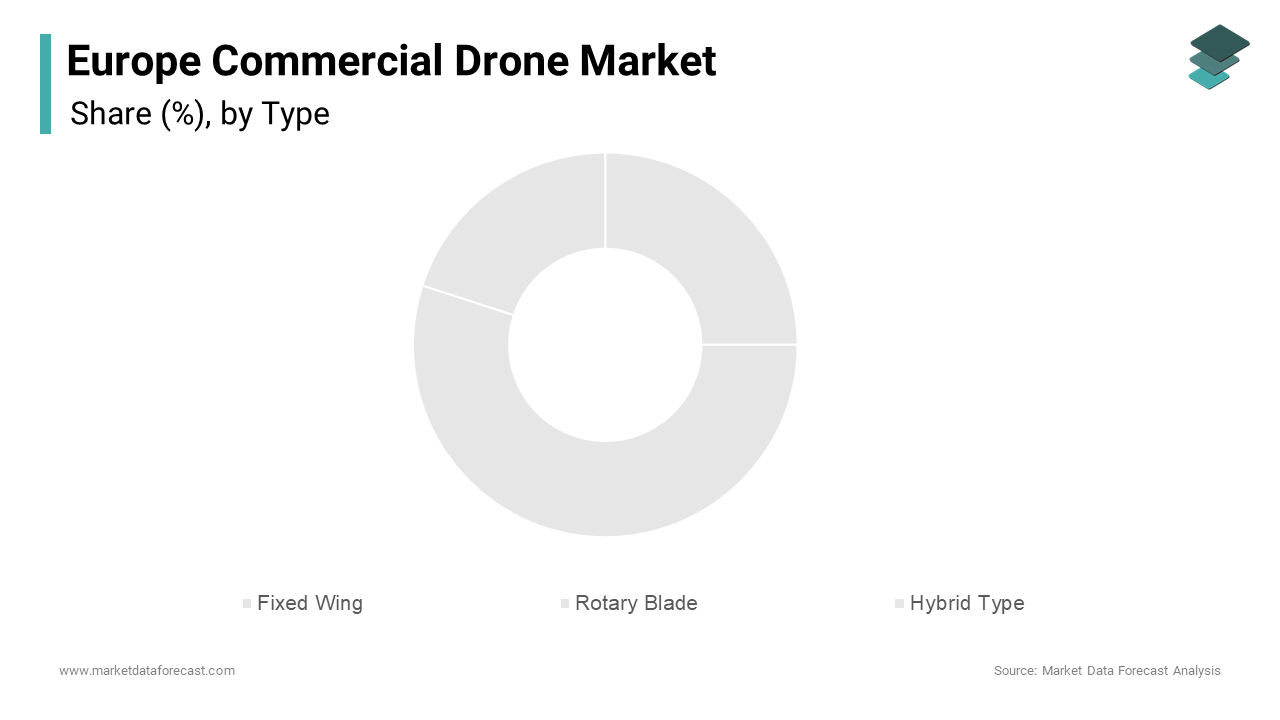
The hybrid drones segment is predicted to witness the highest CAGR of 14.38% from 2025 to 2033 due to the rising demand for long-range, beyond visual line of sight (BVLOS) missions in infrastructure monitoring, border surveillance, and renewable energy asset management. Hybrid unmanned aerial systems can fly for longer durations compared to pure rotary systems. Also, Hybrid platforms are capable of mapping expansive areas in a single operation. Mapping using hybrid systems offers high levels of positional accuracy. The use of hybrid platforms for operations beyond the visual line of sight has been increasing. Hybrid unmanned aerial systems are a valuable tool for inspecting infrastructure in challenging environments. Hybrid drones assist in tasks like mapping perimeters in remote, difficult-to-access locations. Hybrid drones will soon unlock valuable applications previously out of reach, as the EU’s U-space framework allows for scalable BVLOS operations, and better batteries enhance flight capabilities.
By Application Insights
The agriculture segment held the largest share of 34.3% of the European commercial drone market in 2025. The prominence of the agriculture segment is propelled by the sector’s early adoption of drone technology for precision farming and compliance with EU environmental regulations. Many farms using eco schemes have incorporated data collected by unmanned aerial vehicles (drones) to support practices that reduce the use of pesticides and fertilizers. Rotary drones equipped with multispectral sensors generate normalized difference vegetation index (NDVI) maps that detect nitrogen deficiency, pest outbreaks, or irrigation stress before visible symptoms appear. The use of drones is becoming more common among growers of cereals and vineyards in certain regions. The application of variable-rate spraying techniques using drones has helped decrease herbicide use, contributing to broader objectives aimed at cutting chemical inputs in agriculture. The integration of drone data with Galileo satellite positioning enables centimeter-accurate field mapping, while cloud platforms like DroneDeploy automate analytics for non-technical users. This fusion of policy incentives, yield optimization, and ease of use has entrenched drones as indispensable tools in Europe’s sustainable farming transition.
The energy segment is estimated to register the fastest CAGR of 12.74% during the forecast period, owing to the continent’s massive investment in renewable energy infrastructure and the need for cost-effective, safe inspection of distributed assets. Renewable energy installations, such as solar photovoltaic and wind power, are growing and require frequent monitoring for optimal performance. Unmanned Aerial Vehicles (drones) with thermal cameras are utilized to survey solar panels and identify performance-reducing anomalies. Drones with stabilization features are being adopted for offshore wind turbine assessments to evaluate potential blade surface degradation, offering potential for reducing operational expenses. Additionally, drones inspect high-voltage transmission lines without grid shutdowns. So, drones are becoming essential for compliance, performance verification, and predictive maintenance across Europe’s green energy ecosystem.
By End Use Insights
The agriculture segment led the market by capturing 28.1% of the European market share in 2025. The widespread adoption of drones in agriculture is driven by their ability to enhance precision farming practices, which are critical for optimizing resource use and increasing crop yields. The European Commission highlights that drones can reduce pesticide usage by up to 30% and improve irrigation efficiency by 25%. With around 40% of the EU’s land area dedicated to agriculture, drones play a pivotal role in monitoring crop health, conducting soil analysis, and managing large-scale farming operations. Their cost-effectiveness and ability to cover vast areas quickly make them indispensable for modernizing traditional agricultural practices across Europe.
The delivery and logistics segment is estimated to register the fastest CAGR of 16.2% over the forecast period, owing to the rising demand for faster and more sustainable urban delivery solutions, particularly in e-commerce and healthcare. The European Parliament reports that drone deliveries can reduce delivery times by up to 80% and lower carbon emissions by 50% compared to traditional vehicles. Pilot projects in cities like Paris and Amsterdam have demonstrated their potential for delivering medical supplies and retail goods efficiently. Eurostat projects that urban populations in Europe will grow by 7% by 2050, further intensifying the need for innovative logistics solutions. This positions drone-based delivery systems as a transformative force in addressing urban mobility challenges.
COUNTRY LEVEL ANALYSIS
Germany Commercial Drone Market Analysis
Germany led the European commercial drone market by occupying a 21.5% share in 2025. The demand for commercial drones in Germany is attributed to its advanced industrial base, harmonized drone regulations, and early adoption in infrastructure and energy sectors. The country was among the first to implement EASA’s U-space framework, enabling routine beyond visual line of sight operations for railway and power line inspections. The number of commercial drone operators has shown a significant upward trend. The level of commercial drone activity in this country is substantial, indicating a mature market. Organizations within the rail and energy grid sectors are using unmanned aerial vehicles (drones) for essential infrastructure monitoring. The use of drones for monitoring activities supports operational efficiency improvements. Adopting drone technology in infrastructure inspection leads to reduced manual oversight needs and associated expenses. Additionally, Germany’s strong manufacturing sector, home to companies, drives innovation in hybrid fixed-wing platforms. Germany's comprehensive approach to drones, featuring strong regulations, technical talent, and industrial demand, positions it as a leader in the European market.
France Commercial Drone Market Analysis
France was the second-largest region in the European commercial drone market and accounted for a 17.3% share in 2025. The expansion of the French market is driven by its command in precision agriculture and national security applications. Drones are integrated into large-scale farms for data collection. Multispectral data from these systems helps demonstrate compliance with agricultural policy and environmental measures. Drone use in agricultural settings such as vineyards and cereal areas has seen an increase. Drones are used for monitoring a variety of situations, including wildfires, search and rescue, and crowd observation. Drones support real-time resource allocation during emergency management activities, such as mapping wildfire perimeters. The national drone platform, launched by the Directorate General for Civil Aviation, provides centralized airspace authorization, reducing flight approval time from days to hours. This dual focus on rural productivity and urban security positions France as a versatile and policy-driven drone market.
United Kingdom Commercial Drone Market Analysis
The United Kingdom continues to be a noteworthy player in the European commercial drone market because of advanced beyond visual line of sight operations and integration into critical infrastructure management. Regulatory environments are supporting numerous advanced unmanned aerial vehicle trials. Automated unmanned aerial vehicles are being integrated into infrastructure inspections. Unmanned aerial systems can replace traditional inspection methods and potentially offer environmental benefits. Unmanned aerial vehicles equipped with specialized sensors are used for monitoring track conditions and surrounding vegetation. There is a move toward mandating unmanned aerial inspections in new energy developments, which facilitates technology uptake in industrial sectors. Despite Brexit, the UK aligns closely with EASA standards while pursuing sovereign drone traffic management through the Altitude Angel platform. The UK is an ideal testing ground for scalable, high-impact drone applications due to its strong regulatory agility and urgent need for infrastructure development.
Italy Commercial Drone Market Analysis
Italy is an attractive country in the European commercial drone market due to its rapid renewable energy expansion and unique need for cultural heritage preservation. Unmanned Aerial Vehicles (drones) are being utilized to inspect significant lengths of power lines. This approach is helping the power grid accommodate a higher percentage of renewable electricity sources. The use of this technology supports operational goals related to energy transition and infrastructure management. Simultaneously, Italy’s Ministry of Cultural Heritage deploys drones with photogrammetry capabilities to monitor the structural integrity of ancient sites like the Colosseum and Pompeii, where ground access is restricted. The Italian Civil Aviation Authority streamlined authorization for low-altitude flights over historical zones, recognizing drones as non-invasive inspection tools. Additionally, southern regions like Sicily use drones for wildfire surveillance in Mediterranean forests, coordinating with the EU Civil Protection Mechanism. This blend of modernization and preservation creates a distinctive market where drones serve both economic and cultural imperatives.
Netherlands Commercial Drone Market Analysis
The Netherlands is anticipated to expand considerably in the European commercial drone market over the forecast period. It is renowned for its leadership in drone logistics and urban air traffic integration. A national initiative supports the use of unmanned aerial vehicles for medical delivery, port inspection, and last-mile logistics. Automated flights for infrastructure monitoring are integrated within a digital corridor framework. Partnerships facilitate the use of drones to transport medical samples between healthcare facilities, reducing delivery times. Advanced drone traffic management systems are in operation, handling numerous flight plans monthly. The Netherlands is a proving ground for scalable, high-density drone operations due to its urban development, advanced digital infrastructure, and supportive regulations, serving as a model for other European countries.
COMPETITIVE LANDSCAPE
Competition in the European commercial drone market is defined by a dual dynamic between global technology leaders and regionally focused innovators, emphasizing data sovereignty and regulatory alignment. While companies like DJI dominate through scale and sensor versatility, European players such as Parrot and Wingtra compete on securitcompliancean,ce offlineoperationton and integration with EU digital infrastructure like Galileo U-space. The market is segmented by application maturity, with agriculture and infrastructure inspection being highly competitive, while logistics and urban air mobility remain in pilot phases. Price is secondary to reliability, data integrity, and regulatory certification, particularly in public sector contracts. Fragmentation persists in software ecosystems as operators seek interoperable platforms that avoid vendor lock-in. As the EU strengthens its stance on non-EU drone usage in sensitive sectors, competition increasingly hinges on trust, transparency, and technical localization rather than hardware specifications alone.
KEY MARKET PLAYERS
Companies playing a prominent role in the europe commercial drone market include
- AeroVironment, Inc.
- Autel Robotics
- ESA Space Solutions
- ModalAI
- DJI
- Intel Corporation
- Griff Aviation
- EHang Holdings Limited
- Parrot Drones S.A.S.
- Autel Robotics Co., Ltd.
- Draganfly Inc.
TOP LEADING PLAYERS IN THE MARKET
- DJI is a global leader in commercial drone technology with a strong presence across the European commercial drone market through its enterprise-grade Matrice and Phantom series. The company supplies drones equipped with advanced imaging, thermal, and multispectral payloads widely used in agriculture, infrastructure inspection, and public safety. DJI’s European operations comply with EASA regulations and GDPR data handling standards through localized firmware and geofencing. DJI also expanded its developer ecosystem by partnering with European software firms to integrate drone data into construction and energy management platforms, reinforcing its role as a hardware and software integrator in global commercial drone workflows.
- Parrot SA is a French technology company and a key European player in the commercial drone sector, specializing in secure and sovereign drone solutions for government defense and industrial clients. Its ANAFI USA and ANAFI AI platforms are designed with full data privacy compliance, offering offline operation and encrypted storage to meet stringent EU and NATO security standards. Parrot actively collaborates with European defense ministries and emergency services, providing drones for border surveillance, wildfire monitoring, and critical infrastructure protection. By emphasizing European data sovereignty and regulatory alignment, Parrot has established itself as a trusted alternative to non-EU drone manufacturers in high-security applications.
- Wingtra AG is a Swiss-based innovator in hybrid VTOL fixed-wing drones that serve high-precision mapping and surveying applications across Europe’s energy, agriculture, and construction sectors. Its WingtraOne platform delivers survey-grade accuracy with RTK GNSS and professional-grade cameras, enabling large area coverage in a single flight. The company’s drones are widely adopted by European public agencies and engineering firms for topographicmappingg environmental monitoring, and renewable energy site planning. It also expanded service centers in Germany and Spain to support growing demand for BVLOS operations under the TU-space framework. Wingtra’s focus on data quality, flight endurance, and regulatory compliance positions it as a niche leader in professional geospatial drone solutions with global export reach.
TOP STRATEGIES USED BY THE KEY MARKET PARTICIPANTS
Key players in the European commercial drone market prioritize regulatory compliance by aligning hardware and software with EASA operational categories and GDPR data privacy mandates. They develop secure and offline-capable platforms to address government and infrastructure sector concerns about data sovereignty. Companies invest in hybrid and long-endurance drone designs to enable beyond visual line of sight missions for energy and agriculture applications. Strategic partnerships with European software providers integrate drone data into digital twin and asset management systems. Additionally, firms establish localized service and training centers to support certified pilot networks and ensure rapid technical support. These strategies collectively address Europe’s unique balance of innovation, ambition sa f, ety or and digital autonomy in commercial drone deployment.
EUROPE COMMERCIAL DRONE MARKET NEWS
- In January 2025, DJI launched a new enterprise drone model with AI-driven analytics, targeting industries like agriculture and energy. This initiative aimed to enhance operational efficiency and strengthen their market presence.
- In March 2025, Wingcopter partnered with DHL to integrate drones into last-mile delivery networks, reducing transportation times by 50% and expanding customer reach.
- In June 2023, Parrot introduced biodegradable components for its drones, addressing environmental concerns and appealing to eco-conscious consumers.
- In May 2025, Skydio expanded its drone portfolio in Eastern Europe, launching affordable models to target price-sensitive consumers.
- In August 2023, Volansi collaborated with a European healthcare provider to deliver medical supplies via drones, improving access to critical resources in underserved regions.
MARKET SEGMENTATION
This research report on the europe commercial drone market is segmented and sub-segmented into the following categories.
By Type
- Fixed Wing
- Rotary Blade
- Hybrid Type
By Application
- Filming and Photography
- Inspection and Maintenance
- Mapping and Surveying
- Precision Agriculture
- Surveillance and Monitoring
By End Use
- Agriculture
- Delivery and Logistics
- Energy
- Media and Entertainment
- Real Estate and Construction
- Security and Law Enforcement
By Country
- UK
- France
- Spain
- Germany
- Italy
- Russia
- Sweden
- Denmark
- Switzerland
- Netherlands
- Turkey
- Czech Republic
- Rest of Europe
Frequently Asked Questions
1. Which country dominates the Europe Commercial Drone Market?
The United Kingdom holds the largest share of the Europe Commercial Drone Market, accounting for around 27% of regional revenue in 2024, followed closely by Germany and France. The UK’s leadership comes from advanced BVLOS trials, strong government support for drone innovation, and widespread use in construction, energy, and logistics, while Germany benefits from a robust industrial base and high R&D spending on drone technology
2. What are the key applications in the Europe Commercial Drone Market?
The Europe Commercial Drone Market is segmented by application into construction, agriculture, energy, media & entertainment, law enforcement, delivery & logistics, and other uses like environmental monitoring and insurance. Construction is currently the largest segment, driven by drone-based site mapping, progress tracking, and digital twin integration, while energy and logistics are among the fastest-growing due to offshore wind inspections and last-mile delivery pilots.
3. Which end-use sectors are driving the Europe Commercial Drone Market?
The Europe Commercial Drone Market is driven by end-use sectors such as agriculture, delivery & logistics, energy, real estate & construction, security & law enforcement, and media & entertainment. Agriculture uses drones for crop monitoring and precision spraying, logistics for urban and rural delivery trials, energy for power line and wind turbine inspections, and construction for 3D mapping and progress monitoring, all contributing to rising demand across the region.
4. What are the main product types in the Europe Commercial Drone Market?
The Europe Commercial Drone Market is segmented by product into rotary blade (multirotor), fixed-wing, and hybrid/VTOL drones. Rotary blade drones dominate the market due to their vertical takeoff/landing and hovering capabilities, making them ideal for inspection, mapping, and surveillance. Fixed-wing drones are preferred for long-range missions like agriculture and border patrol, while hybrid/VTOL platforms are growing fast for BVLOS and heavy-payload operations.
5. How do regulations affect the Europe Commercial Drone Market?
Regulations, especially the EU-wide UAS rules and EASA’s U-space framework, have a major impact on the Europe Commercial Drone Market by standardizing operations across member states, simplifying cross-border missions, and enabling BVLOS flights. Harmonized rules reduce compliance complexity for operators, encourage investment in drone services, and support the growth of drone-as-a-service (DaaS) models, although GDPR and local privacy rules still add compliance costs for data-heavy applications.
6. What is the role of BVLOS in the Europe Commercial Drone Market?
Beyond Visual Line of Sight (BVLOS) operations are a key growth driver in the Europe Commercial Drone Market, enabling long-range missions in agriculture, energy, logistics, and infrastructure. As EASA and national authorities roll out U-space and automated traffic management, BVLOS is becoming more viable, unlocking new use cases like offshore wind inspections, rural delivery, and large-scale surveying, which are expected to accelerate market expansion over the next decade.
7. Which propulsion types are used in the Europe Commercial Drone Market?
The Europe Commercial Drone Market is segmented by propulsion into electric, gasoline, and hybrid systems. Electric drones dominate due to their low noise, zero emissions, and ease of operation, making them ideal for urban and sensitive environments. Hybrid propulsion is gaining traction for long-endurance missions in logistics, inspection, and surveillance, while gasoline-powered drones are used in niche heavy-lift and long-range applications, especially in remote or industrial settings.
8. What are the major challenges in the Europe Commercial Drone Market?
Key challenges in the Europe Commercial Drone Market include strict regulations from EASA and national authorities, GDPR-related data privacy compliance costs, pilot training and licensing bottlenecks, battery transport restrictions, and urban counter-drone systems. These factors increase operational complexity and costs, especially for small service providers, and can slow down the adoption of BVLOS and fully autonomous operations in densely populated areas.
9. Who are the leading companies in the Europe Commercial Drone Market?
Major players in the Europe Commercial Drone Market include DJI, Parrot Drones SAS, Delair SAS, Flyability SA, Skydio, Airbus, and several European start-ups and system integrators. DJI holds a dominant position in hardware, while European firms like Parrot and Delair focus on enterprise and defense solutions with strong EASA compliance and data sovereignty. These companies compete through innovation in AI, autonomy, and specialized payloads for inspection, mapping, and delivery.
10. How is AI and autonomy shaping the Europe Commercial Drone Market?
AI and autonomy are transforming the Europe Commercial Drone Market by enabling fully autonomous missions, automated data analysis, and drone-in-a-box solutions for routine inspections and monitoring. AI-powered drones can detect defects in infrastructure, analyze crop health, and optimize flight paths, reducing the need for constant human control. This shift supports higher sortie rates, lower operating costs, and faster adoption in sectors like energy, construction, and agriculture.
Related Reports
Access the study in MULTIPLE FORMATS
Purchase options starting from
$ 2000
Didn’t find what you’re looking for?
TALK TO OUR ANALYST TEAM
Need something within your budget?
NO WORRIES! WE GOT YOU COVERED!
Call us on: +1 888 702 9696 (U.S Toll Free)
Write to us: sales@marketdataforecast.com