Europe Concrete Market Size, Share, Trends & Growth Forecast Report – Segmented By Application (Structural Components, Pavements, Roadways, and Bridges, Dams & Water Infrastructure, and Others), End Use, and Country (UK, France, Spain, Germany, Italy, Russia, Sweden, Denmark, Switzerland, Netherlands, Turkey, Czech Republic & Rest of Europe), Industry Analysis From 2025 to 2033
Europe Concrete Market Size
The Europe concrete market size was valued at USD 458.92 billion in 2024 and is projected to reach USD 631.47 billion by 2033 from USD 475.49 billion in 2025, growing at a CAGR of 3.61%.

Concrete is a composite building material made from a mixture of aggregates (such as sand and gravel), water, and a binder like cement. It serves as the backbone of Europe’s built environment, from high-speed rail viaducts to energy-efficient housing retrofits. European concrete mix design and usage across member states are standardised and regulated by strict performance and durability criteria. According to studies, concrete, specifically reinforced or precast types, is the predominant primary structural material in the vast majority of new residential and non-residential building constructions across the European Union. The sector’s evolution is further shaped by the European Green Deal. As per research, the construction sector is a major consumer of materials in the EU, and concrete accounts for the largest proportion of this consumption by volume. This positions the European concrete market at the intersection of physical development and ecological responsibility, where technical innovation must reconcile structural performance with planetary boundaries.
MARKET DRIVERS
Mandatory Infrastructure Renewal Under the EU Mission on Climate-Neutral Cities
The region’s ageing civil infrastructure necessitates large-scale rehabilitation and reconstruction, which directly surges concrete demand through policy-enforced renewal cycles and thereby accelerates the growth of the European concrete market. According to studies, a significant portion of Europe's existing infrastructure, specifically road bridges and railway tunnels, is reaching or has exceeded its original designed service life. This mission allocates a substantial amount through 2030 for urban retrofitting, with concrete specified as the primary material for structural upgrades due to its durability and fire resistance. Major urban renewal projects across key European nations (Germany, France, and Italy) are generating a significant demand for high-performance concrete. National building codes have also been revised. For instance, national standards in some member states (e.g., Germany) are being updated to mandate the use of highly durable concrete mixes in new public infrastructure projects, focusing on extended service life. These regulatory and fiscal mechanisms transform infrastructure obsolescence into a structural driver of concrete consumption, particularly for advanced formulations that meet both longevity and sustainability criteria.
Stringent Embodied Carbon Regulations Under the Construction Product Regulation
The European Union’s tightening regulatory framework on embodied carbon is accelerating the adoption of low-carbon concrete formulations, paradoxically increasing demand for technically advanced concrete while constraining traditional mixes, which ultimately bolsters the expansion of the European concrete market. As per research, the revised Construction Products Regulation (CPR) was published in December 2024 and entered into force on January 7, 2025, with a gradual implementation schedule. The regulation mandates the declaration of environmental data, including GWP, for priority products like concrete. In addition, according to sources, the use of supplementary cementitious materials (SCMs) like ground granulated blast furnace slag (GGBS) and the development of Limestone Calcined Clay Cement (LC3) are growing trends for sustainability. Public procurement policies in some EU member states are also beginning to encourage the use of lower-carbon alternatives. These regulatory pressures are reshaping material specifications, making compliance a prerequisite for market participation and driving demand for next-generation concrete with reduced clinker content.
MARKET RESTRAINTS
Escalating Cost and Volatility of Supplementary Cementitious Materials
The growing reliance on industrial byproducts as fly ash and slag, to decarbonise concrete is encountering supply constraints that threaten cost stability and mix consistency in the region and ultimately restrain the growth of the European concrete market. According to research, the availability of ground granulated blast furnace slag in Europe has significantly declined, driven by the closure of coal plants and the steel industry's shift toward decarbonization processes. Similarly, Europe is experiencing a structural shortfall in fly ash production, as supply from coal-fired power plants is insufficient to meet the concrete industry's demand for this key supplementary cementitious material. This scarcity has driven price volatility. Producers face formulation instability as inconsistent chemical compositions of available substitutes compromise compressive strength and setting time. A lack of available low-carbon binders at the necessary scale creates a material bottleneck in the concrete value chain, which impedes performance and sustainability and thereby hinders the very decarbonization goals the binders were intended to support.
Fragmented Adoption of Circular Economy Standards Across Member States
Inconsistent national implementation of concrete recycling standards affects material efficiency and increases virgin aggregate dependency, despite EU-wide circular economy ambitions. This fragmented adoption restricts the expansion of the European concrete market. According to studies, there are significant national disparities in the adoption of concrete recycling across the EU, with some member states demonstrating very high recycling rates, while others lag considerably. The adoption of European standards for using recycled aggregates in structural concrete applications is inconsistent across member states, which indicates a fragmented regulatory landscape. This fragmentation forces producers to maintain multiple product lines, inflating logistics and compliance costs. Operational material circularity for recycled concrete requires the enforcement of binding harmonised standards.
MARKET OPPORTUNITIES
Rising Demand for Prefabricated Modular Construction in Urban Housing
The region’s acute housing shortage is causing a shift toward off-site modular construction, where precast concrete elements offer speed, precision, and thermal performance unmatched by traditional methods, which provides potential prospects for the growth of the European concrete market. Europe is experiencing a significant and persistent shortage of social and mid-income housing units, indicating a substantial gap between housing needs and current supply. In addition, the production and adoption of precast concrete for residential construction are increasing in major European countries, which reflects a growing preference for industrialised and efficient building methods. National building authorities now recognise the benefits. Building codes and regulations in Europe are evolving to favour construction materials and methods, such as concrete-based modular units, that meet high energy efficiency and sustainability standards. This systemic shift transforms concrete from a cast-in-place material into a factory-engineered product, which unlocks opportunities in standardised high-quality urban infill development while reducing on-site waste and labour dependency.
Integration of Digital Twins in Smart Infrastructure Projects
The deployment of digital twin technology in European infrastructure is opening fresh opportunities for the European concrete market. This creates new performance requirements for concrete that enhance its role beyond structural support to data-enabled asset management. As per research, the implementation of sensor-ready or smart concrete in urban infrastructure projects is increasing for real-time performance monitoring. Standardisation bodies are actively developing regulations for the use of advanced materials like fibre-optic sensors and conductive aggregates in concrete mixes. Public agencies now specify these smart concretes in procurement. This convergence of material science and digital infrastructure transforms concrete into an active component of Europe’s smart city ecosystem by opening avenues for value-added formulations that support long-term asset intelligence.
MARKET CHALLENGES
Persistent Shortage of Skilled Labour in On-Site Concreting Operations
The region’s construction sector faces a serious and worsening shortage of skilled workers, which directly compromises structural integrity and project timelines and degrades the growth of the European concrete market. These workers can execute high-quality concrete placement and curing. According to reports from March 2024, the European construction sector is experiencing widespread labour shortages, with over 30% of EU building contractors unable to complete all their work due to a lack of personnel. This gap has tangible consequences. Successfully managing modern, complex concrete projects, which increasingly involve self-compacting and fibre-reinforced mixes, requires a level of precision that untrained crews simply cannot achieve. Labour shortages will fundamentally hinder quality, scalability, and innovation in concrete construction until effective upskilling programs and automation technologies are implemented to bridge the gap.
Inconsistent Carbon Pricing Impact Across Regional Cement Producers
The European Union Emissions Trading System imposes a carbon cost on cement production, but its uneven pass-through to concrete pricing distorts competition and discourages low-carbon investment, which in turn slows down the expansion of the European concrete market. According to the sources, the cost of carbon emissions in clinker production is not being fully passed on to the price of ready-mix concrete. Moreover, public tenders in Southern Europe infrequently include carbon criteria, which disadvantages sustainable concrete alternatives. This market failure reduces the return on investment for decarbonization. As per research, the payback period for cement plants investing in carbon capture technology is being extended due to weak market price signals. Consequently, despite regulatory pressure, there has been a slow rate of decline in the amount of clinker used in EU concrete. The market lacks the necessary economic drive for a timely transition in the absence of harmonised green public procurement or carbon-adjusted pricing mechanisms.
REPORT COVERAGE
| REPORT METRIC | DETAILS |
| Market Size Available | 2024 to 2033 |
| Base Year | 2024 |
| Forecast Period | 2025 to 2033 |
| CAGR | 3.61% |
| Segments Covered | By Application, End Use, and Region |
| Various Analyses Covered | Global, Regional, & Country Level Analysis; Segment-Level Analysis; DROC, PESTLE Analysis; Porter’s Five Forces Analysis; Competitive Landscape; Analyst Overview of Investment Opportunities |
| Regions Covered | UK, France, Spain, Germany, Italy, Russia, Sweden, Denmark, Switzerland, Netherlands, Turkey, and the Czech Republic |
| Market Leaders Profiled | Wells Concrete, Weckenmann Anlagentechnik, Votorantim Group, CEMEX, HeidelbergCement AG, Forterra, Holcim Ltd, CRH PLC, and Sika AG |
SEGMENTAL ANALYSIS
By Application Insights
The structural components segment captured the majority share of 42.5% of the European concrete market. The supremacy of the structural components segment in the regional market is primarily driven by the pervasive use of reinforced and precast concrete in load-bearing elements across residential, commercial, and infrastructural projects. As per sources, there is a clear movement towards establishing a mandatory design framework across the European Union for all concrete structures, which emphasises the use of high-strength and durable concrete mixes to guarantee long-term safety and serviceability. The European Commission’s Affordable Housing Initiative has further amplified demand. Also, European Union initiatives aimed at promoting affordable housing have driven significant construction activity in countries like Germany, France, and Spain, with a strong preference for concrete framing to meet fire safety and energy efficiency standards. Apart from these, seismic resilience requirements in Southern Europe mandate ductile concrete detailing in buildings. These regulatory and programmatic forces cement structural components as the core application segment.
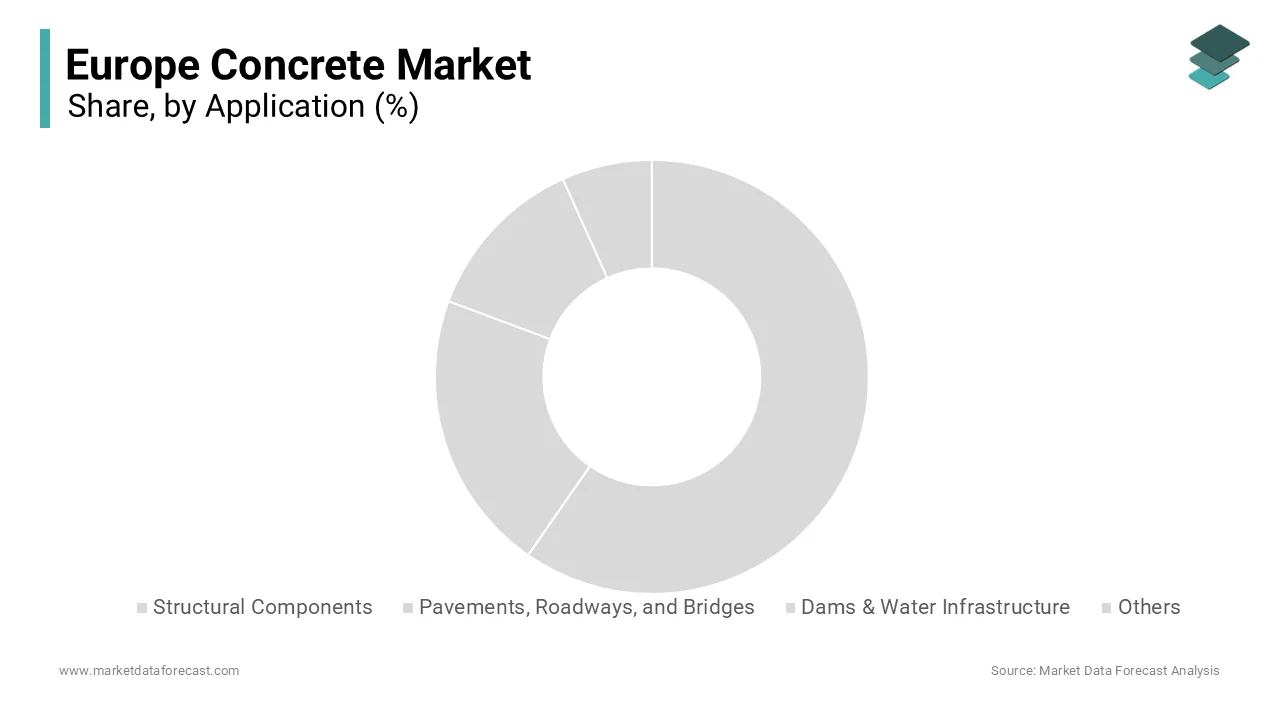
The bridges application segment is estimated to register the fastest CAGR of 6.8% from 2025 to 2033 due to the EU Mission on Climate Neutral and Smart Cities, which mandates the replacement or strengthening of ageing transport infrastructure with low-carbon, resilient alternatives. According to research, a significant portion of road bridges across the European Union requires major rehabilitation in the near future to comply with updated safety and load capacity standards. National governments are responding with targeted funding. Like, Germany is allocating substantial funding specifically for the retrofitting and life extension of its concrete bridges, utilising advanced materials to significantly increase their service life. Similarly, the Netherlands is increasingly mandating the use of innovative, self-sensing concrete technology in all new bridge construction to enable continuous, real-time structural health monitoring. These engineering and policy imperatives position bridges as the most dynamic growth frontier in concrete applications.
By End Use Insights
In 2024, the infrastructural segment was the top performer in the European concrete market by occupying a 36.1% share. Factors like sustained public investment in transport energy and water systems under the European Green Deal and Recovery and Resilience Facility are propelling the growth of the infrastructural segment. As per the European Investment Bank, it disbursed over €48 billion within the EU in 2023, funding a range of projects including sustainable transport (such as high-speed rail and metro expansions) and water infrastructure (wastewater treatment plants), among other priorities like climate action and cohesion. National strategies reinforce this trend. France's recovery and resilience plan ("France Relance") has a strong focus on the green and digital transitions, dedicating approximately €20 billion (around 50% of the total plan value) to green investments like building renovation and sustainable transport (rail modernisation). Besides, climate adaptation mandates drive demand for flood defences and coastal protection. This convergence of connectivity, decarbonization, and resilience objectives ensures infrastructure remains the largest segment.
The industrial segment is anticipated to witness the fastest CAGR of 7.2% over the forecast period, owing to the EU’s strategic push for supply chain sovereignty and clean manufacturing capacity. European policy initiatives promoting net-zero industries, such as gigafactories and hydrogen production plants, necessitate the construction of significant infrastructure requiring substantial concrete foundations and specialised shielding materials. In addition, there is a pronounced increase in the construction of battery cell manufacturing facilities across key European nations, driving considerable demand for specialised concrete materials. Similarly, funded clean hydrogen projects require specific engineering solutions, including the use of high-density, vibration-resistant concrete slabs to support heavy industrial equipment, as per research. National industrial zones are also being upgraded. These policy-driven industrial expansions are transforming concrete into a foundational enabler of Europe’s reindustrialisation.
REGIONAL ANALYSIS
Germany Market Analysis
Germany outperformed other regions in the European concrete market and accounted for a 21.6% share in 2024. The prominence of the German market is due to its dual focus on infrastructure modernisation and industrial decarbonization. There is a significant increase in investment in the modernisation and expansion of Germany's transportation infrastructure networks, including railways, roads, and bridges. Simultaneously, Germany’s industrial transformation drives demand. According to research, the construction of numerous large-scale industrial facilities, such as gigafactories and green hydrogen plants, is driving the demand for advanced specialised construction materials. This policy coherence between the transport industry and sustainability ensures Germany’s continued leadership.
France Market Analysis
France was the next-largest contributor to the European concrete market and captured a 16.2% share in 2024. The demand for concrete in France is fuelled by aggressive urban densification and nuclear infrastructure programs. It allocated funds for social housing construction with concrete selected as the structural material due to its fire safety and acoustic performance. Simultaneously, France’s nuclear renaissance is concrete-intensive. These overlapping drivers in housing energy and regulation sustain France’s strong market position.
Italy Market Analysis
Italy remains a notable country in the European concrete market, with seismic retrofitting and tourism infrastructure renewal. It is prioritising the seismic retrofitting of a large number of buildings located in high-risk zones, often requiring advanced techniques like concrete jacketing or base isolation systems. The Italian government is making substantial financial investments in the modernisation and infrastructure upgrades of key transportation hubs and historic city access routes, focusing on the use of durable and resilient concrete pavements to handle heavy usage. This combination of safety mandates and tourism-driven upgrades defines Italy’s robust concrete demand.
United Kingdom Market Analysis
The United Kingdom witnessed steady growth in the European concrete market. Despite its post-Brexit status, the UK maintains strong concrete demand through its National Infrastructure Strategy and housing crisis response. The construction of new homes, particularly high-rise developments, increasingly favours the use of concrete. Network Rail is undertaking extensive rehabilitation and lining projects for existing concrete viaducts and tunnels as part of its network upgrades. UK concrete producers are significantly increasing the incorporation of recycled construction waste into their new mixes. The regulatory and programmatic continuity ensures the UK remains a key market.
Spain Market Analysis
Spain is anticipated to expand in the European concrete market from 2025 to 2033, owing to high-speed rail expansion and climate adaptation infrastructure. It is demonstrating a continued trend of significant investment and expansion of its high-speed rail network, involving substantial infrastructure projects like precast concrete sleepers and viaducts. Climate challenges, particularly ongoing chronic drought, are compelling Spanish national policy and regional authorities to focus more on the construction of new water infrastructure like desalination plants and reservoirs, aiming to secure water supplies. These initiatives position Spain as a climate-responsive growth market.
COMPETITIVE LANDSCAPE
KEY MARKET PLAYERS
Some of the notable key players in the European concrete market are
- Wells Concrete
- Weckenmann Anlagentechnik
- Votorantim Group
- CEMEX
- HeidelbergCement AG
- Forterra
- Holcim Ltd
- CRH PLC
- Sika AG
TOP STRATEGIES USED BY THE KEY MARKET PLAYERS
Key players in the European concrete market prioritise decarbonization by reformulating mixes with supplementary cementitious materials and recycled aggregates to comply with the Construction Products Regulation. They invest in carbon capture, utilisation and storage technologies through partnerships with research institutions and EU-funded initiatives like LEILAC. Strategic vertical integration ensures control over raw material sourcing and recycling streams, enhancing supply chain resilience. Companies actively engage standardisation bodies to shape future regulations on embodied carbon and circularity. Additionally, they deploy digital tools for mixoptimisation, real-time quality control and carbon tracking to meet green public procurement requirements and differentiate their offerings in competitive tenders.
COMPETITION OVERVIEW
The European concrete market features intense competition among multinational producers, national champions and regional independents, all navigating a landscape defined by sustainability mandates and infrastructure urgency. Unlike ccommodity-drivenmarkets competition here centres on environmental performance, technical certification, and compliance with evolving EU regulations. Global players like Holcim and Heidelberg Materials leverage scale and R and D to lead ilow-carbonon innovation, while regional firms such as Cemex in Spain and Italcementi in Italy compete through localised logistics and public sector relationships. The absence of price-based differentiation has shifted rivalry toward value-added services, including carbon transparencyy, digital batching, and circular material integration. Public procurement policies that mandate Environmental Product Declarations further intensify the race for green credentials. This environment rewards those who align product development with policy direction while penalising laggards in decarbonization and digitalisation.
TOP PLAYERS IN THE MARKET
- Heidelberg Materials is a leading force in the European concrete market with a strong legacy in sustainable construction materials. The company operates an extensive network of ready mix plants and cement facilities across Germany, France, and Eastern Europe,, pe enabling localised low carbon concrete production. In 24, Heidelberg Materials launched its ECOPact range across all Western European markets, featuring coconcreteith with up tto ninety-fivelower CO2 emissions through clinker reduction and recycled content. The company also partnered with the European Circular Economy Stakeholder Platform to standardise concrete recycling protocols. Its global contribution includes pioneering carbon capture projects such as the LEILAC2 facility in Belgium, which aims to decarbonise cement production at scale. These initiatives reinforce its role as a sustainability innovator in both European and global construction sectors.
- Holcim plays a pivotal role in the European concrete market through its integrated solutions for infrastructure and urban development. The company supplies advanced concrete formulations for major projects, including high-speed rail networks and energy-efficient housing across Switzerland, France and the UK. In early 2024, Holcim expanded its ECECOPlanet low-carbon concrete portfolio to all twenty-seven EU member states, ensuring compliance with the updated Construction Products Regulation. It also launched the Circular Aggregates Program, which recycles demolition waste into certified structural aggregates globally. Globally, Holcim contributes by setting industry benchmarks for circularity and net zero operations, having committed to net zero cement and concrete by 2050. Its strategic focus on green construction aligns with Europe’s decarbonization mandates and strengthens its technological leadership worldwide.
- CRH is a major European concrete producer with significant operations in the UK, Ireland, reland Netherlands, and Germany. The company specialises in precast and ready-mix concrete tailored for residential and infrastructural applications. In 2024, CRH enhanced its Carbon Neutral Concrete initiative by integrating calcined clay and ground granulated blast furnace slag into standard mixes across its European footprint. It also invested in digital batching technology to optimise mix designs for minimal environmental impact. CRH’s global influence stems from its vertically integrated model and leadership in building materials innovation. The company actively participates in European standardisation bodies shaping EN norms for low-carbon and recycled-content concrete. Through these actions, CRH reinforces its commitment to suburbanisation and exporting practices to its operations in North America and Asia.
MARKET SEGMENTATION
This research report on the European concrete market has been segmented and sub-segmented based on categories.
By Application
- Structural Components
- Pavements, Roadways, and Bridges
- Dams & Water Infrastructure
- Others
By End Use
- Residential
- Commercial
- Industrial
- Infrastructural
By Country
- UK
- France
- Spain
- Germany
- Italy
- Russia
- Sweden
- Denmark
- Switzerland
- Netherlands
- Turkey
- Czech Republic
- Rest of Europe
Frequently Asked Questions
1. What is the Europe concrete market?
The Europe concrete market encompasses the production, distribution, and application of concrete materials used across residential, commercial, industrial, and infrastructure construction projects.
2. What are the major factors driving the growth of the Europe concrete market?
Key drivers include rapid urbanization, growing infrastructure investments, adoption of sustainable construction materials, and increased demand for durable building structures.
3. Which are the primary applications of concrete in Europe?
Concrete is widely used in structural components, pavements, roadways, bridges, dams, and water infrastructure projects.
4. What are the major end-use industries for concrete in Europe?
Major end users include residential, commercial, industrial, and infrastructure construction sectors.
5. How is sustainability influencing the European concrete industry?
Sustainability trends are pushing manufacturers to develop low-carbon, recycled, and green concrete solutions to meet EU environmental standards.
6. Which countries are leading the concrete market in Europe?
Germany, the United Kingdom, France, and Italy are among the leading markets due to strong construction activity and investment in infrastructure.
7. What are some of the latest technological advancements in concrete production?
Innovations include self-healing concrete, 3D-printed concrete, high-performance concrete, and smart admixtures that improve strength and durability.
8. What are the main challenges faced by the concrete market in Europe?
Challenges include fluctuating raw material costs, strict environmental regulations, and high energy consumption during production.
9. How is the demand for ready-mix concrete evolving in Europe?
Demand for ready-mix concrete is rising due to its convenience, consistent quality, and suitability for modern construction projects.
10. Who are the major players in the Europe concrete market?
Leading companies include HeidelbergCement AG, Holcim Ltd, CRH PLC, CEMEX, Sika AG, and Forterra, among others.
Related Reports
Access the study in MULTIPLE FORMATS
Purchase options starting from
$ 2000
Didn’t find what you’re looking for?
TALK TO OUR ANALYST TEAM
Need something within your budget?
NO WORRIES! WE GOT YOU COVERED!
Call us on: +1 888 702 9696 (U.S Toll Free)
Write to us: sales@marketdataforecast.com