Europe Ecotourism Market Size, Share, Trends & Growth Forecast Report, By Type, Traveller, Age Group, Booking Mode, Passenger, And Country (UK, France, Spain, Germany, Italy, Russia, Sweden, Denmark, Switzerland, Netherlands, Turkey, Czech Republic & Rest Of Europe) - Industry Analysis From (2025 To 2033)
Europe Ecotourism Market Size
The European ecotourism market size was valued at USD 90.76 billion in 2024 and is anticipated to reach USD 104.17 billion in 2025 to USD 279.46 billion by 2033, growing at a CAGR of 14.76% during the forecast period from 2025 to 2033.
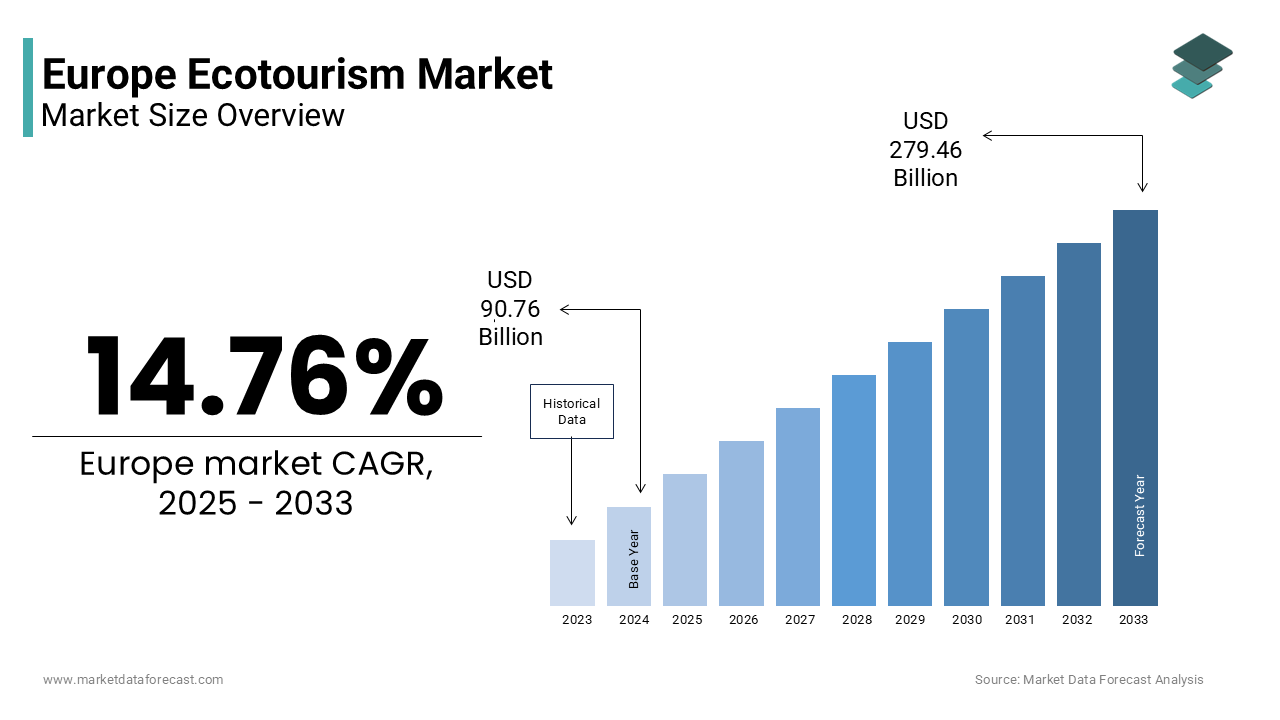
Ecotourism is a travel experience that prioritises environmental conservation, cultural respect and community well-being, while occurring in natural or semi-natural areas across the European continent. Unlike conventional tourism,m ecotourism emphasises low-impact visitor behaviour, educational engagement and direct contribution to local stewardship initiatives. As per Eurostat, over 65% of European households took at least one leisure trip to rural or natural areas in 202,4, reflecting a broad societal inclination toward nature-based recreation. According to the European Environment Agency, the European Union’s land territory is now designated as protected areas, including national parks, Natura 2000 sites and biosphere reserves, providing a vast operational canvas for ecotourism. Furthermore, the European Commission’s Green Public Procurement criteria now require that publicly funded educational and youth trips incorporate sustainability certifications by 2025. These institutional behavioural shifts illustrate how ecotourism in Europe is evolving from a niche alternative into a licit-supported mainstream travel ethos grounded in planetary responsibility and intergenerational equity.
MARKET DRIVER
Integration of Ecotourism into National Green Recovery and Rural Revitalisation Strategies
The governments are actively embedding ecotourism within post-pandemic economic resilience plans to counter urban migration and revive depopulated regions. He integration of ecotourism into national green recovery and rural revitalisation strategies is majorly accelerating the growth of the European ecotourism market. The European Commission’s Long Term Vision for Rural Areas targets that by 2040, all rural communities should have access to sustainable tourism as a core income stream with over four billion euros allocated through the Common Agricultural Policy for nature-based enterprise development between 2023 and 2027. The member states have adopted national ecotourism roadmaps that link visitor flows to conservation financing. In Portugal, the government’s Interior Plus Program reported in 2024 that ecotourism cooperatives in the Douro and Alentejo regions created many new jobs since 2021, reducing youth outmigration.
Rising Consumer Demand for Regenerative and Educational Travel Experiences
The European travellers increasingly seek journeys that not only minimise harm but also actively restore ecosystems and empower host communities. The rising consumer demand for regenerative and educational travel experiences is also escalating the growth of the European ecotourism market. According to the European Travel Commission, travellers aged 25 to 45 expressed willingness to pay a premium for trips that include verified conservation or community development components in 2024. Educational institutions are also catalysing demand as per the European Schoolnet, which documented that secondary schools in Nordic and Alpine countries organised certified ecotourism field trips in 2024 focused on biodiversity monitoring and climate literacy. In Sweden, the Swedish Environmental Protection Agency launched a citizen science ecotourism program where visitors contribute data on bird migration and soil health, with over 15,000 participants in its first year. This emergence of ethical consumption, experiential learning, and civic engagement is redefining ecotourism as a participatory act of stewardship rather than passive observation.
MARKET RESTRAINTS
Inconsistent Certification Standards and Greenwashing Across the Sector
The absence of a harmonised European ecotourism certification framework allows misleading sustainability claims to proliferate, undermining consumer trust and market integrity is restraining the growth of the European ecotourism market. As per the European Consumer Organisation, lodges and tour operators marketing themselves as eco-friendly in 2024 lacked third-party verification or used self-declared labels with no audit trail. The European Commission’s 2024 sweep of green claims in tourism identified over 250 businesses making unsubstantiated environmental assertions, including false carbon neutrality or wildlife protection credentials. This regulatory fragmentation enables opportunistic actors to exploit growing demand without delivering tangible ecological benefits.
Insufficient Infrastructure and Seasonal Limitations in Protected Natural Areas
Many ecotourism destinations across Europe suffer from underdeveloped year-round infrastructure that restricts accessibility and service quality outside peak seasons. According to the European Environment Agency, Natura 2000 sites have integrated visitor management plans that include wastewater treatment, renewable energy and low-impact transport links. In the Carpathian Mountains, the Romanian Ministry of Tourism reported that 86% of ecotourism accommodations close between November and March due to a lack of heating connectivity and trained staff. Similarly, in Finland, the Lapland Tourism Board noted that nature-based experiences operate in winter despite high demand for Arctic conservation tours. This seasonality not only limits revenue streams for local operators but also concentrates visitor pressure during the shora t window,,s exacerbating trail erosion, wildlife disturbance and water overuse.
MARKET OPPORTUNITIES
Leveraging Digital Platforms for Transparent Impact Tracking and Booking
The digital innovation to enhance accountability and personalisation is more likely to set up new opportunities for the growth of the European ecotourism market. Blockchain-enabled platforms now allow travellers to verify real-time conservation outcomes, such as hectares of reforested land or kilograms of plastic removed, linked to their bookings. As per the European Institute of Innovation and Technology, seven pilot projects in 2024 enabled tourists in Slovenia, Portugal, Turkey and Estonia to track their contribution to local biodiversity indicators via mobile dashboards. In Norway, the Wild Norway app uses this data to suggest alternative trails when popular routes exceed carrying capacity, reducing environmental degradation by an estimated 23% in pilot zones. These digital tools empower travellers to become informed co-managers of natural heritage while optimising distribution and impact measurement at scale.
Expansion of Transboundary Ecotourism Corridors Under EU Biodiversity Strategy
The European Union’s Biodiversity Strategy for 2030 promotes cross-border ecological networks that create seamless ecotourism itineraries spanning multiple countries and ecosystems. The expansion of transboundary ecotourism corridors under the EU biodiversity strategy is significantly degrading the growth of the European ecotourism market. The Danube Delta Mura Drava Karupa Biosphere Reserve, a UNESCO site shared by Romania, Croatia, and Hungary, launched a unified ecotourism passport in 2024 that funds joint ranger patrols and community homestays with revenue shared based on visitor nights. According to the European Environment Agency, such transboundary initiatives increased local income in peripheral villages while reducing illegal logging through enhanced monitoring. Similarly, the Alpine Space Programme supported cross-national ecotourism trails in 2024, connecting protected areas from Slovenia to France with standardised interpretation centres and carbon-neutral transport shuttles. The European Commission reported that these corridors attracted over 1.8 million visitors in their first year, with the integrated cross-border experience as their primary motivation.
MARKET CHALLENGES
Balancing Visitor Access with Biodiversity Protection in Fragile Ecosystems
The growing popularity of ecotourism places mounting pressure on Europe’s most sensitive habitats, threatening the very biodiversity it aims to conserve. As per the European Environment Agency, protected sites in Southern Europe now exceed their ecological carrying capacity during summer months, leading to soil compaction, water pollution and wildlife displacement. In the Pyrenees, the French Biodiversity Office documented a decline in capercaillie populations between 2019 and 2,024, attributed to trail proliferation and drone disturbances from amateur ecotourists. Similarly, in the Greek island of Ios, the Marine Protected Areas Agency reported that unregulated kayak tours caused a reduction in seagrass meadows for carbon sequestration and juvenile fish habitat. Well-intentioned policies on paper, enforcement remains weak with only a few European parks employing real-time monitoring systems, according to the European Park Federation.
Limited Access to Financing and Technical Capacity for Community-Based Operators
Grassroots ecotourism enterprises, particularly those led by rural cooperatives, indigenous groups, women, and men, face significant barriers in accessing capital and professional training needed to meet market and regulatory expectations. The limited access to financing and technical capacity of community-based operators is an additional challenge for the growth of the European ecotourism market. According to the study, 18% of micro ecotourism businesses in Eastern and Southern Europe secured loans between 2022 and 2024 due to a lack of collateral or formal business registration. The European Training Foundation found that 64% of local guides in the Balkans and Baltic states lack certification in first aid, environmental interpretation or digital marketing, ng limiting their competitiveness. In Bulgari, the National Ecotourism Association reported that community initiatives rely on volunteer labour and informal cash transactions, hindering scalability and tax compliance. While EU structural funds exist, application processes are often complex and biased. This capacity gap perpetuates dependence on external tour operators, who capture the majority of revenue, leaving local stewards under-resourced to manage the landscapes they protect.
REPORT COVERAGE
| REPORT METRIC | DETAILS |
| Market Size Available | 2024 to 2033 |
| Base Year | 2024 |
| Forecast Period | 2025 to 2033 |
| CAGR | 14.76% |
| Segments Covered | By Type, Traveller, Age Group, Booking Mode, Passenger, and Region |
| Various Analyses Covered | Global, Regional, & Country Level Analysis; Segment-Level Analysis, DROC, PESTLE Analysis, Porter’s Five Forces Analysis, Competitive Landscape, Analyst Overview of Investment Opportunities |
| Regions Covered | North America, Europe, APAC, Latin America, Middle East & Africa |
| Market Leaders Profiled | G Adventures (Canada), Adventure Alternative Ltd (Ireland), ROW Adventures (U.S.), Steppes Travel (U.K.), Aracari (U.S.), Small World Journeys (Australia), Black Kite Tour (Ethiopia), Global Sustainable Ecotours (U.S.), Discover Corps (U.S.), Rickshaw Travel Group (Tanzania) |
SEGMENTAL ANALYSIS
By Type Insights
The Nature & Wildlife Tourism segment accounted in holding 54.3% of the European ecotourism market share in 2024 due to the continent’s extensive network of protected areas and growing public interest in biodiversity observation. The European Environment Agency reports that the European Union’s land is designated as protected Natura sites, many of which offer guided wildlife experiences. Birdwatching has surged with the European Bird Census Council, an increase in organised tours across Spain, Portugal, and Greece between 2022 and 2024. National parks, such as Plitvice in Croatia and Białowieża in Poland, now generate their operational funding from ecotourism fees, directly supporting anti-poaching and habitat restoration. Additionally, the European Commission’s LIFE Programme allocated two hundred thirty million euros in 2024 for community-based wildlife monitoring projects that integrate tourist participation. These institutional and ecological synergies ensure that nature and wildlife tourism remain the cornerstone of Europe’s ecotourism identity.
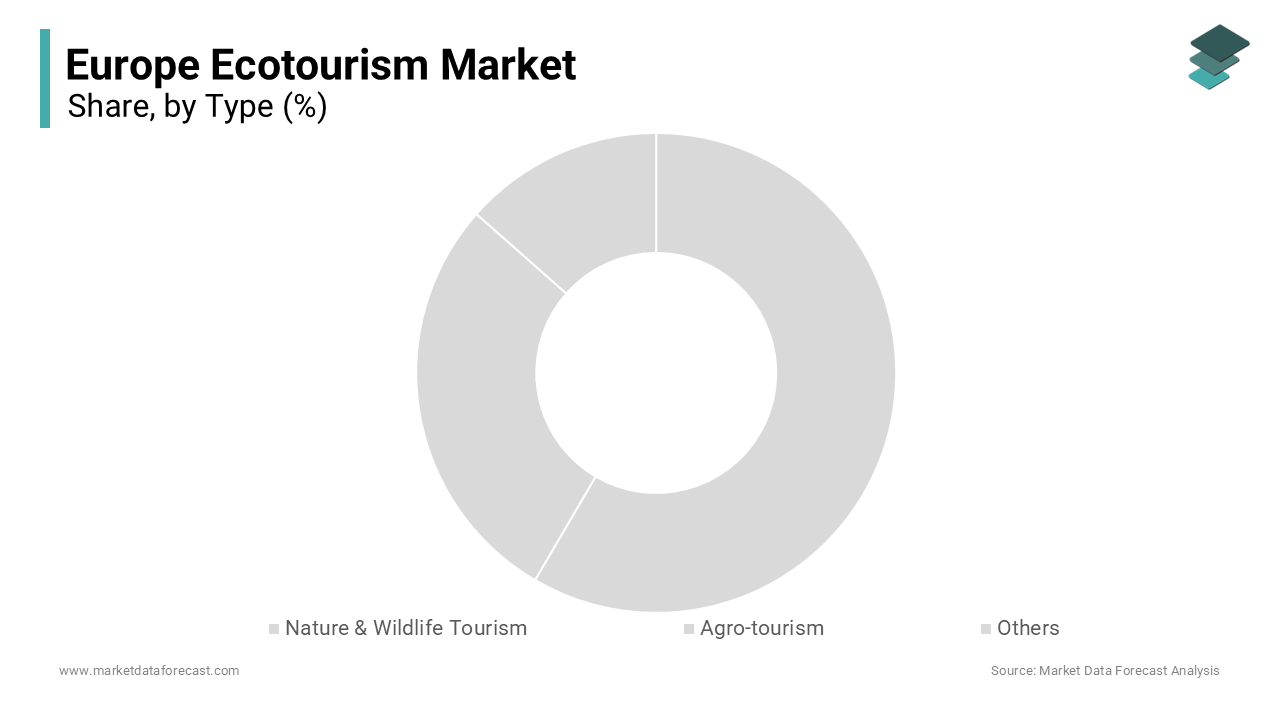
The Agro-tourism segment is expected to witness the fastest CAGR of 12.3% from 2025 to 2033, with the consumer demand for authentic food provenance, rural immersion, and support for small-scale sustainable farming. As per the European Commission, 45,000 farms across the European Union now offer agro-tourism services ranging from harvest stays to cheese-making workshops, with Italy and France accounting for these operations. The Common Agricultural Policy reforms of 2023 introduced direct subsidies for farms that combine production with educational tourism, leading to an increase in certified agro-tourism enterprises in 2024. In Portugal, the Rural Development Programme reported that agro-tourism reduced farm abandonment in interior regions between 2021 and 2024 by creating diversified income streams.
By Traveller Insights
The group travel segment was the largest by holding a dominant share of the European ecotourism market in 2024. Schools, universities and corporate wellness programs increasingly organise multi-day nature excursions, with the European Schoolnet documenting that some secondary schools in Nordic and Alpine countries conducted certified ecotourism field trips in 2024. Conservation NGOs also facilitate group experiences, such as reforestation weekends or wolf tracking expeditions with the WWF European Network, reporting over many participants across twenty countries in 2024. Additionally, family multigenerational groups prefer guided packages that accommodate varying mobility levels and provide expert interpretation. This preference for collective engagement ensures group travel remains the primary consumption model.
The solo ecotourism segment is likely to witness a prominent CAGR of 9.3% from 2025 to 20,33, with digital nomadism, mental wellness retreats, and self-guided nature immersion gaining traction among independent travellers. According to Eurofound, European millennials undertook at least one solo nature trip in 202,4, citing digital detox and personal reflection as primary motivations. Platforms like Komoot and AllTrails now offer turn-by-turn navigation for self-guided trails in over 15000 European natural areas with offline safety features that reduce reliance on guides. In Sweden, the Right of Public Access principle enables free solo hiking and camping, which the Swedish Tourist Association reports attracted over five hundred thousand international solo visitors in 2024.
By Booking Mode Insights
The direct bookings segment accounted in holding 56.4% of the European ecotourism market share in 2024 and was also growing at the fastest CAGR of 10.4% during the forecast period. The proliferation of digital platforms such as BookDifferent, FairTri, and regional park authority websites enables consumers to book cabi, ns uided wa,lks and conservation experiences without intermediaries. As per the European Data Portal, national park accommodations in 2024 offered direct online reservation systems that reinvest revenue locally. The European Consumer Organisation found that ecotourists prefer direct channels to verify sustainability claims and communicate specific needs such as dietary restrictions or accessibility requirements. This disintermediation trend aligns with the ethical ethos of ecotourism, where financial leakage undermines conservation goals. The European Commission’s Digital Europe Programme funded local tourism portals in 2024 that integrate verified eco labels, Abel's payment security and multilingual support, rt enabling small operators to compete globally. Additionally, the General Data Protection Regulation has increased consumer confidence in direct transactions by ensuring personal data remains within local jurisdictions. The European Travel Commission observed that direct booking growth is strongest among travellers under 40, who associate intermediaries with profit extraction rather than value addition.
By Age Group Insights
The millennials segment was the largest European ecotourism market by holding 42.3% of the share in 2024, with their alignment with sustainability values, digital fluency, and experiential consumption. As per Eurofound, 76% of European millennials consider a destination’s environmental impact when planning trips, with 63% willing to pay a premium for certified eco experiences. This cohort dominates bookings for multi-day hiking, wildlife safari, and volunteer conservation programs with ecotourism participants aged millennials in 2024. They also drive demand for social media shareable, yet low-impact moments, such as silent forest walks or citizen science beach cleanups. Educational institutions further reinforce this behaviour as university sustainability curricula in Germany and the Netherlands include mandatory ecotourism fieldwork. Their economic influence and values-based decision-making cement millennials as the primary demographic engine.The
Generation Z segment is likely to witness the fastest CAGR of 12.3% from 2025 to 2033. According to the European Youth Forum, many Europeans aged 18 to 24 participated in at least one nature-based trip in 2024 by choosing operators that publish annual conservation impact reports. They also prioritise eco-creation, designing their own itineraries via apps that calculate ecological footprints in real time. In France, university collectives launched “Eco Escapepeer-to-peerer homestays on organic farms, attracting over eighty thousand bookings in 2024. Their expectation that travel should actively heal ecosystems rather than merely observe them redefines ecotourism’s future trajectory.
By Passenger Insights
The domestic travellers segment was the largest by holding a significant share of the European ecotourism market in 2024, with the post-pandemic preferences for local exploration and reduced carbon footprints. As per Eurostat, European leisure trips in 2024 occurred within country borders, with rural and natural areas being the top choice. Government campaigns, such as France’s “Explore Your Region” and Italy’s “Borghi Experience,” further incentivised local nature stays through tax credits and transport subsidies. Additionally, domestic travellers face fewer visa or language barriers, enabling deeper engagement with conservation activities. The European Environment Agency noted that domestic ecotourists stay on average 2.3 nights longer than international visitors and participate more in volunteer programs.
The international ecotourism segment is expected to witness the fastest CAGR of 11.2% from 2025 to 2033, as European natural sites gain global recognition and air travel decarbonization initiatives rebuild long-haul confidence. UNESCO biosphere reserves in the Azores, Transylvania, and the Danube Delta saw international visitor numbers rebound to one hundred twelve per cent of 2019 levels by 2024. The European Union’s Green Travel Corridors initiative introduced visa fast tracking and carbon offset mandates for inbound ecotourists, which increased bookings from North America and East Asia. Additionally, transboundary trails like the Via Dinarica and E1 European Long Distance Path attract dedicated international hikers with the rise in cross-border permits issued in 2024.
COUNTRY ANALYSIS
Italy Ecotourism Market Analysis
Italy was the top performer of the European ecotourism market by holding 25.3% of the share in 2024 through its unparalleled blend of biodiversity, agrarian heritage, and protected landscapes. The country hosts over 30 UNESCO biosphere reserves and the largest number of organic farms in the European Uni, offering ideal conditions for agro and nature ecotourism. As per the Italian Ministry of Agriculture, many farms offered ecotourism services in 2024 to generate rural income. National parks, such as GranParadisond Pollino, have implemented digital reservation systems that cap daily visitors to protect ecosystems, while funding anti-poaching units. Additionally, Italy’s “Borghi” program revitalised depopulated villages by converting historic structures into eco lodges.
Spain Ecotourism Market Analysis
Spain was positioned second by holding 23.2% of the share in the European ecotourism market due to its vast network of natural parks, diverse climates, and strong policy support for sustainable rural tourism. The country manages the European Union’s Natura 2000 sites with regions like Andalusia andGalicia, leading in certified ecotourism offerings. According to the Spanish Ministry for Ecological Transition, ecotourism enterprises received Green Key or Biosphere certification in 2024. Birdwatching in Doñana, and whalewatching in the Canary Islands, attracted over two million international visitors in 204 with strict quotas ensuring ecological balance.
France Ecotourism Market Analysis
France's ecotourism market growth is likely to be driven by its ambitious “Green Tourism” certification scheme and extensive protected mountain and coastal zones. As per some reports, over 1200 ecotourism providers held official sustainable labels in 20,, covering everything from alpine refuges to oyster farm visits. The government’s “Plan Montagne” invested many millions of euros between 2021 and 2024 to upgrade eco infrastructure in the Alps and Pyrenees, reducing car dependency through electric shuttle networks. In rural areas, the “Maisons du Parc” system provides a centralised look and interpretation services that channel revenue directly to local guides and farmers. Additionally, France’s leadership in the European Ecotourism Observatory enables data-driven management of visitor flows in sensitive areas, such as the Camargue wetlands.
Germany Ecotourism Market Analysis
Germany's ecotourism market growth is likely to grow with the high environmental awareness,,s strong domestic demand, nd and institutional support for nature education. Germany’s “Quality Charter for Sustainable Tourism” certifies over eight hundred ecotour businesses, ensuring compliance with strict ecological and social criteria. Additionally, schools and universities routinely organise multi-day conservation camps with the Standing Conference of Education Ministers mandating outdoor learning modules that include ecotourism components. Deutsche Bahn’s “Eco Ticket” program is offering discounted rail access to national parks, increased off-peak visitation in 2024.
COMPETITIVE LANDSCAPE
Competition in the European ecotourism market is characterised by a dual structure comprising global digital platforms and hyper-local community-based operators. Large players leverage technology to find scalable, varied experiences while enterprises differentiate through deep place-based knowledge, cultural intimacy and reinvestment in stewardship. The absence of a mandatorEU-wide ecotourism standard creates both opportunity and risk as credible actors strive for differentiation amid widespread greenwashing. Consumer demand is increasingly segmented between those seeking convenience and those prioritising direct community impact. Regulatory developments such as the EU Green Claims Directive are raising the bar for sustainability assertions, pressuring all participants to adopt auditable practices. Success hinges on balancing scalability with authenticity, transparency with emotional resonance and global outreach with local accountability in a market where trust is the ultimate currency.
KEY MARKET PLAYERS
A few of the market players in the European ecotourism market are
- G Adventures (Canada)
- Intrepid Travel
- Responsible Travel
- Much Better Adventures
- Adventure Alternative Ltd (Ireland)
- ROW Adventures (U.S.)
- Steppes Travel (U.K.)
- Aracari (U.S.)
- Small World Journeys (Australia)
- Black Kite Tour (Ethiopia)
- Global Sustainable Ecotours (U.S.)
- Discover Corps (U.S.)
- Rickshaw Travel Group (Tanzania)
Top Players In The Market
- Intrepid Travel plays a pivotal role in the European ecotourism market by offering small group itineraries that emphasise local community engagement,,nt low environmental impact, and cultural authenticity. Glob ly the company is recognised for its certified B Corporation status and carbon-neutral operations since 2010. In Europe, Intrepid partners with cooperatives, indigenous guides and family-run eco lodges across the Balkans, Iberia and the Nordic regions to ensure economic benefits remain within host communities. It launched a Regenerative Travel Initiative in collaboration with European protected area authorities, rtwhichontributesirectly to rewilding and trail restoration projects. The company also introduced digital impact passports that track each traveller’s conservation contribution, reinforcing transparency and deepening experiential value across its European portfolio.
- Responsible Travel is a UK-based digital marketplace that curates over two thousand verified ecotourism experiences across Europe and gglgloballyithhstrict vetting process focused on environmental stewardship and social equity. The platform excludes any operator lacking third-party sustainability certification or demonstrable community benefit. In Europe, it champions lesser-known destinations such as the Carpathians and Sardinian highlands to alleviate overtourism in hotspots. Responsible Travel integrated real-time carbon calculators and biodiversity impact scores into every booking page, enabling travellers to compare ecological footprints. It also partnered with the European Ecotourism Association to co-develop a unified verification framework for small-scale operators, enhancing sector credibility and consumer trust throughout the European market.
- Much Better Adventures has emerged as a key innovator in the European ecotourism market by blending adventure travel with measurable conservation outcomes. The company channels fiveof every booking directly into nature-based projects such as wolf corridor restoration in the Pyrenees and seagrass protection in the Adriatic. Globally, it pioneered the “Adventure with Purpose” model that links trip participation to specific ecological metrics. In 2024, it launched a European Regenerative Fund co-financed by travellers and corporate partners to support reforestation and anti-poaching units in Eastern Europe. Its digital platform features transparent project dashboards showing real-time outcomes, enhancing accountability.
Top Strategies Used By The Key Market Participants
Key players in the European ecotourism market prioritise direct partnerships with local communities to ensure economic leakage is minimised and cultural authenticity is preserved. They invest in third-party sustainability certifications and transparent impact reporting to build consumer trust in an era of greenwashing scepticism. Companies increasingly integrate digital tools such as carbon calculators, biodiversity trtrackersssandd regenerative contribution dashboards to enhance accountability. Strategic diversification of off-the-beaten-path destinations helps alleviate pressure on over-touristed hotspots while supporting rural revitalisation. Additionally, they collaborate with public agencies, protected area authorities and European Union programs to align offerings with policy frameworks like the Biodiversity Strategy for 2030 and Green Public Procurement guidelines.
MARKET SEGMENTATION
This research report on the European ecotourism market is segmented and sub-segmented into the following categories.
By Type
- Nature & Wildlife Tourism
- Agro-tourism
- Others
By Traveller Type
- Solo
- Group
By Booking Mode
- Travel Agents
- Direct
By Age Group
- Generation X
- Millennials
- Generation Z
By Country
- UK
- France
- Spain
- Germany
- Italy
- Russia
- Sweden
- Denmark
- Switzerland
- Netherlands
- Turkey
- Czech Republic
- Rest of Europe
Related Reports
Access the study in MULTIPLE FORMATS
Purchase options starting from
$ 2000
Didn’t find what you’re looking for?
TALK TO OUR ANALYST TEAM
Need something within your budget?
NO WORRIES! WE GOT YOU COVERED!
Call us on: +1 888 702 9696 (U.S Toll Free)
Write to us: sales@marketdataforecast.com