Europe Escape Room Market Size, Share, Trends & Growth Forecast Report Segmented By Type (Physical Escape Rooms, Virtual Escape Rooms, Hybrid Escape Rooms), Theme, Application, End User, And Country (UK, France, Spain, Germany, Italy, Russia, Sweden, Denmark, Switzerland, Netherlands, Turkey, Czech Republic & Rest of Europe), Industry Analysis From 2026 To 2034
Europe Escape Room Market Report Summary
The Europe escape room market was valued at USD 3.51 billion in 2025 and is projected to reach USD 7.72 billion by 2034, growing from USD 3.83 billion in 2026 at a CAGR of 9.14% during the forecast period. Market growth is driven by increasing demand for immersive entertainment experiences, rising popularity of group activities, and the expansion of experiential leisure industries. Escape rooms are gaining traction among individuals, corporate teams, and tourists as a unique form of interactive entertainment.
Key Market Trends
- Rising demand for experiential and immersive entertainment
- Increasing popularity of group-based recreational activities
- Growth in corporate team-building events and gamification
- Expansion of themed and story-driven escape room concepts
- Integration of technology such as AR/VR in escape room experiences
Segmental Insights
- Based on type, the physical escape room segment dominated the Europe escape room market in 2025 by accounting for 74.7% of the regional market share, driven by demand for real-world immersive experiences
- Based on theme, the mystery theme segment led the market in 2025 by capturing 36.3% of the total market share, supported by strong consumer interest in puzzle-solving and storytelling
- Based on application, the entertainment segment held the largest share in 2025 at 57.5%, driven by recreational usage and social activities
- Based on end user, the individuals segment dominated the market in 2025, supported by rising participation in leisure and group experiences
Regional Insights
- United Kingdom led the Europe escape room market in 2025 by holding 23.2% of the regional market share, driven by a strong leisure industry and urban entertainment demand
- Germany ranked second, supported by high interest in logic-based and puzzle-driven experiences
- France is expected to maintain a notable share due to growing tourism and entertainment sectors
Competitive Landscape
- The Europe escape room market is fragmented and highly competitive, with numerous regional and local operators offering diverse themes and experiences. Companies are focusing on storytelling, technology integration, and customer engagement to differentiate their offerings.
- Prominent players in the Europe escape room market include HintHunt, Escape Hunt, Breakout Games, Fox in a Box, ClueQuest, Mission Escape, Escape Live, Escape Reality, Exit Games, Paradox Project, Enigma Quests, LogicLocks, and Escape Plan Ltd.
Europe Escape Room Market Size
The Europe escape room market size was calculated to be USD 3.51 billion in 2025 and is anticipated to be worth USD 7.72 billion by 2034, from USD 3.83 billion in 2026, growing at a CAGR of 9.14% during the forecast period.

Escape rooms comprise a dynamic sector of live-action interactive entertainment where participants are locked in a themed environment and must solve puzzles to achieve a specific goal within a set time limit. This industry has evolved from niche hobbyist activities into a mainstream leisure phenomenon, driven by the consumer desire for immersive social experiences that transcend passive consumption. The market is characterized by high levels of creativity, technological integration, and thematic diversity, ranging from horror mysteries to historical adventures. As per Eurostat data, 92% of individuals in the European Union used the internet in 2023, which supports the digital booking infrastructure for cultural and entertainment activities. Furthermore, the European Travel Commission reported that domestic tourism within Europe reached pre-pandemic levels in 2023, with travelers increasingly seeking unique local experiences rather than traditional sightseeing. This shift supports the proliferation of escape rooms as attractive attractions for both residents and tourists. The average duration of these experiences typically ranges from 60 to 90 minutes, making them ideal for short leisure windows. According to the International Association of Amusement Parks and Attractions, the global attractions industry has seen a significant recovery with an 11% increase in attendance at major theme parks and interactive venues. In Europe, the density of venues is highest in urban centers such as London, Berlin, and Paris, reflecting the concentration of target demographics, including young professionals, students, and corporate groups seeking team-building opportunities.
MARKET DRIVERS
Rising Demand for Experiential Social Interaction Among Millennials and Gen Z
The escalating preference for experiential social interaction among Millennials and Generation Z is one of the major factors propelling the expansion of the European escape room market. Unlike previous generations that prioritized material goods, these demographic cohorts value shared memories and active participation in leisure activities. As per a survey by the European Youth Forum, 68% of respondents aged 18 to 35 stated they prefer spending money on experiences such as games and events rather than physical products. This behavioral shift drives consistent footfall to escape room venues, which offer collaborative problem-solving and social bonding in a controlled environment. According to the World Bank, the services sector, which includes entertainment and leisure, accounts for approximately 70% of the GDP in many high-income European countries. Escape rooms provide a unique platform for friends, families, and colleagues to engage in face-to-face interaction free from digital distractions, which is increasingly valued in a hyper-connected world. In the United Kingdom, for instance, according to the Office for National Statistics, 92% of adults used the internet daily in 2023, highlighting an environment where people seek physical interactive gaming experiences for leisure. The social nature of these games encourages repeat visits as groups seek to tackle different themes and difficulty levels. Furthermore, the rise of social media amplifies this driver as participants share their achievements and reactions online, creating organic marketing momentum. This strong cultural inclination towards shared experiential consumption ensures sustained demand for escape room facilities across the continent.
Expansion of Corporate Team Building and Professional Development Programs
The widespread adoption of escape rooms as effective tools for corporate team building and professional development further fuels the expansion of the Europe escape room market. Organizations increasingly recognize the value of immersive simulations in enhancing communication, leadership, and problem-solving skills among employees. As per the European Foundation for the Improvement of Living and Working Conditions, 55% of companies in the EU implemented new team-building initiatives in 2023, focusing on soft skill enhancement through interactive activities. Escape rooms offer a neutral ground where hierarchical structures are temporarily suspended, allowing employees to collaborate on equal footing to solve complex puzzles. This format reveals individual strengths and weaknesses in real time, providing valuable insights for management. According to the Bureau of Labor Statistics, companies that invest in employee training and development see a 24% higher profit margin than those that do not. In Germany, the Chamber of Commerce reported that 40% omedium-sizeded enterprises utilized escape room experiences for staff induction and cohesion workshops in 2023. The structured yet engaging nature of these activities makes them superior to traditional seminars for fostering engagement and morale. Additionally, the scalability of escape room operations allows large corporations to book multiple rooms simultaneously for extensive off-site events. This institutional demand provides a stable revenue stream for operators, mitigating seasonal fluctuations associated with leisure tourism. Consequently, the integration of escape rooms into corporate human resource strategies acts as a robust driver for market expansion.
MARKET RESTRAINTS
High Operational Costs and Capital Intensity of Venue Setup
Substantial initial capital investment and ongoing operational costs are inhibiting the growth of the Europe escape room market. Creating a high-quality immersive experience requires specialized construction, advanced audiovisual equipment, and intricate mechanical props, which entail considerable upfront expenditure. As per the European Small Business Alliance, the average setup cost for a single themed escape room ranges from 30,000 to 80,000 euros, depending on complexity and technological integration. This financial barrier limits the ability of small entrepreneurs to enter the market and restricts the expansion capabilities of existing operators. Furthermore, recurring expenses such as rent, utilities, insurance, and staff salaries place continuous pressure on profit margins. In major urban centers like Paris and Amsterdam, commercial rental rates have increased significantly, according to Eurostat data, which shows a 4.1% annual increase in service costs during 2023. The need for regular maintenance and theme updates to keep content fresh adds to the financial burden as consumer expectations for novelty remain high. Unlike digital games, which have low marginal reproduction costs, physical escape rooms require tangible resources for every new iteration. According to the European Commission, approximately 50% of new businesses fail within their first five years, highlighting the risk for entertainment ventures with high fixed costs. These economic constraints discourage investment and can lead to market consolidation where only well-capitalized entities survive. Consequently, the high cost structure serves as a formidable restraint on the overall growth and diversity of the Europe escape room market.
Limited Scalability and Revenue Per Square Meter Constraints
The inherent physical limitations of escape room venues regarding scalability and revenue generation per square meter are another notable restraint to the Europe escape room market. Unlike cinema complexes or bowling alleys, which can accommodate large numbers of patrons simultaneously, escape rooms operate on a one group per room model with strict time limits. As per the International Association of Leisure Facilities, the maximum throughput for a standard escape room is typically four to six groups per day, assuming 60-minute sessions and turnover time. This caps the potential daily revenue regardless of demand spikes. In densely populated European cities, where real estate is at a premium, maximizing floor space efficiency is critical. According to the Urban Land Institute, prime retail rents in London increased by 5.6% in 2023, making it difficult for entertainment venues to match the revenue per square meter of high-density retail outlets. Escape rooms often require large footprints for elaborate sets, yet can only serve a limited number of customers at any given time. This inefficiency makes it challenging for operators to justify high rental costs in prime locations. Furthermore, expanding capacity requires acquiring additional physical space and constructing new rooms, which is capital-intensive and time-consuming. The inability to scale operations digitally or through mass participation models restricts growth potential. Consequently, operators face diminishing returns on investment as they attempt to expand, leading to slower market penetration and limited geographic spread in high-cost regions.
MARKET OPPORTUNITIES
Integration of Advanced Technologies Such as VR and Augmented Reality
The integration of advanced technologies such as virtual reality VR and augmented reality AR provides a lucrative opportunity for the Europe escape room market. By blending physical sets with digital overlays, operators can create hybrid experiences that offer unprecedented levels of immersion and narrative depth. As per the European Virtual and Augmented Reality Association, the adoption of VR in entertainment venues grew by 35% in 202,3 driven by consumer curiosity and improved hardware accessibility. Hybrid escape rooms allow for dynamic environment changes impossible with physical props alone, such as shifting walls or magical effects, enhancing the storytelling experience. This technological augmentation enables operators to refresh themes without complete physical reconstruction, reducing long-term renovation costs. In Sweden, several venues have successfully launched VR-enhanced escape experiences, reporting a 20% increase in average ticket prices due to the perceived added value. The use of wearable haptic feedback devices further intensifies sensory engagement, attracting tech-savvy demographics. According to a study by the European Commission, the digital transformation of entertainment can lead to a 40% increase in operational efficiency. This technology also facilitates remote participation options where off-site players can join via avatars, expanding the potential customer base beyond physical visitors. As hardware costs decline and software capabilities improve, the barrier to entry for tech-integrated experiences lowers. Embracing these innovations allows operators to stand out in a crowded market and appeal to a broader audience seeking cutting-edge entertainment.
Franchising Models and Brand Standardization for Market Expansion
The development of franchising models and brand standardization offers significant opportunities for rapid market expansion and operational efficiency in the Europe escape room market. Currently, the sector is highly fragmented with many independent operators lacking the resources for marketing and quality control. Establishing recognized brands through franchising allows for economies of scale in procurement, marketing, and training. As per the European Franchise Federation, the franchise sector in Europe grew by 8% in 2023, with leisure and entertainment being a key growth area. Franchised escape room chains can leverage standardized design templates and proven puzzle mechanics to reduce setup times and ensure consistent quality across locations. This consistency builds consumer trust and loyalty as patrons know what to expect regardless of location. In France, emerging franchise brands have expanded to over 50 locations within three years, demonstrating the viability of this model. Standardization also facilitates easier staff training and operational management, reducing overhead costs. Furthermore, established brands can negotiate better terms with landlords and suppliers, enhancing profitability. The opportunity to license intellectual property from popular movies or games further attracts customers and differentiates franchises from independent competitors. By adopting a franchising strategy, operators can accelerate geographic penetration and achieve market dominance more effectively than organic growth allows. This structured approach to expansion addresses the fragmentation issue and creates a more resilient and scalable industry landscape.
MARKET CHALLENGES
Intellectual Property Theft and Lack of Puzzle Originality
The pervasive issue of intellectual property theft and lack of puzzle originality is a significant challenge to the Europe escape room market, which is undermining innovation and competitive advantage. Due to the physical nature of escape rooms, successful puzzle designs and themes are easily replicated by competitors without legal recourse. As per the European Intellectual Property Office, there are limited mechanisms to protect game mechanics and narrative structures in live entertainment, leading to widespread copying. Many new entrants mimic popular themes and puzzle sequences from successful venues, resulting in market saturation with generic offerings. According to the European Commission, copyright and related rights contribute to 42% of the EU's total economic activity, yet enforcement in live games remains difficult. This lack of originality dilutes brand identity and reduces the incentive for investment in creative development. Consumers quickly become bored with repetitive experiences, leading to declining repeat visitation rates. In Italy, industry forums frequently discuss the frustration of seeing identical room layouts appear in neighboring cities shortly after opening. The absence of strong copyright protection for interactive game elements means that innovators do not fully reap the rewards of their creativity. This environment discourages high-level investment in research and development as the return on innovation is compromised by imitation. Consequently, the market risks stagnation with a proliferation of low-quality clones that fail to engage discerning customers. Addressing this challenge requires industry-wide standards and potentially new legal frameworks to protect creative assets.
Regulatory Hurdles and Safety Compliance Requirements
Stringent regulatory hurdles and safety compliance requirements are another major challenge to the operation and expansion of escape room venues in Europe. As physical entertainment spaces involving locked doors and potential hazards, escape rooms are subject to rigorous fire safety building codes and health regulations. As per the European Agency for Safety and Health at Work, incidents in entertainment venues have led to tighter scrutiny across member states. Operators must install emergency release mechanisms, smoke detectors, and clear signage, which can be costly and technically complex to integrate into themed environments. In the United Kingdom, the Health and Safety Executive mandates regular inspections and risk assessments for all public entertainment facilities. Non-compliance can result in heavy fines or closure, as seen in several cases in Poland where hundreds of venues were inspected for fire safety violations in 2022. The variability of regulations across different European countries complicates expansion for multi-national operators who must navigate distinct legal frameworks in each jurisdiction. For instance, requirements for wheelchair accessibility and emergency exits differ significantly between Germany and Spain. These compliance burdens increase operational costs and delay opening timelines. Furthermore, insurance premiums for escape rooms have risen significantly, according to the European Insurance and Occupational Pensions Authority, which notes that insurance prices for high-risk entertainment grew by 25% in recent years. These regulatory and financial pressures constrain operational flexibility and pose a constant challenge to sustainable business management in the sector.
REPORT COVERAGE
| REPORT METRIC | DETAILS |
| Market Size Available | 2025 to 2034 |
| Base Year | 2025 |
| Forecast Period | 2026 to 2034 |
| CAGR | 9.14% |
| Segments Covered | By Type, Theme, Application, End User, And Region |
| Various Analyses Covered | Global, Regional & Country Level Analysis; Segment-Level Analysis; DROC, PESTLE Analysis; Porter’s Five Forces Analysis; Competitive Landscape; Analyst Overview of Investment Opportunities |
| Regions Covered | UK, France, Spain, Germany, Italy, Russia, Sweden, Denmark, Switzerland, Netherlands, Turkey, and the Czech Republic |
| Market Leaders Profiled | HintHunt, Escape Hunt, Breakout Games, Fox in a Box, ClueQuest, Mission Escape, Escape Live, Escape Reality, Exit Games, Paradox Project, Enigma Quests, LogicLocks, Escape Plan Ltd |
SEGMENTAL ANALYSIS
By Type Insights
The physical escape room segment dominated the market by holding 74.7% of the European market share in 2025. The dominance of the physical escape room segment in the European market is primarily driven by the consumer preference for tangible immersive experiences that facilitate genuine face-to-face social interaction. Unlike virtual alternatives, physical rooms offer haptic feedback through props, locks, and mechanisms that enhance the sense of presence and achievement. As per a survey by the European Leisure Association, 82% of participants cited the physical tactile nature of the game as the primary reason for their choice over digital formats. The desire for unplugged social bonding has intensified post-pandemic, with groups seeking shared activities that require direct communication and collaboration. According to VisitBritain, the volume of domestic day trips in Great Britain increased by 11% in 2023, supporting physical attractions. The psychological satisfaction of physically manipulating objects and exploring real space creates memorable experiences that drive word-of-mouth referrals. Furthermore, physical rooms allow for elaborate set designs and atmospheric effects such as lighting, sound, and temperature changes that are difficult to replicate virtually. This multisensory engagement appeals to a broad demographic ranging from families to corporate teams. The established infrastructure of physical venues in urban centers also contributes to their dominance, as they are easily accessible and integrated into existing leisure districts. Consequently, the inherent appeal of real-world immersion ensures that physical escape rooms remain the cornerstone of the European market.
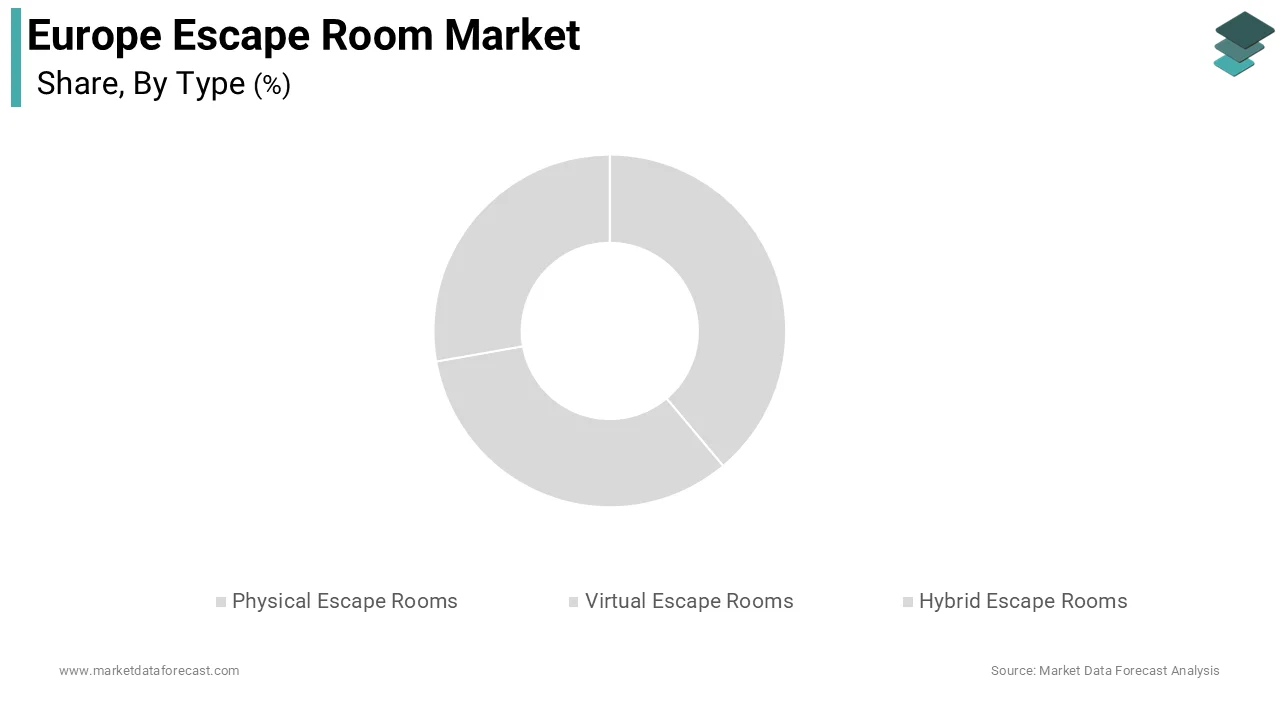
However, the hybrid escape room segment is promising and is estimated to record a CAGR of 19.4% over the forecast period, owing to the innovative integration of physical sets with digital technologies such as augmented reality and interactive projections. This combination offers a unique value proposition by enhancing narrative depth and allowing for dynamic environment changes that pure physical rooms cannot achieve. As per the European Virtual and Augmented Reality Association, the adoption of mixed reality in entertainment venues increased by 40% in 2023 as operators sought to differentiate their offerings. Hybrid rooms enable real-time story adjustments based on player decisions, increasing replayability and personalization. According to a study by the University of Amsterdam, interactive digital media can increase user engagement levels by 25% due to the seamless blend of tactile and visual stimuli. Technologies such as RFID sensors and motion tracking allow puzzles to trigger automatic effects, creating a magical and immersive atmosphere. This technological sophistication attracts tech-savvy demographics, including millennials and Gen Z, who seek novel and Instagram-worthy experiences. In Sweden, hybrid venues reported a 35% increase in repeat customers compared to traditional rooms. The ability to update digital content without costly physical renovations also improves operational efficiency for owners. By offering a superior level of immersion and flexibility, hybrid escape rooms are rapidly gaining popularity and driving significant growth in the European market.
By Theme Insights
The mystery theme segment led the market with 36.3% of the regional market share in 2025. The dominance of the mystery theme segment in the European market is attributed to the universal appeal of detective narratives and the cognitive satisfaction derived from solving logical puzzles and uncovering secrets. Mystery themes often draw inspiration from popular culture, including classic literature, films, and true crime stories, which resonate with a wide audience. As per a survey by the European Entertainment Research Institute, 70% of first-time escape room players choose mystery themes due to their familiar structure and clear objectives. The genre allows for intricate storytelling and layered puzzles that engage participants intellectually without relying heavily on scare tactics or specialized knowledge. In the United Kingdom, according to VisitEngland, over 40% of residents participated in some form of puzzle or problem-solving leisure activity in 2023. The flexibility of the mystery genre allows operators to create diverse scenarios ranging from historical whodunits to modern cyber crimes, ensuring broad demographic appeal. Furthermore, mystery rooms are perceived as safe and inclusive, making them suitable for families, corporate groups, and mixed-age parties. The emphasis on logic and observation rather than physical agility or horror tolerance makes this theme accessible to the widest possible customer base. Consequently, the combination of intellectual stimulation and cultural familiarity solidifies the mystery segment as the market leader in Europe.
On the other hand, the horror theme segment is predicted to showcase a CAGR of 15.5% over the forecast period in the European market due to the increasing consumer demand for thrill-seeking experiences and adrenaline-inducing activities. Horror escape rooms combine the intellectual challenge of puzzle solving with the visceral excitement of fear, creating a highly intense and memorable experience. As per the International Journal of Tourism Research, participation in high-arousal entertainment activities increased by 30% among young adults in Europe during the recovery period. The physiological response to fear, including increased heart rate and alertness, enhances the emotional impact of the game, making it more memorable than standard puzzles. In Germany, the Federal Association of Entertainment Providers reported that horror rooms command a 20% price premium due to their specialized acting and atmospheric requirements. The social aspect of facing fear together strengthens group bonds and creates shared stories that are frequently shared on social media, driving organic marketing. Halloween and other festive periods see significant spikes in bookings for horror themes, indicating strong seasonal demand. The evolution of horror themes from simple jump scares to psychological narratives has broadened their appeal to include fans of thriller genres. This combination of physiological arousal and social bonding makes horror escape rooms a rapidly growing segment, particularly among younger demographics seeking intense leisure experiences.
By Application Insights
The entertainment segment led the market by capturing 57.5% of the European market share in 2025 due to the fundamental role of escape rooms as a leisure activity for friends, families, and couples seeking social bonding and fun. As per Eurostat data, household spending on recreational and cultural services in the European Union increased by 8% in 2023, reflecting a robust demand for experiential entertainment. Escape rooms provide a structured yet flexible environment for social interaction, allowing groups to collaborate and celebrate achievements together. The casual nature of entertainment bookings allows for spontaneous visits and gift purchases, making it a staple of urban leisure economies. In Spain, the Ministry of Industry, Trade, and Tourism reported that recreational services were a primary driver of the 2.5% GDP growth in 2023. The versatility of escape rooms as birthday party venues, date night options, and weekend activities ensures consistent demand throughout the year. Unlike corporate or educational applications, which are often scheduled in advance, entertainment bookings benefit from walk-in traffic and last-minute reservations. The broad appeal of entertainment themes ensures that escape rooms remain accessible to the general public. Consequently, the primary function of escape rooms as a source of enjoyment and social connection solidifies the entertainment segment as the market leader.
On the other end, the team building segment is estimated to post a healthy CAGR of 15.4% over the forecast period, owing to the increasing corporate focus on developing soft skills such as communication, leadership, and problem-solving. Organizations recognize that traditional training methods often fail to engage employees effectively, whereas escape rooms provide a dynamic and interactive learning environment. As per the European Foundation for the Improvement of Living and Working Conditions, 50% of companies increased their budget for experiential team building activities in 2023. Escape rooms force teams to work under pressure, revealing individual strengths and fostering collective resilience. According to the London School of Economics, teams with high levels of social cohesion are 15% more productive in workplace tasks. The measurable outcomes of improved teamwork and morale justify the investment for human resource departments. In the Netherlands, the Confederation of Netherlands Industry and Employers reported a 25% rise in corporate bookings for escape rooms as part of employee wellness programs. The structured nature of escape rooms allows for debriefing sessions where managers can discuss observed behaviors and lessons learned. This practical application of gamification to professional development drives the rapid adoption of escape rooms for team building purposes across Europe.
By End-User Insights
The individuals segment dominated the market with the highest share of the regional market in 2025 due to the high volume of leisure seekers, including friends, families, and couples who visit escape rooms for recreational purposes. As per Eurostat, the participation rate in cultural and entertainment activities among individuals in the EU was 72% in 2023, indicating a large potential customer base. Individual bookings are characterized by frequent repeat visits as groups seek to try different themes and difficulty levels. The flexibility of scheduling for small groups allows for spontaneous decisions and weekend outings. In France, the National Institute of Statistics and Economic Studies reported that household consumption on leisure services remained robust in 2023. The word-of-mouth marketing generated by satisfied individual players drives organic growth and brand awareness. Individual users are also more likely to leave online reviews and share experiences on social media, amplifying marketing reach. The diverse range of themes available caters to various interests, ensuring broad appeal among individual consumers. Consequently, the sheer number of individual leisure seekers and their propensity for repeat consumption solidify this segment as the market leader.
However, the corporate end-user segment is on the rise and is expected to expand at a promising CAGR of 15.1% over the forecast period in the European market, owing to the strategic investments in employee development and retention initiatives. Companies are increasingly viewing experiential activities as essential tools for fostering a positive organizational culture and reducing turnover. As per the European Human Resources Management Association, 55% of organizations prioritized employee engagement strategies in 2023, with interactive team building being a key component. Escape rooms offer a unique opportunity to observe employee dynamics and identify leadership potential in a non-work setting. According to McKinsey and Company, companies with top-quartile employee engagement scores are 21% more profitable than those in the bottom quartile. The ability of escape rooms to simulate high-pressure scenarios helps teams develop resilience and adaptive problem-solving skills. In Germany, the Federal Ministry of Labour and Social Affairs emphasized the importance of soft skill training for future workforce readiness. Corporations are allocating larger budgets for off-site activities that provide both fun and functional value. The measurable impact on team cohesion and communication justifies the expense for HR departments. This strategic alignment with business objectives drives the rapid adoption of escape rooms by corporate clients across Europe.
REGIONAL ANALYSIS
United Kingdom Escape Room Market Analysis
The United Kingdom dominated the escape room market in Europe in 2025 with 23.2% of the regional market share. The dominance of the UK in the European market is attributed to its mature entertainment industry and high consumer spending on leisure activities. London is a global hub for escape room innovation with a high density of venues offering diverse and high-quality experiences. As per VisitBritain, inbound tourism spending in the UK reached 31.1 billion pounds in 2023, supporting leisure venues. The UK market is characterized by strong brand recognition and professional standards, with many venues achieving international acclaim. The British Interactive Entertainment Association reports that the sector employs thousands of individuals contributing to the local economy. The prevalence of English language themes allows for easy export of concepts and attraction of international tourists. High disposable income among urban populations supports premium pricing for immersive experiences. The regulatory framework for safety and entertainment is well established, providing stability for operators. The strong culture of pub quizzes and social gaming translates naturally to escape room participation. Furthermore, the UK leads in the integration of technology such as augmented reality into physical rooms. This combination of market maturity, technological innovation, and strong consumer demand positions the United Kingdom as the dominant force in the European escape room landscape.
Germany Escape Room Market Analysis
Germany held the second-largest share of the Europe escape room market in 2025 due to its strong engineering tradition and appreciation for logical puzzles. The German market is known for high technical standards and intricate mechanical props that appeal to detail-oriented consumers. As per the German Federal Ministry for Economic Affairs and Climate Action, the leisure and entertainment sector has shown resilient growth with a 1.6% increase in private consumption in 2023. Cities like Berlin and Munich have vibrant escape room scenes catering to both locals and tourists. The German Association of Entertainment Providers notes a growing trend towards hybrid and technologically advanced rooms. Corporate team building is a major driver in Germany, with many medium-sized enterprises utilizing escape rooms for staff development. The country’s central location in Europe makes it a key destination for international tourists seeking cultural and recreational experiences. Strict safety regulations ensure high quality and secure environments for players. The strong educational system fosters a culture of problem-solving and critical thinking, which aligns well with escape room mechanics. Furthermore, the presence of major technology firms supports the development of innovative digital integrations. This blend of technical excellence, corporate demand, and tourist appeal sustains Germany’s prominent role in the European market.\
France Escape Room Market Analysis
France is estimated to account for a prominent share of the Europe escape room market during the forecast period, owing to its rich cultural heritage and strong tourism industry. Paris is a major destination for escape rooms that often incorporate historical and artistic themes appealing to both locals and visitors. As per the French Ministry of Culture, cultural and leisure activities are integral to the French lifestyle, with the creative economy contributing significantly to the national GDP. The French market is characterized by artistic storytelling and immersive set designs that reflect the country’s aesthetic sensibilities. According to the National Institute of Statistics and Economic Studies, household spending on leisure and culture in France grew by 4.2% in 2023.
COMPETITION OVERVIEW
The competition in the Europe escape room market is highly fragmented and characterized by a mix of independent operators and emerging franchise chains. Independent venues often compete on creativity and unique local themes while franchises leverage brand recognition and operational efficiency. The barrier to entry remains relatively low, leading to a saturated market in major urban centers. Differentiation is achieved through superior production value,s advanced technology integration, and exceptional customer service. Price competition is moderate as consumers prioritize experience quality over cost. Strategic partnerships with tourism boards and corporate clients help operators secure steady demand. Innovation in game mechanics and narrative complexity is crucial for retaining customer interest. Digital marketing and online reviews play a pivotal role in influencing consumer choices. Regulatory compliance regarding safety and accessibility adds operational complexity. Consolidation is expected as larger entities acquire successful independent venues to expand their portfolios. The market demands continuous adaptation to changing consumer preferences and technological advancements. Success depends on balancing creative innovation with operational scalability and financial sustainability in a competitive environment.
KEY MARKET PLAYERS
A few major players of the Europe escape room market include
- HintHunt
- Escape Hunt
- Breakout Games
- Fox in a Box
- ClueQuest
- Mission Escape
- Escape Live
- Escape Reality
- Exit Games
- Paradox Project
- Enigma Quests
- LogicLocks
- Escape Plan Ltd
Top Strategies Used by Key Market Participants
Key players in the Europe escape room market primarily focus on product differentiation through unique themes and advanced technology integration. Companies invest heavily in research and development to create immersive narratives that distinguish their offerings from competitors. Franchising is a common strategy used to expand geographic reach while minimizing capital risk. Operators standardize operations to ensure consistent quality across multiple locations. Marketing efforts emphasize social media engagement and user-generated content to build brand awareness. Partnerships with corporate clients provide stable revenue streams through team-building events. Continuous innovation in puzzle design and special effects keeps the experience fresh for repeat customers. Safety compliance and customer service excellence are prioritized to build trust and loyalty. Price optimization strategies balance affordability with perceived value. These approaches help participants maintain competitiveness and drive sustainable growth in the dynamic European entertainment landscape.
Leading Players in the Europe Escape Room Market
- The Escape Game is a prominent international brand with a significant presence in the European market, particularly in the United Kingdom. The company specializes in high production value rooms featuring immersive sets and professional game masters. It contributes to the global market by setting industry standards for customer service and operational consistency. Recently, the company expanded its portfolio by introducing new themed experiences that incorporate advanced technology and narrative depth. These initiatives aim to enhance player engagement and attract repeat visitors. The Escape Game also focuses on corporate partnerships, offering tailored team-building packages. By maintaining strict quality control and investing in marketing, the company strengthens its brand recognition. Its strategy includes leveraging social media and customer reviews to drive organic growth. This approach ensures a competitive edge in the crowded entertainment sector while delivering memorable experiences.
- HintHunt is a leading franchise operator in the Europe escape room market with locations across multiple countries, including France, Belgium, and Switzerland. The company is known for its diverse range of themes and scalable business model. Globally, HintHunt contributes by pioneering the franchising concept in the industry, enabling rapid expansion. Recent actions include the launch of updated digital booking systems and enhanced safety protocols to improve customer experience. The company also invests in staff training programs to ensure high service standards across all franchises. HintHunt collaborates with local partners to adapt themes to regional preferences. This localization strategy helps it maintain relevance in diverse markets. By focusing on operational efficiency and brand consistency, HintHunt solidifies its position as a key player. Its continuous innovation in game design keeps the offerings fresh and appealing to a broad audience.
- Lockout is a major player in the Europe escape room market with a strong footprint in the United Kingdom and expanding internationally. The company focuses on creating intense and thrilling experiences, often incorporating horror elements. Globally, Lockout contributes by pushing the boundaries of immersive theater and interactive gaming. Recent actions include the development of multi-room scenarios that allow larger groups to participate simultaneously. This innovation addresses the demand for corporate events and large parties. Lockout also enhances its digital presence through targeted online marketing campaigns. The company prioritizes customer feedback to refine game mechanics and storylines. By investing in high-quality props and special effects, Lockout differentiates itself from competitors. Its commitment to delivering adrenaline-fueled adventures attracts thrill seekers. This strategic focus on niche markets helps Lockout maintain a loyal customer base and strengthen its market position.
MARKET SEGMENTATION
This research report on the European escape room market has been segmented and sub-segmented based on type, theme, application, end user & region.
By Type
- Physical Escape Rooms
- Virtual Escape Rooms
- Hybrid Escape Rooms
By Theme
- Adventure
- Horror
- Mystery
- Sci-Fi
- Others
By Application
- Entertainment
- Team Building
- Education
- Others
By End User
- Individuals
- Corporate
- Schools & Colleges
- Others
By Region
- UK
- France
- Spain
- Germany
- Italy
- Russia
- Sweden
- Denmark
- Switzerland
- Netherlands
- Turkey
- Czech Republic
- Rest of Europe
Frequently Asked Questions
1. What is driving the growth of the Europe escape room market?
Growth is driven by increasing demand for immersive entertainment, rising popularity of team-building activities, tourism growth, and social gaming trends.
2. Who are the main customers of escape rooms in Europe?
Customers include families, corporate teams, tourists, students, and groups of friends seeking interactive entertainment experiences.
3. What are the key themes used in escape rooms?
Popular themes include mystery, horror, adventure, crime investigation, fantasy, and science fiction.
4. How do escape rooms operate?
Players are locked in a themed room and must solve puzzles, find clues, and complete tasks within a time limit, usually 60 minutes, to escape.
5. What are the major benefits of escape rooms?
They promote teamwork, problem-solving skills, communication, and provide a unique and engaging entertainment experience.
6. What challenges does the Europe escape room market face?
Challenges include high setup costs, maintaining unique themes, safety regulations, and market saturation in some regions.
7. How has technology influenced escape rooms?
Technology such as augmented reality (AR), virtual reality (VR), and advanced automation has enhanced gameplay and user experience.
8. What role does tourism play in the escape room market?
Tourism significantly boosts demand as travelers seek unique and interactive local experiences.
9. What pricing models are used in escape rooms?
Pricing is typically per person or per group, with variations based on location, complexity, and duration of the experience.
10. What is the future outlook of the Europe escape room market?
The market is expected to grow steadily due to increasing demand for experiential entertainment and continuous innovation in game design.
Related Reports
Access the study in MULTIPLE FORMATS
Purchase options starting from
$ 2000
Didn’t find what you’re looking for?
TALK TO OUR ANALYST TEAM
Need something within your budget?
NO WORRIES! WE GOT YOU COVERED!
Call us on: +1 888 702 9696 (U.S Toll Free)
Write to us: sales@marketdataforecast.com