Europe Home Remodeling Market Size, Share, Trends, & Growth Forecast Report By Project Type ( DIY(Do it Yourself), Professional), Distribution Channel, Application and Country (UK, France, Spain, Germany, Italy, Russia, Sweden, Denmark, Switzerland, Netherlands, Turkey, Czech Republic and Rest of Europe), Industry Analysis From 2026 to 2034
Europe Home Remodeling Market Report Summary
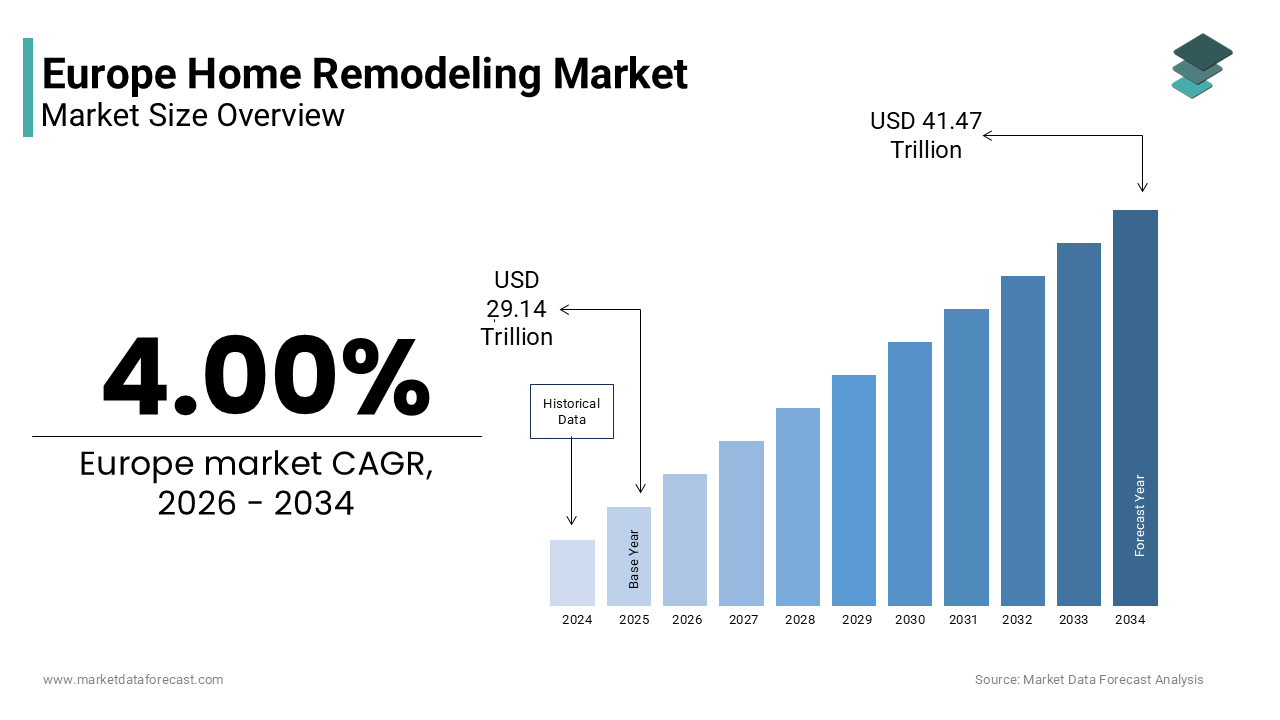
The Europe home remodeling market was valued at USD 29.14 trillion in 2025, is estimated to reach USD 30.30 trillion in 2026, and is projected to reach USD 41.47 trillion by 2034, growing at a CAGR of 4.00% during the forecast period from 2026 to 2034. The growth of the European home remodeling market is driven by the aging housing stock, stringent energy efficiency regulations, and increasing demand for modern, sustainable living spaces. Rising adoption of smart home technologies, government incentives for green renovations, and evolving lifestyle needs such as remote work setups are further fueling market growth. Additionally, the push toward energy-efficient upgrades and compliance with environmental standards continues to strengthen remodeling activities across Europe.
Key Market Trends
- Increasing demand for energy-efficient renovations driven by EU climate policies and sustainability goals
- Rising adoption of smart home technologies and automation systems in remodeling projects
- Growing popularity of DIY home improvement projects supported by online tutorials and digital platforms
- Expansion of green financing schemes and government incentives for sustainable housing upgrades
- Strong focus on modernizing kitchens, bathrooms, and living spaces to enhance property value
Segmental Insights
- Based on project type, the professional segment was the largest and held a significant share of the Europe home remodeling market in 2025. The segment’s dominance is attributed to the complexity of renovation projects, regulatory compliance requirements, and the need for skilled labor and high-quality workmanship.
- Based on distribution channel, the offline segment accounted for a major share of the Europe home remodeling market in 2025. This is driven by the need for physical inspection of materials, immediate availability, and strong relationships between contractors and local suppliers.
Regional Insights
The Europe home remodeling market is witnessing steady growth across major economies, supported by government-backed renovation programs, sustainability initiatives, and increasing housing modernization needs.
- Germany was the largest contributor to the European home remodeling market in 2025, driven by its large aging housing stock, strong regulatory framework, and high investments in energy-efficient renovations.
- The United Kingdom and France continue to perform well, fueled by high property renovation rates, government incentives, and strong consumer interest in home improvement and sustainability.
Competitive Landscape
The Europe home remodeling market is characterized by a highly fragmented competitive environment, with the presence of global construction material manufacturers, regional contractors, and local service providers. Leading players are focusing on sustainable materials, smart home integration, and digital tools for design and project management. Strategic collaborations, product innovation, and the expansion of eco-friendly solutions are strengthening market competition. Prominent players in the Europe home remodeling market include Vinci SA, Bouygues Construction, Skanska AB, Saint-Gobain, Kingspan Group, Kingfisher plc, Leroy Merlin, OBI Group Holding, Hornbach Holding AG, Bauhaus AG, VELUX Group, Geberit AG, GROHE AG, IKEA, and Roca Sanitario S.A.
Europe Home Remodeling Market Size
The Europe home remodeling market size was valued at USD 29.14 trillion in 2025 and is anticipated to reach USD 30.30 trillion in 2026 from USD 41.47 trillion by 2034, growing at a CAGR of 4.00% during the forecast period from 2026 to 2034.
Home remodeling refers to changing the structure, layout, or function of a room or an entire house. This market involves a wide range of activities from minor cosmetic updates to major structural modifications aimed at enhancing functionality aesthetics and energy efficiency. The market is driven by the need to modernize aging housing stock adapt living spaces to changing lifestyle requirements and comply with evolving environmental standards. According to the European Commission, approximately 85% of the total building stock in the European Union was constructed before 2001, while roughly 75% of existing buildings are currently energy inefficient, representing a massive market for modernization. As per the European Commission buildings are responsible for 40 percent of energy consumption and 36 percent of greenhouse gas emissions in the EU which has led to stringent regulatory frameworks promoting energy efficient renovations. The Renovation Wave strategy aims to at least double the annual energy renovation rate of buildings by 2030 further stimulating demand for remodeling services. Additionally the shift towards remote work has increased the demand for dedicated home office spaces and improved indoor environments. The market is characterized by a fragmented landscape of contractors suppliers and design professionals catering to diverse consumer preferences. Regulatory incentives such as tax credits and subsidies for energy efficient upgrades play a crucial role in shaping market dynamics. The integration of smart home technologies and sustainable materials is becoming increasingly prevalent reflecting consumer awareness of environmental impact and technological convenience. This sector serves as a vital component of the construction industry contributing significantly to economic activity and employment across the region.
MARKET DRIVERS
Stringent energy efficiency regulations and sustainability mandates
The implementation of rigorous energy efficiency regulations and sustainability mandates by European governments is a key force behind the expansion of the Europe home remodeling market. The European Union has set ambitious climate goals requiring significant reductions in carbon emissions from the building sector. According to the European Commission, the 2024 Energy Performance of Buildings Directive mandates that all new buildings must be zero-emission buildings (ZEB) by 2030, phasing out on-site fossil fuel emissions entirely. This regulatory pressure compels homeowners to undertake remodeling projects such as installing insulation upgrading windows and replacing heating systems to meet compliance standards. As per the IEA's 2025 Efficiency Report, deep retrofitting of existing residential buildings can reduce energy consumption by up to 80%, with homeowners in some regions saving over $400 per square metre in lifetime energy costs. Many member states offer substantial subsidies and tax deductions for energy efficient renovations further driving demand. For instance Germany’s KfW bank provides low interest loans and grants for energy efficient refurbishment projects. The growing awareness of climate change and environmental responsibility among consumers also motivates voluntary upgrades. Homeowners are increasingly seeking sustainable materials and technologies to reduce their carbon footprint. The alignment of personal values with regulatory requirements creates a robust demand for remodeling services. This driver ensures a steady flow of projects focused on energy optimization and sustainability. The long term benefits of reduced operational costs and increased property value further reinforce the decision to remodel. Thus, the regulatory landscape serves as a powerful engine for market growth.
Aging housing stock requiring modernization and maintenance
The vast inventory of aging residential properties across the region necessitates continuous modernization and maintenance, which accelerates the growth of the Europe home remodeling market. Consequently, this creates substantial demand for home remodeling services. A large proportion of the European housing stock was built several decades ago and suffers from outdated infrastructure deteriorating materials and inefficient layouts. According to Eurostat, roughly 85% of the EU's building stock was constructed before 2001, and nearly 45% predates 1970, necessitating a massive scale-up of modern insulation and clean heating systems. These older structures require extensive repairs and upgrades to remain safe comfortable and functional for contemporary living standards. As per the European Construction Industry Federation the average age of buildings in countries like Italy and France exceeds 40 years creating a persistent need for renovation. Homeowners invest in remodeling to address issues such as plumbing leaks electrical hazards and structural weaknesses. Additionally changing demographic trends such as an aging population and smaller household sizes drive the need for adaptable living spaces. Older adults often require accessibility modifications such as walk in showers and wider doorways to age in place safely. Younger generations prefer open plan layouts and modern amenities that older homes typically lack. The desire to preserve historical character while incorporating modern conveniences also fuels remodeling activities in heritage rich cities. This structural necessity ensures a consistent baseline of demand for remodeling services regardless of economic fluctuations. The sheer volume of older properties guarantees a long term pipeline of renovation projects.
MARKET RESTRAINTS
High costs and limited access to financing for homeowners
The substantial financial burden associated with home remodeling projects and the limited availability of affordable financing options are slowing down the expansion of the Europe home remodeling market. Remodeling involves considerable expenses for materials labor permits and design services which can be prohibitive for many households. According to the European Central Bank rising inflation and interest rates have increased the cost of borrowing making loans for home improvements more expensive. As per Eurostat, the household saving rate in the euro area remains elevated at 14.4% as of late 2025; however, the ECB notes that while savings are high, uncertainty and precautionary motives continue to restrain actual discretionary spending on large-scale renovations. Many homeowners hesitate to undertake large scale projects due to uncertainty about return on investment and potential budget overruns. Small and medium sized enterprises in the construction sector also face challenges in securing working capital to fund projects leading to delays and reduced capacity. The complexity of navigating subsidy applications and grant processes further discourages participation particularly among less financially literate consumers. In some regions the lack of transparent pricing and reliable cost estimates creates distrust and hesitation. Economic instability and fear of job loss prompt households to prioritize essential expenditures over home improvements. The high upfront costs combined with uncertain economic outlooks constrain the willingness of consumers to commit to remodeling projects. This financial barrier limits the market potential especially for middle and lower income households. Without accessible financing solutions the pace of remodeling activity remains subdued.
Shortage of skilled labor and construction professionals
The acute shortage of skilled labor and qualified construction professionals also constrains the growth of the Europe home remodeling market. The construction industry faces a significant gap between the demand for skilled workers and the available supply impacting project timelines and quality. According to the European Construction Industry Federation (FIEC), approximately 56% of construction firms cite the shortage of skilled workers as a major operational risk, with recruitment challenges remaining a top priority across nearly all EU Member States. This labor shortage is exacerbated by an aging workforce and a lack of young entrants into vocational training programs. As per the European Centre for the Development of Vocational Training the mismatch between skills provided by education systems and industry needs contributes to the scarcity of qualified carpenters plumbers electricians and masons. The inability to secure reliable labor leads to project delays increased costs and compromised workmanship. Homeowners often experience long wait times for contractors to become available discouraging them from initiating projects. The competition for skilled workers drives up labor costs further inflating the overall price of remodeling. In some regions the informal economy attracts workers offering lower prices but lacking proper insurance and guarantees posing risks to consumers. The lack of standardized certification and recognition of qualifications across borders hinders the mobility of labor within the EU. Addressing this shortage requires significant investment in training and education which takes time to yield results. Until the labor supply improves the market will continue to face capacity constraints.
MARKET OPPORTUNITIES
Integration of smart home technologies and automation
The increasing integration of smart home technologies and automation systems creates new paths for expansion in the Europe home remodeling market. Consumers are increasingly seeking connected devices that enhance convenience security and energy management within their homes. According to the European Smart Home Market Report the adoption of smart home devices is expected to grow steadily as prices decrease and user friendliness improves. Remodeling projects provide an ideal opportunity to install integrated systems such as smart lighting heating controls security cameras and voice activated assistants. As per sources, the revenue in the smart home segment in Europe is projected to reach billions of euros in the coming years driven by consumer demand for enhanced living experiences. Homeowners are willing to invest in technology that offers remote monitoring and control of household functions. The compatibility of smart devices with existing infrastructure allows for seamless upgrades during renovations. Energy management systems that optimize heating and cooling based on occupancy patterns appeal to environmentally conscious consumers. The ability to personalize home environments through automated scenarios adds value to properties. Contractors and designers who offer expertise in smart home integration can differentiate themselves in a competitive market. Partnerships with technology providers enable the offering of comprehensive solutions. The trend towards digitalization in daily life supports the sustained adoption of smart home features. This technological evolution opens new revenue streams for remodeling professionals. It transforms traditional renovations into modern intelligent living spaces.
Government incentives and green financing schemes
The availability of government incentives and green financing schemes offers strong potential for the Europe home remodeling market. Various European governments have introduced financial support mechanisms to encourage energy efficient renovations and sustainable building practices. According to the European Commission the NextGenerationEU recovery instrument allocates significant funds for building renovation initiatives across member states. These funds are distributed through grants low interest loans and tax credits aimed at reducing the financial burden on homeowners. Leading financial institutions like the European Investment Bank are increasingly utilizing dedicated climate-focused debt instruments to fund massive sustainability projects, which in turn helps national governments provide the capital needed for energy-efficient housing upgrades. Programs such as France’s MaPrimeRénov and Italy’s Superbonus scheme have successfully stimulated demand for energy efficient upgrades. These incentives lower the effective cost of remodeling making it more accessible to a broader range of consumers. The clear eligibility criteria and streamlined application processes enhance participation rates. Financial institutions are developing specialized products to support green renovations leveraging these government backing. The emphasis on sustainability aligns with consumer values and regulatory goals creating a favorable environment for market expansion. Remodeling companies that assist clients in navigating these financial opportunities can gain a competitive advantage. The long term commitment of governments to climate goals ensures the continuity of these support mechanisms. This financial encouragement drives higher volumes of remodeling activity. It accelerates the transition towards a more sustainable building stock.
MARKET CHALLENGES
Supply chain disruptions and material price volatility
Supply chain disruptions and the volatility of material prices are significant challenges to the Europe home remodeling market. The global nature of construction material supply chains makes them vulnerable to geopolitical tensions trade restrictions and logistical bottlenecks. According to the European Construction Industry Federation the prices of key materials such as timber steel and copper have experienced significant fluctuations in recent years. These price increases directly impact the cost of remodeling projects leading to budget overruns and contract disputes. As per Eurostat producer prices for construction materials have risen sharply affecting the profitability of contractors and the affordability for homeowners. Delays in the delivery of essential components such as windows doors and fixtures prolong project timelines causing inconvenience to clients. The unpredictability of supply availability forces contractors to maintain higher inventory levels tying up capital. Shortages of specific materials can halt projects entirely leading to dissatisfaction and potential legal issues. The reliance on imports from outside Europe exposes the market to currency exchange rate risks. Manufacturers struggle to predict demand and adjust production schedules accordingly. Homeowners face uncertainty in planning and budgeting due to these volatile conditions. The lack of transparency in pricing and availability complicates decision making. Mitigating these risks requires flexible sourcing strategies and strong supplier relationships. However the inherent instability of global supply chains remains a persistent challenge. It undermines confidence in the remodeling process.
Regulatory complexity and permitting delays
The complexity of regulatory frameworks and the lengthy permitting processes associated with home remodeling projects pose serious obstacles in the Europe home remodeling market. Each country and often each municipality has distinct building codes zoning laws and heritage preservation regulations that must be navigated. According to the European Commission administrative burdens and bureaucratic hurdles are frequently cited as obstacles to efficient construction and renovation activities. Obtaining necessary permits for structural changes facade modifications or energy system upgrades can be time consuming and costly. Global economic research from international financial organizations suggests that intricate local regulations and permit requirements create additional financial overhead and extend the timeframes for completing residential improvements. In historic city centers strict conservation rules limit the scope of permissible renovations requiring specialized approvals and expert consultations. The lack of harmonization across European jurisdictions complicates operations for multinational remodeling firms. Inconsistent interpretation of regulations by local authorities creates uncertainty and potential for disputes. Homeowners often lack the knowledge to navigate these regulatory landscapes requiring professional assistance which adds to expenses. Delays in permit approval can disrupt scheduling and increase labor costs. The rigidity of some regulations may hinder the adoption of innovative materials and techniques. Streamlining these processes is essential for improving market efficiency. However the decentralized nature of governance in Europe makes standardization difficult. This regulatory friction slows down the pace of remodeling activity. It creates barriers to entry for smaller players.
REPORT COVERAGE
| REPORT METRIC | DETAILS |
| Market Size Available | 2025 to 2034 |
| Base Year | 2025 |
| Forecast Period | 2026 to 2034 |
| CAGR | 4.00% |
| Segments Covered | By Project Type, Distribution Channel, Application and Region |
| Various Analyses Covered | Global, Regional, & Country Level Analysis; Segment-Level Analysis, Drivers, Restraints, Opportunities, Challenges, PESTLE Analysis, Porter’s Five Forces Analysis, Competitive Landscape, Analyst Overview of Investment Opportunities |
| Regions Covered | UK, France, Spain, Germany, Italy, Russia, Sweden, Denmark, Switzerland, the Netherlands, Turkey, the Czech Republic, and the Rest of Europe |
| Key Market Players | Vinci SA, Bouygues Construction, Skanska AB, Saint-Gobain, Kingspan Group, Kingfisher plc, Leroy Merlin, OBI Group Holding, Hornbach Holding AG, Bauhaus AG, VELUX Group, Geberit AG, GROHE AG, IKEA, and Roca Sanitario S.A. |
SEGMENTAL ANALYSIS
By Project Type Insights
In 2025, the professional segment held the majority share of 65.1% of the Europe home remodeling market. This prominence of the segment is credited to the complexity of modern renovation projects the need for regulatory compliance and the increasing preference for high quality craftsmanship that requires specialized skills and tools. A top factor for the dominance of the professional segment is the increasing complexity of structural and technical renovations which require specialized expertise and certification. Modern home remodeling often involves intricate electrical wiring plumbing systems and structural modifications that must adhere to strict building codes and safety standards. According to the European Construction Industry Federation complex renovations involving load bearing walls or major system upgrades necessitate licensed professionals to ensure structural integrity and legal compliance. As per Eurostat a significant portion of the European housing stock consists of older buildings that require specialized knowledge to renovate without compromising their historical or structural value. Homeowners lack the technical skills to safely execute these tasks leading them to hire qualified contractors. The integration of smart home technologies and energy efficient systems such as heat pumps and solar panels further increases the technical demands of remodeling projects. Professional contractors possess the necessary training and equipment to install these advanced systems correctly. The risk of costly errors or safety hazards associated with DIY attempts in complex projects discourages homeowners from undertaking such tasks themselves. Consequently the demand for professional services remains robust particularly for large scale renovations. The assurance of warranty and insurance coverage provided by professional firms also adds value. This reliance on expertise ensures that the professional segment maintains its leading position in the market. Strict regulatory requirements and the demand for quality assurance significantly contribute to the dominance of the professional segment in the Europe home remodeling market. European countries have stringent building regulations regarding energy efficiency fire safety and accessibility which must be met during any major renovation. Trends observed by digital media analysts indicate that a vast audience of homeowners now utilizes social media and video sharing platforms to learn basic maintenance skills, which has increased public participation in minor cosmetic house projects. As per the International Organization for Standardization adherence to quality standards such as ISO 9001 is increasingly expected by homeowners seeking reliable and durable remodeling outcomes. Professional contractors are well versed in navigating the permitting process ensuring that all legal requirements are met efficiently. This reduces the risk of fines or forced reversals of unauthorized work. Homeowners prioritize quality assurance to protect their property value and avoid future maintenance costs. Professional firms offer guarantees on their workmanship providing peace of mind that DIY projects cannot match. The complexity of coordinating multiple trades such as electricians plumbers and carpenters is better managed by professional project managers. This coordination ensures timely completion and minimizes disruptions. The growing emphasis on sustainable building practices also requires professional expertise to source and install eco friendly materials correctly. These factors collectively drive homeowners to choose professional services over DIY options. The trust in professional execution sustains the segment's market leadership.
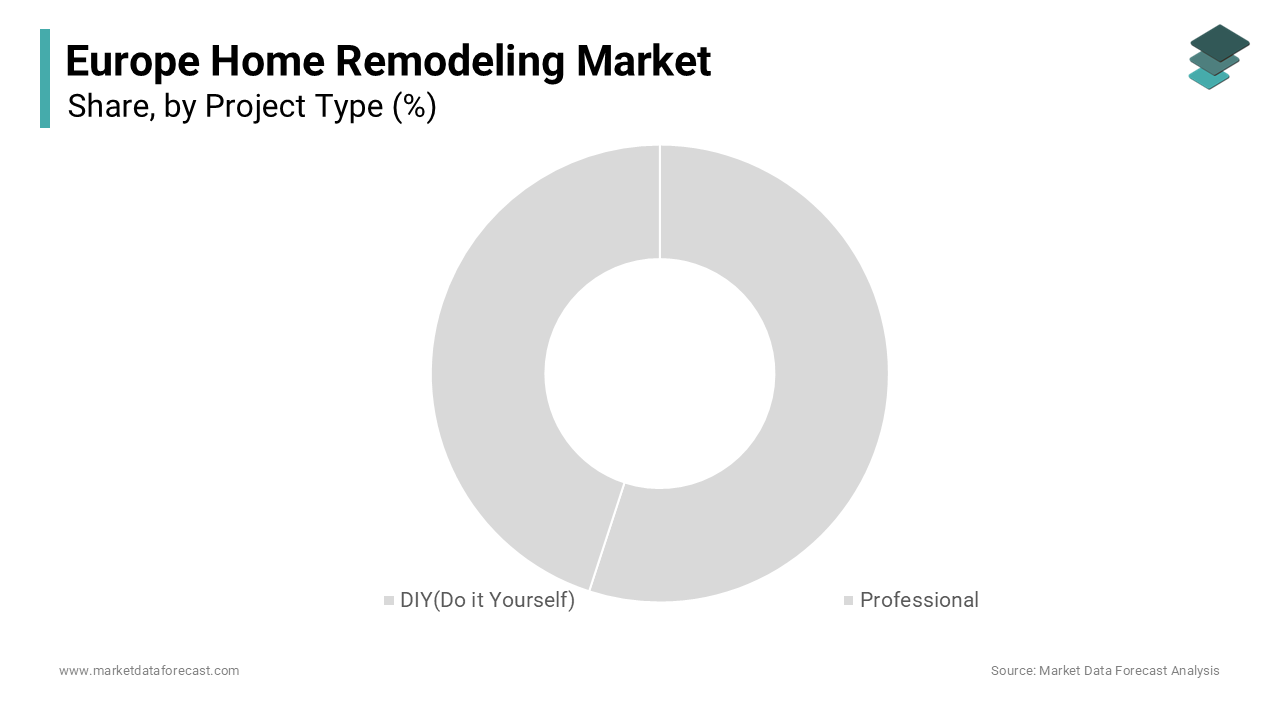
The DIY segment is likely to experience the fastest CAGR of 5.8% during the forecast period due to the rising popularity of home improvement content online the availability of user friendly tools and the desire for cost savings among homeowners. Moreover, the pervasive influence of digital media and the widespread availability of online tutorials are primary catalysts for the rapid growth of the DIY segment in the Europe home remodeling market. Social media platforms and video sharing sites have democratized access to home improvement knowledge making it easier for homeowners to learn new skills. These resources provide step by step instructions visual demonstrations and troubleshooting advice reducing the perceived difficulty of remodeling tasks. Homeowners feel empowered to tackle projects such as painting tiling and furniture assembly without professional help. The community aspect of online forums allows users to share experiences and solutions fostering a supportive environment for DIY enthusiasts. Retailers have capitalized on this trend by offering workshops and online guides further encouraging self service. The convenience of accessing information anytime and anywhere accelerates the adoption of DIY practices. This digital empowerment lowers the barrier to entry for novice remodelers. The continuous flow of inspirational content drives frequent small scale projects. This cultural shift towards self sufficiency ensures sustained growth for the DIY segment. The strong desire for cost savings and economic prudence among European homeowners is accelerating the adoption of DIY remodeling projects. In an environment of rising living costs and inflation many households seek ways to reduce expenditure on home improvements. DIY allows homeowners to save on labor fees which can account for a significant portion of total project costs. The availability of affordable tools and materials from large retail chains makes DIY financially accessible. Homeowners can control the budget more effectively by purchasing materials directly and working at their own pace. The satisfaction of completing a project personally also adds non monetary value. Economic uncertainty encourages a cautious approach to spending making DIY an attractive option for minor upgrades. The ability to spread costs over time by doing work in phases further appeals to budget conscious consumers. This financial motivation drives the consistent growth of the DIY segment. The trend is particularly strong among younger demographics who are resourceful and tech savvy. These economic factors ensure that DIY remains a rapidly expanding sector.
By Distribution Channel Insights
The offline distribution channel segment led the Europe home remodeling market and captured a substantial share in 2025. Factors such as the tactile nature of building materials the need for immediate availability and the established relationships between contractors and local suppliers are contributing to the leading position of this segment. A key driver for the dominance of the offline channel is the consumer preference for tactile evaluation of materials and the need for immediate availability during construction projects. Homeowners and contractors often need to physically inspect materials such as tiles flooring and countertops to assess quality color and texture before purchase. Offline stores allow for immediate pickup of materials which is essential for maintaining project timelines and avoiding delays. Construction schedules often require just in time delivery of supplies which local hardware stores and specialized dealers can provide more reliably than online retailers. The ability to return or exchange items easily in person also adds convenience. Professional contractors frequently rely on local suppliers for bulk orders and consistent supply. The personal interaction with sales staff provides expert advice and recommendations tailored to specific project needs. This hands-on experience builds trust and confidence in the purchase. The immediacy and tangibility offered by offline channels make them indispensable for many remodeling tasks. This practical advantage sustains the leading position of the offline segment. The strength of established relationships and professional networks between contractors and offline suppliers significantly contributes to the dominance of this distribution channel. Professional remodelers often have long standing accounts with local distributors allowing them to access trade discounts credit terms and priority service. Offline channels enable face to face negotiations and personalized service that online platforms cannot replicate. Suppliers often provide technical support and product training to contractors strengthening these partnerships. The trust built over years of collaboration ensures consistent quality and reliability. Contractors prefer suppliers who understand their specific needs and can offer customized solutions. Local suppliers are also better equipped to handle large and heavy items that are difficult to ship online. The logistical advantages of local delivery and pickup reduce transportation costs and environmental impact. These professional networks create a loyal customer base that consistently chooses offline channels. The integration of offline stores into the professional workflow ensures their continued relevance. This ecosystem of trust and convenience maintains the offline segment's leadership.
The online distribution channel segment is on the rise and is expected to be the fastest growing segment in the market by witnessing a CAGR of 8.5% between 2026 and 2034 owing to the increasing penetration of e commerce the convenience of home delivery and the wide variety of products available digitally. In addition, the unparalleled convenience and extensive product variety offered by online platforms are primary drivers for the rapid growth of this distribution channel. Consumers appreciate the ability to browse thousands of products compare prices and read reviews from the comfort of their homes. The ability to filter search results by specifications style and price saves time and effort. Online retailers often offer detailed product descriptions images and virtual reality tools to help visualize items in space. Home delivery services eliminate the need for transporting heavy materials reducing physical strain and logistical hassle. The ease of returning items through prepaid labels also enhances the shopping experience. The availability of customer reviews provides social proof and helps in decision making. Online platforms operate 24/7 offering flexibility for busy consumers. The integration of augmented reality apps allows users to preview products in their homes. These conveniences attract a growing number of DIY enthusiasts and even professionals. The digital shift in consumer behavior ensures sustained growth for the online channel. The competitive pricing and frequent promotional offers available on online platforms are accelerating the adoption of this distribution channel in the home remodeling market. Online retailers often have lower overhead costs compared to physical stores allowing them to offer more attractive prices. Consumers can easily compare prices across multiple vendors ensuring they get the best value for money. Discount codes cashback offers and bundle deals further incentivize online purchases. The ability to track price history helps shoppers time their buys for maximum savings. Online marketplaces often feature third party sellers increasing competition and driving down prices. The availability of financing options such as buy now pay later schemes makes larger purchases more affordable. These financial incentives appeal to budget conscious homeowners and DIYers. The ease of accessing global brands and niche products at competitive rates expands consumer choices. The dynamic pricing models used by online retailers ensure constant attractiveness. This cost advantage drives the rapid expansion of the online segment. The focus on value and affordability sustains this growth trajectory.
By Application Insights
The kitchen and bathroom segment was the largest segment in the Europe home remodeling market and accounted for a 35.7% share in 2025. This dominance of the segment is driven by the high frequency of updates in these high traffic areas the desire for modern aesthetics and the functional importance of these rooms. The primary driver for the dominance of the kitchen and bathroom segment is the high frequency of updates and modernization efforts in these essential living spaces. Kitchens and bathrooms are subject to heavy daily use leading to wear and tear that necessitates regular refurbishment. Research indicates that property owners typically undertake major updates to their primary service rooms once every decade or two to ensure that equipment remains reliable and the environment remains sanitary. As per Houzz kitchens and bathrooms are the most popular rooms for remodeling projects due to their impact on daily life and property value. Outdated fixtures appliances and layouts often fail to meet contemporary standards of convenience and efficiency. Homeowners seek to upgrade to energy efficient appliances water saving fixtures and ergonomic designs. The desire for open plan kitchens and spa like bathrooms reflects current lifestyle trends. These rooms are central to social interactions and personal relaxation making their appearance and function highly prioritized. The availability of diverse design options and materials encourages frequent updates. The potential for significant return on investment also motivates homeowners to invest in these areas. The emotional connection to these spaces drives willingness to spend. This consistent demand for modernization ensures the segment's leading position. The focus on improving quality of life sustains high renovation activity. Besides these, the significant impact of kitchen and bathroom renovations on property value and overall home aesthetics significantly contributes to the dominance of this segment. These rooms are key selling points for real estate and heavily influence buyer perceptions. Valuation studies from major lending institutions suggest that modernizing essential facilities can meaningfully enhance the total market worth of a residence compared to similar properties with original fixtures. As per Rightmove properties with updated kitchens and bathrooms sell faster and at higher prices than those with outdated facilities. Homeowners invest in these renovations to enhance the visual appeal and marketability of their properties. Contemporary designs high quality materials and smart features attract potential buyers. The aesthetic transformation of these spaces creates a sense of luxury and comfort. Upgrading to stylish cabinets countertops and fittings improves the overall look of the home. The focus on cohesive design themes extends to lighting flooring and accessories. Real estate agents often recommend these upgrades to maximize sale potential. The psychological benefit of living in a modern and beautiful space also drives demand. Homeowners take pride in these showcase areas. The combination of financial return and aesthetic satisfaction makes kitchen and bathroom remodeling a top priority. This dual benefit ensures the segment remains the largest in the market.
The windows and doors segment is expected to exhibit a noteworthy CAGR of 7.2% over the forecast period. This quick surge of the segment is supported by stringent energy efficiency regulations the need for improved insulation and the aesthetic enhancement of building facades. The implementation of strict energy efficiency regulations and the urgent need for improved thermal insulation are primary drivers for the rapid growth of the windows and doors segment. Older windows and doors are major sources of heat loss in residential buildings contributing to high energy bills. Technical guidelines from European energy agencies indicate that upgrading from outdated single-pane glass to modern high-performance units significantly minimizes the amount of warmth that escapes through a building's envelope. As per the International Energy Agency upgrading windows and doors is one of the most effective measures for improving the energy performance of existing buildings. Government incentives and subsidies for energy efficient renovations encourage homeowners to replace old frames with high performance alternatives. Modern windows and doors offer superior insulation soundproofing and security features. The push towards nearly zero energy buildings mandates higher standards for building envelopes. Homeowners are increasingly aware of the long term savings associated with energy efficient upgrades. The availability of advanced materials such as uPVC aluminum and composite frames provides durable and low maintenance options. The reduction of carbon footprint aligns with environmental goals. These regulatory and economic factors drive substantial demand. The focus on sustainability ensures continued growth. This segment benefits directly from green renovation initiatives. The desire for aesthetic enhancement and improved curb appeal is accelerating the adoption of new windows and doors in the Europe home remodeling market. Windows and doors play a crucial role in the architectural character and visual appeal of a home. According to the European Fenestration Association homeowners often replace windows and doors to update the exterior look of their properties. As per Houzz large windows and sliding glass doors are popular choices for creating bright and airy interior spaces that connect with the outdoors. Modern designs offer sleek profiles and expansive glass areas that enhance natural light and views. The customization options in terms of color finish and style allow homeowners to personalize their homes. Upgrading to contemporary styles can modernize older properties significantly. The improvement in natural lighting positively impacts indoor well being. The integration of smart features such as automated blinds and sensors adds convenience. The visual transformation provided by new windows and doors offers immediate satisfaction. The increase in property value through improved aesthetics is another motivator. The trend towards biophilic design supports the installation of larger glazing elements. These aesthetic and functional benefits drive the rapid growth of the segment. The focus on visual appeal sustains market momentum.
REGIONAL ANALYSIS
Germany Home Remodeling Market Analysis
Germany dominated the Europe home remodeling market and occupied a 22.3% share in 2025. This supremacy of the German market is attributed to its large aging housing stock strong regulatory framework for energy efficiency and high disposable income levels. The German government has implemented aggressive energy efficiency targets through the Building Energy Act which mandates regular upgrades to heating systems and insulation. According to the Federal Ministry for Economic Affairs and Climate Action billions of euros are allocated annually for building renovation subsidies. As per Destatis the majority of residential buildings in Germany were constructed before 1979 requiring significant modernization to meet current standards. The high cost of energy has further motivated homeowners to invest in energy saving remodeling projects. The presence of a robust construction industry and skilled labor force supports efficient project execution. German consumers prioritize quality and sustainability driving demand for premium materials and technologies. The KfW bank offers favorable loans for energy efficient renovations making projects financially viable. The cultural emphasis on environmental responsibility reinforces the adoption of green remodeling practices. The stable economic environment provides confidence for long term investments in property. The demand for smart home integration is also rising among tech savvy homeowners. The focus on barrier free living for an aging population drives accessibility renovations. These factors collectively sustain Germany’s position as the largest market. The continuous policy support ensures steady growth. The strong industrial base facilitates innovation in building materials.
United Kingdom Home Remodeling Market Analysis
The United Kingdom followed closely behind in the Europe home remodeling market and secured a 18.7% share in 2025. This growth of the UK market is propelled by a vibrant housing market high property turnover and a strong culture of home improvement. The UK has a significant number of older Victorian and Edwardian properties that require ongoing maintenance and modernization. According to the English Housing Survey, a significant portion of the housing stock has poor energy efficiency, characterized by uninsulated walls or lofts and reliance on conventional heating systems. As per the Federation of Master Builders home remodeling is a key strategy for homeowners to increase property value in a competitive real estate market. The government’s Green Homes Grant scheme although discontinued has raised awareness about energy efficiency. The prevalence of DIY culture in the UK supports a robust market for materials and tools. Homeowners frequently undertake cosmetic updates such as painting and flooring. The rise of remote work has increased demand for home office conversions. The shortage of new housing supply encourages renovation of existing properties. The strong presence of retail chains and online platforms facilitates easy access to products. The emotional attachment to homes drives investment in personalization. The focus on extending living space through loft and basement conversions is popular. These dynamics maintain the UK’s strong position. The resilient housing market supports consistent demand. The cultural inclination towards home improvement sustains activity.
France Home Remodeling Market Analysis
France maintains a notable share of the Europe home remodeling market due to extensive government incentives for energy renovation and a large stock of historic buildings. The French government’s MaPrimeRénov scheme provides substantial financial aid for energy efficient renovations driving significant market activity. According to the French Ministry of Ecological Transition millions of households have benefited from these grants to upgrade insulation and heating systems. As per INSEE the aging building stock in France requires continuous maintenance and modernization to preserve heritage and improve comfort. The strict regulations on preserving historical facades in cities like Paris create a niche for specialized remodeling services. Homeowners are increasingly investing in sustainable materials and renewable energy systems. The cultural appreciation for aesthetics drives demand for high quality interior design. The rise in energy prices has accelerated the adoption of heat pumps and solar panels. The fragmented nature of the construction industry offers opportunities for small and medium enterprises. The focus on improving living conditions in rural areas is also growing. The government’s commitment to carbon neutrality supports long term market growth. The strong artisan tradition ensures high craftsmanship standards. These factors contribute to the steady expansion of the market. The regulatory support is a key driver. The emphasis on heritage preservation adds complexity and value.
Italy Home Remodeling Market Analysis
Italy expanded steadily in the Europe home remodeling market owing to the Superbonus tax incentive scheme and the need to retrofit older seismic vulnerable structures. The Superbonus 110 percent scheme although modified has stimulated a wave of deep energy renovations and seismic upgrades. According to the Italian National Institute of Statistics the majority of buildings in Italy were constructed before 1970 lacking modern safety and efficiency standards. As per the Italian Construction Confederation the focus on seismic retrofitting is critical due to the country’s geological risks. Homeowners are investing in structural reinforcements alongside aesthetic improvements. The rich architectural heritage requires specialized restoration techniques. In addition, the demand for modernizing kitchens and bathrooms remains high. The economic recovery post pandemic has boosted consumer confidence in home improvements. Also, the availability of skilled artisans supports high quality renovations. The focus on energy independence drives the installation of solar panels and efficient boilers. The cultural importance of home ownership encourages long term investment. The government’s continued support for renovation ensures market stability. The integration of smart technologies is gaining traction. These elements sustain Italy’s market position. The unique regulatory landscape shapes project types. The emphasis on safety and efficiency drives demand.
Netherlands Home Remodeling Market Analysis
The Netherlands is predicted to grow significantly in the Europe home remodeling market over the forecast period due to its progressive sustainability goals high housing density and strong focus on energy transition. Moreover, the Dutch government has set ambitious targets for reducing natural gas usage driving the replacement of gas boilers with heat pumps. According to Statistics Netherlands a significant portion of the housing stock requires insulation upgrades to meet energy label requirements. The Dutch Construction Industry Federation (Bouwend Nederland) notes that strict environmental regulations and the need for sustainable housing have shifted the industry's focus toward the deep renovation and repurposing of existing urban structures. Homeowners are investing in sustainable materials and circular construction principles. The high population density in urban areas drives vertical expansions and attic conversions. The strong DIY culture supports the market for tools and materials. The emphasis on water management and flood resilience influences exterior remodeling. The government subsidies for sustainable renovations encourage participation. The high level of digital literacy supports the adoption of smart home technologies. The focus on compact and efficient living spaces drives innovative design solutions. The collaborative approach between residents and municipalities facilitates large scale renovation projects. These factors position the Netherlands as a leader in sustainable remodeling. The regulatory push for gas free neighborhoods is a key driver. The focus on innovation sustains market growth.
Top Players in the Europe Home Remodeling Market
Saint Gobain
Saint Gobain is a global leader in the construction materials sector with a significant presence in the Europe home remodeling market. The company provides essential products such as insulation glass and interior solutions that are critical for energy efficient renovations. Saint Gobain contributes to the global market by developing sustainable building materials that reduce carbon footprints and enhance living comfort. Recent actions to strengthen its market position include the acquisition of specialized insulation manufacturers to expand its product portfolio. The company has also invested heavily in digital platforms that allow homeowners and contractors to visualize and plan renovation projects easily. Saint Gobain actively promotes circular economy principles by recycling construction waste and producing eco friendly materials. Their commitment to sustainability aligns with European regulatory goals driving demand for their green solutions. The company collaborates with architects and designers to innovate new applications for existing materials. By focusing on lightweight and high performance products Saint Gobain addresses the needs of modern retrofitting projects. These strategic initiatives reinforce its leadership in providing comprehensive remodeling solutions. The emphasis on customer centric innovation ensures continued relevance in a competitive landscape.
Kingspan Group
Kingspan Group is a prominent player in the Europe home remodeling market specializing in high performance insulation and building envelope solutions. The company plays a crucial role in helping homeowners achieve energy efficiency targets through advanced thermal management technologies. Kingspan contributes to the global market by setting standards for sustainable construction and net zero carbon buildings. Recent actions to strengthen its market position include the expansion of its manufacturing facilities across Europe to meet growing demand. The company has launched innovative insulated panels that offer superior thermal performance and ease of installation for retrofitting projects. Kingspan actively engages in research and development to create materials with lower embodied carbon. Their digital tools provide accurate energy modeling helping customers make informed decisions about insulation upgrades. The company partners with government bodies to support national renovation strategies and compliance with building codes. Kingspan emphasizes safety and quality ensuring that its products meet rigorous international standards. By focusing on energy transition Kingspan positions itself as a key enabler of sustainable home improvements. The integration of smart sensors into insulation products further enhances value proposition. This focus on innovation and sustainability drives long term growth.
Velux Group
Velux Group is a leading provider of roof windows and skylights with a strong influence on the Europe home remodeling market. The company specializes in bringing natural light and fresh air into homes which is a key aspect of modern renovation projects. Velux contributes to the global market by promoting healthy indoor environments and sustainable living practices. Recent actions to strengthen its market position include the introduction of solar powered roof windows that enhance energy efficiency and convenience. The company has expanded its service offerings to include professional installation and maintenance packages for homeowners. Velux actively campaigns for the benefits of daylighting in residential spaces raising consumer awareness. Their products are designed to integrate seamlessly with smart home systems allowing remote control and automation. The company collaborates with architects to develop innovative solutions for attic conversions and extensions. Velux prioritizes sustainability by using recyclable materials and optimizing production processes. By focusing on user experience and environmental responsibility Velux maintains a strong brand reputation. The emphasis on health and well being resonates with contemporary consumer values. This strategic alignment ensures sustained demand for their products in the remodeling sector.
Top Strategies Used by the Key Market Participants
Key players in the Europe home remodeling market primarily focus on sustainability and energy efficiency to align with stringent regulatory requirements and consumer preferences. Companies are investing heavily in research and development to create eco friendly materials and technologies that reduce carbon emissions. Digital transformation is another major strategy with firms developing online platforms and augmented reality tools to enhance customer engagement and project visualization. Strategic acquisitions and partnerships enable companies to expand their product portfolios and geographic reach efficiently. Emphasis on circular economy principles drives the adoption of recycling programs and sustainable sourcing practices. Providers are also enhancing their service offerings by integrating installation and maintenance support to create comprehensive solutions. Customer centric approaches involve personalized consultations and tailored design services to meet specific homeowner needs. These strategies collectively help companies maintain competitive advantages and drive growth in a dynamic market environment focused on sustainability and innovation.
COMPETITIVE LANDSCAPE
The competition in the Europe home remodeling market is characterized by a highly fragmented landscape comprising multinational corporations regional specialists and local contractors. Large material manufacturers compete on product innovation sustainability credentials and brand reputation while leveraging extensive distribution networks. Regional players differentiate themselves through localized expertise customized services and strong relationships with local communities. The market sees intense rivalry in areas such as energy efficient solutions smart home integration and digital customer experiences. Price competition is moderate as consumers increasingly prioritize quality durability and environmental impact over initial cost. Strategic collaborations between manufacturers and installation services are becoming common to offer end to end solutions. The threat of new entrants is low due to high capital requirements and established brand loyalty but digital platforms are lowering barriers for service providers. Regulatory compliance serves as a significant differentiator with companies adhering to strict environmental and safety standards gaining trust. The market is consolidating as larger firms acquire niche innovators to enhance their technological capabilities. This dynamic environment drives continuous improvement and benefits consumers through enhanced product offerings and services.
KEY MARKET PLAYERS
Some of the companies that are playing a dominating role in the Europe home remodeling market include
- Vinci SA
- Bouygues Construction
- Skanska AB
- Saint-Gobain
- Kingspan Group
- Kingfisher plc
- Leroy Merlin
- OBI Group Holding
- Hornbach Holding AG
- Bauhaus AG
- VELUX Group
- Geberit AG
- GROHE AG
- IKEA
- Roca Sanitario SA
MARKET SEGMENTATION
This research report on the Europe Artificial Intelligence in Aviation Market has been segmented and sub-segmented based on the following categories.
By Project Type
- DIY(Do it Yourself)
- Professional
By Distribution Channel
- Online
- Offline
By Application
- Windows and Doors
- Kitchen and Bathroom
- Floor and Roof
- Walls
- Other Application
By Country
- UK
- France
- Spain
- Germany
- Italy
- Russia
- Sweden
- Denmark
- Switzerland
- Netherlands
- Turkey
- Czech Republic
- Rest of Europe
Access the study in MULTIPLE FORMATS
Purchase options starting from
$ 2000
Didn’t find what you’re looking for?
TALK TO OUR ANALYST TEAM
Need something within your budget?
NO WORRIES! WE GOT YOU COVERED!
Call us on: +1 888 702 9696 (U.S Toll Free)
Write to us: sales@marketdataforecast.com