Europe Internet Advertising Market Size, Share, Trends & Growth Forecast Report, Segmented By Type (Mobile, Laptop, Desktop, Tablets, Others), Format, Pricing Model, And Country (UK, France, Spain, Germany, Italy, Russia, Sweden, Denmark, Switzerland, Netherlands, Turkey, Czech Republic & Rest Of Europe) - Industry Analysis From (2026 To 2034)
Europe Internet Advertising Market Report Summary
The Europe internet advertising market size was valued at USD 94.81 billion in 2025, is estimated to reach USD 110.74 billion in 2026, and is projected to reach USD 383.28 billion by 2034, growing at a CAGR of 16.79% during the forecast period. The growth of the Europe internet advertising market is driven by the rapid expansion of digital media consumption, increasing smartphone and internet penetration, and the growing importance of data-driven marketing strategies. Businesses across Europe are increasingly shifting their advertising budgets from traditional media to digital platforms to reach targeted audiences more effectively. The growth of e-commerce, social media engagement, video streaming platforms, and programmatic advertising technologies is further accelerating the demand for internet advertising solutions across the region.
Key Market Trends
- There is an increasing shift of advertising budgets from traditional media to digital platforms such as search engines, social media, and video streaming services.
- The growing dominance of mobile advertising is due to the rising use of smartphones and mobile internet across Europe.
- Expansion of programmatic advertising and artificial intelligence-driven targeting for improved campaign performance.
- The rising popularity of video advertising and influencer marketing across social media platforms.
- Increasing demand for personalized and data-driven advertising strategies to enhance consumer engagement and return on investment.
Segmental Insights
- Based on type, the mobile segment dominated the Europe internet advertising market in 2025. The growth of this segment is driven by the increasing use of smartphones, mobile apps, and mobile-friendly digital content, which enable advertisers to reach consumers more effectively through targeted campaigns.
- Based on format, the search engine advertising segment held the major share of the Europe internet advertising market in 2025. Businesses increasingly rely on search engine marketing to improve online visibility, attract potential customers, and drive website traffic.
- Based on the pricing model, the cost per thousand (CPM) segment led the market with the highest share in 2025. CPM remains widely used for brand awareness campaigns and display advertising across digital platforms.
Regional Insights
- The United Kingdom held the dominant position in the Europe internet advertising market in 2025, supported by a highly developed digital economy, a strong e-commerce sector, and widespread adoption of digital marketing strategies by businesses.
- Germany accounted for the second-largest share of the European internet advertising market in 2025, driven by its strong industrial base, expanding online retail sector, and increasing adoption of digital advertising channels.
- France is expected to account for a prominent share of the market due to its strong creative industry, thriving luxury sector, and growing demand for social media and video advertising formats.
- Italy is predicted to witness a healthy CAGR in the European internet advertising market during the forecast period due to increasing digital transformation among businesses and rising online consumer engagement.
- The Netherlands is anticipated to account for a notable share of the Europe internet advertising market over the forecast period, supported by high internet penetration and strong adoption of digital marketing technologies.
Competitive Landscape
The Europe internet advertising market is highly competitive and dominated by global technology companies and digital advertising platforms offering advanced marketing solutions. Companies are focusing on artificial intelligence-driven advertising technologies, programmatic advertising platforms, and data analytics to enhance targeting and campaign effectiveness. Strategic partnerships with publishers, advertisers, and e-commerce platforms are helping companies expand their digital advertising ecosystems.
Prominent companies operating in the Europe internet advertising market include Google LLC, Meta Platforms, Inc., Amazon.com, Inc., Microsoft Corporation, Alphabet Inc., TikTok Ltd, Snap Inc., Twitter, Inc., LinkedIn Corporation, Adobe Inc., The Trade Desk, Inc., Criteo S.A, Adform A/S, PubMatic, Inc., and Taboola.com Ltd.
Europe Internet Advertising Market Size
The Europe internet advertising market size was calculated to be USD 94.81 billion in 2025 and is anticipated to be worth USD 383.28 billion by 2034, from USD 110.74 billion in 2026, growing at a CAGR of 16.79% during the forecast period.

Internet advertising encompasses the ecosystem of digital promotional activities delivered via connected devices, including search engines, social media platforms, display networks, and video streaming services. This sector functions as the primary engine for commercial communication across the continent, leveraging data analytics to target specific demographics with precision. The operational landscape is uniquely defined by a highly connected populace operating within a stringent regulatory framework designed to protect user privacy. As per Eurostat, households across the European Union have widespread internet access, creating a vast audience for digital campaigns. Furthermore, according to the European Commission, social network usage among individuals is significant, which is establishing these platforms as critical channels for brand engagement. The General Data Protection Regulation imposes rigorous constraints on data collection and processing, which are fundamentally altering how advertisers track user behavior and measure campaign effectiveness. As per the Interactive Advertising Bureau Europe, the shift toward mobile connectivity is profound, with smartphones accounting for the majority of time spent online across major European markets. This environment necessitates a sophisticated approach where compliance, contextual relevance, and cross-border cultural adaptation are paramount for success. The market continues to evolve as businesses migrate budgets from traditional media to digital channels that offer measurable returns and real-time optimization capabilities.
MARKET DRIVERS
Pervasive Mobile Internet Penetration and App Usage
The ubiquitous adoption of mobile devices is a major factor propelling the growth of the European internet advertising market. As per GSMA Intelligence, mobile penetration in Europe is expected to be very high by 2030, with smartphones acting as the principal gateway to the internet for the majority of the population. This device proliferation has led to an explosion in mobile app usage, with users spending significant portions of their day within applications ranging from social media to gaming and productivity tools. Advertisers are compelled to follow this attention shift by allocating substantial budgets to mobile-first formats, such as in-app display ads, rewarded video, and interactive rich media. The ability of mobile devices to provide location-based data enables hyperlocal targeting, allowing retailers to serve promotions to consumers when they are in proximity to physical stores. This immediacy and relevance drive higher conversion rates compared to desktop advertising. Furthermore, the integration of mobile wallets and one-click payment systems simplifies the purchase journey, turning ad impressions into immediate transactions. The continuous improvement in mobile network speeds through fifth-generation rollout further enhances the quality of video and interactive ad experiences, making mobile the dominant force shaping advertising strategies across the continent.
Surge in Video Consumption and Connected TV Adoption
The exponential growth in online video consumption and the rapid adoption of Connected Television are further boosting the expansion of the European internet advertising market. As per Ofcom, online video viewing has overtaken traditional television viewing among adults, which is a trend mirrored across major European markets like Germany and France. Streaming platforms and video-sharing sites have become the primary destination for entertainment, news, and educational content, which is drawing audiences away from scheduled broadcast programming. This behavioral shift has prompted advertisers to redirect significant portions of their television budgets toward digital video formats, including pre roll, mid roll and overlay ads. The rise of Connected TV specifically offers the scale of traditional television combined with the targeting precision and measurability of digital advertising. Brands can now target specific household demographics and track viewer engagement with unprecedented accuracy. The popularity of short-form video content on social media platforms has also created new inventory pools that appeal to younger demographics who are increasingly difficult to reach through conventional media. The immersive nature of video content allows for stronger emotional storytelling and brand recall, which is making it a preferred format for major campaigns.
MARKET RESTRAINTS
Stringent Data Privacy Regulations and Cookie Deprecation
The complex and evolving landscape of data privacy regulation in Europe is hindering the growth of the European internet advertising market. As per the European Data Protection Board, the enforcement of the General Data Protection Regulation has led to strict requirements for explicit user consent before any personal data can be collected or processed for advertising purposes. This has resulted in lower consent rates across many European countries, shrinking the pool of addressable users for programmatic advertising campaigns. Furthermore, the deprecation of third-party cookies by major browser vendors and operating system updates that restrict cross-app tracking have severely impacted the efficacy of traditional targeting methods. Advertisers struggle to maintain the same level of return on investment when unable to build detailed user profiles or attribute conversions accurately across different touchpoints. The fragmentation of consent management platforms and varying interpretations of privacy laws across member states add layers of operational complexity and compliance risk. Small and medium enterprises often lack the resources to navigate these legal intricacies, leading to reduced participation in sophisticated digital advertising programs. The industry is forced to invest heavily in developing alternative identification solutions and contextual targeting strategies, which are still maturing and may not yet offer the same precision as previous methods.
Widespread Adoption of Ad Blocking Technologies
The extensive use of ad-blocking software among European internet users is further hampering the expansion of the European internet advertising market. As per PageFair, a significant portion of internet users in Northern and Western European countries actively employ ad blockers to prevent advertisements from loading on their devices. This phenomenon is particularly prevalent among younger demographics and tech-savvy users who prioritize uninterrupted browsing experiences and data privacy. The widespread adoption of these tools results in substantial revenue loss for publishers and limits the inventory available for advertisers to reach their target audiences. In response, some publishers have implemented anti-ad-blocking measures or paywalls, which can further fragment the audience and create friction in the user journey. The prevalence of ad blocking forces advertisers to seek less intrusive ad formats such as native advertising or sponsored content, which often require higher production costs and more nuanced creative strategies. Additionally, the rise of privacy-focused browsers that block trackers by default exacerbates the challenge of measuring campaign performance and attributing sales. This persistent resistance to traditional display advertising compels the industry to continuously innovate in delivery methods and value propositions to regain user trust and visibility.
MARKET OPPORTUNITIES
Emergence of Retail Media Networks
The rapid development of retail media networks is a promising opportunity in the European internet advertising market. As per eMarketer, retail media is becoming one of the largest digital advertising channels as retailers monetize their shopper data to offer highly targeted advertising solutions. European retailers are increasingly building their own advertising platforms that allow brands to promote products directly to consumers at the point of purchase decision. This model offers advertisers access to closed-loop attribution, enabling them to see exactly how ads influence sales within the retailer ecosystem. The high intent of users browsing shopping sites makes these placements exceptionally valuable compared to open web display ads. Furthermore, the decline of third-party cookies has elevated the importance of first-party data, making retail media networks an attractive sanctuary for performance marketing. Brands can utilize these networks to target customers based on actual purchase history and real-time browsing behavior without relying on external tracking mechanisms. The expansion of quick commerce and grocery delivery services in Europe further broadens the scope of retail media beyond traditional e-commerce into everyday essential categories. This convergence of retail and media creates a lucrative new revenue stream and a powerful tool for brands to drive measurable business outcomes.
Advancement of Artificial Intelligence in Programmatic Advertising
The integration of advanced artificial intelligence and machine learning technologies offers a significant opportunity to enhance the efficiency and effectiveness of programmatic advertising across Europe. As per the World Federation of Advertisers, AI-driven tools are revolutionizing how ads are bought, sold, and optimized by enabling real-time bidding decisions based on complex data sets. These technologies allow advertisers to predict user behavior, optimize bid prices dynamically, and personalize creative content at scale with minimal human intervention. Generative AI is also emerging as a powerful tool for creating diverse ad variations tailored to specific audience segments, languages, and cultural contexts across the fragmented European market. This capability reduces production costs and accelerates the testing and iteration process, leading to higher-performing campaigns. AI algorithms can also improve fraud detection and brand safety by analysing traffic patterns and identifying suspicious activity instantly. The ability to process vast amounts of contextual data enables advertisers to move beyond simple demographic targeting to sophisticated psychographic and behavioral segmentation. As privacy regulations tighten, AI models trained on aggregated and anonymized data offer a pathway to maintain targeting precision without compromising user privacy.
MARKET CHALLENGES
Fragmentation of Languages and Cultural Nuances
The profound linguistic and cultural diversity across Europe is challenging the expansion of the European internet advertising market. As per Eurostat, the European Union recognizes numerous official languages, and consumer preferences, humour, and purchasing behaviours vary significantly between nations and even regions within countries. Creating effective advertising content requires deep localization rather than simple translation, necessitating substantial investment in creative production and cultural consulting. A campaign that resonates in Germany may fail in Spain due to differing cultural values and communication styles. This fragmentation complicates the scaling of advertising operations and increases the cost per market entry for brands. Advertisers must navigate distinct media consumption habits, with some markets favoring specific social platforms or search engines over others. The regulatory environment also differs, with varying national implementations of European directives adding another layer of complexity. Managing multiple localized versions of campaigns while maintaining brand consistency requires sophisticated project management and robust technology stacks. Success in Europe demands a decentralized approach that empowers local teams to adapt strategies to their specific cultural contexts, which can be resource-intensive and operationally challenging.
Escalating Costs of Customer Acquisition
The intensifying competition for digital attention in Europe has led to a steady increase in customer acquisition costs, which is further challenging the growth of the European internet advertising market. For instance, costs associated with clicks and impressions have risen consistently due to the saturation of premium inventory and the entry of more bidders into the auction ecosystem. The concentration of advertising spend on a few dominant platforms like Google and Meta creates a supply-demand imbalance that drives up prices. Small and medium enterprises often find themselves priced out of competitive keywords and audience segments, forcing them to seek less efficient alternatives. The reduction in targeting precision caused by privacy changes further exacerbates this issue, as advertisers need to cast wider nets to achieve the same conversion volumes, thereby increasing waste and overall spend. The pressure to demonstrate immediate return on investment leads to short-term thinking and aggressive bidding wars that inflate costs for everyone. Additionally, the rising cost of creative production required to stand out in a crowded feed adds to the total expense. Businesses must constantly optimize their funnels and explore emerging channels to find cost-effective growth, but the overall trend of rising acquisition costs remains a significant headwind for the industry.
REPORT COVERAGE
| REPORT METRIC | DETAILS |
| Market Size Available | 2025 to 2034 |
| Base Year | 2025 |
| Forecast Period | 2026 to 2034 |
| CAGR | 16.79% |
| Segments Covered | By Type, Format, Pricing Model, And Region |
| Various Analyses Covered | Global, Regional & Country Level Analysis; Segment-Level Analysis; DROC, PESTLE Analysis; Porter’s Five Forces Analysis; Competitive Landscape; Analyst Overview of Investment Opportunities |
| Regions Covered | UK, France, Spain, Germany, Italy, Russia, Sweden, Denmark, Switzerland, Netherlands, Turkey, and the Czech Republic |
| Market Leaders Profiled | Google LLC, Meta Platforms, Inc., Amazon.com, Inc., Microsoft Corporation, Alphabet Inc., TikTok Ltd., Snap Inc., Twitter, Inc., LinkedIn Corporation, Adobe Inc., The Trade Desk, Inc., Criteo S.A., Adform A/S, PubMatic, Inc., Taboola.com Ltd. |
SEGMENTAL ANALYSIS
By Type Insights
The mobile segment dominated the market by commanding the highest share of the European internet advertising market in 2025. The growth of the mobile segment in the European market is attributed to the fundamental shift in consumer behavior where smartphones have become the primary device for internet access, communication, and commerce. The ubiquity of mobile applications, the ability of advertisers to leverage location data for hyper-local targeting, and the near-universal adoption of smartphones across the European population are fuelling the expansion of the mobile segment in the European market. As per Eurostat, mobile phone usage for internet access is widespread among individuals in the European Union, creating a massive addressable audience that dwarfs desktop users. Consumers now spend significantly more time on mobile devices than on any other screen, with social media browsing, messaging, and video streaming occurring predominantly on handheld devices throughout the day. This shift in attention forces advertisers to allocate the majority of their budgets to mobile-optimized formats to ensure visibility and engagement. The portability of these devices allows for continuous connectivity, enabling brands to reach consumers at every touchpoint from morning commutes to evening leisure. Furthermore, the integration of biometric authentication and mobile wallets on smartphones has streamlined the purchase journey, allowing users to convert ad impressions into transactions instantly. The sheer volume of daily active users on mobile platforms ensures that this segment remains the cornerstone of digital advertising strategies across the continent.
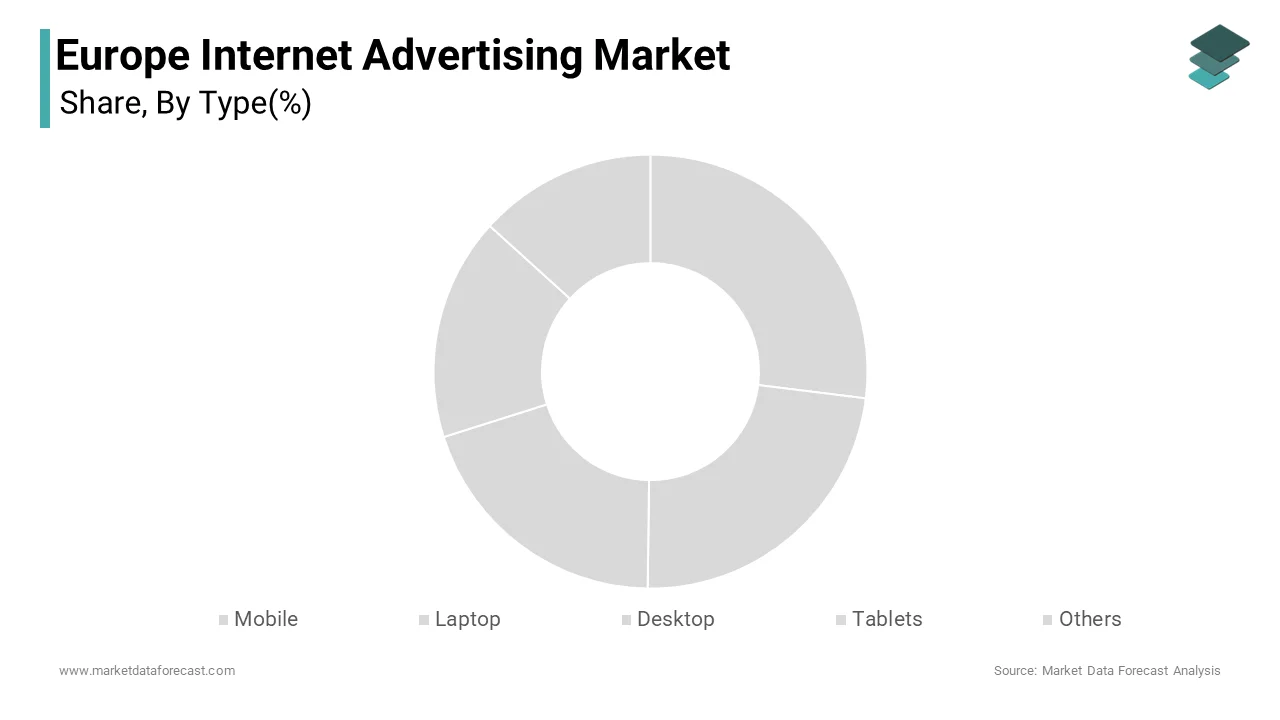
The laptop, desktop, and tablet segment is projected to register a CAGR of 9.12% over the forecast period, owing to the normalization of hybrid work models and the specific requirements of high-value B2B transactions. The structural shift toward hybrid work arrangements that has increased the reliance on laptops and desktop computers for professional activities is further boosting the expansion of the laptops, desktop and tablets segment in the European market. As per Eurofound, a majority of European companies have institutionalized hybrid work policies requiring employees to split their time between home offices and corporate headquarters. This trend has led to a sustained demand for larger screen devices that facilitate complex tasks such as data analysis, video conferencing, and content creation, which are difficult to perform efficiently on smartphones. Advertisers targeting business professionals and decision makers find that these devices offer superior engagement rates for B2B campaigns, white papers, and software demonstrations. The extended screen real estate allows for more detailed and immersive ad formats that can convey complex value propositions effectively. Furthermore, the separation of work and personal life on different devices means that advertising during working hours on laptops reaches audiences in a focused mindset conducive to professional purchasing decisions. The continued investment by enterprises in upgrading employee hardware fleets ensures a growing base of active users on these devices.
By Format Insights
The search engine advertising segment held the major share of the European internet advertising market in 2025. The growth of the search engine advertising segment in the European market is attributed to its unparalleled ability to capture high-intent traffic and deliver measurable return on investment for advertisers across all industries. This format remains the backbone of digital marketing strategies due to its direct correlation with consumer purchase intent. As per Google, billions of searches are conducted monthly across Europe, with a significant portion containing commercial intent. This intent-driven nature ensures that ads displayed alongside search results reach audiences who are further down the sales funnel and more likely to convert compared to passive display or social media viewers. Businesses of all sizes rely on this format because it offers immediate visibility for relevant keywords, allowing them to compete effectively regardless of brand awareness levels. The pay-per-click model ensures that advertisers only pay when a user demonstrates interest by clicking the link, maximizing budget efficiency. Furthermore, the granularity of keyword targeting allows for extreme precision, enabling brands to tailor messages to specific stages of the buyer journey. The trust users place in search engines as neutral information retrievers also lends credibility to the ads displayed.
The video advertising is anticipated to witness the fastest CAGR of 16.2% over the forecast period in the European market, owing to the meteoric rise of short-form video content on social media platforms, which has captivated audiences across all age groups in Europe. As per Ofcom, online video viewing has surpassed traditional linear television viewing among adults in the United Kingdom, a trend that is replicating across Germany, France, and Italy. Platforms dedicated to short vertical videos have become the primary source of entertainment and news for the younger demographic,s forcing advertisers to shift substantial budgets toward in-feed video ads, sponsored challenges, and influencer collaborations. The immersive and autoplay nature of these formats captures attention more effectively than static images, leading to higher brand recall and emotional connection. The algorithmic distribution of video content ensures that ads are served to users most likely to engage based on their viewing history and interests. Furthermore, the ease of creating and sharing video content has democratized production, allowing even small businesses to launch effective video campaigns.
By Pricing Model Insights
The cost per thousand or CPM segment led the market with the leading share of the European internet advertising market in 2025. The growth of the CPM segment in the European market is driven by its suitability for brand-building campaigns and its widespread adoption in programmatic display and video advertising ecosystems. This model remains the standard for buying mass reach and ensuring brand visibility. The enduring priority of major brands is to build awareness and maintain top-of-mind presence among broad audiences rather than focusing solely on immediate conversions. As per the World Federation of Advertisers, a significant portion of marketing budgets in Europe is allocated to brand-building activities, which require guaranteed exposure to thousands of viewers. CPM allows advertisers to secure inventory on premium publisher sites and popular applications, ensuring their message is seen by a large volume of people, regardless of click-through rates. This model is particularly effective for launching new products, reinforcing brand identity, and competing for share of voice in crowded categories. Programmatic trading desks heavily utilize CPM for real-time bidding operations as it simplifies the valuation of impression-based inventory across diverse exchanges. Furthermore, the shift toward viewable CPM, where advertisers only pay for ads that are actually seen on screen, has increased confidence in this model.
The performance-based advertising segment is estimated to register a CAGR of 13.5% over the forecast period in this regional market due to the increasing demand for accountability, the rise of affiliate marketing, and the need for measurable ROI in uncertain economic times. The intensifying pressure on marketers to demonstrate clear and measurable return on investment for every euro spent is further contributing to the expansion of the performance-based advertising segment in this regional market. As per the Chartered Institute of Marketing, accountability and tangible results are prioritized by a majority of European marketing leaders, especially in volatile economic conditions. Performance models such as Cost Per Action, Cost Per Lead, and Cost Per Sale align the interests of advertisers and publishers by ensuring payment occurs only when a specific desired outcome is achieved. This risk mitigation strategy appeals strongly to small and medium enterprises and e-commerce brands that operate with tight margins and cannot afford wasted spend. The transparency of performance tracking allows businesses to scale successful campaigns confidently while pausing underperforming ones immediately. The proliferation of advanced attribution tools has made it easier to track complex customer journeys and assign credit accurately to various touchpoints. This data-driven culture encourages a shift away from traditional impression-based buying toward models that guarantee business results.
REGIONAL ANALYSIS
United Kingdom Internet Advertising Market Analysis
The United Kingdom held the dominating position in the European internet advertising market in 2025. The dominance of the UK in the European market is driven by its mature digital economy, advanced tech infrastructure, high concentration of global agency headquarters, exceptionally high internet penetration, and a sophisticated advertiser base that readily adopts innovative formats. As per Statista, the UK plays a critical role in European internet advertising expenditure, reflecting its position as a regional powerhouse. London serves as a global hub for fintech and e-commerce, driving intense competition for digital inventory among high-value sectors. The widespread adoption of Connected TV and the early shift away from third-party cookies have positioned UK advertisers as pioneers in privacy-compliant targeting strategies. The strong regulatory environment enforced by the Information Commissioner's Office sets benchmarks for data usage that influence practices across the continent. Furthermore, the vibrant startup ecosystem continuously generates demand for performance marketing to fuel rapid growth.
Germany Internet Advertising Market Analysis
Germany had the second-largest share of the European internet advertising market in 2025 due to its robust industrial base, strong e-commerce growth, and cautious but steadily increasing adoption of digital advertising channels. The nation benefits from being the largest economy in Europe with a massive domestic consumer base that is increasingly comfortable with online transactions. As per the German Association for Digital Economy, internet advertising spend in Germany has grown significantly as traditional media budgets continue to migrate online, particularly in the automotive and manufacturing sectors. German advertisers place a high premium on data privacy and compliance, leading to a unique market dynamic where contextual advertising and first-party data strategies are more prevalent than in other regions. The growth of retail media networks linked to major domestic retailers is reshaping the landscape, offering new avenues for brand promotion. The federal structure of the country requires localized strategies, but the high literacy rate and digital skills of the population facilitate effective campaign execution. The government's push for digitalization of small and medium enterprises is expanding the pool of advertisers beyond large corporations.
France Internet Advertising Market Analysis
France is expected to account for a prominent share of the market owing to a strong creative industry, vibrant luxury sector, proactive government initiatives to support the digital economy, the dominance of local media groups, and a distinct preference for video and social media advertising formats. As per the French Authority for Professional Regulation of Advertising, digital ad spend in France has grown steadily, driven by the luxury fashion and cosmetics industries, which rely heavily on visual storytelling to engage global audiences. The French market sees high engagement with mobile video and influencer marketing, particularly among younger demographics in Paris and other major cities. Government regulations regarding language and cultural protection necessitate localized content strategies but also foster a thriving domestic creative ecosystem. The rise of quick commerce and food delivery apps has created new inventory pools for hyperlocal advertising. Additionally, the emphasis on sustainability and ethical advertising is shaping brand narratives and media buying decisions.
Italy Internet Advertising Market Analysis
Italy is predicted to witness a healthy CAGR in the European internet advertising market during the forecast period, owing to its dynamic small and medium enterprise sector, strong tourism industry, rapid acceleration in digital adoption following recent modernization efforts, and a heavy reliance on mobile devices and social media platforms as primary channels for reaching consumers. As per ISTAT, internet usage in Italy has reached record levels, with a large portion of the population accessing the web primarily via smartphones, driving mobile-first advertising strategies. The fashion, design, and food sectors are major contributors to ad spend, leveraging visual platforms to showcase products to both domestic and international audiences. The fragmentation of the business landscape means that performance-based advertising and local search are crucial for smaller entities seeking visibility. The growth of e-commerce has been a key catalyst prompting traditional retailers to invest heavily in digital channels to compete. Cultural nuances and regional differences require tailored approaches, but the high engagement rates on social networks offer fertile ground for viral campaigns.
Netherlands Internet Advertising Market Analysis
The Netherlands is anticipated to account for a notable share of the European internet advertising market during the forecast period due to its exceptional digital literacy, high English proficiency, and role as a gateway for multinational corporations entering the European market. The Dutch market status is defined by early adoption of new technologies and a pragmatic approach to data-driven marketing. As per Statistics Netherlands, internet usage is nearly universal, creating one of the most saturated and competitive digital landscapes in Europe. The concentration of international headquarters in Amsterdam drives demand for sophisticated B2B advertising and programmatic solutions. Dutch consumers are known for their ad-blocking usage, which forces advertisers to adopt native and non-intrusive formats to ensure visibility. The strong logistics and trade sectors utilize search and display advertising to reach global partners. The market is also a testing ground for innovative ad tech startups due to the supportive regulatory environment and tech-savvy workforce. The emphasis on transparency and measurable results aligns well with performance-based models. This combination of connectivity, openness, and technological sophistication secures the Netherlands a leading position in the regional hierarchy despite its smaller population size.
COMPETITION OVERVIEW
The competition within the Europe internet advertising market is intense and characterized by a rivalry between global technology giants and specialized regional platforms vying for advertiser budgets. Large hyperscalers leverage their vast data ecosystems and cross-device reach to offer comprehensive solutions, while niche players compete on specific vertical expertise or superior customer service. The market sees constant innovation as companies race to develop effective targeting methods that comply with stringent privacy laws like the General Data Protection Regulation. Differentiation increasingly depends on the sophistication of artificial intelligence tools, the quality of first-party data assets, and the ability to measure cross-channel impact accurately. Price competition remains fierce, particularly in programmatic display, where inventory commoditization pressures margins. The rise of retail media has introduced new competitors from the commerce sector, challenging traditional search and social dominance. Talent acquisition is another critical battleground as skilled data scientists and ad tech engineers are scarce. This dynamic environment forces continuous adaptation and strategic investment to maintain relevance and capture growth in a fragmented yet lucrative landscape.
KEY MARKET PLAYERS
A few major players of the Europe internet advertising market include
- Google LLC
- Meta Platforms, Inc
- Amazon.com, Inc
- Microsoft Corporation
- Alphabet Inc
- TikTok Ltd
- Snap Inc
- Twitter, Inc
- LinkedIn Corporation
- Adobe Inc
- The Trade Desk, Inc
- Criteo S.A
- Adform A/S
- PubMatic, Inc
- Taboola.com Ltd
Top Strategies Used by Key Market Participants
Key players in the Europe internet advertising market primarily focus on developing privacy-centric targeting solutions to navigate strict data protection regulations while maintaining ad effectiveness. Companies are heavily investing in artificial intelligence and machine learning to automate campaign optimization and personalize creative content at scale. Another major strategy involves expanding retail media networks to leverage first-party transactional data for high-intent advertising. Providers are forming strategic partnerships with traditional media owners to create unified omnichannel measurement frameworks. Firms are also diversifying revenue streams by entering connected television and streaming video markets to capture shifting viewer attention. There is a significant push toward enhancing mobile-first ad formats, including augmented reality and interactive rich media. Finally, companies are prioritizing transparency and brand safety tools to build trust with advertisers and regulatory bodies across diverse European jurisdictions.
Leading Players in the Europe Internet Advertising Market
- Google LLC dominates the Europe internet advertising market through its comprehensive suite of search, display, and video advertising products that reach billions of users daily. The company contributes significantly to the global market by setting standards for programmatic trading and data-driven targeting capabilities. Google recently strengthened its European position by launching enhanced privacy sandbox initiatives designed to replace third-party cookies while maintaining ad relevance. The firm continues to invest heavily in artificial intelligence tools that automate bid strategies and optimize creative assets for diverse European languages. Strategic partnerships with major publishers and retailers have expanded its retail media network offerings across the continent. Google also focuses on sustainability by powering its data centers with renewable energy to align with European green goals. These actions reinforce its status as the primary infrastructure provider for digital commerce and brand communication in the region.
- Meta Platforms Inc operates as a leading force in the Europe internet advertising market, leveraging its vast social networking ecosystem,s including Facebook, Instagram, and WhatsApp. The company drives global innovation in social commerce and immersive advertising experiences through its advanced machine learning algorithms. Meta has recently intensified its focus oshort-formrm video content to compete with emerging platforms and capture younger European demographics. The corporation introduced new augmented reality ad formats that allow users to virtually try on products before purchasing. Their commitment to transparency includes detailed ad libraries and robust verification tools to combat misinformation and build trust with regulators. Meta actively collaborates with European small businesses to provide simplified advertising solutions that drive local economic growth. By integrating shopping features directly into its apps, Meta creates seamless pathways from discovery to conversion. These strategic moves ensure its continued relevance and influence in the evolving social media landscape.
- Amazon Company has rapidly emerged as a major player in the Europe internet advertising market by monetizing its extensive e-commerce ecosystem andPrime Videoo streaming service. The group contributes to the global market by pioneering retail media networks that leverage first-party purchase data for high-intent targeting. Amazon recently expanded its advertising capabilities in Europe by introducing sponsored display ads that reach shoppers both on and off its platform. The company launched new video advertising options within Prime Video to capture the growing audience of cord-cutters across the continent. Its investment in logistics and cloud infrastructure supports low-latency ad delivery and real-time analytics for brands. Amazon also emphasizes sustainability through its climate pledge, which appeals to environmentally conscious European advertisers. By connecting brands directly with consumers at the point of purchase, Amazon offers unparalleled measurement and return on investment. These initiatives solidify its position as a critical partner for performance marketing in Europe.
MARKET SEGMENTATION
This research report on the Europe internet advertising market has been segmented and sub-segmented based on type, format, pricing model, & region.
By Type
- Mobile
- Laptop
- Desktop
- Tablets
- Others
By Format
- Search Engine Advertising/Search Engine Marketing
- Display Advertising
- Mobile Advertising
- Social Media Advertising
- Video Advertising
- Online Classifieds Ads
- Others
By Pricing Model
- Cost Per Thousand (CPM)/Cost-Per-Mille (CPM)
- Performance-Based Advertising
- Hybrid
- Others
By Region
- UK
- France
- Spain
- Germany
- Italy
- Russia
- Sweden
- Denmark
- Switzerland
- Netherlands
- Turkey
- Czech Republic
- Rest of Europe
Frequently Asked Questions
1. What factors are driving the growth of the Europe Internet Advertising Market?
Increasing internet penetration, rapid growth of social media usage, expansion of e-commerce, and the adoption of digital marketing strategies by businesses are major drivers.
2. Which advertising formats are commonly used in the Europe Internet Advertising Market?
Common formats include search advertising, display advertising, social media advertising, video advertising, and native advertising.
3. Which industries are major advertisers in Europe’s internet advertising market?
Key industries include retail and e-commerce, automotive, BFSI, healthcare, travel & tourism, and consumer electronics.
4. How is mobile advertising influencing the Europe Internet Advertising Market?
The rapid increase in smartphone usage has significantly boosted mobile advertising, enabling brands to reach consumers through apps, mobile websites, and in-app ads.
5. What role does programmatic advertising play in the Europe Internet Advertising Market?
Programmatic advertising automates the buying and selling of ad inventory using AI and real-time bidding, improving targeting efficiency and campaign performance.
6. What challenges are faced by the Europe Internet Advertising Market?
Key challenges include strict data privacy regulations, ad fraud, ad blockers, and increasing competition among digital platforms.
7. What opportunities exist in the Europe Internet Advertising Market?
Opportunities include growth in video advertising, influencer marketing, AI-driven targeting, and personalized advertising strategies.
8. What is the role of artificial intelligence in internet advertising?
AI helps analyze consumer behavior, optimize ad placements, personalize marketing campaigns, and improve return on advertising spend.
9. How do data privacy regulations affect internet advertising in Europe?
Regulations such as GDPR require companies to obtain user consent for data collection and targeted advertising, influencing how digital campaigns are executed.
10. What is the future outlook for the Europe Internet Advertising Market?
The market is expected to grow steadily due to increasing digital transformation, rising online consumer engagement, and advancements in advertising technologies.
Related Reports
Access the study in MULTIPLE FORMATS
Purchase options starting from
$ 2000
Didn’t find what you’re looking for?
TALK TO OUR ANALYST TEAM
Need something within your budget?
NO WORRIES! WE GOT YOU COVERED!
Call us on: +1 888 702 9696 (U.S Toll Free)
Write to us: sales@marketdataforecast.com