Europe OTT Market Size, Share, Trends and Growth Analysis Report, Segmented By Content, Device, Component, and Country (Russia, Germany, United Kingdom, Sweden, And Denmark, Poland, Switzerland, Netherlands, France, Italy, Spain and Rest of Europe), Industry Analysis From 2026 to 2034.
Europe OTT Market Size
The Europe OTT market size was valued at USD 281.44 million in 2025 and is anticipated to reach USD 366.87 million in 2026 to reach from USD 2397.86 million by 2034, growing at a CAGR of 30.33% during the forecast period from 2026 to 2034.

Current Introduction of the Europe OTT Market
OTT (Over-the-Top) refers to the delivery of film, television, and audio content directly to viewers over the internet, bypassing traditional distribution channels like cable, satellite, and broadcast TV. This sector has evolved from simple video-on-demand libraries to complex hybrid models incorporating live linear channels interactive advertising and original production studios tailored to diverse linguistic groups across the continent. The fundamental shift in consumer behavior toward on-demand consumption defines the current landscape as linear television viewership continues its structural decline among younger demographics. As per a study, household internet access in the EU has shown consistent, steady growth, surpassing nearly all household levels by the mid-2020s, enabling high-definition streaming and 4K content delivery to be a standard experience. The penetration of fiber optic networks supports this growth. Fixed very high capacity network coverage is expanding rapidly across the EU, narrowing the gap between urban and rural areas, with the vast majority of households expected to have access to gigabit-capable networks in the coming years. Smartphone and smart TV adoption remains a critical component. The European Audiovisual Observatory observed that connected televisions account for a significant portion of daily screen time among adults. The regulatory environment shaped by the Audiovisual Media Services Directive influences content quotas and local production requirements making compliance a central operational requirement. This market functions as the primary entertainment source for millions while driving substantial investment in local creative industries across various member states.
PRIMARY DEMAND DRIVERS
Pervasive High Speed Broadband Infrastructure Enables Premium Streaming
Fiber optics and 5G networks are being widely deployed across the region, which fuels the growth of the Europe OTT market. This infrastructure is the primary catalyst for the surge in high-definition and ultra-high-definition content consumption. Consumers increasingly demand cinematic quality experiences including 4K resolution and High Dynamic Range which require substantial bandwidth only modern infrastructure can provide. According to research, European mobile market maturity continues, with a very high proportion of the population owning a mobile subscription, driving toward a near-universal penetration rate by the end of the decade. This ubiquity ensures that service providers can reach users instantly on any device thereby increasing total viewing hours significantly. The rollout of fifth generation networks has further accelerated this trend by enabling low latency live streaming of sports and news events directly within mobile applications without interruption. 5G availability in Europe is expanding rapidly, transitioning from initial rollout to broader coverage and increased time spent on 5G networks, although significant disparities remain between northern/southern Europe and lagging regions. Operators specifically capitalize on this connectivity through edge computing nodes that reduce lag to imperceptible levels for live broadcasts. The shift is evident in subscription figures where premium tiers offering higher resolution often report double digit growth rates compared to standard definition plans. Mobile data caps are increasing and home internet speeds are climbing. Consequently, the dependency on robust network infrastructure has become absolute for business survival. This structural change in delivery mechanisms guarantees that connectivity will remain the dominant enabler for market expansion.
Rising Demand for Localized and Original Content Drives Subscriptions
There is an exponential rise in consumer preference for local narratives and original series, which further propels the expansion of the Europe OTT market. As a result, platforms are being forced to invest heavily in regional content creation to meet this demand. As global audiences seek stories that reflect their own cultures languages and social contexts international giants are forced to localize their offerings beyond simple dubbing. According to the European Audiovisual Observatory subscription video on demand user numbers and revenue continued to show strong growth, with market penetration rising, despite a shift in consumer behavior toward more selective, value-conscious choices (e.g., ad-supported tiers). This migration of viewer attention necessitates continuous innovation in storytelling such as co-productions between nations and adaptations of local literature. Platforms utilize data analytics to identify regional trends and commission content that resonates deeply with specific demographics. Local European productions are gaining traction. However, the top-performing titles on major international streaming platforms in Europe continue to be dominated by US-produced content. This cross border dynamic encourages operators to adopt culturally nuanced marketing strategies to resonate with diverse audiences. The need for fresh content ensures that production budgets remain fluid and responsive to viewer feedback. Consequently the health of the OTT market is inextricably linked to the vitality of the regional creative ecosystem and the ability to tell authentic stories.
CRITICAL MARKET RESTRAINTS
Fragmented Regulatory Landscape Complicates Pan-European Operations
European nations have implemented divergent media laws and content regulations, which creates a significant obstacle for the Europe OTT market. This lack of harmony restricts operators from deploying uniform strategies and content libraries. Each member state maintains its own rules regarding content quotas taxation and age verification which creates a fragmented single market potential. As per the European Commission while the Audiovisual Media Services Directive provides a framework national implementations vary significantly leading to substantial legal and compliance overheads. This regulatory pressure forces retailers to maintain complex IT systems capable of geo-blocking content and calculating varying tax rates for dozens of jurisdictions simultaneously. The inability to offer a unified catalog across borders discourages economies of scale and limits the addressable market for niche titles. Operators now face higher barriers to entry and must invest heavily in legal counsel to navigate shifting fiscal landscapes. The fragmentation of rules adds complexity for pan-European campaigns requiring teams to constantly monitor legislative changes. These constraints reduce the overall efficiency of capital allocation and limit the ability to compete with domestic incumbents who understand local nuances better. The industry continues to grapple with balancing standardization against the fiscal and cultural mandates imposed by various European governments.
Market Saturation and Subscription Fatigue Limit User Acquisition
The proliferation of streaming services has become overwhelming and acts as a major restraint to the Europe OTT market. Now, consumers are scrutinizing their monthly bills and cutting redundant subscriptions. When the number of available platforms exceeds the budgetary willingness of households churn rates increase and customer acquisition costs soar unsustainably. According to the European Consumer Organisation nearly forty percent of subscribers admitted to rotating services by subscribing for one month to watch specific content and then cancelling in 2024. This financial strain leads households to prioritize only two or three core services abandoning long tail platforms that lack must-have exclusive content. Large operators which form the bulk of the European market fabric are particularly vulnerable to this volatility and may face revenue stagnation despite growing content libraries. Data indicates that while "subscriber churn" is a significant concern for streaming platforms, the proportion of users practicing "service rotation" (frequent cancellations and subscriptions) is lower than the cited percentage, with many consumers opting to keep multiple subscriptions, though this is shifting. The volatility makes it difficult for new entrants to forecast revenue or secure funding for original productions. Suppliers often demand favorable terms from large platforms which compresses margins for smaller buyers further. Furthermore the fluctuating public sentiment impacts the willingness of payment processors to service high churn businesses. This macro-structural imbalance creates a cautious environment where diversity of supply stagnates despite the underlying cultural demand for varied entertainment voices.
EMERGING GROWTH OPPORTUNITIES
Integration of Advertising Based Video On Demand Models
The rapid adoption of Advertising Based Video On Demand provides a lucrative opportunity for operators within the Europe OTT market. They can now capture price-sensitive consumers who are unwilling to pay for multiple subscription fees. Ad-supported tiers allow platforms to monetize a broader demographic base, including younger viewers and students. This trend is driven by users seeking cost-effective alternatives. Ad-supported streaming revenues in Europe are experiencing significant growth, driven by a shift in consumer behavior and increased investment in connected TV formats. This transition allows retailers to bundle ad-free and ad-supported options creating flexible value packages that enhance customer lifetime value. The ability to leverage first-party data for targeted advertising enhances the relevance of commercials and improves yields for advertisers. Smart data processing continues to rise. European streaming companies are increasingly investing in advanced data processing and ad-tech stacks to improve targeted advertising and operational efficiency. Providers are increasingly allocating portions of their inventory to these digital channels to capture deeper insights into viewer behavior. The format supports interactive ad formats such as shoppable videos that bridge the gap between entertainment and commerce. Programmatic trading is maturing. Consequently, the inventory for targeted advertising will grow substantially. This evolution represents a paradigm shift where advertising becomes a premium revenue stream rather than a secondary afterthought opening new financial avenues.
Expansion of Live Sports and Event Streaming Rights
The continuous enhancement of live streaming technologies offers a potential opening to capitalize on the enduring popularity of sports and real-time events to drive subscriber acquisition and retention, which is anticipated to drive the expansion of the Europe OTT market. These tools enable operators to offer exclusive access to major leagues and tournaments predicting outcomes and automating multi-camera angles without human intervention. Media rights deals for major sporting events are increasingly focusing on digital-only streaming platforms as part of broader shifts in audience distribution strategies. Generative data models allow for the creation of personalized viewing experiences tailored to specific moments such as player tracking and instant replays ensuring that each user sees the most relevant options possible. This level of immediacy was previously unattainable at scale and significantly boosts engagement frequency while reducing churn during off-seasons. Predictive analytics help operators anticipate server loads and adjust their infrastructure proactively rather than reacting to historical data. The technology also improves fraud detection by identifying illegal streams more accurately thereby protecting integrity and revenue. Natural language processing facilitates better commentary integration allowing companies to synchronize odds with live text and video feeds seamlessly. Lower latency reduces the barrier to entry for high-frequency betting and interaction. Consequently, casual fans are able to participate more actively. This technological leap ensures that the European market remains at the forefront of live entertainment innovation driving efficiency and excitement across all verticals.
PERSISTENT MARKET CHALLENGES
Piracy and Unauthorized Distribution Undermine Revenue Streams
The pervasive issue of digital piracy and unauthorized streaming is a major hindrance to the Europe OTT market. This occurs by diverting potential subscribers and devaluing intellectual property. The ease with which illegal streams can be hosted and distributed across peer-to-peer networks makes enforcement difficult and costly for rights holders. According to research, European digital piracy, particularly streaming of live sports and TV, shows a persistent, high-frequency trend. Studios often struggle with the sheer volume of infringing links appearing daily on file hosting sites and torrent trackers which outpaces takedown capabilities. The lack of a unified continental enforcement mechanism means that legal actions must be pursued in multiple jurisdictions diluting their effectiveness. Cross-border jurisdictional issues remain problematic especially when servers hosting illegal content are located outside European legal reach. Piracy is a significant concern for digital income in the European audiovisual sector. This fragmentation increases the cost and complexity of protecting works requiring specialized legal teams and automated monitoring technologies. The inability to secure digital rights accurately undermines confidence in digital publishing models and hampers investment in new titles. Overcoming this disjointed enforcement landscape requires substantial investment in digital rights management tools and harmonized international cooperation.
Intensifying Competition for Exclusive Content Elevates Costs
The saturation of the digital space with an ever-increasing number of licensed operators creates intense competition for limited premium content that hampers the expansion of the Europe OTT market. This competition is driving up the cost of acquisition significantly. As more brands vie for the same blockbuster movies and popular series the auction dynamics of rights bidding result in inflated licensing fees. Ad-supported premium long-form streaming (CTV) is expanding rapidly, with digital ad spend generally outpacing traditional media growth. This bidding war disproportionately affects smaller operators that lack the deep pockets of multinational corporations to sustain high content burns. The sheer volume of promotional offers displayed to consumers daily leads to promotion fatigue where users subconsciously ignore marketing content reducing overall effectiveness. Regulators continuously update their guidelines to restrict aggressive bundling practices forcing brands to spend more on brand building just to maintain visibility. The competition extends beyond traditional studios as tech giants and telecom operators enter the content space adding to the congestion. Attention spans are shrinking. Content creators are adapting to fragmented media landscapes, often emphasizing faster, more intense, or shorter engagement methods to capture viewer attention. Operators must therefore invest more in high-quality original production to break through the noise which further escalates campaign budgets. This relentless upward pressure on costs threatens the sustainability of content acquisition models for many digital native streaming businesses.
REPORT COVERAGE
| REPORT METRIC | DETAILS |
| Market Size Available | 2025 to 2034 |
| Base Year | 2025 |
| Forecast Period | 2026 to 2034 |
| CAGR | 30.33% |
| Segments Covered | By Content, Device, Component, and Region. |
| Various Analyses Covered | Global, Regional, and Country Level Analysis, Segment-Level Analysis, DROC, PESTLE Analysis, Porter’s Five Forces Analysis, Competitive Landscape, Analyst Overview of Investment Opportunities |
| Regions Covered | North America, Europe, APAC, Latin America, Middle East & Africa |
| Market Leaders Profiled | 8x8 Inc., Alphabet Inc., Amazon.com Inc., Amazon Prime Video, Apple Inc., Disney+, Cineverse Entertainment Corp., Comcast Corp., Deezer SA, Meta Platforms Inc., FlixFling LLC, iflix Ltd., iMPACTFUL Group Inc., Microsoft Corp., Netflix Inc., Paramount Global, Sirius XM Holdings Inc., Sony Group Corp., Spotify Technology SA, Telstra Corp. Ltd., Tencent Holdings Ltd., The Walt Disney Co. |
SEGMENTAL ANALYSIS
By Content Insights
The video content segment dominated the Europe OTT market and accounted for a substantial share in 2025. The dominance of the segment is driven by the widespread availability of high-speed broadband which enables seamless streaming of 4K and High Dynamic Range content that rivals traditional broadcast quality. This dominance is deeply rooted in the fundamental human preference for visual storytelling and the massive investment by global and local players in high-production original series and films. The European audiovisual market is seeing a steady, significant migration of consumer demand from traditional linear television towards subscription-based video-on-demand platforms, according to reports from the European Audiovisual Observatory. The proliferation of smart TVs and connected devices has further solidified this position by making video access effortless within the living room environment. Data from the International Telecommunication Union indicates that video traffic now accounts for over eighty percent of all internet traffic in Europe facilitating real time data transmission essential for buffer-free viewing. Operators specifically capitalize on this connectivity through exclusive licensing deals for major sports leagues and blockbuster movies which act as primary acquisition tools. The shift is evident in advertising figures where video ad spend often accounts for a significant share of total digital video turnover for major platforms. Mobile data caps are increasing and home internet speeds are climbing. As a result, the dependency on robust network infrastructure is becoming absolute for business survival. This structural change in media consumption guarantees that video will remain the cornerstone of the European OTT industry.
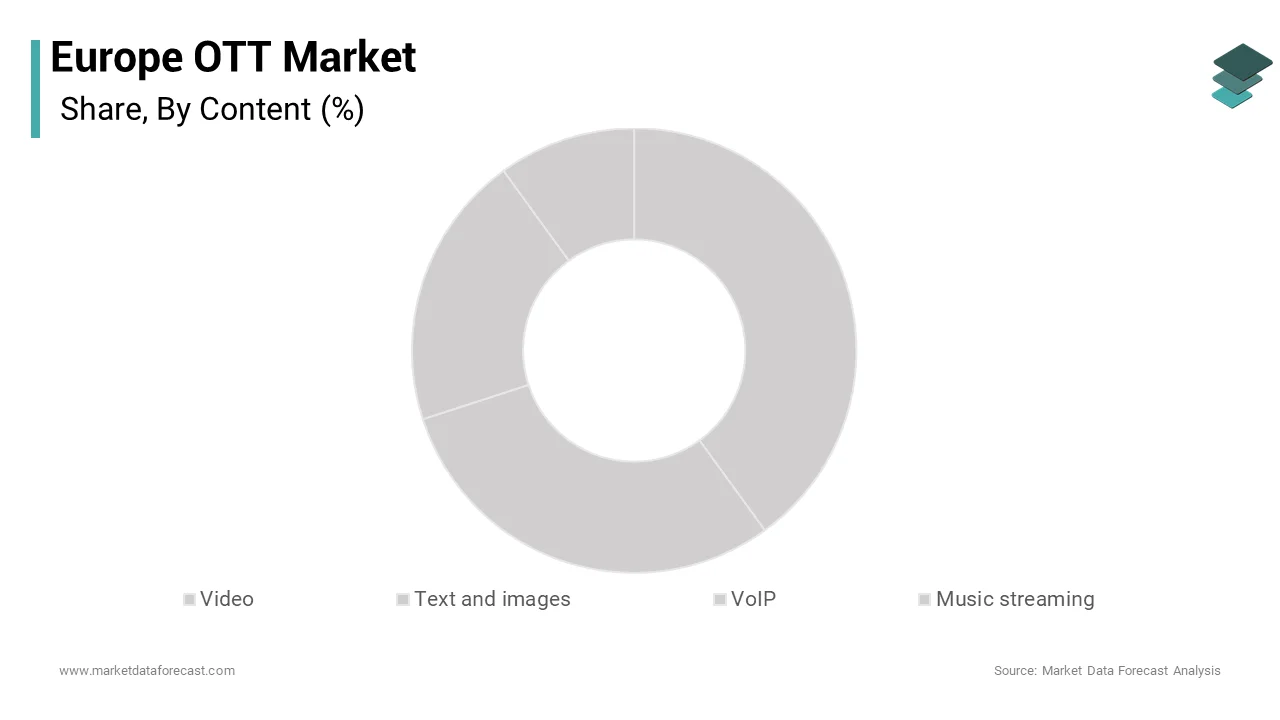
The music streaming segment is estimated to register the fastest CAGR of 14.6% from 2026 to 2034 due to the ubiquitous presence of smartphones and smart speakers which have made audio content accessible anywhere and anytime without requiring visual attention. This rapid expansion is also fueled by the changing lifestyles of modern Europeans who increasingly seek audio content for multitasking during commutes workouts or household chores. Paid music streaming continues to be the primary engine for recorded music revenue growth in Europe, driven by increasing user adoption of subscription services, according to IFPI data. The proliferation of high speed mobile networks allows for seamless streaming of lossless audio files eliminating buffering issues that previously hindered user experience. Smart speaker ownership and usage are increasing, leading to new, voice-driven avenues for music discovery and content interaction within European homes. Production costs for high fidelity audio have decreased due to advancements in compression technology enabling platforms to offer superior sound quality more economically. The rise of bundled subscription models offering unlimited listening alongside video content has also lowered the barrier to entry for casual listeners who might not purchase standalone music plans. Celebrity curated playlists and exclusive podcast integrations are attracting younger demographics who traditionally prefer social audio content over static albums. This convergence of technology lifestyle changes and content availability ensures the music streaming segment will outpace other content types in growth velocity.
By Device Insights
The smart TVs segment remained the largest segment in the Europe OTT market and captured a 44.8% share in 2025. This prominence of the segment is attributed to the rapid replacement cycle of televisions where newer models come pre-installed with popular OTT applications eliminating the need for external set-top boxes or dongles. Moreover, this overwhelming leadership is also supported by the desire for a communal cinematic experience within the home which larger screens and superior sound systems facilitate better than mobile devices. Smart TV adoption continues to rise in Western Europe as consumers replace older sets, driven by high demand for integrated streaming services. The integration of advanced operating systems allows for seamless voice control and personalized recommendations directly from the remote enhancing user engagement significantly. The ability to display high resolution 4K and 8K content makes Smart TVs the preferred choice for consuming premium original productions and live sports events. Manufacturers favor this segment because it drives hardware sales while creating sticky ecosystems that lock users into specific content libraries. Furthermore, the integration of gaming and fitness apps transforms the television into a multifunctional entertainment hub. These structural advantages ensure that Smart TVs remain the primary gateway for OTT consumption in European homes.
The smartphones and tablets segment is anticipated to witness the fastest CAGR of 16.8% during the forecast period owing to the advancement in mobile display technology and battery life which now supports extended viewing sessions without compromising visual quality. This surge is also driven by the increasing demand for on-the-go entertainment and the ability to consume content during fragmented time slots such as commutes or breaks. Europe continues to show very high mobile subscription rates, providing a massive, saturated market for mobile OTT applications. The rise of fifth generation networks has further accelerated adoption by enabling ultra-low latency streaming of high-definition video even in crowded urban areas. Data from the European Telecommunications Standards Institute indicates that fifth generation coverage now extends to more than sixty percent of the European population facilitating uninterrupted streaming experiences. Providers are increasingly optimizing their interfaces for vertical scrolling and touch interaction to cater to native mobile behaviors. The flexibility of offline download features allows users to consume content in areas with poor connectivity such as subways or airplanes. The integration of social sharing features within mobile apps encourages viral discovery and peer-to-peer recommendation. This alignment with the mobile-first lifestyle of younger demographics ensures the smartphone and tablet segment will experience sustained double-digit growth.
By Component Insights
The solutions segment held the majority share of 62.4% of the Europe OTT market in 2025. The supremacy of the segment is credited to the complexity of delivering high-quality video across diverse devices and networks which requires sophisticated software architectures to manage encoding transcoding and distribution efficiently. Additionally, the segment is helped by the critical need for robust content management systems digital rights management and video delivery networks that form the backbone of any streaming service. European media companies are steadily increasing their adoption of cloud-based platforms for OTT operations, driven by the need for better data management and scalability. The scalability of these solutions enables providers to update features instantly ensuring that viewers always access the most current interface and security protocols without physical redistribution costs. Spending on IT services related to digital transformation and cloud in Europe is rising, with a strong focus on AI-related infrastructure and partner solutions. Institutions favor solutions because they reduce long-term operational expenses associated with maintaining legacy hardware while offering rich analytics capabilities that static systems cannot match. The integration of artificial intelligence tools within these platforms empowers operators to identify technical issues early and optimize bandwidth usage proactively. Furthermore the ability to integrate third-party tools such as payment gateways and customer relationship management suites creates a comprehensive ecosystem that locks in user dependency. These factors collectively ensure that solutions remain the backbone of the digital broadcasting landscape.
The services segment is likely to experience the fastest CAGR of 19.3% over the forecast period. This rapid expansion is fueled by the increasing specialization required to launch and maintain competitive streaming platforms in a saturated market. In addition, this area is supported by the trend among traditional broadcasters and new entrants to outsource non-core functions such as content aggregation metadata management and customer support to specialized vendors. European media companies are increasingly adopting managed OTT services to accelerate the launch of new services. The shift toward subscription-based service models allows providers to access cutting-edge technology and expertise without significant upfront capital expenditure. Organizations in Europe are increasingly using external consulting and integration services to speed up cloud adoption and modernize infrastructure, prioritizing speed over in-house development. Vendors are increasingly offering end-to-end packages that include monetization strategy user experience design and regulatory compliance assistance. The flexibility to scale services up or down based on viewer demand appeals strongly to seasonal content providers and sports rights holders. The rise of white-label solutions enables niche players to enter the market with professional-grade platforms quickly. This convergence of expertise flexibility and cost-efficiency ensures the services segment will outpace solution sales in growth velocity.
COUNTRY LEVEL ANALYSIS
United Kingdom OTT Market Analysis
The United Kingdom led the European OTT market and occupied a 24.1% share in 2025. The leading position of the UK market is driven by the mature digital infrastructure and high penetration of smart TVs which facilitate widespread adoption of premium streaming services. This preeminent position is also supported by its status as a global hub for creative talent and the home of world-renowned production studios that supply content to platforms worldwide. UK internet users are spending significantly more time online, with high-speed, on-demand video streaming becoming the dominant form of home entertainment, driven by increased viewing among all age groups. The country serves as a key testing ground for new technologies such as interactive storytelling and augmented reality experiences due to its sophisticated consumer base. A well-developed regulatory framework under Ofcom ensures fair competition and high content standards fostering trust among subscribers. UK film and high-end television production has achieved record-high spending levels, with substantial investment driven by inward production and strong international confidence in the UK's production infrastructure. The presence of major global streaming headquarters in London contributes significantly to the depth of available content and localized marketing strategies. Strong English language content also allows UK-based services to expand easily into international markets. This combination of creative excellence technological readiness and regulatory maturity ensures the UK retains its top rank.
Germany OTT Market Analysis
Germany was the next prominent country in the Europe OTT market due to its large population and strong appetite for high-quality localized content. The nation benefits from a robust economy and high disposable income levels which support multiple subscription commitments per household. A further reason for this growth is the strict adherence to data privacy and content regulations which has forced operators to develop highly secure and compliant platforms that build long-term consumer trust. Germany has seen a rapid increase in fiber-optic and high-speed broadband availability, which has enabled a surge in high-definition, on-demand video streaming demand across all types of internet-connected households. The presence of leading telecommunications companies fosters a vibrant ecosystem where bundling of OTT services with internet packages drives rapid user acquisition. Data from the German Multimedia Association reveals that viewing hours for local language productions have consistently grown even as international titles fluctuate demonstrating the resilience of domestic content. The post-pandemic shift in media consumption has led to unique opportunities for hybrid models combining linear and on-demand offerings. High digital literacy rates among the population facilitate rapid adoption of new features like voice control and personalized recommendations. The strength of the German language content market also allows local providers to serve as hubs for expansion into neighboring German-speaking regions. This blend of economic muscle regulatory rigor and cultural pride cements Germany as a pivotal market.
France OTT Market Analysis
France maintains a noteworthy position in the Europe OTT market owing to its deep-seated cinematic traditions and government efforts to promote French language content in the digital age. It is known for a strong emphasis on protecting local culture while embracing new formats like short-form series and interactive documentaries. A further driving factor is the state-led initiative to reduce barriers for local producers to distribute content on global platforms which has stimulated demand and encouraged investment in digital conversion. As per a study, Consumption of online video and subscription services (SVoD/AVoD) is rising steadily in France, with significant growth in streaming among adults and higher consumption of on-demand content. The popularity of prestigious film festivals and media coverage of new releases drives significant traffic to online platforms during award seasons. The French SVoD landscape is maturing, with revenue growth driven by price increases and advertising tiers, while usage among younger demographics remains high. The existence of strong public broadcasters that have developed their own robust streaming channels adds diversity to the distribution landscape. Cross-border e-commerce within the EU allows French viewers to access a wider range of international titles seamlessly. The focus on cultural exception policies ensures that local authors and filmmakers receive prominent visibility on digital platforms. This strategic balance between heritage preservation and digital innovation ensures France remains a key growth engine.
Italy OTT Market Analysis
Italy is also a major player in the European market. The country leverages its rich history of art cinema and television drama to sustain steady demand for both classic and contemporary digital titles. The market status is defined by a rapid catch-up in digital adoption as traditional viewers increasingly recognize the convenience of online purchasing and streaming compared to scheduled broadcasts. Internet usage for video purposes is increasing in Italy, with a strong preference for mobile, especially among younger users. A key driving factor is the resurgence of interest in historical dramas and crime series which perform exceptionally well in digital formats due to easy searchability and binge-watching capabilities. The tourism sector also contributes indirectly as visitors seek digital guides and content related to Italian culture before and after their trips. Mobile streaming in Italy is increasing, and consumers are shifting toward smartphone-based viewing and shopping, but not at the rate attributed to the AIE. Government incentives for digitalization under the National Recovery and Resilience Plan have provided funds for broadcasters to acquire digital collections and upgrade transmission infrastructure. The fragmented nature of the retail landscape creates opportunities for online aggregators to offer centralized access to diverse titles. This fusion of cultural wealth with modern digital tools positions Italy for sustained growth.
Spain OTT Market Analysis
Spain is likely to grow in the Europe OTT market during forecast period owing to its strategic role as a bridge between European and Latin American entertainment markets. The nation has emerged as a critical hub for Spanish-language digital content serving millions of speakers globally through its online platforms. The market status shows swift growth in mobile streaming and social viewing features as young demographics embrace flexible viewing formats. Digital investment in Spain continues to rise, especially in IT and content, with significant growth in specific corporate sectors. A primary driving factor is the intense popularity of genre fiction such as thriller and romance which thrives in the digital ecosystem due to high release frequencies and affordable pricing. The government has implemented policies to promote digital literacy and access to culture which has boosted online content consumption in rural areas. Internet usage in Spain is extremely high, with a vast majority of the population accessing the internet daily, leading to strong potential for digital content consumption. The rise of self-production has found a particularly receptive audience among Spanish creators driving innovation in direct-to-consumer sales models. Urban centers like Madrid and Barcelona are becoming hubs for streaming startups attracting talent and investment from across the Spanish-speaking world. This dynamic environment ensures Spain plays an increasingly important role in the regional digital economy.
COMPETITIVE LANDSCAPE
The competition in the Europe OTT market is intensely fierce characterized by a constant battle for subscriber attention and content rights among global streaming giants and specialized regional broadcasters. Dominant players leverage vast content libraries and deep financial reserves to produce high-budget original titles that smaller competitors struggle to match in terms of visual fidelity and marketing reach. However niche operators thrive by focusing on specific genres or local cultures where they can offer curated selections and community relevance that mass market products often overlook. The landscape is further complicated by stringent data protection laws and varying content quota regulations across nations which forces all participants to innovate around compliance while maintaining engaging user experiences. New entrants from the telecommunications and sports broadcasting sectors are disrupting traditional dynamics by offering bundled packages that combine connectivity with exclusive live content. Price wars occasionally erupt in subscription fees but differentiation increasingly relies on content exclusivity user interface quality and ecosystem integration. Mergers and acquisitions remain common as companies seek to consolidate content portfolios and expand their geographic footprint efficiently. This dynamic environment ensures rapid evolution where adaptability technological prowess and creative excellence determine long-term survival and success in the region.
KEY MARKET PLAYERS
A few of the market players in the Europe OTT market are
- 8x8 Inc.
- Alphabet Inc.
- Amazon.com Inc.
- Amazon Prime Video
- Apple Inc.
- Disney+
- Cineverse Entertainment Corp.
- Comcast Corp.
- Deezer SA
- Meta Platforms Inc.
- FlixFling LLC
- iflix Ltd.
- iMPACTFUL Group Inc.
- Microsoft Corp.
- Netflix Inc.
- Paramount Global
- Sirius XM Holdings Inc.
- Sony Group Corp.
- Spotify Technology SA
- Telstra Corp. Ltd.
- Tencent Holdings Ltd.
- The Walt Disney Co.
Top Players In The Market
- Netflix operates as a foundational pillar within the Europe OTT ecosystem through its extensive library of original series and films tailored to diverse linguistic groups. The company leverages its dominant data analytics capabilities to curate personalized viewing experiences that connect millions of subscribers with relevant content across the continent. Recent actions focus heavily on expanding local production studios in key markets like Spain and France to create authentic regional hits that resonate globally. Netflix has launched new ad-supported tiers to capture price-sensitive consumers while simultaneously cracking down on password sharing to boost revenue per user. The firm continues to invest in live streaming technology for comedy specials and reality show finales to enhance real-time engagement. Globally Netflix sets industry standards for content volume and algorithmic recommendation engines. Netflix is refining its mobile gaming integration. This helps European users enjoy interactive entertainment without leaving the application ecosystem.
- Amazon Prime Video maintains a massive presence in the Europe OTT market by utilizing its unique bundling strategy with the broader Amazon Prime membership ecosystem. The company excels in delivering high-budget original productions and securing exclusive sports rights such as local football leagues which resonate deeply with European audiences. Recent strategic moves include heavy investment in local language content creation and the integration of shoppable ads that allow viewers to purchase items seen on screen instantly. Amazon has enhanced its X-Ray features to provide deeper context about actors and music thereby improving user engagement during playback. The firm actively develops partnerships with telecom operators to bundle subscriptions with internet services for wider market penetration. Globally Amazon drives innovation in cloud-based video delivery and hybrid monetization models. Their commitment to leveraging first-party shopping data helps align content recommendations with consumer purchasing behavior while maintaining robust growth for stakeholders.
- Disney+ has rapidly evolved into a critical player in the Europe OTT market by capitalizing on its unparalleled portfolio of iconic brands including Marvel Star Wars and Pixar. The company offers unique family-friendly content and franchise extensions that target consumers seeking premium storytelling and nostalgic value. Recent actions involve aggressive expansion of local language productions and the introduction of bundled packages combining Disney+ with Hulu or ESPN+ in select regions. Disney+ has implemented stricter account sharing policies and introduced advertising tiers to diversify revenue streams beyond pure subscription fees. The firm leverages its global theme park and merchandise synergies to create immersive cross-platform experiences for European fans. Globally Disney+ reshapes family entertainment by proving the enduring value of intellectual property in the streaming age. Their continuous enhancement of 4K and HDR content quality helps maintain high satisfaction levels. This brand-centric approach allows them to adapt quickly to changing viewer preferences while maintaining strong loyalty across diverse international regions.
Top Strategies Used By Key Market Participants
Key players in the Europe OTT market primarily focus on hyper-localization strategies to create original content in native languages that resonates deeply with specific cultural demographics. Companies heavily invest in artificial intelligence and machine learning to personalize content recommendations and optimize user interfaces for individual viewing habits. Strategic partnerships with telecommunications providers help bundle streaming subscriptions with internet and mobile plans to increase accessibility and reduce churn rates. Major participants are expanding their advertising-supported tiers to capture price-sensitive consumers who are unwilling to pay for premium standalone subscriptions. Development of live streaming capabilities for sports and special events drives real-time engagement and reduces cancellation risks during off-peak seasons. Firms also prioritize strict enforcement of account sharing policies to convert unauthorized users into paying subscribers and boost revenue per account. Continuous investment in high-definition and immersive audio technologies ensures superior viewing experiences that differentiate platforms from competitors. These strategies collectively aim to maximize subscriber lifetime value while navigating complex regulatory landscapes effectively.
MARKET SEGMENTATION
This research report on the Europe OTT market is segmented and sub-segmented into the following categories.
By Content Type
- Video
- Text and images
- VoIP
- Music streaming
By Device
- Smartphones and tablet
- Laptop and desktop
- Smart TV
By Component
- Solution
- Services
- Solution
- Services
By Country
- UK
- Russia
- Germany
- Italy
- France
- Spain
- Sweden
- Denmark
- Poland
- Switzerland
- Netherlands
- Rest of Europe
Frequently Asked Questions
Why has OTT streaming become a major entertainment choice in Europe?
Viewers prefer on-demand content that fits their personal schedules rather than fixed broadcast times.
What makes OTT platforms different from traditional television services?
They deliver video content directly through internet connections without relying on cable or satellite infrastructure.
Why are European audiences subscribing to multiple streaming services?
Different platforms offer exclusive shows and localized content appealing to varied viewer tastes.
How does regional language diversity influence OTT content strategies?
Platforms invest in multilingual productions to connect with audiences across different European countries.
Why are original productions important for OTT providers?
Exclusive content helps platforms attract and retain subscribers.
How does mobile viewing affect streaming service growth?
Smartphones and tablets allow audiences to watch content anywhere with internet access.
Why are data analytics crucial for OTT platforms?
Viewer behavior insights guide recommendations and future content development.
How does competition shape pricing strategies in the OTT industry?
Providers experiment with subscription tiers and ad-supported plans to attract broader audiences.
Why is internet infrastructure important for OTT adoption in Europe?
Reliable high-speed connectivity ensures smooth streaming experiences.
How do partnerships with telecom providers benefit OTT services?
Bundled subscriptions increase user access and simplify billing.
Access the study in MULTIPLE FORMATS
Purchase options starting from
$ 2000
Didn’t find what you’re looking for?
TALK TO OUR ANALYST TEAM
Need something within your budget?
NO WORRIES! WE GOT YOU COVERED!
Call us on: +1 888 702 9696 (U.S Toll Free)
Write to us: sales@marketdataforecast.com