Europe Pitchfork Market Size, Share, Trends & Growth Forecast Report By Demographic, By Behavioral Pattern, By Pricing Model, and By Country (Germany, France, United Kingdom, Netherlands, Sweden, Italy, Spain & Rest of Europe) – Industry Analysis and Forecast, 2026 to 2034
Europe Pitchfork Market Size
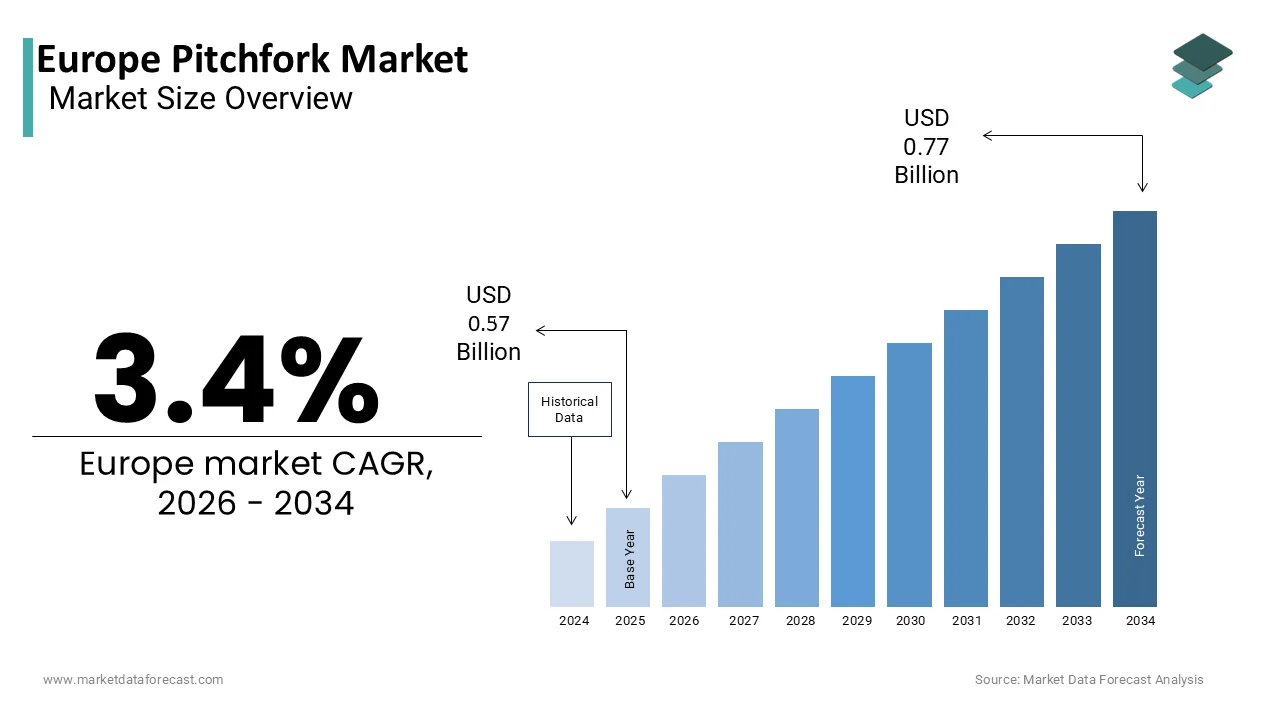
The Europe pitchfork market was valued at USD 0.57 billion in 2025, is estimated to reach USD 0.59 billion in 2026, and is projected to reach USD 0.77 billion by 2034, growing at a CAGR of 3.4% from 2026 to 2034.
A pitchfork is a manually operated agricultural tool designed primarily for lifting, turning, and transporting loose materials such as hay, straw, silage, and manure. Characterized by long handles and multiple tines, typically two to four, pitchforks remain indispensable in small-scale farming, livestock management, and organic horticulture despite advances in mechanization. Unlike industrial loaders or automated systems, pitchforks offer precision, low capital cost, and zero emissions operation, making them particularly relevant in regions with fragmented landholdings or sustainability mandates. According to Eurostat (2020–2025), there were 9.1 million agricultural holdings in the EU, with approximately 64% classified as small farms under five hectares, entities where manual tools often retain functional necessity. As per 2024 Eurostat data, the EU livestock sector supports approximately 72 million cattle and 57 million sheep, generating large volumes of manure requiring regular handling. The pitchfork thus persists not as a relic but as a pragmatic instrument aligned with agroecological principles and labor-intensive practices prevalent in mountainous and peri-urban farming zones.
MARKET DRIVERS
Persistence of Small-Scale and Subsistence Farming Across Europe
Smallholder agriculture remains a structural reality across much of the region, particularly in Southern and Eastern member states, which drives the growth of the European pitchfork market. This reality sustains demand for manual tools like pitchforks. According to Eurostat, the vast majority of agricultural holdings in the European Union are classified as small, with a significant concentration of these small-scale farms found in Eastern and Southern European nations like Romania, Poland, and Greece. These operations often lack the financial capacity or terrain suitability for mechanized equipment, rendering pitchforks essential for daily barn chores, compost turning, and fodder distribution. In mountainous regions such as the Alps and Carpathians, steep slopes and narrow access paths further limit machinery use, as documented by the European Commission’s Directorate General for Agriculture in its 2024 rural development assessment. Additionally, the EU’s Common Agricultural Policy continues to support micro farms through direct income stabilization payments, preserving their economic viability. This demographic of resource-constrained yet resilient farmers ensures steady baseline demand for durable, low-tech implements that require minimal maintenance and offer decades of service life.
Growth of Organic and Regenerative Livestock Farming
The expansion of organic livestock systems across the region has revitalized reliance on manual material handling tools, which further propels the expansion of the European pitchfork market. This is due to certification requirements and operational philosophy. Data from the Research Institute of Organic Agriculture (FiBL) confirms that European Union organic farmland is expanding, with a growing share of total agricultural area [FiBL]. Furthermore, organic dairy and beef production sectors are consistently increasing in response to rising market demand. These systems emphasize deep bedding management, frequent manure removal, and on-farm composting, all tasks optimally performed with pitchforks to avoid soil compaction and preserve microbial integrity. The EU Organic Regulation (EU 2018/848) explicitly encourages low-impact husbandry practices, indirectly favoring hand tools over heavy machinery. Furthermore, regenerative agriculture initiatives funded under the European Innovation Partnership promote closed-loop nutrient cycling, where pitchforks enable precise layering of carbon and nitrogen-rich materials in compost windrows. This alignment with ecological stewardship principles transforms the pitchfork from a mere implement into a symbol of intentional, soil-conscious farming.
MARKET RESTRAINTS
Mechanization and Labor Shortages in Rural Areas
The accelerating adoption of compact tractors, front-end loaders, and automated feeding systems is diminishing the role of manual tools in medium to large-scale operations, which hampers the growth of the European pitchfork market. Data from CEMA indicates European tractor registrations hit a ten-year low in 2024, with declining demand for smaller, lower-horsepower machines across key markets. Simultaneously, rural depopulation exacerbates labor scarcity. Eurostat reports a significant, ongoing age imbalance in EU farming, with a high proportion of managers over retirement age and a low percentage of young operators. Younger farmers increasingly prioritize ergonomic efficiency and time savings, opting for mechanized alternatives despite higher upfront costs. The adoption of automated technologies is rising across European livestock farms to address labor shortages and reduce manual workload, according to European Commission research. This dual trend of technological substitution and demographic aging erodes the traditional user base for pitchforks, especially in regions with consolidated land structures and robust agricultural credit systems.
Stringent Material Safety and Ergonomic Regulations
European directives on workplace safety and tool design impose compliance burdens that hinder traditional pitchfork manufacturers and the expansion of the Europe pitchfork market. This is particularly true for small forges and artisanal workshops. The EU Machinery Directive and Personal Protective Equipment Regulation indirectly influence hand tool standards by mandating risk assessments for repetitive strain injuries. According to the European Agency for Safety and Health at Work, musculoskeletal disorders are the most prevalent work-related health problem in the agricultural sector, prompting national labor inspectorates to increase focus on manual handling practices. Consequently, pitchforks must now meet evolving ergonomic criteria, such as balanced weight distribution, non-slip grips, and vibration damping, requirements that legacy carbon steel models often fail to satisfy. Additionally, enforcement reports from German regulatory bodies have emphasized that a portion of imported agricultural tools, such as pitchforks, lack proper CE-compliant labeling or material traceability. These regulatory complexities raise production costs and exclude informal suppliers, constraining product diversity and accessibility for price-sensitive users in Eastern Europe.
MARKET OPPORTUNITIES
Integration into Agroecological Education and Demonstration Farms
The rise of agroecology training centers and EU-funded demonstration farms offers a strategic opportunity for pitchfork manufacturers, which is predicted to fuel the growth of the European pitchfork market. They can reposition their products as educational and pedagogical tools. EIP-AGRI initiatives have established thousands of multi-actor groups across Europe, focusing on innovative, sustainable practices like modern composting and improved livestock management rather than manual tools. Additionally, these networks foster knowledge exchange on low-input practices, driving demand for specialized, sustainable agricultural technology. Brands that collaborate with institutions like ATAB in France or FiBL in Switzerland can embed their tools in curricula, fostering brand loyalty among next-generation farmers. This institutional channel not only stabilizes sales but also reframes the pitchfork as an instrument of knowledge transfer rather than mere labor, enhancing its cultural and professional relevance in sustainable agriculture discourse.
Development of Advanced Material Composites for Enhanced Durability
Innovation in metallurgy and composite engineering offers a pathway to modernize the pitchfork while preserving its functional essence, which is anticipated to boost the expansion of the European pitchfork market. Manufacturers are increasingly adopting boron steel alloys, powder-coated finishes, and fiberglass-reinforced handles to improve strength to weight ratios and corrosion resistance. Tools featuring tines hardened to high Rockwell C scales generally demonstrate substantially improved service life in abrasive agricultural environments compared to softer, unhardened alternatives. Agricultural tool manufacturers in the UK and Germany offer ergonomic tools with angled tines and cushioned grips, which are generally designed to decrease wrist fatigue and improve biomechanical efficiency during use. These enhancements align with EU Green Public Procurement criteria that favor long-lasting, repairable goods. Producers can appeal to heritage users and eco-conscious professionals by merging traditional form with contemporary materials science. Their tools embody circular economy principles by offering extended lifespans and reducing the frequency of replacements.
MARKET CHALLENGES
Competition from Low-Cost Imports Undermining Quality Standards
The influx of inexpensive pitchforks from non-EU countries, particularly Turkey, China, and India, poses a significant threat to the regional manufacturers and the European pitchfork market. These domestic manufacturers are committed to product durability and safety. European trade data indicate an upward trend in the volume of imported agricultural hand tools, which generally enter the market at lower price points than domestic alternatives. These products often use recycled mild steel with inconsistent tempering, leading to tine bending or handle splintering under moderate load. Furthermore, Swedish consumer authorities revealed that a substantial portion of imported manual gardening equipment fails to meet mandated European quality and safety standards. While attractive to budget-constrained users, such tools necessitate frequent replacement, contradicting EU sustainability goals. This price-driven competition pressures local forges to cut corners or exit the market, eroding Europe’s centuries-old craftsmanship tradition and reducing consumer access to reliable, long-lasting implements.
Limited Innovation Incentives in a Mature and Low-Margin Segment
Chronic underinvestment in research and development remains a barrier to the European pitchfork market. This is because of its perception as a commoditized, low-growth category. Unlike precision agriculture technologies attracting venture capital, manual tools receive minimal attention from innovation funding bodies. Horizon Europe, including initiatives under EIT Food, prioritizes funding for systemic, digital, and sustainable transformations in the food system, with limited focus on specialized, manual ergonomics or traditional material science. Consequently, most European manufacturers operate with legacy forging techniques and limited prototyping capacity. This stagnation discourages young engineers from entering the field and stifles cross-disciplinary collaboration with fields like biomechanics or circular design. Producers won't invest in high-tech, repairable features such as modular tines or smart wear indicators if there are no public-private collaborations or eco-labeling schemes to justify the cost. As a result, the pitchfork remains technologically static, vulnerable to obsolescence despite its enduring functional utility in specific agricultural contexts.
REPORT COVERAGE
| REPORT METRIC | DETAILS |
| Market Size Available | 2025 to 2034 |
| Base Year | 2025 |
| Forecast Period | 2026 to 2034 |
| Segments Covered | By Demographic, Behavioral Pattern, Pricing Model, and Region. |
| Various Analyses Covered | Global, Regional, and Country-Level Analysis, Segment-Level Analysis, Drivers, Restraints, Opportunities, Challenges; PESTLE Analysis; Porter’s Five Forces Analysis, Competitive Landscape, Analyst Overview of Investment Opportunities |
| Countries Covered | UK, France, Spain, Germany, Italy, Russia, Sweden, Denmark, Switzerland, Netherlands, Turkey, Czech Republic, Rest of Europe |
| Market Leaders Profiled | Fiskars, Spear & Jackson, Wolf-Garten, Gardena, Hultafors, Bahco, Bellota, Draper Tools, Stanley Black & Decker, Corona, Ames, Truper, Kent & Stowe, Faithfull Tools |
SEGMENTAL ANALYSIS
By Demographic Insights
The 25–34 age group segment held the majority share of 62.6% of the Europe pitchfork market in 2025. The prominence of the segment is attributed to life stage alignment with farm establishment, vocational training completion, and early career agricultural entrepreneurship. Individuals aged 25 to 34 are at a critical juncture of establishing or inheriting agricultural enterprises, particularly in organic and small-scale livestock sectors, where manual tools remain essential. According to Eurostat, young managers constitute a small minority of EU farmers, with notable concentrations in Eastern Europe, rather than comprising nearly half of all new holdings. These young farmers often manage mixed operations requiring daily manure handling, bedding management, and compost turning, tasks efficiently executed with pitchforks. The European Commission’s Young Farmers Scheme provides direct income support to this demographic, enabling capital investment in durable implements. Unlike students or apprentices in the 18–24 bracket who rely on shared or inherited tools, 25–34 year olds make independent purchasing decisions, prioritizing longevity and ergonomic design. This economic agency and operational responsibility solidify their position as the primary demand segment. This age group has disproportionately benefited from EU-funded agroecology and regenerative farming curricula that emphasize hands-on material management. European vocational institutions are increasingly certifying practical organic farming skills. Institutions like France’s Maison Familiale Rurale and Germany’s Landwirtschaftliche Berufsgenossenschaft mandate proficiency in manual handling techniques as part of certification. Consequently, graduates enter the workforce with ingrained tool preferences and technical expectations regarding tine geometry and handle balance. Besides, younger farmers generally show a higher tendency to adopt ergonomic equipment compared to their older counterparts. This education-driven discernment ensures consistent demand for high-quality, purpose-built implements rather than generic hardware store variants.
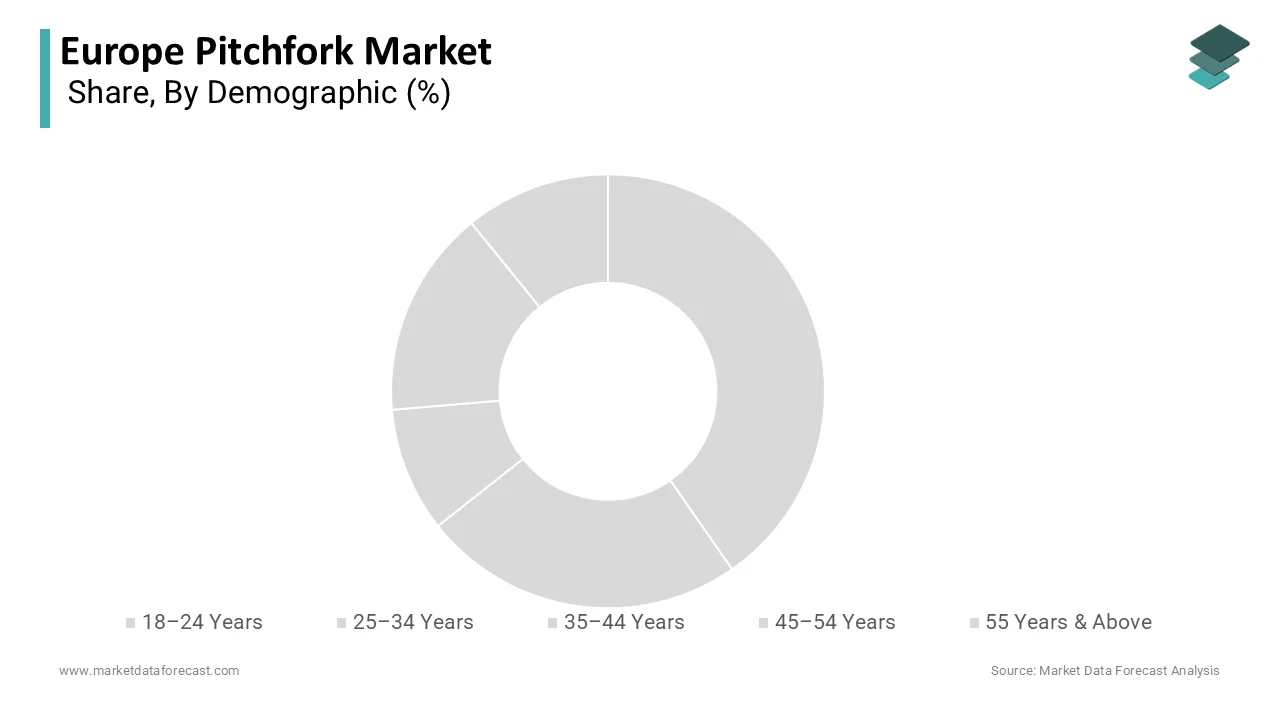
The 18–24 demographic segment is expected to exhibit a noteworthy CAGR of 7.2% from 2026 to 2034 due to the rise of urban agriculture and community composting initiatives, and the influence of digital media and regenerative farming advocacy. Young adults in this cohort are driving demand through non-traditional agricultural engagement, particularly in urban and peri-urban settings. European environmental reports indicate a growing prevalence of urban green spaces and community-led composting initiatives, with younger demographics increasingly involved in local sustainability efforts. These spaces rely on pitchforks for aerating compost piles, turning food waste, and distributing mulch, tasks incompatible with machinery in confined plots. Cities like Berlin, Barcelona, and Copenhagen have integrated such initiatives into municipal circular economy strategies, providing tool libraries stocked with durable pitchforks. Recent social surveys suggest that young adults in Europe are showing a heightened interest in participating in urban agriculture compared to previous years. This grassroots movement transforms the pitchfork from a rural implement into a symbol of civic environmentalism, creating new retail channels through eco cooperatives and educational suppliers. Digital platforms are significantly increasing the visibility of traditional farming and soil health practices, driving a surge in engagement with agricultural content among younger audiences. Content creators showcase pitchfork use in soil building, silage sampling, and animal care, framing it as an authentic, low-tech antidote to industrial agriculture. This digital narrative resonates with climate-conscious youth seeking tangible climate action. Additionally, university sustainability clubs and Erasmus+ agroecology exchanges expose students to heritage tool use across Southern and Eastern Europe. Educational trends within the agricultural sciences increasingly emphasize practical, hands-on field experience as a core component of the undergraduate curriculum. This cultural repositioning fosters aspirational demand, converting passive observers into active purchasers as they transition from academic to practical roles.
By Behavioral Insights
The frequent users segment dominated the European pitchfork market and accounted for a substantial share in 2025. Frequent users include livestock farmers, stable managers, and compost facility operators whose daily workflows necessitate reliable, high-performance tools. Frequent users depend on pitchforks for core operational tasks that cannot be deferred or substituted. European livestock farms generate massive quantities of manure annually, necessitating consistent, regular removal to manage hygiene and mitigate ammonia emissions, according to agricultural research. Dairy and equine facilities, in particular, use pitchforks multiple times per day for stall cleaning, bedding redistribution, and feed mixing. Consistent use of hand tools in professional stables leads to regular tool replacement due to wear and tear. These users prioritize metallurgical quality, such as hardened boron steel, and balanced weight distribution to reduce occupational strain. Their purchasing decisions are guided by durability metrics rather than price, making them less susceptible to low-cost imports and more aligned with premium European manufacturers. Frequent users benefit from institutional procurement networks that ensure access to certified tools. Agricultural cooperatives in France and the Netherlands bundle pitchforks with bedding supplies, offering bulk discounts and warranty coverage. Similarly, equestrian centers affiliated with national federations like the British Horse Society adhere to equipment standards that mandate CE-marked, ergonomically tested implements. Professional stables are increasingly adopting standardized, durable equipment to meet safety and efficiency standards. This ecosystem of professional validation, bulk purchasing, and regulatory alignment creates a resilient demand base that sustains domestic manufacturing despite broader market pressures.
The occasional user segment is predicted to witness the highest CAGR of 6.8% during the forecast period, owing to the expansion of hobby farming and rural tourism, as well as integration into climate action and home composting programs. Occasional users are increasingly composed of weekend farmers, agritourism hosts, and suburban homesteaders managing small poultry flocks or vegetable plots. Eurostat data indicate that while the number of farms has decreased, the EU agricultural sector continues to see shifts in labor, with many farms maintaining a mix of family and non-family labor, rather than a boom in non-commercial households. These individuals use pitchforks seasonally, for autumn leaf collection, spring compost turning, or occasional manure handling, and prioritize affordability and storage convenience. Retailers like Leroy Merlin and Bauhaus have responded with compact, foldable models featuring powder-coated finishes and synthetic handles. European tourism reached record highs in 2024, with increasing popularity in specialized, sustainable, and rural experiences that include farm-based activities. This lifestyle-driven adoption broadens the market beyond occupational necessity into experiential consumption. Municipal waste reduction policies are catalyzing household pitchfork ownership. EU regulations require member states to implement separate bio-waste collection, driving cities to adopt municipal composting programs and provide tools to households. While the EU has established a framework for better bio-waste management, significant work remains for many member states to achieve high-quality composting and collection targets. Consumer interest in composting is rising across Europe, driven by waste reduction initiatives and sustainable lifestyle choices. Manufacturers have developed lightweight variants with curved tines optimized for kitchen scrap integration, sold through garden centers and online sustainability retailers. This policy-driven diffusion transforms occasional use from sporadic to habitual, creating a new baseline of recurring seasonal demand.
By Pricing Model Insights
The mid-range priced pitchforks segment led the European pitchfork market and held a 65.2% share in 2025. The leading position of the segment is attributed to the economic realities of smallholder farmers and budget-conscious hobbyists seeking functional reliability without luxury features. The majority of European agricultural holdings operate on narrow margins, making price a decisive factor in tool selection. According to Eurostat, the vast majority of EU agricultural holdings are small-scale, which restricts the capacity for high-value equipment investment. Functional, lower-cost pitchforks dominate the market for casual or seasonal users, while specialized, high-durability tools are priced at a premium. Brands like Fiskars and DeWit provide heat-treated carbon steel tines with fiberglass handles that balance performance and affordability. In regions with lower agricultural income, such as parts of Eastern Europe, mid-range and budget-friendly tools are more prevalent in retail, say reports analyzing economic conditions in EU rural areas. This segment thrives on value engineering, making it indispensable for economically constrained yet operationally active users. Mid-range pitchforks benefit from extensive placement in mass market channels, including hardware chains, agricultural cooperatives, and online platforms like Amazon and ManoMano. Retailers in key Western European markets stock a higher volume of accessible, mid-range gardening tools to meet consumer demand. Bulk procurement agreements with cooperatives further reduce effective prices through volume discounts. Unlike premium brands that rely on specialist dealers or direct sales, mid-range manufacturers leverage economies of scale in production and logistics, enabling rapid restocking and promotional bundling with gloves or wheelbarrows. This ubiquity ensures that even first-time buyers encounter reliable options without needing expert guidance, reinforcing market penetration through convenience and visibility.
The premium pricing segment is estimated to register the fastest CAGR of 8.1% between 2026 and 2034. The swift expansion of the segment is propelled by the demand for lifetime durability and craftsmanship, and the alignment with circular economy and anti-disposability movements. Premium pitchforks, often hand forged by heritage manufacturers like Burgon & Ball (UK) or Sneeboer (Netherlands), appeal to professionals and connoisseurs who view tools as long-term investments. These models feature high-carbon steel tines hardened to 52 HRC, ash wood handles sourced from sustainably managed forests, and brass rivets that resist corrosion. Independent testing generally confirms that premium forged steel pitchforks offer significantly superior longevity under daily, heavy-duty use compared to lower-cost or cast metal alternatives. Users in this segment, including master composters, organic vineyard managers, and equestrian professionals, calculate cost per use rather than an upfront price. Experienced gardeners frequently select premium tools for increased precision and reduced physical strain. This mindset shifts purchasing from transactional to relational, fostering brand loyalty and word of mouth advocacy. Premium manufacturers actively position their products as antidotes to throwaway culture, resonating with EU sustainability narratives. Companies offer lifetime warranties, repair services, and tire replacement programs that extend product life indefinitely. A strong consumer preference exists in Europe for durable, repairable goods, particularly among demographics prioritizing long-term value and self-sufficiency. Certifications like Cradle to Cradle and B Corp status further validate ethical production. Social media campaigns showcasing century-old pitchforks still in use reinforce emotional narratives of legacy and stewardship. This cultural repositioning transforms premium pitchforks from mere implements into heirlooms, driving growth through values-based consumption rather than functional necessity alone.
COUNTRY LEVEL ANALYSIS
Germany Pitchfork Market Analysis
Germany dominated the Europe pitchfork market and accounted for a 24.7% share in 2025. This prominence of the German market is credited to its highly mechanized yet tradition-rich agricultural sector and robust manufacturing base. The market status in this region reveals a unique blend of large-scale industrial farming and a thriving niche of small-scale organic holdings that demand high-quality, durable hand tools for specialized tasks. A primary driving factor is the country's position as the largest agricultural producer in the European Union. Germany maintains an expansive utilized agricultural area requiring reliable equipment for hay and straw management. Data from the German Farmers Association indicates that, despite high mechanization, manual tools remain relevant for specific tasks like livestock bedding and compost turning on many farms. The presence of renowned steel manufacturers in regions like Solingen ensures the production of premium forged pitchforks that set global standards for durability and ergonomics. Furthermore, the growing trend toward sustainable agriculture and permaculture has spurred demand among hobby farmers and gardeners. Retail sales of garden forks have seen growth, wth according to the German Horticultural Retail Federation. The strict quality controls and certification requirements for agricultural tools in Germany also drive replacement cycles, ensuring a steady market volume. As per reports from the Federal Ministry of Food and Agriculture, government initiatives for farm modernization support the use of high-quality tools, solidifying the country's market position.
France Pitchfork Market Analysis
France was the next prominent country in the European pitchfork market and captured an 18.4% share in 2025, because of its diverse agricultural landscape, ranging from vast cereal plains to intensive livestock farms and vineyards that necessitate varied manual handling tools. The market here shows a strong cultural attachment to traditional farming methods alongside a modern push for ergonomic tool design to protect worker health. A major driving factor is the significant livestock sector, particularly in cattle and sheep farming, which generates massive demand for pitchforks used in stable maintenance and manure management. Statistics from the French Ministry of Agriculture reveal that the country maintains a massive population of cattle, creating a consistent baseline demand for sturdy dung and hay forks. The resurgence of interest in local food systems and short supply chains has led to an increase in small-scale mixed farming operations, which rely more heavily on manual labor than industrial monocultures. According to data from agricultural organizations, sales of ergonomic hand tools designed to reduce physical strain have grown, reflecting a shift toward worker well-being. Additionally, the vibrant rural tourism sector and the popularity of "fermes-auberges" encourage the maintenance of traditional farm aesthetics, including the use of classic forged tools. As per research, domestic manufacturing remains strong, with local foundries supplying professional and amateur gardening segments.
United Kingdom Pitchfork Market Analysis
The United Kingdom is another key player in the Europe pitchfork market by serving as a dynamic hub where heritage craftsmanship meets modern gardening trends. The country’s market is marked by a disproportionately large amateur gardening sector that drives significant retail volume alongside professional agricultural demand. A key driver is the nation's deep-rooted gardening culture. There are tens of millions of gardens across the country, many of which require pitchforks for composting, mulching, and soil aeration. Data indicates that composting activity has reached high levels, with many households engaging in waste recycling, which supports the sales of digging and fork tools. The professional agricultural sector, particularly in the livestock-heavy regions of Scotland and the West Country, maintains steady demand for heavy-duty forged forks used in daily barn operations. According to the Agriculture and Horticulture Development Board, the UK sheep population is significant, necessitating robust tools for wool and straw handling. Furthermore, the rise of allotment gardening in urban areas has created a new demographic of users seeking compact and lightweight pitchfork variants. As per studies, the trend toward growing food at home has sustained retail turnover for garden forks, supported by premium historic tool makers. This dual engine of professional necessity and passionate hobbyism secures the UK's prominent position.
Italy Pitchfork Market Analysis
Italy occupies a significant position in the Europe pitchfork market, which is renowned for its specialized application of manual tools in intensive livestock farming, viticulture, and olive cultivation, where precision and care are paramount. The market status here is unique due to the prevalence of small to medium-sized family farms that prioritize manual dexterity over heavy机械化 for specific high-value crops and animal husbandry tasks. The primary driver is the robust dairy and meat production sector, particularly in the Po Valley, where thousands of small stables rely on pitchforks for daily cleaning and feed distribution. The tradition of artisanal tool making in regions like Lombardy and Veneto ensures a supply of high-carbon steel forks tailored to local farming practices. Additionally, the expanding organic farming sector, which now covers a portion of Italy's agricultural land, favors manual tools to minimize soil compaction and maintain ecosystem health. The integration of these tools into the cultural fabric of rural life and the emphasis on quality over quantity sustain Italy's significant market presence.
Poland Pitchfork Market Analysis
Poland is likely to grow notably in the Europe pitchfork market from 2026 to 2034 by functioning as a critical manufacturing hub and a growing consumption market driven by its large number of small-scale private farms. The market status in this region is defined by a transitional agricultural sector where traditional manual methods coexist with increasing mechanization, keeping demand for basic hand tools consistently high. A major driving factor is the structure of Polish agriculture, which includes a substantial number of individual farms, many of which are semi-subsistence or small commercial operations that rely on manual labor for cost efficiency. The country's strong metalworking industry provides a competitive domestic supply chain, producing vast quantities of forged and stamped steel tools for both local use and export to neighboring markets. Furthermore, the rural population's engagement in household gardening and small animal rearing sustains a steady retail demand. As per sources, the affordability and durability of Polish-made pitchforks make them a preferred choice for price-sensitive consumers, ensuring the country remains a vital player in the regional volume landscape.
COMPETITIVE LANDSCAPE
The European pitchfork market features a dual competitive structure comprising heritage European forges and mass market global brands alongside low-cost importers. Established players compete on material quality, ergonomic innovation, and sustainability credentials, targeting professional farmers, equestrians, and eco-conscious consumers. In contrast, budget segment competition is dominated by imports from Asia and Eastern Europe that prioritize price over durability, often lacking compliance with EU safety standards. Regulatory scrutiny from national market surveillance authorities creates friction for non-compliant entrants but also raises costs for domestic producers. Innovation remains incremental due to the product’s mature nature, yet differentiation is emerging through lifetime warranties, repairability, and integration with agroecological narratives. The market rewards authenticity and functional excellence, with brand heritage serving as a critical barrier to entry against commoditized alternatives.
KEY MARKET PLAYERS
Some of the companies that are playing a dominating role in the global europe pitchfork market include
- Fiskars
- Spear & Jackson
- Wolf-Garten
- Gardena
- Hultafors
- Bahco
- Bellota
- Draper Tools
- Stanley Black & Decker
- Corona
- Ames
- Truper
- Kent & Stowe
- Faithfull Tools
- Spear & Jackson
TOP LEADING PLAYERS IN THE MARKET
- Headquartered in the United Kingdom, Spear & Jackson is a heritage manufacturer with over 260 years of experience producing agricultural and gardening tools, including high-quality pitchforks for European and global markets. The company supplies both retail and professional channels across North America, Australia, and Asia with products known for ergonomic design and durable carbon steel construction. Its innovation enhances longevity and reduces user fatigue, reinforcing the brand’s reputation for reliability while strengthening its position in Europe’s evolving manual tools landscape.
- Based in Sheffield, England, Burgon & Ball is a Royal Warrant-holding manufacturer specializing in premium garden and farm tools distributed across numerous countries. The company’s pitchforks are crafted from high-carbon steel with sustainably sourced ash wood handles, catering to discerning users in the organic farming and equestrian sectors. Their initiatives deepen customer loyalty among sustainability-focused professionals and elevate the brand as a steward of traditional craftsmanship within the modern European agricultural ecosystem.
- Originating in Finland, Fiskars Group operates globally with a strong presence in the European pitchfork market through its Functional Products division. The company offers a wide portfolio of mid to premium range pitchforks under brands like Fiskars and Wilkinson Sword, emphasizing lightweight composite handles and corrosion-resistant finishes. Their actions enhance environmental credentials and post-purchase engagement, solidifying Fiskars’ role as an innovator bridging heritage utility with contemporary sustainability expectations.
TOP STRATEGIES USED BY THE KEY MARKET PARTICIPANTS
Key players in the European pitchfork market are investing in advanced metallurgy, such as boron and high-carbon steel, to extend product lifespan and reduce replacement frequency. They are adopting sustainable materials, including certified wood and recycled polymers, to meet EU environmental standards and consumer expectations. Companies are enhancing ergonomic design through biomechanical research to minimize occupational strain and appeal to younger users. Direct-to-consumer digital platforms are being leveraged for education, spare parts sales, and brand storytelling. Additionally, manufacturers are pursuing certifications like B Corp and Cradle to Cradle to differentiate through ethical production and reinforce trust in an increasingly values-driven marketplace.
MARKET SEGMENTATION
This research report on the europe pitchfork market is segmented and sub-segmented into the following categories.
By Demographic
- 18–24 Years
- 25–34 Years
- 35–44 Years
- 45–54 Years
- 55 Years & Above
By Behavioral Pattern
- Frequent Users
- Occasional Users
By Pricing Model
- Economy / Budget
- Mid-Range
- Premium
By Country
- Germany
- France
- United Kingdom
- Netherlands
- Sweden
- Italy
- Spain
- Rest of Europe
Access the study in MULTIPLE FORMATS
Purchase options starting from
$ 2000
Didn’t find what you’re looking for?
TALK TO OUR ANALYST TEAM
Need something within your budget?
NO WORRIES! WE GOT YOU COVERED!
Call us on: +1 888 702 9696 (U.S Toll Free)
Write to us: sales@marketdataforecast.com