Latin America Smartphone Market Size, Share, Trends & Growth Forecast Report By Operating System (Android, iOS, Windows, Others (Linux)), By Distribution Channel (OEMs Stores, Retailer, E-Commerce), and By Country (Brazil, Mexico, Argentina, Chile, Rest of Latin America) – Industry Analysis, 2026 to 2034
Latin America Smartphone Market Size
The Latin America smartphone market was valued at USD 47.60 billion in 2025, is estimated to reach USD 51.85 billion in 2026, and is projected to reach USD 102.79 billion by 2034, growing at a CAGR of 8.93% from 2026 to 2034.

The smartphone is designed, distributed, sold, and used in mobile computing devices with advanced operating systems, connectivity, and application capabilities across 20 countries in the region, from Mexico to Argentina. Mobile networks cover over 95% of the region’s population, as reported by the International Telecommunication Union, yet rural connectivity remains inconsistent, with only 52% of remote communities having reliable 4G access, as noted by the Economic Commission for Latin America and the Caribbean (ECLAC).
MARKET DRIVERS
Expansion of Digital Financial Services and Mobile Banking
The rapid adoption of fintech and mobile banking platforms is accelerating the growth of the Latin America smartphone market. In Brazil alone, Nubank serves more than 80 million customers, all of whom require smartphones to access its services, as confirmed by the Central Bank of Brazil. Similarly, Mexico’s government-operated digital wallet, Bienestar, mandates smartphone use for beneficiaries of social programs, which is reaching over 20 million low-income users. This shift toward digital finance is transforming smartphones from communication tools into essential instruments for economic participation among unbanked populations.
Proliferation of Remote Work and Digital Education Models
The institutionalization of remote work and e-learning has significantly increased the necessity of smartphone ownership for workforce and academic engagement. As per the International Labour Organization, 32% of formal sector employees in Latin America continue to work remotely at least part-time, a trend sustained beyond the pandemic in countries like Chile and Costa Rica. In education, UNESCO indicates that over 70 million students in the region relied on mobile devices for distance learning during school closures, and hybrid models remain prevalent. Additionally, platforms like Google Classroom and Zoom are now embedded in secondary and tertiary curricula, which require reliable smartphone access.
MARKET RESTRAINTS
High Import Tariffs and Taxation on Electronic Devices
The imposition of high import duties and indirect taxes on electronic goods is restricting the growth of the Latin America smartphone market. According to the United Nations Economic Commission for Latin America and the Caribbean, import tariffs on smartphones range from 10% to 25% across countries such as Argentina, Ecuador, and Venezuela, while value-added taxes (VAT) often exceed 19%. In Argentina, total effective taxation on mid-range smartphones can reach 45%, as reported by the Argentine Chamber of Electronics and Computing. These levies inflate retail prices, making even entry-level devices unaffordable for large segments of the population. The Inter-American Development Bank notes that in Bolivia, the average cost of a basic smartphone equals 42% of the monthly minimum wage, compared to 12% in South Korea.
Persistent Income Inequality and Informal Employment
The widespread economic disparity and a large informal labor sector constrain consumer purchasing power is also hindering the growth of the Latin America smartphone market. As per the World Bank, over 30% of Latin America’s workforce operates in the informal economy, lacking stable income and access to credit, which hinders device acquisition. In Guatemala and Honduras, informal employment exceeds 70%, according to the International Labour Organization, where workers often lack the financial predictability to invest in durable technology. A 2023 study by the University of São Paulo found that 45% of low-income households in Northeast Brazil share a single smartphone among multiple users, indicating constrained ownership capacity. These socioeconomic realities limit the scalability of premium device markets and reinforce dependency on low-cost, second-hand models.
MARKET OPPORTUNITIES
Growth of Localized Content and Regional App Ecosystems
The emergence of culturally relevant digital content and homegrown mobile applications is creating new opportunities for the growth of Latin America smartphone market. According to AppsFlyer, local app downloads in the region grew by 38% between 2021 and 2023, outpacing global averages, driven by music streaming platforms like Resso and regional social networks such as Codigo Postal. Additionally, indigenous language apps in Quechua and Guarani are being developed in Peru and Paraguay, increasing digital inclusion. This cultural resonance is transforming smartphones into personalized tools for identity, commerce, and community by encouraging first-time adoption among previously disengaged populations.
Expansion of Affordable 4G and 5G Infrastructure
The ongoing rollout of cost-effective 4G networks and early-stage 5G deployment is enhancing connectivity is additionally to fuel the growth of the Latin America smartphone market. As per the GSMA, 4G coverage now reaches 85% of Latin America’s population, up from 60% in 2018, with mobile data prices decreasing by 40% over the same period. Countries like Uruguay and Chile offer some of the most affordable data plans in the developing world, averaging $2.50 per gigabyte, according to the Alliance for Affordable Internet. In Brazil, the 5G network launched in 2022 now covers 1,200 municipalities by enabling high-speed applications in telemedicine and remote education.
MARKET CHALLENGES
E-Waste Management and Environmental Sustainability Gaps
The environmental degradation due to inadequate e-waste recycling infrastructure is limiting the growth of Latin America smartphone market. According to the United Nations University, the region generates over 2.5 million metric tons of electronic waste annually, yet less than 15% is formally recycled, with the remainder ending up in landfills or informal dismantling sites. In Mexico, only 8% of discarded smartphones are processed through regulated channels, as reported by the Ministry of Environment and Natural Resources. Informal recycling practices in cities like Lima and Bogotá expose workers to hazardous materials such as lead and mercury. As per the Pan American Health Organization, e-waste contamination has led to elevated blood lead levels in children near unregulated dumpsites.
Cybersecurity Threats and Digital Fraud Vulnerability
The rise in digital fraud and cyberattacks is degrading consumer trust, which may additionally hamper the growth of Latin America smartphone market. In Argentina, 38% of smartphone users have encountered fraudulent apps mimicking banks, as found by the National Cybersecurity Directorate. The Inter-American Development Bank notes that fear of fraud deters 29% of unbanked adults from using financial apps, even when devices are available. The cybersecurity risks pose a systemic barrier to the safe and inclusive expansion of the smartphone ecosystem without robust consumer protection frameworks and public awareness campaigns.
REPORT COVERAGE
| REPORT METRIC | DETAILS |
| Market Size Available | 2025 to 2034 |
| Base Year | 2025 |
| Forecast Period | 2026 to 2034 |
| Segments Covered | By Operating System, Distribution Channel, and Region. |
| Various Analyses Covered | Global, Regional, and Country-Level Analysis, Segment-Level Analysis, Drivers, Restraints, Opportunities, Challenges; PESTLE Analysis; Porter’s Five Forces Analysis, Competitive Landscape, Analyst Overview of Investment Opportunities |
| Countries Covered | Brazil, Mexico, Argentina, Chile, Rest of Latin America |
| Market Leaders Profiled | Samsung Electronics Co. Ltd, Huawei Technologies Co. Ltd, Apple Inc., Xiaomi Corporation, BBK Electronics Corporation, Lenovo Group Limited, HTC Corporation, HMD Global Oy, Sony Corporation, ZTE Corporation, Google LLC, and Others. |
SEGMENTAL ANALYSIS
By Operating System Insights
The Android operating system dominated the Latin America smartphone market by capturing a dominant share in 2025 with the platform’s adaptability to diverse price segments and its integration with low-cost device manufacturing. The open-source nature of Android enables local and regional brands such as Positivo in Brazil and Movilmax in Mexico to customize firmware and pre-install region-specific applications, enhancing user relevance. Google’s ecosystem encompasses Maps, YouTube, and mobile banking apps, which are deeply embedded in daily digital life across the region. The widespread availability of affordable smartphones from diverse manufacturers is accelerating the growth of the Latin America smartphone market. Additionally, telecom operators across the region bundle Android phones with data plans is additionally enhancing the growth of the Latin American smartphone market. This ecosystem of affordability, customization, and carrier support ensures Android remains the foundational platform for mobile connectivity in Latin America.
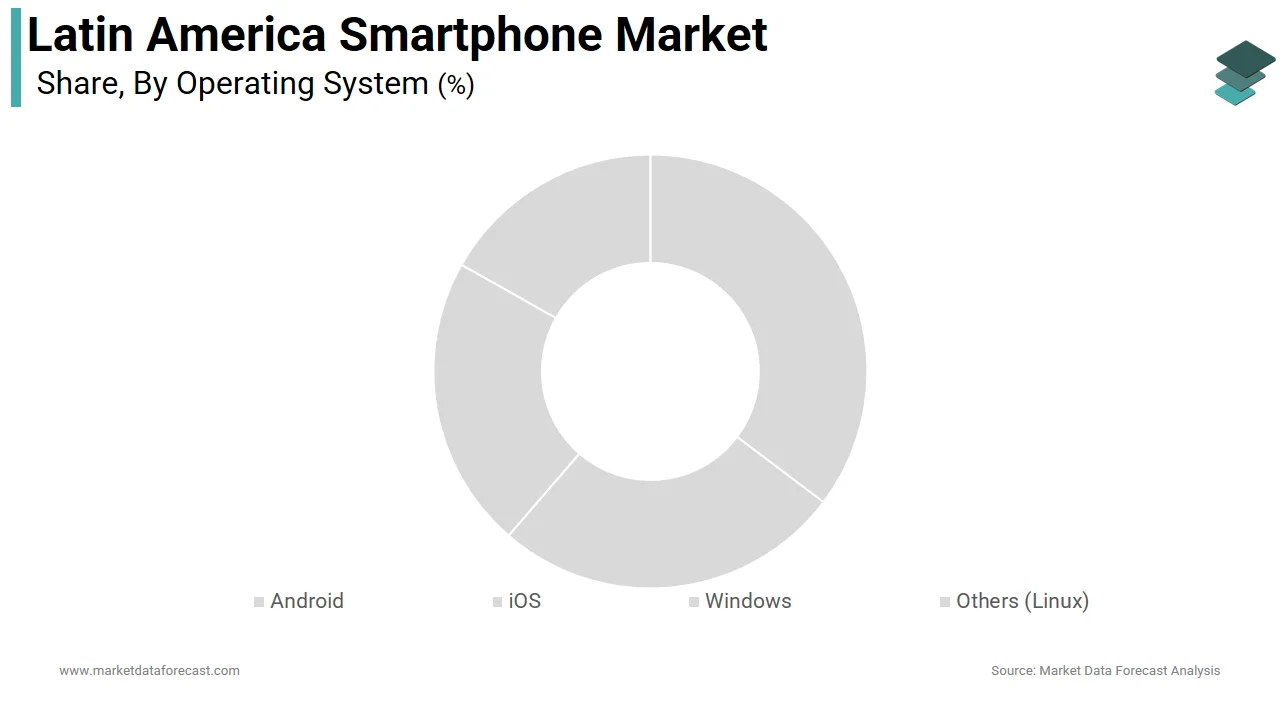
The iOS segment is anticipated to witness a significant CAGR of 9.4% in the coming years. Apple’s iPhone has become a status symbol and financial asset in many urban centers, where resale values remain high. The increasing availability of financing and trade-in programs is additionally to enhance the growth of the Latin America smartphone. Additionally, Apple’s localized services such as Apple Music with regional content and iCloud integration with local banking apps are improving user retention.
By Distribution Channel Insights
The retailer segment was the largest and held 52.3% of the Latin America smartphone market share in 2024, with the continued reliance on physical stores for device evaluation, instant ownership, and post-purchase support, particularly in markets with low digital trust and limited credit infrastructure. Major electronics chains such as Falabella in Chile, Magazine Luiza in Brazil, and El Palacio de Hierro in Mexico serve as primary sales points by offering bundled financing and carrier integration. In addition, the integration of retail networks with carrier partnerships and consumer financing is leveraging the growth of the Latin America smartphone market.
The e-Commerce segment is projected to grow at a CAGR of 13.8% during the forecast period, with improved logistics, digital payment adoption, and shifting consumer behavior toward online shopping. In 2023, e-commerce accounted for 28% of smartphone sales in the region, up from 16% in 2020, according to Mercado Libre’s annual market report. Platforms like Mercado Libre, Amazon Mexico, and Magalu Digital have optimized delivery networks, reducing average delivery times to under five days in major cities. Additionally, social commerce via WhatsApp and Instagram has surged, with 40% of millennials in Mexico purchasing smartphones through direct merchant chats, as reported by NielsenIQ. These infrastructural and behavioral shifts are transforming e-commerce into the most dynamic sales channel in the smartphone market.
COUNTRY-LEVEL ANALYSIS
Brazil Smartphone Market Insights
Brazil was the top performer of the Latin America smartphone market by occupying 34.3% of the market share in 2024. Its vast population of over 215 million, combined with a relatively mature digital economy, creates sustained demand across urban and emerging markets. In 2023, Brazil recorded 48 million smartphone shipments, with Android devices accounting for 89%, according to IDC Brazil. The country’s retail ecosystem, led by chains like Casas Bahia and Fast Shop, dominates sales, while e-commerce platforms such as Mercado Livre are expanding rural reach.
Mexico Smartphone Market Insights
Mexico was positioned second by holding 21.2% of the Latin America smartphone market share in 2024, with the strategic location, large youth population, and growing middle class sustaining robust demand for mobile technology. The country has become a key assembly hub, with manufacturing zones in Baja California and Nuevo León producing devices for both domestic and export markets.
Argentina Smartphone Market Insights
Argentina smartphone market growth is likely to grow with a significant CAGR during the forecast period. Local brands like BGH and Samsung dominate retail channels, while online platforms such as Fravega and Mercado Libre have expanded financing options. The Ministry of Productive Development notes that 4G coverage reached 88% of the population, with 5G trials underway in Buenos Aires.
COMPETITION OVERVIEW
Competition in the Latin America smartphone market is defined by a dynamic interplay between global brands and regional economic realities, where affordability, network compatibility, and after-sales service determine market success. Samsung leads with a broad product range and deep retail integration, while Apple focuses on premium branding and ecosystem stickiness despite high pricing. Chinese manufacturers like Xiaomi and Realme challenge incumbents with value-driven models in Brazil and Mexico.
KEY MARKET PLAYERS
Some of the noteworthy companies in the Latin America Smartphone market profiled in this report are
- Samsung Electronics Co. Ltd
- Huawei Technologies Co. Ltd
- Apple Inc.
- Xiaomi Corporation
- BBK Electronics Corporation
- Lenovo Group Limited
- HTC Corporation
- HMD Global Oy
- Sony Corporation
- ZTE Corporation
- Google LLC
TOP LEADING PLAYERS IN THE MARKET
- Samsung Electronics maintains a dominant player in the Latin America smartphone market through a diversified portfolio spanning entry-level to premium devices tailored to regional consumer behavior. The company has strengthened its footprint by launching budget-friendly Galaxy A and M series models preloaded with localized apps such as Rappi, Mercado Pago, and Glovo by enhancing user relevance. In 2023, Samsung expanded its service network to over 500 authorized repair centers across Brazil, Mexico, and Colombia, improving after-sales reliability. It also partnered with Claro and Movistar to offer exclusive trade-in programs and installment plans, increasing affordability. In education, Samsung collaborated with ministries in Chile and Peru to supply Galaxy Tab devices for digital learning initiatives. Its investment in 5G-ready mid-tier smartphones, such as the Galaxy A54, aligns with regional network upgrades, ensuring long-term device compatibility and reinforcing brand loyalty across urban and emerging markets.
- Apple has intensified its strategic engagement in Latin America by adapting its distribution, financing, and ecosystem integration to overcome economic and logistical barriers. Although premium-priced, the iPhone has gained traction through expanded carrier partnerships and flexible payment options; in Brazil, Apple launched 24-month interest-free financing via Itaú and Bradesco in 2023, significantly broadening access. The company opened its first official online store for Latin America in 2022, covering ten countries and enabling direct sales with localized tax handling. Apple also enhanced iCloud integration with regional banking and identity systems, such as Mexico’s CUIT and Brazil’s CPF, improving user onboarding.
- Motorola Solutions (under Lenovo) has reasserted its influence in Latin America by leveraging legacy brand recognition and aggressive pricing in the mid-to-low smartphone segment. The company’s Moto G and Moto E series remain top sellers in countries like Argentina, Colombia, and Peru due to their durability, clean Android experience, and affordability. In 2023, Motorola launched the Moto G Power series with extended battery life, specifically designed for areas with unreliable electricity, a feature validated by user demand in rural Mexico and the Andean region. It also partnered with Telecom Argentina and Entel in Chile to bundle devices with data plans by enhancing affordability. Motorola’s localized marketing campaigns in regional Spanish dialects and Portuguese have strengthened consumer connections.
TOP STRATEGIES USED BY THE KEY MARKET PARTICIPANTS
Key players in the Latin America smartphone market are deploying localized product development, carrier and retail partnerships, flexible financing models, ecosystem integration, and expansion of after-sales service networks to consolidate their positions. Strategic alliances with telecom operators enable bundled plans and subsidized pricing, crucial in markets with low credit penetration. E-commerce optimization and last-mile delivery enhancements are accelerating online sales. Firms are also investing in localized customer support and repair infrastructure to reduce churn. Additionally, integration with regional fintech, social, and government digital platforms strengthens device utility and brand loyalty by ensuring sustainable engagement in a highly competitive and economically diverse landscape.
RECENT MARKET DEVELOPMENTS
- In January 2023, Samsung launched the Galaxy A14 5G across ten Latin American countries, featuring extended battery life and optimized performance for streaming services popular in the region, thereby enhancing appeal among young, data-intensive users.
- In June 2023, Apple introduced 24-month interest-free financing for iPhone purchases in Brazil through partnerships with Itaú and Bradesco, which significantly improved affordability and expanded access to its premium devices.
- In September 2023, Motorola partnered with Telecom Argentina to offer exclusive bundled plans combining Moto G smartphones with unlimited data, with its presence in the postpaid segment and increasing customer retention.
- In February 2024, Xiaomi expanded its Mi Store network to 30 new cities in Mexico and Colombia by enhancing physical retail visibility and providing localized customer support to compete with established brands.
- In May 2024, Google collaborated with Mercado Libre to pre-install Android-based financial and delivery apps on Pixel devices sold in Chile and Peru, which is deepening ecosystem integration and improving user onboarding in the Latin America smartphone market.
MARKET SEGMENTATION
This Latin America Smartphone market research report is segmented and sub-segmented into the following categories.
By Operating System
- Android
- iOS
- Windows
- Others (Linux)
By Distribution Channel
- OEMs Stores
- Retailer
- E-Commerce
By Country
- Brazil
- Mexico
- Argentina
- Chile
- Rest of Latin America
Frequently Asked Questions
1. What is the Latin America Smartphone Market?
The Latin America Smartphone Market covers the sales, distribution, and trends of smartphones, operating systems, and vendor competition across key markets such as Brazil, Mexico, Argentina, and Colombia
2. Who are the leading smartphone brands in the Latin America Smartphone Market?
Leading brands include Samsung (32.4% market share), Motorola (16.2%), Apple (15.8%), and Xiaomi (13.7%), with HONOR gaining ground as a major competitor
3. How is 5G adoption progressing in the Latin America Smartphone Market?
5G penetration is expected to reach 53% of all mobile connections by 2030, with 30+ operators launching services and consumer migration to affordable 5G smartphones accelerating
4. What factors are influencing smartphone shipments in Latin America?
Factors include currency volatility, inflation, e-commerce growth, ongoing macroeconomic pressures, channel promotions, and increased urban smartphone adoption
5. What role does e-commerce play in the Latin America Smartphone Market?
E-commerce is a key sales driver, with more consumers buying smartphones through digital retailers, supporting brands’ direct-to-customer strategies
6. How is the average selling price (ASP) trending in the Latin America Smartphone Market?
Vendors are introducing AI features into mid- and entry-level models, maintaining competitive ASPs while expanding value options and driving volume
7. How do smartphone replacement cycles affect the Latin America Smartphone Market?
Replacement cycles lengthened in 2025, with consumers postponing upgrades due to higher device prices and global economic uncertainty
8. What is the impact of global supply chain and inventory adjustments in 2025?
Vendors such as Transsion saw channel slowdowns and inventory corrections, illustrating broader global supply chain impacts on LATAM shipments
9. What are the key consumer trends in the Latin America Smartphone Market?
Consumers are increasingly favoring affordable models with AI and camera features, longer battery life, and are influenced by aggressive retail promotions
10. Which countries represent the largest markets in the Latin America Smartphone Market?
Brazil and Mexico are the largest markets, followed by Colombia, Argentina, and Chile, each with unique regional sales drivers and vendor shares
Related Reports
Access the study in MULTIPLE FORMATS
Purchase options starting from
$ 1600
Didn’t find what you’re looking for?
TALK TO OUR ANALYST TEAM
Need something within your budget?
NO WORRIES! WE GOT YOU COVERED!
Call us on: +1 888 702 9696 (U.S Toll Free)
Write to us: sales@marketdataforecast.com