Latin America Incontinence Pads Market Size, Share, Trends, COVID-19 Impact & Growth Analysis Report – Segmented By Product Type (Heavy Absorbency, Moderate Absorbency, Light Absorbency), Consumer and End-User, Distribution Channel & Country (Mexico, Brazil, Argentina, Chile and Rest of Latin America) - Industry Analysis From 2026 to 2034
Latin America Incontinence Pads Market Size
The Latin America incontinence pads market size was valued at USD 945.63 million in 2025 and is anticipated to reach USD 994.24 million in 2026 from USD 1484.69 million by 2034, growing at a CAGR of 5.14% during the forecast period from 2026 to 2034.

Incontinence pads are absorbent hygiene products specifically engineered to manage urinary incontinence among adults and elderly populations. These products, distinct from menstrual pads, are designed with advanced fluid-locking polymers, odor control technologies, and skin-friendly materials to ensure comfort, dignity, and prolonged wear. The rising prevalence of age-related and chronic health conditions is reshaping demand, particularly as Latin America undergoes a demographic transition marked by increasing life expectancy. According to the United Nations Population Division, the number of individuals aged 60 and above in Latin America is projected to double from 83 million in 2020 to over 170 million by 2050. This silent public health issue, compounded by limited access to pelvic floor therapy and urological care, has elevated the importance of discreet, reliable incontinence management solutions across both home and institutional settings.
MARKET DRIVERS
Accelerating Population Aging and Elderly Care Needs
The rapid aging of Latin America’s population is a primary catalyst for the growing demand for incontinence pads. Also, the proportion of people aged 60+ in the region is increasing, the fastest in the developing world. In Chile, adults over 65 now constitute 17.4% of the population, according to the National Institute of Statistics, placing immense pressure on long-term care infrastructure. Urinary incontinence affects a high percentage of elderly individuals in nursing homes. Governments in Uruguay and Argentina have begun subsidizing absorbent products for seniors with chronic conditions, signaling a shift toward recognizing incontinence care as a component of dignified aging, thereby validating market expansion.
Rising Prevalence of Chronic Diseases and Post-Surgical Recovery Needs
The surge in chronic conditions such as diabetes, obesity, and prostate disorders is directly contributing to higher rates of urinary incontinence across Latin America. According to the International Diabetes Federation, over 49 million adults in the region live with diabetes, a condition linked to nerve damage and bladder dysfunction. These clinical realities have created a consistent demand for medical-grade incontinence pads that offer high absorbency and skin protection. Hospitals and rehabilitation centers are increasingly procuring specialized products for post-operative care, while patients seek discreet, reliable solutions for reintegration into daily life, driving both institutional and retail adoption.
MARKET RESTRAINTS
Persistent Social Stigma and Low Condition Disclosure
The deep-seated cultural stigma surrounding urinary incontinence, which discourages open discussion and delays product adoption, is a major barrier to market growth. This silence is particularly pronounced among men, where incontinence is perceived as a threat to masculinity. The reluctance to purchase incontinence products in physical stores, where packaging lacks discretion, further suppresses sales.
Limited Reimbursement and Healthcare Coverage for Incontinence Products
The absence of comprehensive insurance coverage for incontinence management severely restricts access to high-quality pads, particularly among low- and middle-income populations. In most Latin American countries, incontinence pads are classified as hygiene items rather than medical necessities, excluding them from public health reimbursement programs. Even in private health schemes, coverage is often limited to institutionalized patients. This financial burden forces many to ration usage or switch to inferior alternatives, undermining health outcomes and constraining market growth. Without policy recognition of incontinence as a treatable medical condition, affordability remains a systemic roadblock.
MARKET OPPORTUNITIES
Expansion of Home Healthcare and Elderly Care Services
The growing shift toward home-based care for the elderly presents a significant opportunity for incontinence pad manufacturers. Companies are responding by developing bulk-packaged, cost-effective products tailored for caregivers, along with educational materials on hygiene protocols. Additionally, partnerships with home care agencies in Chile and Mexico are enabling direct distribution and product training, improving adherence. The integration of incontinence supplies into formal home care packages not only enhances patient dignity but also creates a structured, scalable channel for market expansion beyond traditional retail.
Digital Commerce and Discreet Subscription Models
The rise of e-commerce and digital health platforms is unlocking new pathways for incontinence pad distribution, particularly for consumers seeking privacy. In 2023, online sales of adult incontinence products in Latin America grew compared to the previous year. Platforms like Mercado Libre and Farmacias Online in Colombia now offer discreet packaging and scheduled delivery options, reducing the psychological barrier to purchase. Companies have launched direct-to-consumer subscription services in Argentina and Peru, allowing users to receive monthly deliveries without repeated decision-making. This digital shift enables brands to build long-term customer relationships, personalize offerings, and collect usage data to improve product design, positioning e-commerce as a transformative channel for market growth.
MARKET CHALLENGES
Lack of Standardization and Product Quality Variability
The incontinence pad market in Latin America suffers from inconsistent product quality and a lack of regulatory standardization across countries. While Chile and Uruguay enforce strict absorbency and skin safety testing under their national health ministries, other nations lack mandatory performance benchmarks. Counterfeit or substandard products, often unbranded and sold in local markets, are prevalent in countries like Honduras and Guatemala, where oversight is weak. According to the Pan American Health Organization, poor-quality pads contribute to higher rates of urinary tract infections and pressure ulcers among bedridden patients. This inconsistency undermines consumer trust and complicates efforts by reputable manufacturers to differentiate through innovation and safety, requiring urgent regional harmonization of product regulations.
Underdiagnosis and Limited Clinical Integration of Incontinence Care
Urinary incontinence remains widely underdiagnosed in Latin America due to inadequate screening in primary healthcare systems. In public clinics across Bolivia and El Salvador, pelvic floor assessments are rarely conducted due to time constraints and lack of training. This diagnostic gap prevents early intervention and limits referrals to appropriate management tools, including incontinence pads. Without systemic integration of continence care into primary medicine, awareness remains low, and product adoption stays reactive rather than preventive, hindering market maturity and patient outcomes.
SEGMENTAL ANALYSIS
By Product Type Insights
The heavy absorbency incontinence pads segment dominated the Latin America market by capturing a 45.1% of total product sales in 2024. This dominance is driven by their essential role in managing severe urinary incontinence, particularly among the elderly, post-surgical patients, and individuals with chronic neurological conditions. In Brazil, most of nursing homes and long-term care facilities exclusively use heavy absorbency products for bedridden residents. The rising prevalence of conditions such as Parkinson’s disease and stroke, both linked to incontinence, is further increasing demand. These pads are also preferred in home care settings where caregivers prioritize leak-proof security and extended wear time, reducing nighttime disruptions and skin complications.
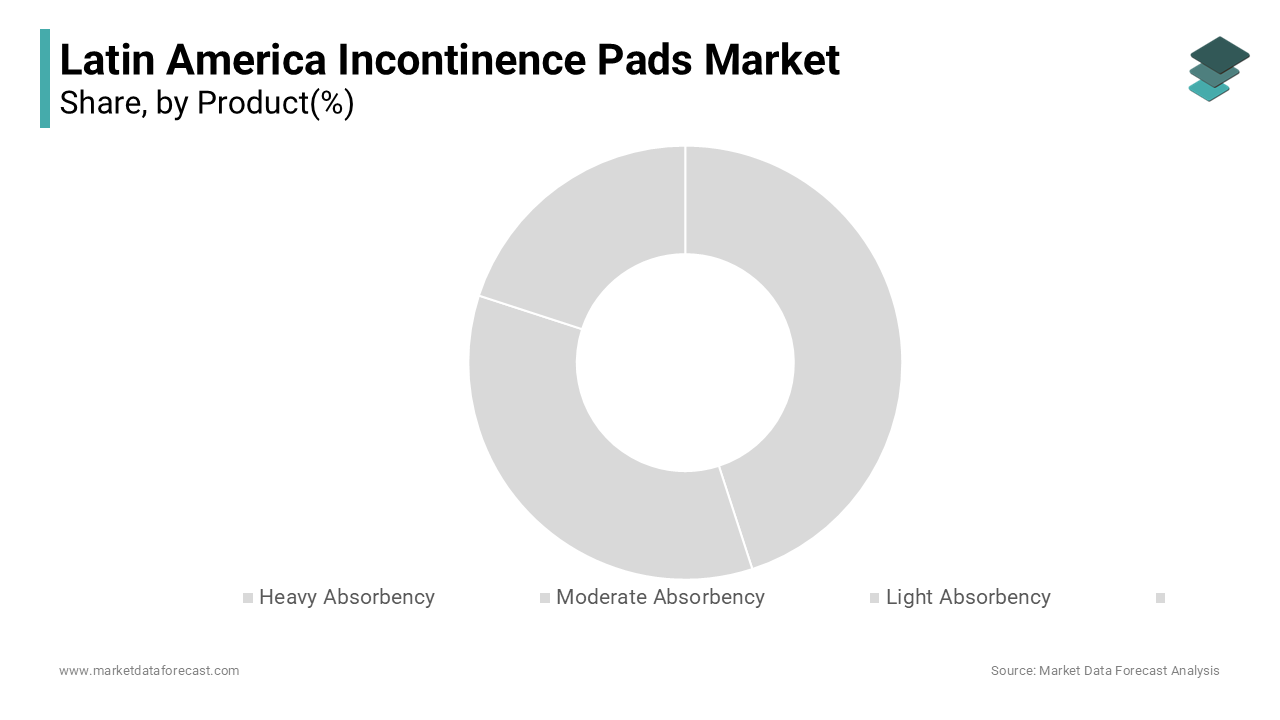
The light absorbency incontinence pads segment represent the fastest-growing and is projected to expand at a CAGR of 9.4% from 2025 to 2033. This growth is fueled by increasing adoption among younger and middle-aged adults managing mild stress or urge incontinence discreetly. In urban centers like Santiago and Mexico City, rising awareness of pelvic floor health has led to early intervention, with women using light absorbency pads during exercise, travel, or postpartum recovery. Brands such as Tena Lady and Abena have introduced ultra-thin, pantyliner-style designs with odor-neutralizing technology, enhancing comfort and discretion. Besides, the normalization of men’s health discussions has expanded usage among younger men recovering from prostate procedures, further accelerating demand for low-profile, lifestyle-integrated solutions
By Consumer and End User Insights
The women segment constituted the largest consumer by accounting for 62.4% of incontinence pad usage in Latin America in 2024. This dominance is due to higher physiological susceptibility due to pregnancy, childbirth, and menopause all significant risk factors for stress and mixed incontinence. In Colombia, a notable share of women over 40 experience urinary leakage, with prevalence rising among those who have had multiple vaginal deliveries. The integration of pelvic floor education into maternal health programs in countries like Argentina and Uruguay has improved early diagnosis and product adoption. Additionally, brands have tailored marketing campaigns to female consumers, emphasizing dignity, mobility, and active lifestyles.
The home care segment is the fastest-growing end-user and is projected to grow at a CAGR of 10.2% through 2033. This surge is driven by the strong cultural preference for aging in place and the limited availability of formal long-term care facilities. As per the Economic Commission for Latin America and the Caribbean (ECLAC), over 85% of elderly individuals in the region live with family members who assume caregiving responsibilities. Families increasingly rely on commercial incontinence pads to maintain hygiene and prevent infections. Companies are responding with bulk packs, subscription models, and caregiver guides distributed via pharmacies and e-commerce. Also, home-based procurement dominate incontinence product sales, reflecting a systemic shift away from institutional dependency toward decentralized, family-led care ecosystems.
By Distribution Channel Insights
The pharmacies segment was the prevailing distribution channel by representing 44.4% of total sales in 2024. This lead position is due to consumer trust, professional guidance, and integration with broader healthcare services. In Argentina, most of incontinence pad purchases occur in pharmacy chains, where pharmacists often advise on product selection based on severity and skin sensitivity. Pharmacies also serve as key access points for government-subsidized health programs. Additionally, private-label offerings from pharmacy networks, such as Ahumada’s Cuidar line in Chile, provide affordable alternatives without compromising perceived quality. The co-location of incontinence pads with diabetes, urology, and geriatric supplies reinforces their medical legitimacy, making pharmacies the most credible and accessible retail node for sensitive health products.
The online stores segment is the fastest-growing distribution channel and is projected to expand at a CAGR of 13.1% from 2025 to 2033. This acceleration is driven by the demand for discretion, convenience, and privacy in purchasing incontinence products. In Brazil, online sales of adult incontinence pads surged, with platforms offering discreet packaging and scheduled deliveries. Subscription models from brands like Tena and Abena have gained traction, ensuring consistent supply and reducing decision fatigue. In Chile, digital payment adoption is high, facilitating seamless transactions. The scalability of e-commerce enables brands to reach remote and underserved areas, transforming how sensitive health products are accessed across the region.
REGIONAL ANALYSIS
Brazil held the largest share of the Latin America incontinence pads market at 38%. The country’s position is anchored in its massive aging population, growing prevalence of chronic diseases, and expanding private healthcare infrastructure. With over 31 million people aged 60 and above, projected to reach 58 million by 2050, according to the Brazilian Institute of Geography and Statistics (IBGE), the demand for age-related care products is accelerating. In response, private insurers and home care agencies have begun including incontinence supplies in service packages. Major cities like São Paulo and Belo Horizonte are witnessing rising adoption of premium brands such as Tena and Always Discreet. Additionally, e-commerce penetration and digital health platforms are enabling discreet access, positioning Brazil as the region’s most dynamic and high-potential market for incontinence care innovation.
Mexico is also a key player in the market whch is driven by a rapidly aging population and increasing awareness of urological health. The number of Mexicans aged 60+ is expected to double by 2050, reaching over 36 million, as per the National Population Council (CONAPO). Despite limited public reimbursement, private pharmacies and online retailers are expanding access, with chains like Farmacias Similares offering affordable generic alternatives. Additionally, NGOs such as Movimiento por la Incontinencia Urinaria have launched awareness campaigns to reduce stigma. Also, product usage has increased since 2020, reflecting a gradual shift toward normalized, proactive management of bladder health.
COMPETITIVE LANDSCAPE
The competition in the Latin America incontinence pads market is intensifying as global leaders and regional manufacturers compete to capture a growing yet fragmented demand base shaped by demographic shifts and rising health awareness. Multinational corporations like Essity, Kimberly-Clark, and Hartmann dominate through brand trust, clinical validation, and extensive distribution networks, particularly in urban centers and private healthcare channels. At the same time, local players and pharmacy private labels are gaining traction by offering cost-effective alternatives in price-sensitive markets. The market is increasingly influenced by digital transformation, with e-commerce and subscription models reshaping consumer behavior. Social stigma remains a barrier, prompting brands to focus on discretion, education, and empathy in marketing. As aging populations expand and public health systems begin to recognize incontinence as a legitimate care priority, competition is shifting toward innovation in product design, sustainability, and integrated care solutions, creating a dynamic and evolving landscape.
KEY MARKET PLAYERS
Some of the prominent companies operating in the Latin America incontinence pads market include
- Kimberly-Clark
- Essity AB
- Procter & Gamble
- Unicharm Corporation
- Ontex Group
- Domtar Corporation
- First Quality Enterprises
- Drylock Technologies
- Hengan International Group
Top Players in the Latin America Incontinence Pads Market
Essity (Tena)
Essity, through its global brand Tena, has established a strong foothold in the Latin America incontinence pads market by combining clinical credibility with consumer-centric innovation. The company has localized its product lines to address regional needs, introducing tropical-climate-optimized variants with enhanced breathability and odor control for markets like Brazil and Colombia. The brand has also expanded its e-commerce presence through integrations with Mercado Libre and farmaciasonline.com, offering subscription models with home delivery. Additionally, Tena has invested in sustainability by reducing plastic content in packaging across its Latin American portfolio. These initiatives reflect a strategy centered on dignity, discretion, and long-term brand trust, positioning Tena as a leader in both institutional and retail segments.
Kimberly-Clark (Poise, Depend)
Kimberly-Clark has significantly influenced the Latin America incontinence pads market through its globally recognized brands Poise and Depend, which emphasize reliability, skin health, and lifestyle integration. The company has adapted its product formulations to meet the anatomical and climatic preferences of Latin American consumers, introducing low-profile, high-absorbency pads suitable for humid environments. It also launched a digital wellness hub offering pelvic floor exercise guides and discreet purchasing options, directly engaging consumers through mobile platforms. The introduction of breathable, latex-free materials has improved comfort for sensitive users, particularly among the elderly. By aligning with healthcare providers and leveraging digital outreach, Kimberly-Clark has strengthened its reputation as a medically informed, empathetic brand in a traditionally under-discussed health domain.
Hartmann Group (Absorba, Seni)
Hartmann Group has carved a niche in the Latin America incontinence pads market by focusing on medical-grade quality and institutional partnerships, particularly in home care and long-term care settings. Through its Absorba and Seni brands, the company offers high-performance products with advanced moisture-locking technology and pH-balanced surfaces to prevent skin breakdown. The company also introduced training modules for nursing staff on incontinence management protocols, enhancing clinical integration. In Argentina, Hartmann partnered with public geriatric clinics to pilot subsidized pad programs for low-income seniors. Additionally, its investment in sustainable manufacturing reducing carbon emissions across Latin American supply chains by 2023, as per internal sustainability reports reinforces its commitment to environmental and social responsibility, differentiating it in a competitive, values-driven market.
Top Strategies Used by Key Market Participants
Key players in the Latin America incontinence pads market are deploying targeted strategies to overcome stigma, expand access, and build brand loyalty in a sensitive and underpenetrated market. Companies are investing in product localization by developing climate-adaptive, discreet designs suited to regional lifestyles and body types. Educational campaigns in collaboration with healthcare providers aim to destigmatize incontinence and promote early intervention. Digital engagement through wellness platforms and telehealth integrations enhances consumer trust and facilitates discreet purchasing. Expansion into e-commerce and subscription models ensures consistent supply and improves adherence. Strategic partnerships with home care agencies and public health programs enable institutional penetration. Sustainability initiatives, including reduced plastic packaging and biodegradable materials, appeal to environmentally conscious consumers. Together, these strategies reflect a shift from product-centric to holistic, dignity-focused care models that align with evolving social and medical expectations.
RECENT MARKET DEVELOPMENTS
- In March 2023, Essity launched Tena Comfort Secu in Chile and Colombia, introducing a new generation of breathable, discreet incontinence pads with odor-neutralizing technology, specifically designed for active seniors in tropical climates, enhancing user comfort and brand loyalty.
- In August 2022, Kimberly-Clark partnered with the Mexican Urological Association to distribute educational kits and free samples of Poise pads in 50 clinics across Mexico, improving patient awareness and increasing clinical endorsement of its incontinence products.
- In January 2024, Hartmann Group initiated a pilot program in Buenos Aires to supply subsidized Absorba pads to low-income elderly patients through public geriatric clinics, strengthening its presence in institutional care and demonstrating social responsibility.
- In May 2023, Tena expanded its direct-to-consumer e-commerce platform on Mercado Libre, launching a subscription model with home delivery across Brazil, reducing purchase barriers and increasing customer retention in the home care segment.
- In October 2023, Kimberly-Clark introduced a plastic-reduced packaging line for Depend pads in Peru and Ecuador, aligning with regional environmental regulations and consumer demand for sustainable personal care products, reinforcing brand credibility and long-term market relevance.
MARKET SEGMENTATION
This research report on the Latin America Incontinence Pads Market is segmented and sub-segmented based on categories.
By Product Type
- Heavy Absorbency
- Moderate Absorbency
- Light Absorbency
By Consumer and End-User
- Women
- Men
- Unisex
- Hospitals
- Clinics
- Home Care
By Distribution Channel
- Supermarkets and Hypermarkets
- Convenience Stores
- Pharmacies
- Online Stores
- Others
By Country
- Mexico
- Brazil
- Argentina
- Chile
- Rest of Latin America
Frequently Asked Questions
What is the Latin America Incontinence Pads Market?
The Latin America Incontinence Pads Market refers to the segment within the medical devices industry that focuses on disposable and reusable pads designed to manage urinary and fecal incontinence.
Which factors are driving the growth of the Latin America Incontinence Pads Market?
Key drivers include an aging population, rising prevalence of chronic diseases, growing awareness about hygiene and comfort, and increased healthcare spending across Latin American countries.
What challenges does the Latin America Incontinence Pads Market face?
Major challenges include social stigma around incontinence, lack of awarene
Which countries are leading in the Latin America Incontinence Pads Market?
Brazil, Mexico, and Argentina are the key markets due to their larger elderly population, urbanization, and growing healthcare infrastructure.
What is the growth outlook for the Latin America Incontinence Pads Market?
The market is expected to grow steadily due to rising demand from elderly care, increasing acceptance of healthcare products, and strong investments from global medical device companies.
Access the study in MULTIPLE FORMATS
Purchase options starting from
$ 1600
Didn’t find what you’re looking for?
TALK TO OUR ANALYST TEAM
Need something within your budget?
NO WORRIES! WE GOT YOU COVERED!
Call us on: +1 888 702 9696 (U.S Toll Free)
Write to us: sales@marketdataforecast.com