Latin America Waterproofing Market Size, Share, Trends & Growth Forecast Report Segmented By Material (Modified Bitumen, PVC, TPO, EPDM, HDPE, LDPE), Type, And Country (Brazil, Mexico, Argentina, Chile And Rest Of Latin America), Industry Analysis From 2025 To 2033
Latin America Waterproofing Market Size
The Latin America waterproofing Market size was calculated to be USD 2.52 billion in 2024 and is anticipated to be worth USD 4 billion by 2033, from USD 2.65 billion in 2025, growing at a CAGR of 5.28% during the forecast period.
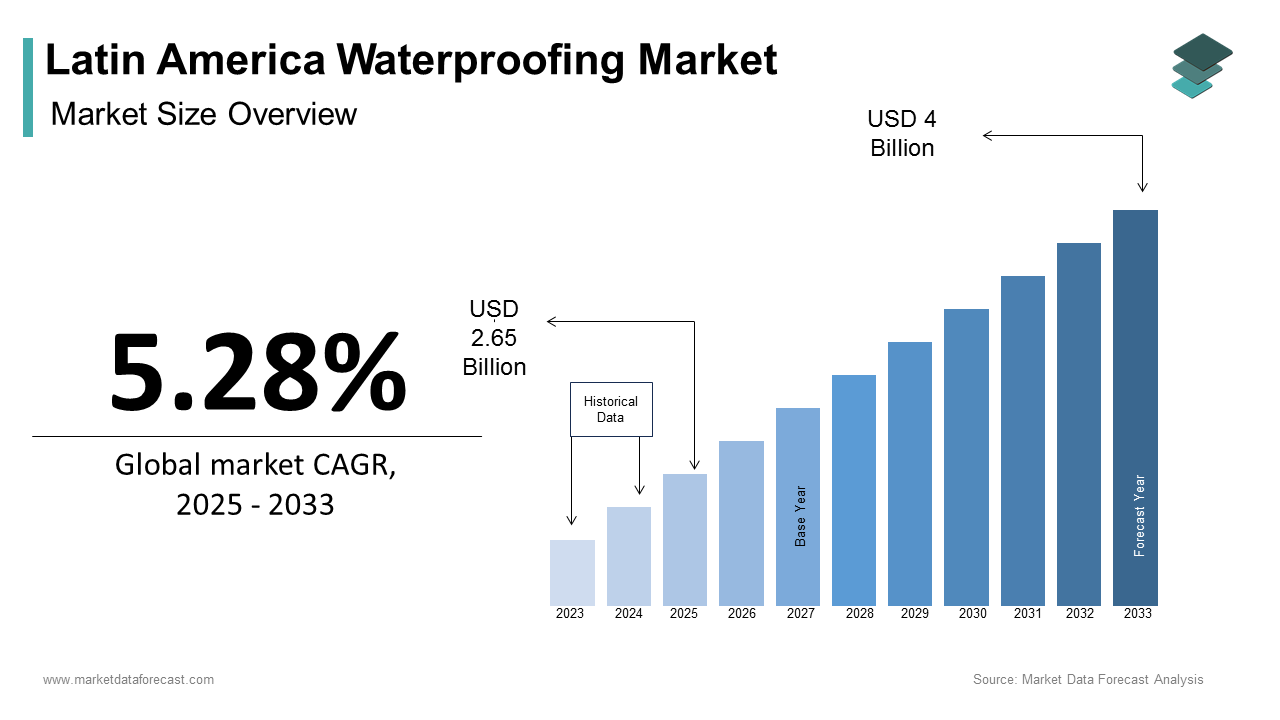
The waterproofing is specialized segment of construction materials and techniques designed to prevent water infiltration in residential, commercial, and infrastructure projects. According to the World Meteorological Organization, countries like Colombia and Ecuador experience annual precipitation levels exceeding 3,000 mm in certain regions, intensifying the need for durable moisture barriers. Furthermore, the Pan American Health Organization reports that over 20 million people in Latin America live in substandard housing prone to dampness and water damage, contributing to respiratory illnesses.
MARKET DRIVERS
Accelerated Urbanization and Expansion of High-Rise Construction
The rapid urban migration for multi-story residential and commercial buildings with the structural durability and occupant safety is propelling the growth of the Latin America waterproofing market. According to the United Nations Economic Commission for Latin America and the Caribbean (ECLAC), over 80% of the region’s population now lives in urban areas, the highest rate globally. This concentration has led to a surge in vertical construction, particularly in cities like São Paulo, Bogotá, and Mexico City, where land scarcity necessitates high-density developments. These structures require comprehensive waterproofing for balconies, terraces, and foundation slabs to prevent seepage and concrete degradation.
Government Investment in Infrastructure Projects
The public-sector infrastructure development is enhancing the growth of the Latin America waterproofing market. In Colombia, the Fourth Generation (4G) highway program includes 45 tunnels and 120 major bridges, all requiring advanced waterproofing membranes to withstand Andean rainfall and seismic movement, as documented by the Ministry of Transport. Similarly, Mexico’s Felipe Ángeles International Airport, completed in 2022, utilized over 1.2 million square meters of waterproofing materials for its underground parking and terminal foundations. The Central Sanitation Plant in Santiago employs crystalline waterproofing technology to protect concrete from corrosive wastewater.
MARKET RESTRAINTS
Prevalence of Informal Construction and Substandard Building Practices
The formal regulatory frameworks is limiting the growth of the Latin America waterproofing market. According to the World Bank, informal housing accounts for up to 40% of urban dwellings in countries like Bolivia, Guatemala, and Honduras, where builders often prioritize cost over durability. This trend is exacerbated by limited access to technical knowledge and affordable materials in rural and peri-urban zones. Contractors frequently substitute certified membranes with low-cost alternatives such as asphalt sheets or plastic liners, which degrade rapidly.
Volatility in Raw Material Supply and Pricing
The production of waterproofing materials like polymer-modified bitumen, acrylics, and polyurethanes is heavily dependent on petrochemical feedstocks, which is restraining the growth of the Latin America waterproofing market. Import dependency further compounds the issue; over 60% of specialty additives used in liquid-applied membranes are sourced from Europe and Asia, according to Brazil’s ABRAFAC. These cost pressures limit innovation and scalability for small and medium-sized enterprises that lack hedging capabilities or vertical integration.
MARKET OPPORTUNITIES
Adoption of Green Building Standards and Sustainable Waterproofing Solutions
The growing emphasis on environmental sustainability with the rising eco-friendly waterproofing technologies that reduce energy consumption and extend building lifespans is posing new opportunities for growth of the Latin America waterproofing market. According to the World Green Building Council, 14 Latin American cities have adopted green building certification programs, including LEED and EDGE, which reward water-resistant designs that prevent mold and structural decay. Companies like Sika and BASF have introduced low-VOC (volatile organic compound) liquid membranes and self-healing crystalline systems in Brazil and Colombia, which is aligning with sustainability mandates.
Expansion of Underground Infrastructure in Metro Systems and Utility Tunnels
The urban congestion and the need for efficient public transport are accelerating investment in underground infrastructure, which is gearing up for the growth of the Latin America waterproofing market. According to the Union Internationale des Transports Publics (UITP), Latin America has over 1,200 kilometers of operational metro lines, with an additional 300 kilometers under construction or planned by 2030. In São Paulo, Line 6-Orange, currently under development, includes 15 underground stations requiring advanced membrane systems to prevent groundwater ingress. The same applies to utility tunnels for fiber optics, water, and electricity in smart city projects across Panama and Costa Rica. These projects prioritize long-term performance, creating demand for durable, seam-free solutions such as spray-applied liquid membranes and bentonite clay systems.
MARKET CHALLENGES
Lack of Skilled Labor and Technical Expertise in Application
The effectiveness of systems depends heavily on proper installation, which is likely to hamper the growth of the Latin America waterproofing market. According to the Pan American Federation of Engineers, only 18% of construction workers in Latin America receive formal training in building envelope technologies. Many contractors lack understanding of substrate preparation, joint detailing, and curing conditions, leading to premature system breakdown. This knowledge gap increases liability risks and reduces client confidence in premium products. Manufacturers are responding with certification programs, but scalability remains limited by fragmented training infrastructure and high turnover in the construction workforce.
Climate Change and Increasing Frequency of Extreme Weather Events
The rising climate variability is hampering the growth of the Latin America waterproofing market. According to the Intergovernmental Panel on Climate Change, extreme precipitation events in Latin America have increased by 25% since 2000 in Central America and the Amazon basin. Similarly, prolonged droughts in northern Chile cause concrete shrinkage, leading to cracks that compromise membrane integrity. These fluctuating conditions demand adaptive, high-resilience materials capable of withstanding both hydrostatic pressure and thermal cycling. However, many existing products are designed for static environments, creating a mismatch between supply and emerging climatic realities.
REPORT COVERAGE
| REPORT METRIC | DETAILS |
| Market Size Available | 2024 to 2033 |
| Base Year | 2024 |
| Forecast Period | 2025 to 2033 |
| CAGR | 5.28% |
| Segments Covered | By Material, Type and Region |
| Various Analyses Covered | Global, Regional & Country Level Analysis; Segment-Level Analysis; DROC, PESTLE Analysis; Porter’s Five Forces Analysis; Competitive Landscape; Analyst Overview of Investment Opportunities |
| Regions Covered | Brazil, Mexico, Argentina, Chile and Rest Of Latin America |
| Market Leaders Profiled | Sika AG, BASF SE, RPM International Inc., Pidilite Industries Limited, Fosroc International Limited, MAPEI S.p.A., Carlisle Companies Inc., GAF Materials Corporation, Tremco Incorporated, Soprema Group, Henry Company, Johns Manville, Saint-Gobain Construction Products |
SEGMENTAL ANALYSIS
By Material Insights

The modified bitumen segment was accounted in holding 38.3% of the Latin American waterproofing market share in 2024 with its deep-rooted presence in roofing applications across residential and commercial construction. Modified bitumen offers a favorable balance between performance and price, making it a go-to choice for contractors and developers operating under tight budgets. The International Trade Administration reports that asphalt-based products, including modified bitumen, account for over 60% of flat roofing systems installed in major Latin American urban centers. Its compatibility with traditional torch-on and self-adhesive application methods further strengthens its foothold, especially in regions where skilled labor is accustomed to these techniques.
The TPO segment is swiftly emerging with an expected CAGR of 7.2% during the forecast period with rising demand for energy-efficient and sustainable building solutions. The U.S. Department of Energy notes that reflective roofing systems like TPO can lower rooftop surface temperatures by up to 50–60°F, which is significantly cutting air conditioning costs. Additionally, TPO is fully recyclable and does not contain chlorine, unlike PVC by aligning with tightening environmental regulations in countries like Chile and Costa Rica. Major multinational manufacturers like Sika and Firestone have expanded TPO production lines in Mexico and Brazil, which is signaling long-term confidence in regional demand.
By Type Insights
The sheet-based membranes segment was the largest and held 58.3% of the Latin American waterproofing market share in 2024 with the superior durability and ease of quality control during installation, especially in large-scale infrastructure and commercial developments. Additionally, the rise of performance-based building codes across the region has elevated the preference for standardized sheet products that meet ASTM and ISO compliance benchmarks. Their compatibility with insulation layers and green roof systems further cements their position as the backbone of modern waterproofing strategies.
The Liquid-applied membranes segment is likely to witness a CAGR of 8.1% during the forecast period with the seamless application and ability to conform to complex architectural geometries. Polyurethane and acrylic-based liquid membranes are gaining traction due to their rapid curing times and low VOC formulations. Furthermore, the rise of renovation and retrofit projects in aging urban centers like Buenos Aires and Bogotá has amplified demand for liquid membranes that can be applied over existing substrates without demolition. Companies like BASF and Fosroc have launched localized formulations tailored to Latin America’s humidity and UV exposure levels by enhancing product efficacy.
REGIONAL ANALYSIS
Brazil Waterproofing Market Insights
Brazil was the top performer in the Latin American waterproofing market with 34.2% of share in 2024. This surge in residential development has amplified the need for reliable waterproofing in foundations, bathrooms, and rooftops. Additionally, major infrastructure projects such as the expansion of São Paulo’s metro system and port modernization in Santos have created demand for high-performance membranes in underground and marine environments. According to the National Water Agency (ANA), over 30% of urban buildings in coastal cities face chronic dampness issues, underscoring the urgency for effective waterproofing. Multinational players like Sika and Saint-Gobain have strengthened their local manufacturing footprint, with Sika inaugurating a new R&D center in São Paulo in 2022 dedicated to tropical climate solutions.
Mexico Waterproofing Market Insights
Mexico waterproofing market held 26.3% of share in 2024 with the strategic position as a manufacturing hub and growing urban population have construction activity in cities like Monterrey, Guadalajara, and Mexico City. This industrial boom has increased demand for durable roofing and basement waterproofing in warehouses and factories. Moreover, the country faces significant challenges from water infiltration due to its diverse topography and frequent rainfall in regions like Veracruz and Chiapas. According to the National Water Commission (CONAGUA), 40% of building maintenance costs in humid zones are linked to moisture damage. The government’s push for sustainable construction, including tax incentives for green buildings, has further accelerated the adoption of high-performance waterproofing systems.
Argentina Waterproofing Market Insights
Argentina waterproofing market growth is likely to have highest CAGR during the forecast period with the aging infrastructure has created a steady need for retrofit waterproofing solutions, particularly in basements and flat roofs. Local manufacturers like Andes and Plastiment have gained traction by offering cost-effective, locally produced membranes. Additionally, the rise of informal construction in peri-urban areas has led to increased awareness of waterproofing as a preventive measure by NGO-led training programs for small contractors.
Chile Waterproofing Market Insights
Chile waterproofing market growth is ascribed to grow with the stringent building codes and focus on durability. According to the Chilean Energy Efficiency Agency, over 70% of new commercial buildings now include reflective or green roofs, increasing the need for compatible waterproofing membranes. Chile’s commitment to sustainability is evident in its adoption of international standards. This regulatory rigor has attracted premium waterproofing brands like BASF and Mapei, which have localized product lines to meet Chile’s unique environmental and structural demands.
Colombia Waterproofing Market Insights
Colombia waterproofing market growth is driven by public infrastructure investment and urban redevelopment, according to the National Department of Statistics (DANE). The government’s "4G Concession Program," which allocated $20 billion for road and bridge construction, has created demand for waterproofing in tunnels, viaducts, and drainage systems. Additionally, cities like Medellín and Bogotá are undergoing major transit expansions, including new metro lines and elevated stations, which all requiring robust moisture protection.
LEADING PLAYERS IN THE LATIN AMERICA WATERPROOFING MARKET
Sika AG
Sika AG has established a robust presence across Latin America through localized production and innovation tailored to regional climatic challenges. The company operates multiple manufacturing facilities in Brazil, Mexico, and Chile, enabling rapid response to construction demands. Sika has intensified its focus on sustainable solutions, launching eco-efficient liquid-applied membranes designed for high UV and humidity conditions. In 2023, it inaugurated a new R&D center in São Paulo to accelerate product development for tropical environments. The company actively collaborates with developers and contractors, offering technical training and on-site support to ensure proper application. Sika’s acquisition of local brands and partnerships with major construction firms have strengthened its distribution network. Its commitment to green building standards, including compliance with LEED and EDGE certifications, has positioned it as a preferred supplier for high-performance waterproofing in commercial and infrastructure projects across the region.
BASF SE
BASF has strategically expanded its construction chemicals footprint in Latin America by aligning its waterproofing solutions with sustainability and energy efficiency goals. The company leverages its global expertise in polymer technology to deliver advanced polyurethane and acrylic-based liquid membranes suited for the region’s diverse climates. In 2022, BASF launched its MasterSeal T 8000 system in Mexico and Brazil, specifically engineered for high-rise buildings and underground structures. The company collaborates with public and private sector developers on large-scale urban projects, providing technical support and customized formulations. BASF also engages in knowledge transfer through partnerships with engineering institutions and contractor training programs. Its integration of digital tools for product selection and performance monitoring has enhanced customer engagement.
Saint-Gobain Weber
Saint-Gobain Weber has its position in Latin America by combining global expertise with regional adaptability in waterproofing solutions. The company offers a comprehensive portfolio, including cementitious, liquid-applied, and sheet membranes, catering to residential, commercial, and infrastructure sectors. Weber has strengthened its market presence through localized manufacturing in Brazil, Argentina, and Colombia, ensuring cost efficiency and supply chain reliability. In 2023, it introduced Weberdry, a high-performance waterproofing system for basements and foundations, in key urban markets. The company emphasizes technical education, conducting regular workshops for contractors on best practices in waterproofing application. Weber also supports sustainable construction through products that meet environmental standards and contribute to green building certifications. Its digital platforms provide real-time project support by enhancing customer experience. Strategic collaborations with developers and participation in major infrastructure tenders have reinforced its reputation as a reliable and innovative market participant.
TOP STRATEGIES USED BY KEY MARKET PARTICIPANTS
Key players in the Latin America waterproofing market are deploying targeted strategies to enhance competitiveness and expand reach. Major companies are investing in localized production to reduce costs and improve supply chain efficiency. Strategic acquisitions of regional brands enable faster market penetration and access to established distribution networks. Companies are launching climate-specific products tailored to high humidity, UV exposure, and seismic conditions prevalent across the region. Partnerships with construction firms and government infrastructure programs ensure integration into large-scale projects. Technical training for contractors is widely used to improve application quality and build brand loyalty. Digital tools, including mobile apps and online design support, are being adopted to streamline product selection and project planning. Sustainability is a growing focus, with firms developing eco-friendly formulations and pursuing green certifications. These strategies collectively strengthen brand positioning and responsiveness in a rapidly evolving construction landscape.
KEY MARKET PLAYERS AND COMPETITION OVERVIEW
Major Players of the Latin America waterproofing market include Sika AG, BASF SE, RPM International Inc., Pidilite Industries Limited, Fosroc International Limited, MAPEI S.p.A., Carlisle Companies Inc., GAF Materials Corporation, Tremco Incorporated, Soprema Group, Henry Company, Johns Manville, Saint-Gobain Construction Products
The competition in the Latin America waterproofing market is intensifying as multinational corporations and regional players vie for dominance across construction segments. The market features a mix of global leaders with advanced technologies and local manufacturers offering cost-effective solutions. Multinationals leverage innovation, technical support, and sustainability credentials to secure contracts in commercial and infrastructure projects. Local firms compete through pricing and established distribution in residential and repair sectors. Competitive differentiation is increasingly based on product performance, application expertise, and compliance with building standards. Companies are expanding manufacturing footprints and enhancing after-sales services to strengthen customer relationships. Mergers, acquisitions, and joint ventures are common as firms seek to consolidate presence.
RECENT HAPPENINGS IN THE MARKET
- In March 2022, Sika AG inaugurated a new R&D center in São Paulo, Brazil, focused on developing high-performance waterproofing solutions for tropical climates by enhancing its technical leadership in the Latin America waterproofing market.
- In June 2022, BASF launched the MasterSeal T 8000 waterproofing system in Mexico and Brazil, a liquid-applied membrane designed for high-rise buildings and challenging environmental conditions, which is strengthening its product innovation in the Latin America waterproofing market.
- In September 2022, Saint-Gobain Weber introduced Weberdry, a new foundation waterproofing system, in Colombia and Chile by expanding its specialized product offerings for underground structures in the Latin America waterproofing market.
- In January 2023, Fosroc opened a new manufacturing facility in Monterrey, Mexico, to increase production capacity and improve supply chain efficiency for waterproofing and construction chemicals in the Latin America waterproofing market.
- In November 2023, Mapei expanded its distribution network in Argentina and Peru through strategic partnerships with local construction suppliers, enhancing market access and technical support availability in the Latin America waterproofing market.
MARKET SEGMENTATION
This research report on the Latin America waterproofing market has been segmented and sub-segmented based on material, type and region.
By Material
- Modified Bitumen
- PVC
- TPO
- EPDM
- HDPE
- LDPE
By Type
- Liquid-Applied Membranes
- Sheet-Based Membranes
By Region
- Brazil
- Mexico
- Argentina
- Chile
- Rest Of Latin America
Frequently Asked Questions
1. What factors are driving the growth of the waterproofing market in Latin America?
Key drivers include rapid urbanization, infrastructure development, increasing awareness of building protection, and government investments in housing and public projects.
2. What are the major applications of waterproofing in Latin America?
Applications include roofing, walls, basements, tunnels, bridges, water tanks, and other infrastructure projects.
3. What types of waterproofing materials are widely used in the region?
Bituminous membranes, liquid-applied membranes, cementitious coatings, polyurethane, and thermoplastic membranes are commonly used.
4. Which end-use sectors dominate the waterproofing demand?
Residential construction, commercial buildings, and infrastructure projects (roads, bridges, and utilities) are key end-use sectors.
5. What are the major challenges faced by the Latin America waterproofing market?
Price fluctuations in raw materials, low awareness in rural areas, and a lack of skilled labor are key challenges.
6. What role do government initiatives play in the growth of waterproofing demand?
Government programs for affordable housing and public infrastructure significantly boost waterproofing adoption.
7. How competitive is the Latin America waterproofing market?
The market is moderately fragmented with the presence of global players like Sika, BASF, MAPEI, and regional manufacturers.
8. What technological advancements are shaping the waterproofing industry in the region?
Innovations include eco-friendly waterproofing solutions, spray-applied membranes, and nanotechnology-based coatings.
9. What is the growth outlook for the waterproofing market in Latin America?
The market is expected to grow steadily, supported by urbanization, climate challenges (heavy rainfall), and investment in smart cities.
10. How is sustainability influencing the waterproofing market in Latin America?
Demand for green building materials and environmentally friendly waterproofing solutions is rising in urban centers.
Related Reports
Access the study in MULTIPLE FORMATS
Purchase options starting from
$ 1600
Didn’t find what you’re looking for?
TALK TO OUR ANALYST TEAM
Need something within your budget?
NO WORRIES! WE GOT YOU COVERED!
Call us on: +1 888 702 9696 (U.S Toll Free)
Write to us: sales@marketdataforecast.com