Middle East Meat Market Size, Share, Trends, Forecast, Research Report - Segmented By Type (Raw, Processed), Product, Distribution Channel, and Region (Brazil, Mexico, Argentina, Chile & Rest of Latin America) – Regional Industry 2025 to 2033
Middle East Meat Market Size
The Middle East meat market size was valued at USD 101.35 billion in 2024, and is expected to reach USD 154.81 billion by 2033 from USD 106.23 billion in 2025. With a growing CAGR of 4.82%.

The meat is an alternative protein sources across the 18 countries in the Middle East. Characterized by deep-rooted culinary traditions and religious dietary practices, meat consumption is intrinsically tied to cultural and social rituals, particularly during religious observances such as Eid al-Adha. According to the Food and Agriculture Organization of the United Nations, the average per capita meat consumption in the Gulf Cooperation Council (GCC) countries reached 87 kilograms annually in 2023, significantly surpassing the global average of 43 kilograms. As per the Arab Organization for Agricultural Development, over 85% of lamb consumed in Saudi Arabia and the UAE is imported, primarily from Australia, Sudan, and Ethiopia, due to limited domestic livestock capacity.
MARKET DRIVERS
Expanding Population and Rising Urban Middle-Class Consumption
The sustained growth of urban populations and rising middle class are majorly driving the growth of the Middle East Meat Market. According to the United Nations Department of Economic and Social Affairs, the region’s population will reach 640 million by 2030, with over 70% residing in urban centers. The increased disposable incomes and evolving dietary preferences in countries like Saudi Arabia and the UAE, where household spending on animal protein is enhancing the growth of the Middle East Meat Market. Urban consumers increasingly favor convenience-oriented meat products such as pre-marinated cuts, chilled poultry, and ready-to-cook meals, which is driving demand for value-added processing.
Religious and Cultural Significance of Meat Consumption
The religious and cultural importance in communal and ceremonial gatherings is escalating the growth of the Middle East Meat Market. During Eid al-Adha, one of the most significant Islamic festivals, millions of livestock are slaughtered across the region in accordance with religious tradition. The ritual sacrifice and subsequent distribution of meat to family, friends, and the underprivileged create a predictable annual spike in demand. Additionally, hospitality customs in Arab societies often require the serving of meat-based dishes such as kabsa, machboos, and grilled kebabs during social events.
MARKET RESTRAINTS
Limited Domestic Livestock Production and Arid Agro-Climatic Conditions
The limitations in domestic meat production due to its predominantly arid climate and scarcity of arable land and freshwater resources is degrading the growth of the Middle East Meat Market. According to the Food and Agriculture Organization, the region possesses less than 2% of the world’s renewable freshwater, severely constraining large-scale livestock farming. According to the GCC imports over 80% of its red meat, which is relying heavily on long-distance supply chains vulnerable to geopolitical disruptions and freight volatility.
Stringent Halal Certification and Traceability Requirements
The fragmented and often non-harmonized halal certification frameworks across Middle Eastern countries create operational complexities for meat importers and distributors, which is hampering the growth of the Middle East Meat Market. According to the Global Islamic Economy Indicator, there are over 50 distinct halal certification bodies operating across the region, each with varying standards and auditing protocols. This lack of standardization increases compliance costs and delays market entry for foreign suppliers.
MARKET OPPORTUNITIES
Expansion of Cold Chain Infrastructure and Modern Retail Distribution
The rapid development of temperature-controlled logistics and modern retail networks is ascribed to level up the growth of Middle East meat market. Governments across the GCC are investing heavily in cold chain infrastructure to reduce post-harvest losses and ensure meat safety. The UAE has established one of the most advanced cold chain systems in the region, with 98% of meat distributed through refrigerated networks, as per the Dubai Municipality. Additionally, the proliferation of hypermarkets, gourmet supermarkets, and e-grocery platforms like Noon and Carrefour UAE has increased access to premium and imported meat products.
Growth of Alternative and Cultured Meat Adoption
The emerging strategic hub for alternative protein innovation by offering a viable solution to supply constraints is additionally to enhance the growth of Middle East Meat Market. The UAE became the first country in the region to approve lab-grown meat for commercial sale in 2023, following regulatory clearance by the Abu Dhabi Department of Economic Development. The UAE aims to produce 40% of its domestic food needs through innovation by 2051, as outlined by the Ministry of Climate Change and Environment.
MARKET CHALLENGES
Geopolitical Volatility and Supply Chain Disruptions
The highly susceptible to geopolitical tensions and regional instability, which can abruptly disrupt import flows and escalate prices is degrading the growth of Middle East meat market. Alternative routing via the Cape of Good Hope added 10–14 days to transit times by increasing spoilage risks and freight costs by up to 300%, as reported by the International Chamber of Shipping. Additionally, political conflicts affect key exporting nations is limiting the growth of Middle East meat market. For example, civil unrest in Sudan is a major live animal supplier to Saudi Arabia that reduced exports by 42% in 2023, as per the African Union’s Interafrican Bureau for Animal Resources.
Escalating Consumer Demand for Transparency and Ethical Sourcing
The urban consumers are increasingly demanding visibility into meat sourcing, animal welfare practices, and environmental impact is also to hinder the growth of the Middle East meat market. Moreover, live animal imports, which constitute a significant portion of supply, face growing scrutiny over transport conditions and slaughter practices. The Royal Society for the Prevention of Cruelty to Animals International has documented repeated welfare violations in shipments from the Horn of Africa, prompting calls for stricter oversight and certification, which is complicating procurement for importers.
REPORT COVERAGE
| REPORT METRIC | DETAILS |
| Market Size Available | 2024 to 2033 |
| Base Year | 2024 |
| Forecast Period | 2025 to 2033 |
| CAGR | 4.82% |
| Segments Covered | By Type, Product, Distribution Channel, and Region |
| Various Analyses Covered | Global, Regional, & Country Level Analysis; Segment-Level Analysis; DROC; PESTLE Analysis; Porter’s Five Forces Analysis; Competitive Landscape; Analyst Overview of Investment Opportunities |
| Regions Covered | KSA, UAE, Israel, Rest of GCC countries and Rest of Middle East. |
| Market Leaders Profiled | Al Ain Farms, Al-Watania Poultry, BRF S.A., Herfy Food Services Co., Kibsons International LLC, and others. |
SEGMENTAL ANALYSIS
By Type Insights
The raw meat segment dominated the Middle East meat market by capturing a significant share in 2024 with the deeply ingrained culinary traditions that prioritize fresh, unprocessed cuts for home cooking and religious rituals. According to the Food and Agriculture Organization, over 74% of meat consumed in Saudi Arabia and Egypt is purchased in raw form from wet markets, local butchers, or hypermarket fresh sections, which is reflecting consumer preference for sensory evaluation of quality. Additionally, the absence of widespread ultra-processed meat culture in the region, unlike in Western markets, sustains demand for whole carcasses, primal cuts, and chilled portions in rural and traditional urban households.
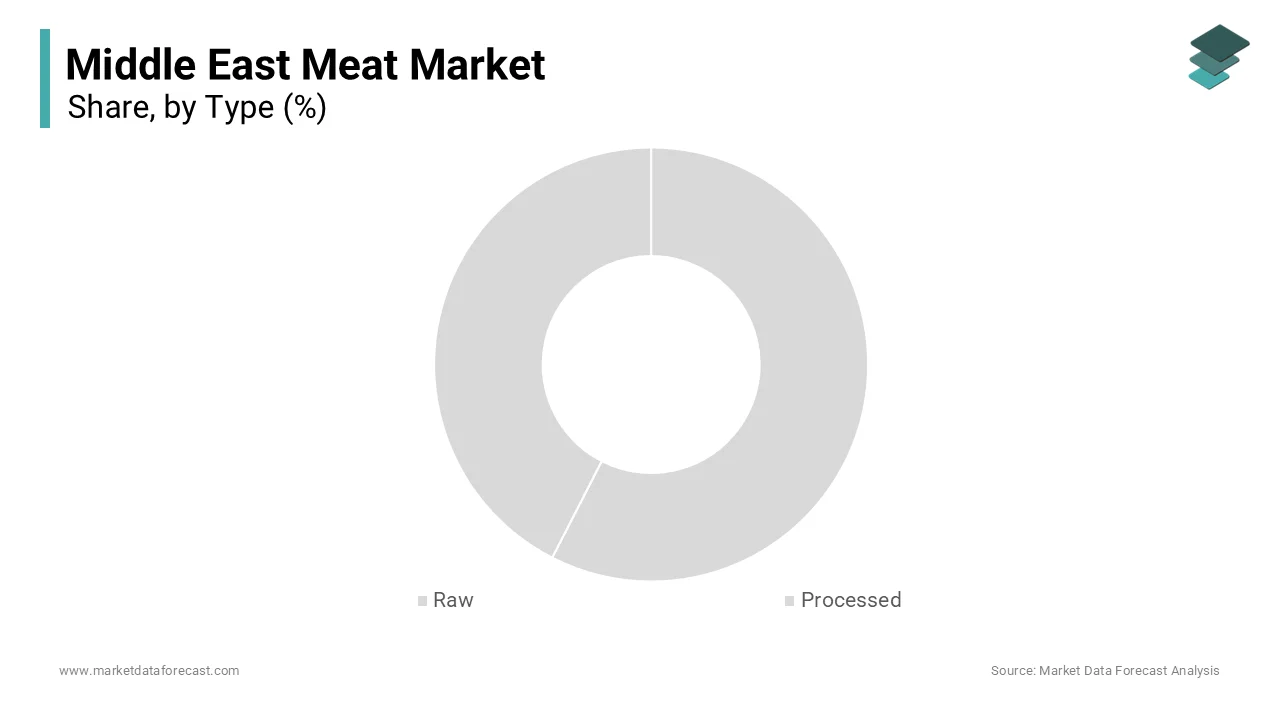
The processed meat segment is projected to grow at a CAGR of 9.6% during the forecast period with the urbanization and shifting lifestyle dynamics that favor convenience and time-saving food solutions. Furthermore, foodservice expansion especially quick-service restaurants and cloud kitchens has amplified demand for standardized, portion-controlled meat inputs.
By Product Insights
The chicken segment was the largest and held 43.3% of the Middle East meat market share in 2024 with economic accessibility and religious permissibility across all Muslim-majority countries. According to the FAO, the average price of chicken per kilogram in Egypt and Jordan is 40–50% lower than beef or mutton, which is making it the preferred protein for low- and middle-income households. The Egyptian Ministry of Agriculture recorded domestic poultry production exceeding 1.8 million metric tons in 2023, supported by government-subsidized feed programs to ensure affordability.
The mutton segment is attributed to grow with an expected CAGR of 8.2% from 2025 to 2033 with its central role in cultural and religious ceremonies during Eid al-Adha and wedding feasts. Saudi Arabia, the largest importer, sourced 4.1 million live animals in 2023 from Sudan, Ethiopia, and Somalia, as per the Kingdom’s Ministry of Environment, Water and Agriculture. Rising disposable incomes in urban centers have also enabled more frequent consumption of mutton beyond ceremonial use. The Kuwait Institute for Scientific Research notes that mutton-based dishes appear in 85% of festive meals across the Gulf, reinforcing sustained demand.
By Distribution Channel Insights
The supermarkets and hypermarkets segment was accounted in holding 52.3% of the Middle East meat market share in 2024 with the consumer trust in regulated, hygienic environments and the availability of halal-certified, traceable meat products. Additionally, hypermarkets offer bundled promotions and loyalty programs that incentivize bulk purchases, particularly during Ramadan and Eid seasons. According to the Saudi Center for Food and Drug Monitoring, 70% of packaged meat in KSA is distributed via organized retail, with modern outlets ensuring temperature-controlled storage from delivery to display.
The online stores segment is swiftly emerging with an expected CAGR of 16.4% during the forecast period with the digital adoption, improved last-mile logistics, and rising demand for contactless, time-efficient meat procurement. Platforms like InstaShop, Noon Grocery, and HungerStation have integrated cold lockers and temperature-controlled delivery fleets by ensuring product integrity. Saudi Ministry of Communications and Information Technology notes that e-commerce penetration in KSA increased from 38% to 61% between 2021 and 2023, supported by government-backed digital infrastructure initiatives such as Saudi Vision 2030’s e-tail transformation agenda.
REGIONAL ANALYSIS
Saudi Arabia Meat Market Insights
Saudi Arabia was the largest contributor in the Middle East meat market by accounting for 28.5% of share in 2024 due to its large population, high per capita meat intake, and status as the epicenter of religious pilgrimage and ritual sacrifice. The Saudi Ministry of Environment, Water and Agriculture reports that annual meat consumption exceeds 1.2 million metric tons, with lamb and chicken leading demand. Vision 2030 has also spurred investments in cold chain logistics and domestic poultry farms to reduce import dependency.
United Arab Emirates Meat Market Insights
United Arab Emirates meat market was positioned second with the rising diverse expatriate population, high disposable incomes, and a thriving hospitality sector. The UAE imports over 90% of its meat, with Australia, India, and Brazil as key suppliers, as reported by the Ministry of Climate Change and Environment. Dubai alone hosts over 15,000 restaurants, many specializing in grilled meats and international cuisines, amplifying demand for premium cuts.
Egypt Meat Market Insights
Egypt meat market is lucratively growing with significant CGAR during the forecast period. Egypt represents a high-volume, price-sensitive market where affordability dictates consumption patterns. The Ministry of Supply and Internal Trade states that chicken accounts for over 60% of meat intake due to government-subsidized poultry programs and low production costs. However, red meat demand is rising with urban income growth, particularly in Cairo and Alexandria. Egypt also serves as a regional transshipment hub, re-exporting frozen meat to Libya, Jordan, and Palestine. Despite efforts to boost local livestock farming, the country remains a net importer, sourcing beef from Brazil and Uruguay.
KEY MARKET PLAYERS AND COMPETITIVE LANDSCAPE
The key players in the Middle East meat market are Al Ain Farms, Al-Watania Poultry, BRF S.A., Herfy Food Services Co., Kibsons International LLC.
The competitive landscape of the Middle East meat market is shaped by a convergence of traditional suppliers, modern retail conglomerates, and technologically advanced agri-businesses vying for dominance in a high-demand, import-dependent environment. Unlike fragmented regional markets, competition is increasingly centralized around entities that control logistics, halal compliance, and cold chain integrity. Domestic producers face challenges from well-funded multinational retailers with global sourcing power, while live animal traders contend with stricter quarantine regulations and shifting consumer preferences toward processed, packaged meat. Innovation in traceability and sustainability is becoming a differentiator, particularly in urban centers. The entry of alternative protein ventures further intensifies rivalry, compelling traditional players to enhance efficiency, transparency, and responsiveness to religious, cultural, and logistical demands across diverse consumer bases.
TOP PLAYERS IN THE MARKET
The Almarai Company
The Almarai Company was integrated food production in the Middle East by operating one of the region’s most advanced dairy and meat processing networks. The company has significantly expanded its poultry and red meat portfolio through vertically controlled supply chains by ensuring halal compliance and traceability across Saudi Arabia and the GCC. In 2023, Almarai inaugurated a state-of-the-art poultry processing facility in Buraidah by enhancing its capacity to serve retail and foodservice sectors with chilled, pre-packaged products. It has also invested in cold chain automation to maintain product integrity across vast distribution networks.
Lulu Group International
Lulu Group International operates as a dominant force in meat retail and distribution across the Middle East through its expansive hypermarket network and in-house meat sourcing operations. The company manages one of the largest halal-certified meat supply chains in the region, sourcing poultry, lamb, and beef from over 20 countries, including Brazil, India, and Australia, to meet diverse consumer preferences. In 2024, Lulu launched a centralized meat processing hub in Abu Dhabi, enabling portioning, marinating, and vacuum packaging under strict hygiene standards. It also introduced blockchain-based traceability for select meat lines, allowing customers to verify origin and handling. The group’s private-label meat brands have gained significant traction in the UAE, Oman, and Egypt.
Al Dahra Agricultural Company
Al Dahra Agricultural Company has emerged as a top player in the Middle East’s meat supply chain by securing large-scale feed and livestock production assets both regionally and globally. Headquartered in Abu Dhabi, the company ensures feedstock stability for domestic livestock farms, indirectly supporting meat production in the UAE and Egypt. Al Dahra operates integrated agri-platforms in Sudan and Kazakhstan, producing fodder and alfalfa that supply dairy and meat farms across the Gulf. In 2023, it expanded its live animal import operations by establishing quarantine and distribution centers in Saudi Arabia and Oman, streamlining entry for sheep and goats during peak demand periods. The company also partners with Australian and South American exporters to manage chilled meat logistics into GCC ports.
TOP STRATEGIES USED BY THE KEY MARKET PLAYERS
Key players in the Middle East meat market are deploying vertical integration, halal certification standardization, investment in cold chain infrastructure, expansion of private-label meat brands, and digital traceability systems to consolidate their competitive standing. Companies are acquiring upstream assets such as feed farms and livestock operations to ensure supply stability and cost control. Simultaneously, they are enhancing downstream capabilities through automated processing and temperature-controlled distribution. The adoption of blockchain and QR-code-based tracking enables transparency, meeting rising consumer demand for origin verification. Strategic partnerships with international exporters secure diversified sourcing, mitigating geopolitical risks.
RECENT HAPPENINGS IN THE MARKET
- In January 2023, Almarai launched a fully automated poultry processing plant in Buraidah, Saudi Arabia, equipped with AI-driven quality inspection systems, enhancing production efficiency and food safety standards for halal-certified chicken products.
- In February 2024, Lulu Group introduced blockchain-enabled traceability for its premium imported lamb line in UAE stores, allowing consumers to scan QR codes and access information on country of origin, transport history, and halal certification.
MARKET SEGMENTATION
This research report on the Middle East meat market is segmented and sub-segmented into the following categories.
By Type
- Raw
- Processed
By Product
- Chicken
- Beef
- Pork
- Mutton
- Others
By Distribution Channel
- Supermarkets and Hypermarkets
- Departmental Stores
- Specialty Stores
- Online Stores
- Others
By Country
- KSA
- UAE
- Israel
- Rest of GCC countries and Rest of Middle East
Frequently Asked Questions
1. What is the Middle East meat market?
The Middle East meat market refers to the production, processing, and distribution of various types of meat, including beef, poultry, lamb, goat, and processed meat products across the region.
2. What factors are driving the growth of the meat market in the Middle East?
Rising population, increasing disposable incomes, urbanization, and the strong demand for protein-rich diets are fueling market growth.
3. Which types of meat are most consumed in the Middle East?
Poultry and lamb are the most widely consumed, followed by beef and goat, while processed meat products are also gaining popularity.
4. How important is halal certification in the Middle East meat market?
Halal certification is crucial, as it ensures meat products comply with Islamic dietary laws, making them acceptable to the majority Muslim population.
5. Which countries dominate the meat market in the Middle East?
Saudi Arabia, the United Arab Emirates, and Iran are among the leading markets, driven by large populations and strong demand.
6. Who are the major players in the Middle East meat market?
Key players include BRF Global, Cargill, JBS S.A., Tyson Foods, Minerva Foods, and regional suppliers.
7. What challenges does the market face?
Challenges include fluctuating feed costs, supply chain disruptions, and the need to balance rising demand with sustainability concerns.
8. What role do imports play in the Middle East meat market?
Imports are significant, as many countries in the region rely on meat imports to meet demand due to limited domestic production capacity.
Related Reports
Access the study in MULTIPLE FORMATS
Purchase options starting from
$ 1600
Didn’t find what you’re looking for?
TALK TO OUR ANALYST TEAM
Need something within your budget?
NO WORRIES! WE GOT YOU COVERED!
Call us on: +1 888 702 9696 (U.S Toll Free)
Write to us: sales@marketdataforecast.com