Global Non-Lethal Weapons Market Size, Share, Trends, & Growth Forecast Report By Product Type, Technology, End-User, Application Area, and Region (North America, Europe, Asia Pacific, Latin America, and Middle East & Africa), Industry Analysis From 2026 to 2034
Global Non-Lethal Weapons Market Size
The global non-lethal weapons market size was valued at USD 10.97 billion in 2025 and is anticipated to reach USD 12.06 billion in 2026 to reach USD 28.27 billion by 2034, growing at a CAGR of 9.93% from 2026 to 2034.
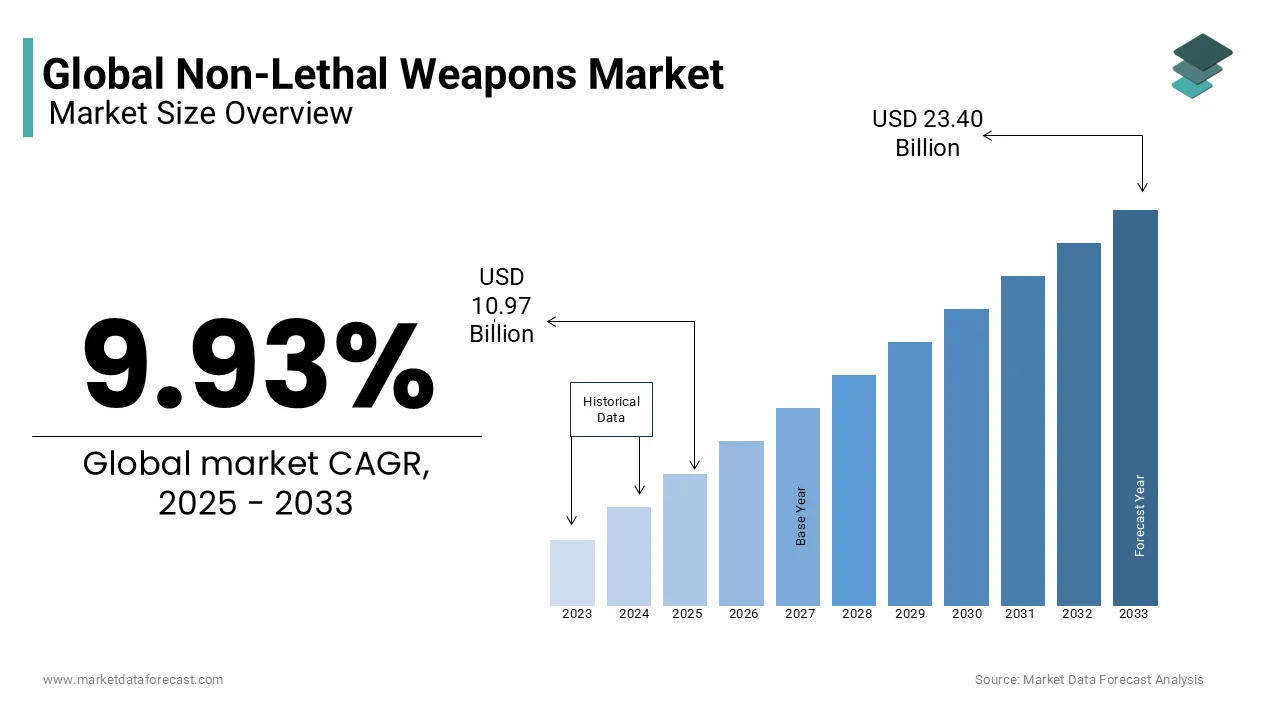
The non-lethal weapons market is predicted to become an important part of law enforcement and asymmetric warfare over the next six years. Non-lethal weapons are designed to disable people and equipment without injuring them. They help reduce fatalities, permanent injuries to employees, and unintended property damage in the targeted area or environment. They also assist in resolving the expansion of force situations by directly impacting personnel and giving psychological impacts. As a result, they're widely used for military policing tasks like crowd control and dispersal, defending convoys and other forms of route control, transporting or guarding prisoners of war, and maintaining security details or guard duties.
MARKET DRIVERS
Non-lethal weapons have effectively replaced traditional weapons such as guns, grenades, and other technology-advanced solutions. Non-lethal weapons are growing due to rapid technological advancements. Moreover, there is a significant demand for non-lethal weapons technologies such as electromagnetic weapons, laser interdiction systems, multi-flash bangs, active denial weapons, and other non-lethal weapons technologies, which are further responsible for the non-lethal weapons market's growth. The development of non-lethal weapons has been supported by government-funded research and innovative organizations. Innovation accounts for a significant amount of a company's revenue. As a result, the non-lethal weapons market is expected to grow during the forecast period. In addition, non-lethal weapons, such as pepper sprays, have been created to help women fight against crime. This element also supports the market's growth.
MARKET RESTRAINTS
Non-lethal weapons can nonetheless cause injury, regardless of their design aim. This is especially true for technologies that interact with sufficiently sensitive body parts, such as kinetic munitions used on the head, neck, eyes, stomach, and urogenital regions. As a result, some analysts consider "non-lethal" a misnomer and suggest characterizing them as "less lethal." At the same time, other sources define "non-lethal" as minimizing the likelihood of creating fatalities or lasting damage without requiring zero probability. Furthermore, the impacts have always lasted for a short time because the design objective is to avoid/minimize persistence. As a result, some effects may be transient, while others may last for a certain amount of time. Therefore, these factors tend to restrain the growth of the global non-lethal weapons market.
REPORT COVERAGE
| REPORT METRIC | DETAILS |
| Market Size Available | 2025 to 2034 |
| Base Year | 2025 |
| Forecast Period | 2026 to 2034 |
| CAGR | 9.93% |
| Segments Covered | By Product Type, Technology, End-User, Application Area, and Region |
|
Various Analyses Covered | Global, Regional & Country Level Analysis, Segment-Level Analysis, DROC, PESTLE Analysis, Porter’s Five Forces Analysis, Competitive Landscape, Analyst Overview of Investment Opportunities |
| Regions Covered | North America, Europe, APAC, Latin America, Middle East & Africa |
|
Market Leaders Profiled | The Safariland Group, Lamperd Less Lethal Inc., Textron Systems, Nonlethal Technologies, BAE Systems Plc., Taser International, The Boeing Company, Pepper Ball Technologies Inc., ISPRA by Ei Ltd., Rheinmetall, CADRE HOLDINGS INC., and others |
SEGMENTAL ANALYSIS
By Product Type Insights
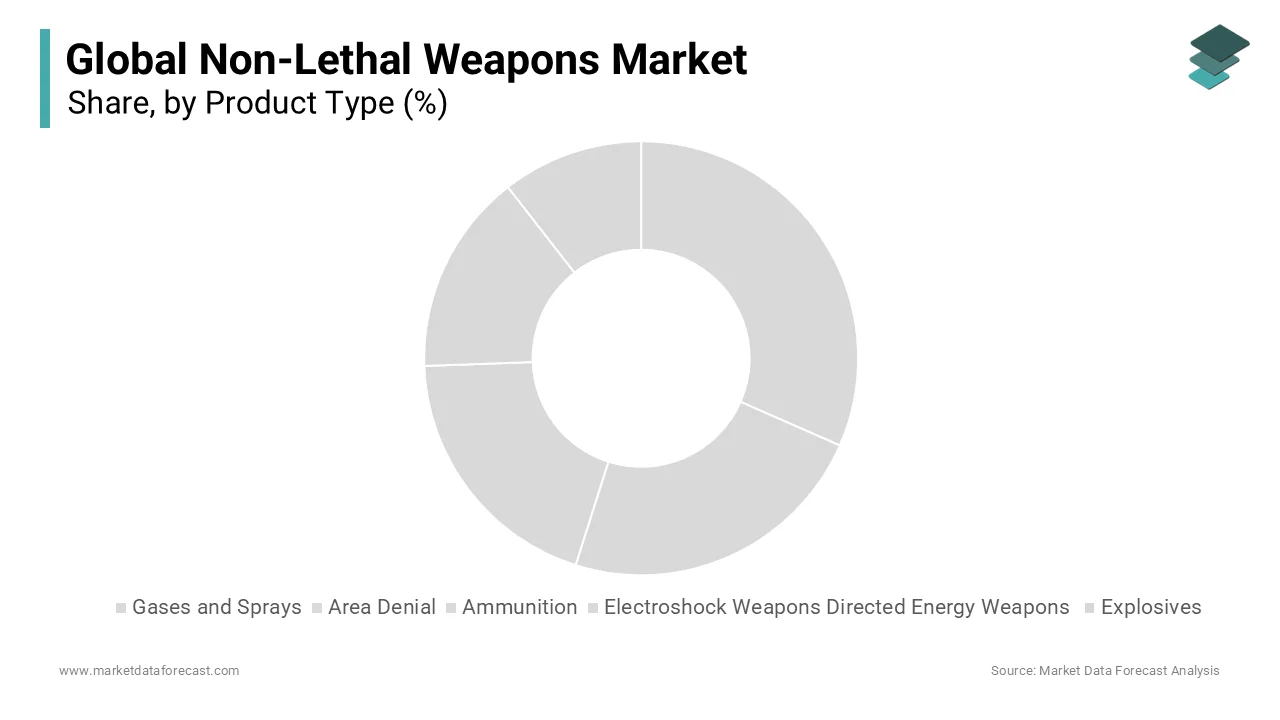
Ammunition holds the most significant global non-lethal weapons market share in the upcoming years based on product type. The market for the non-lethal ammunition segment is highly fragmented, with only a few companies offering traditional non-lethal weapons. Various manufacturers in the United States have been funded and maintained by the government and can meet both short- and long-term demands. Therefore, as the supply chain is localized and supported by government finance and logistics, they may concentrate on certain ammunition and increase production rate on short notice.
By Technology Insights
Based on technology, the chemical segment is estimated to have the highest market share revenue in 2024, primarily because of the increasing demand for non-lethal chemical weapons such as tear gas, aerosols, smoke grenades, and chemical projectiles by law enforcement agencies around the world.
By End-User Insights
The military segment is anticipated to have the highest non-lethal weapons market share during the forecast period. As the military's responsibility in policing civilian populations has grown, the role of the armed forces or military has shifted dramatically. Military units are involved in ongoing international wars that have direct contact with civilian people in today's world. In addition, soldiers serving on humanitarian missions are subject to tight engagement rules. In addition, militaries are ready to operate in MOOTW (Military Operations Other Than War) scenarios in which lethal force is prohibited. With less-lethal weapons such as rubber bullets, batons, foam, bean bag rounds, and sponges failing to achieve their goals, there is an increasing desire for weapons that may achieve pain compliance without the risk of mortality.
REGIONAL ANALYSIS
Asia Pacific Market Analysis
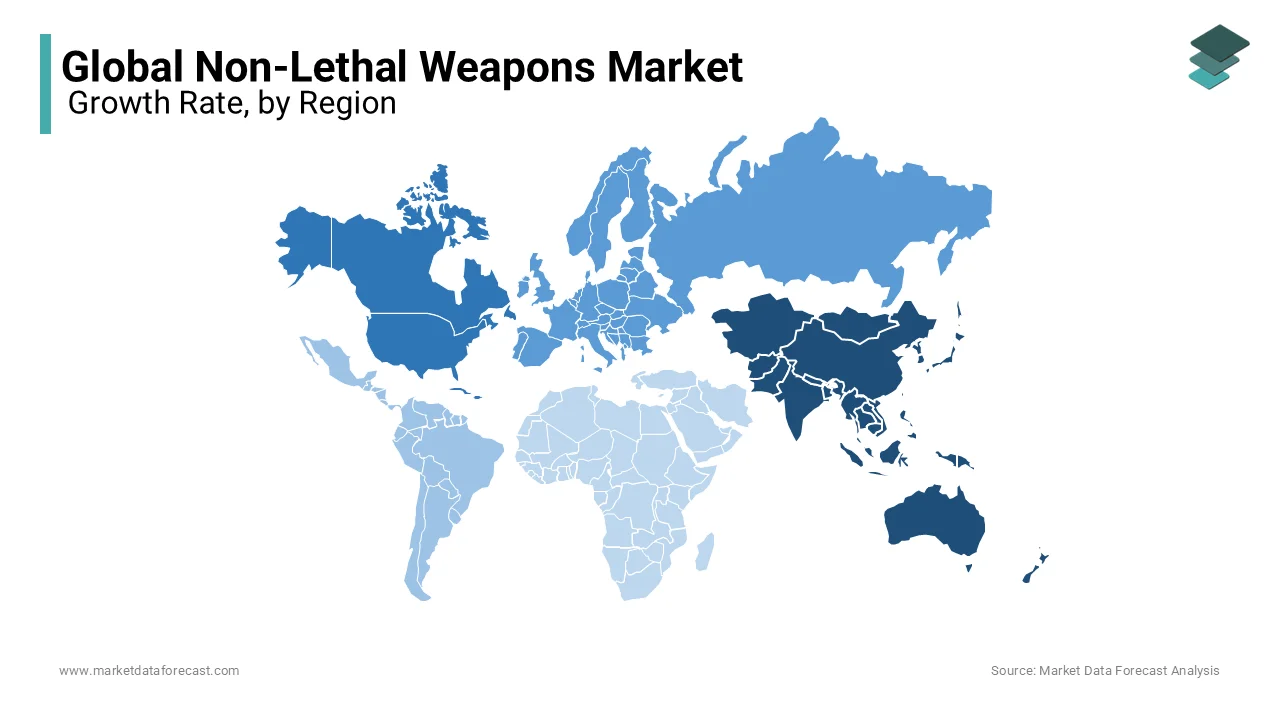
The Asia-Pacific is expected to have the highest CAGR of 8.5 % during the forecast period. The need for less-lethal weaponry has intensified in recent years, as tensions in Kashmir have risen and protests have erupted across India. In addition, occasional riots and civil unrest, such as demonstrations and protests in Eastern Chinese cities, often linked with labor-related, environmental, and educational issues, have led to the use of non-lethal ammunition by police forces, which, collectively, may have a positive impact on the market's growth.
North America Market Analysis
North America is predicted to hold the highest market share during the forecast period. This is because it experienced increased violence-related incidents, and law enforcement agencies' demand for non-lethal weapons is driving the non-lethal weapons market. Furthermore, growing concerns about personal safety may lead to an increase in the market for non-lethal weapons in the United States. In addition, the US Department of Defense (DoD) is now concentrating on creating non-lethal weaponry to reduce the likelihood of fatalities and permanent damage.
In the non-lethal weapons market, the United Kingdom currently has the largest market share during the foreseen period. This is primarily due to the development of new non-lethal weapons that are effective and safe in combating the threat. For example, to assist soldiers in Afghanistan in irritating and deterring prospective opponents, the UK Army developed the Variable Kinetic System (VKS), a new non-lethal weapon. The weapon fires Paintball-like projectiles packed with a hot pepper solution. Furthermore, as compared to traditional firearms, most law enforcement and police officers carry less-lethal weapons such as Tasers, batons, and mace spray canisters.
KEY MARKET PARTICIPANTS
Companies playing a major role in the global non-lethal weapons market include
- The Safariland Group
- Lamperd Less Lethal Inc.
- Textron Systems
- Nonlethal Technologies
- BAE Systems Plc.
- Taser International
- The Boeing Company
- Pepper Ball Technologies Inc.
- ISPRA by Ei Ltd.
- Rheinmetall
- CADRE HOLDINGS INC.
RECENT MARKET NEWS
- On October 18, 2021, a company in Uttar Pradesh created non-lethal weapons for the Army to employ in Galway. In addition, a Noida-based company has developed non-lethal weapons for security forces based on traditional Indian weapons used in man-to-man combat.
- Taser International declared that their non-lethal weapons are ready for the Indian security forces to deal with the Army's club in China.
MARKET SEGMENTATION
This research report on the global non-lethal weapons market has been segmented and sub-segmented based on the product type, technology, end-user, and region.
By Product Type
- Gases & Sprays
- Grenades
- Taser Guns
- Bullets
- Directed Energy Weapons (DEWs)
- Water Cannons & Other Devices
By Technology
- Chemical
- Electroshock
- Mechanical & Kinetic
- Acoustic/Light
- Electromagnetic
By End User
- Law Enforcement Agencies
- Military
- Citizens
By Application Area
- Crowd Control
- Personal Defense
- Military Operations
- Law Enforcement
By Region
- North America
- Asia-Pacific
- Europe
- Latin America
- Middle-East-America
Frequently Asked Questions
What is meant by non-lethal weapons in today’s security landscape?
They are tools designed to incapacitate individuals temporarily without causing permanent harm.
Why are non-lethal weapons gaining importance globally?
They provide a safer alternative for crowd control and law enforcement operations.
How can non-lethal weapons be simply explained?
They are devices used to control or deter threats without fatal consequences.
Which sectors primarily use non-lethal weapons?
Law enforcement agencies, military forces, and private security organizations are key users.
What types of products fall under this market?
It includes devices like tasers, rubber bullets, pepper sprays, and acoustic weapons.
How do non-lethal weapons support public safety?
They help manage conflicts while minimizing the risk of serious injuries or fatalities.
What factors are driving market growth?
Increasing focus on human rights and safer policing methods is boosting demand.
How are technological advancements shaping this market?
Innovations are improving accuracy, range, and effectiveness of non-lethal systems.
What challenges does the non-lethal weapons market face?
Concerns about misuse and regulatory restrictions can limit adoption.
How do governments influence this market?
Policies and regulations determine procurement, usage standards, and deployment guidelines.
Related Reports
Access the study in MULTIPLE FORMATS
Purchase options starting from
$ 2500
Didn’t find what you’re looking for?
TALK TO OUR ANALYST TEAM
Need something within your budget?
NO WORRIES! WE GOT YOU COVERED!
Call us on: +1 888 702 9696 (U.S Toll Free)
Write to us: sales@marketdataforecast.com