North America Exercise Bike Market Size, Share, Trends & Growth Forecast Report By Type (Recumbent Bike, Upright Bike, Dual-Action Bike and Interactive Bike), Distribution Channel, and Country (The United States, Canada and Rest of North America), Industry Analysis From 2026 to 2034
North America Exercise Bike Market Size
The exercise bike market size in North America was valued at USD 363.42 million in 2025 and is predicted to be worth USD 554.67 million by 2034, from USD 380.90 million in 2026 and grow at a CAGR of 4.81% from 2026 to 2034.
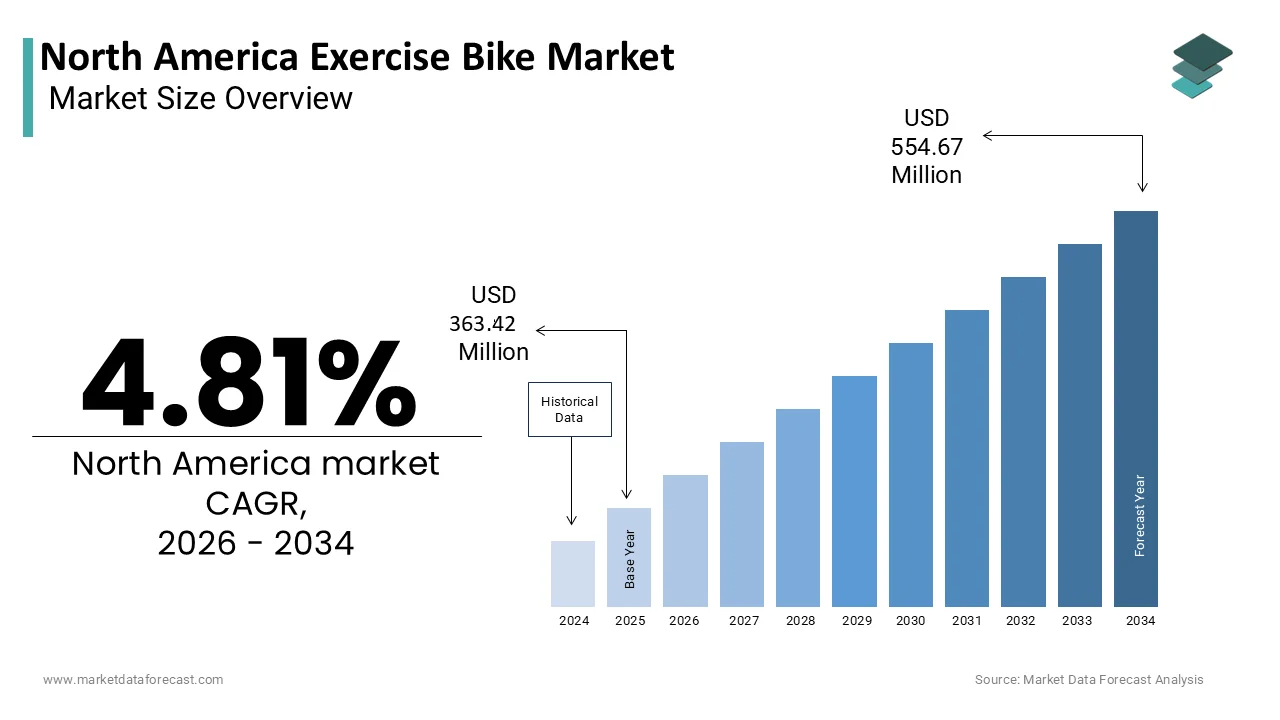
The exercise bikes include upright, recumbent, spin, and smart models equipped with features such as digital displays, heart rate monitoring, resistance control, and connectivity to fitness apps or virtual workout platforms. According to data from the U.S. Census Bureau, shipments in the fitness equipment manufacturing sector grew by 6.8% in 2023 compared to the previous year, indicating a strong recovery post-pandemic. The rise in sedentary lifestyles and chronic lifestyle-related diseases has prompted individuals to invest in personal fitness solutions, particularly in urban areas where access to gyms may be limited or costly. Moreover, advancements in connected fitness have transformed traditional exercise bikes into interactive training systems. Companies like Peloton, NordicTrack, and Echelon have led this shift by integrating live classes, AI-based coaching, and cloud-connected performance tracking.
MARKET DRIVERS
Rise in Home Fitness Adoption and Remote Work Culture
The increasing adoption of home fitness routines is largely influenced by the shift toward remote work and flexible schedules, which is attributed to propelling the growth of the North America exercise bike market. According to the U.S. Bureau of Labor Statistics, approximately 27% of employed Americans worked at least part of the time remotely in 2023, up from less than 5% before the pandemic. Exercise bikes offer a convenient and effective way to maintain cardiovascular health without requiring extensive space or specialized knowledge. A study published by the American College of Sports Medicine found that regular cycling, even indoors, can reduce the risk of heart disease, diabetes, and obesity when combined with a balanced diet. Additionally, the rising cost of gym memberships has made owning an exercise bike a more economical long-term solution. As per data from Statista, the average monthly gym membership fee in the U.S. exceeded $50 in 2023, prompting many individuals to opt for one-time investments in fitness equipment instead.
Integration of Smart Technology and Virtual Fitness Platforms
The integration of smart technology and immersive virtual fitness platforms is amplifying the growth of the North American exercise bike market. Modern exercise bikes are increasingly equipped with touchscreen displays, Wi-Fi connectivity, Bluetooth compatibility, and access to live or on-demand workout sessions hosted by professional instructors. Leading brands such as Peloton, NordicTrack, and Technogym have introduced premium models that sync with mobile applications and subscription-based fitness services, allowing users to participate in real-time classes, track performance metrics, and compete with others globally. Furthermore, advancements in artificial intelligence and machine learning are enabling adaptive workout programs tailored to individual fitness levels and goals.
MARKET RESTRAINTS
High Cost of Premium Smart Exercise Bikes
The high cost associated with premium smart models is hindering the growth of the North America exercise bike market. While basic upright and recumbent bikes remain affordable for many consumers, top-tier models equipped with large touchscreens, AI-driven coaching, and live class subscriptions often exceed $1,500, placing them beyond the reach of budget-conscious buyers. This financial barrier is particularly pronounced among middle- and lower-income households, which represent a substantial portion of the population but may not prioritize expensive fitness equipment. The U.S. Department of Commerce reported that household discretionary spending growth slowed to 2.1% in 2023, reflecting tighter budgets and cautious consumer behavior. Many individuals opt for alternatives such as outdoor cycling, gym memberships, or second-hand equipment rather than investing in high-end indoor bikes. Moreover, recurring costs such as software subscriptions and maintenance fees add to the overall expense.
Space Constraints in Urban Households
The issue of space limitations in urban households in densely populated cities, where apartment living is common, also hinders the growth of the North American exercise bike market. Exercise bikes, especially high-end smart models, require dedicated floor space that many residents may not have available. This spatial limitation discourages potential buyers from purchasing bulky fitness equipment, especially if they lack storage solutions or multipurpose rooms. Additionally, landlords and property management companies frequently impose restrictions on large fitness equipment due to concerns about noise, weight load, and wear and tear on the flooring.
MARKET OPPORTUNITIES
Expansion of Corporate Wellness Programs and Office-Based Fitness Solutions
The growing integration of fitness equipment into corporate wellness programs and office environments is creating new opportunities for the growth of the North American exercise bike market. According to the Society for Human Resource Management, over 70% of mid-sized and large corporations in the U.S. offered wellness initiatives in 2023, including subsidized gym memberships, health screenings, and in-office fitness equipment. Additionally, government-backed health incentives encourage employers to adopt workplace wellness strategies.
Growing Demand for Rehabilitation and Senior-Friendly Fitness Equipment
The increasing demand for rehabilitation-focused and senior-friendly fitness equipment is expected to boost the growth of the North America exercise bike market. There is a growing need for low-impact cardiovascular machines that cater to older adults and individuals with mobility limitations as the aging population expands and post-injury recovery becomes more home-based. According to the U.S. Census Bureau, the number of Americans aged 65 and older surpassed 60 million in 2023, representing over 18% of the total population. This demographic shift has spurred interest in gentle yet effective forms of exercise, with stationary cycling being a preferred option due to its joint-friendly nature and adjustable resistance levels. Furthermore, physical therapy clinics and assisted living facilities are increasingly adopting recumbent and seated bikes designed for rehabilitation purposes. A study published by the Journal of Aging and Physical Activity found that patients recovering from knee surgery showed faster functional improvement when incorporating stationary cycling into their rehab regimen.
MARKET CHALLENGES
Rapid Product Obsolescence and Short Technology Lifecycle
The rapid pace of technological obsolescence, which results in shorter product lifecycles and increased consumer hesitation around high-cost purchases, is restricting the growth of the North American exercise bike market. According to Frost & Sullivan, nearly 30% of smart fitness device owners expressed concerns about premature product depreciation, with some reporting that newer models were released within 12 to 18 months of their initial purchase. This accelerated innovation cycle creates uncertainty among consumers regarding the longevity and future compatibility of their investment. Additionally, manufacturers must continuously update cloud-based platforms, app integrations, and connectivity protocols to keep pace with evolving digital standards. A white paper by the Consumer Technology Association noted that nearly 45% of surveyed consumers delayed purchasing smart fitness equipment due to fears of future incompatibility with new workout platforms or operating system upgrades.
Declining Consumer Engagement Post-Purchase
The declining consumer engagement after the initial purchase period is alsoexpected to spur the growth of the North America exercise bike market. This drop-off is primarily attributed to a lack of sustained motivation, inconsistent workout scheduling, and diminishing novelty.
REPORT COVERAGE
| REPORT METRIC | DETAILS |
| Market Size Available | 2025 to 2034 |
| Base Year | 2025 |
| Forecast Period | 2026 to 2034 |
| Segments Covered | By Type, Distribution Channel, and Region |
|
Various Analyses Covered | Regional & Country Level Analysis, Segment-Level Analysis, DROC, PESTLE Analysis, Porter’s Five Forces Analysis, Competitive Landscape, Analyst Overview on Investment Opportunities |
| Regions Covered | The United States, Canada, Mexico, and the rest of North America |
| Market Leaders Profiled | Peloton Interactive, Inc., Cybex International, Inc., Johnson Health Tech. Co., Ltd. (Nautilus), Precor Incorporated, HOIST Fitness Systems, Inc., Rogue Fitness, Torque Fitness, iFIT Inc, and others |
SEGMENTAL ANALYSIS
By Type Insights
The upright bikes segment held 38.4% of the North American exercise bike market share in 2025due to its accessibility and cost-effectiveness compared to more advanced models. The U.S. Consumer Product Safety Commission reported that upright bikes accounted for nearly half of all home fitness bicycle sales in 2023, with average prices ranging from $200 to $700 b,y making them an attractive option for budget-conscious consumers. Additionally, upright bikes are favored for their space-efficient footprint, making them ideal for apartment dwellers and small workout areas. A survey conducted by the National Association of Home Builders found that over 60% of respondents considered portability and compactness as decisive factors when choosing home fitness products.
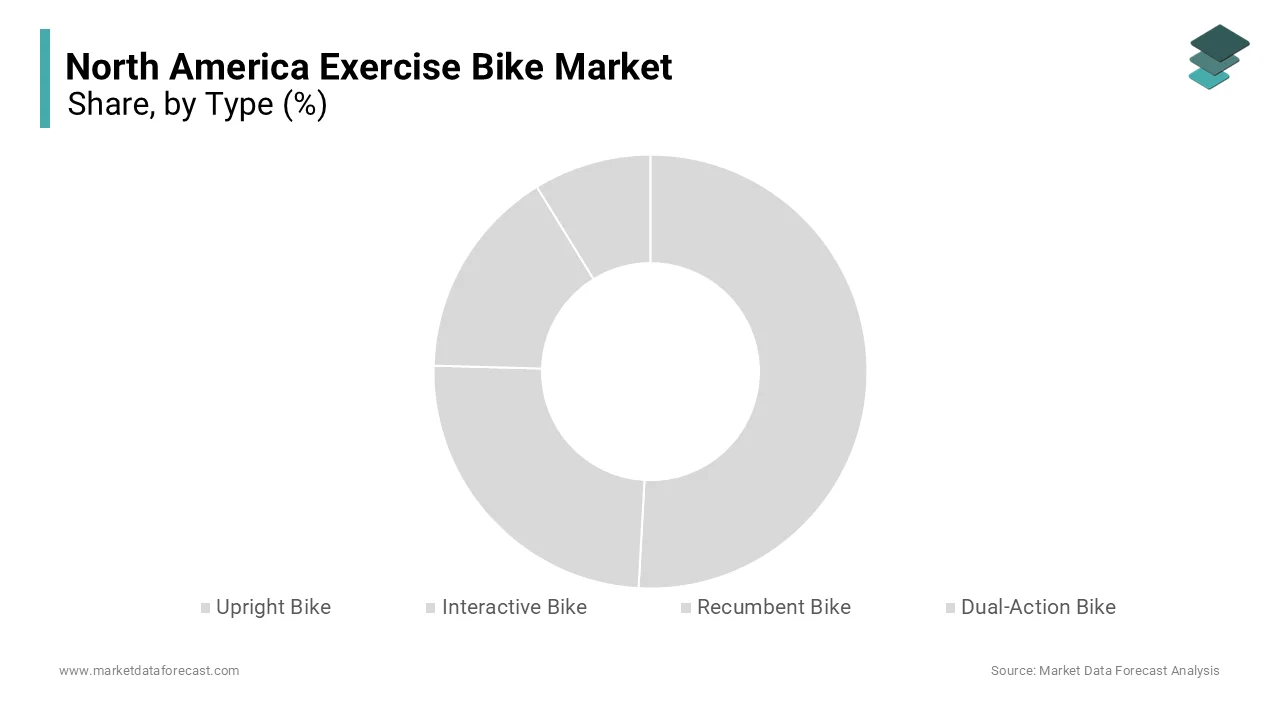
The interactive bikes segment is projected to grow with a CAGR of 14.7% during the forecast period. These high-tech models integrate large touchscreen displays, real-time coaching, live classes, and performance tracking through cloud-based platforms. A report by McKinsey & Company indicated that over 60% of digitally engaged fitness consumers preferred interactive home workouts over conventional gym settings, citing convenience and personalized feedback as key benefits. Companies like Peloton, NordicTrack, and Echelon have capitalized on this trend by offering immersive virtual training environments that simulate outdoor rides and competitive challenges. Moreover, advancements in streaming services and wearable fitness device compatibility have further enhanced user engagement.
By Distribution Channel Insights
The online distribution channels segment was the largest by capturing 59.4% of the North America exercise bike market share in 20,24 with the growing preference for e-commerce shopping, especially for bulky fitness equipment that is difficult to transport from physical stores. According to the U.S. Department of Commerce, online retail sales in the sporting goods and hobby category increased by 11.2% in 2023 compared to the previous year, reflecting stronger digital purchasing behavior. Another contributing factor is the integration of augmented reality tools and detailed product comparisons on e-commerce sites.
The online distribution segment is anticipated to grow with a CAGR of 12.4% in the coming years. The expansion of subscription-based fitness ecosystems has made online purchases more appealing. Furthermore, the proliferation of buy-now-pay-later (BNPL) financing options has lowered entry barriers for high-end smart bikes. The Federal Reserve Bank of New York noted that BNPL usage in fitness equipment purchases grew by 22% in 2023, allowing consumers to spread costs without upfront financial strain.
REGIONAL ANALYSIS
United States
The United States was the top performer in the North America exercise bike market by occupying 85.3% of the market share in 2024. According to the Centers for Disease Control and Prevention, more than 42% of American adults were classified as obese in 2023, reinforcing the urgency for accessible home-based fitness solutions. The shift toward remote work and hybrid lifestyles has further encouraged individuals to invest in personal wellness equipment, with exercise bikes being one of the most popular choices due to their low-impact nature and cardiovascular benefits. In addition, the presence of major fitness tech companies such as Peloton, NordicTrack, and SoulCycle has propelled innovation and market penetration. A report by Morning Consult found that over 50% of Americans who purchased fitness equipment in 2023 did so through direct-to-consumer or e-commerce platforms.
Canada
The Canadian exercise bike market held 12.3% of the share in 2025due to the rising health consciousness, increased home fitness adoption, and growing access to digital workout platforms tailored for Canadian consumers. Moreover, the popularity of virtual fitness programs has surged across the country. A white paper published by the Canadian Fitness Industry Association noted that over 60% of Canadians had tried at least one form of online fitness class in 2023, many of which were accessed via interactive exercise bikes. Additionally, the rise of hybrid work arrangements has allowed urban professionals to incorporate structured workouts into daily routines, further boosting demand for home-use models.
KEY MARKET PLAYERS
North America exercise bike market.Key market players
- Peloton Interactive, Inc.
- Cybex International, Inc.
- Johnson Health Tech. Co., Ltd. (Nautilus)
- Precor Incorporated
- HOIST Fitness Systems, Inc.
- Rogue Fitness
- Torque Fitness
- iFIT Inc.
COMPETITIVE LANDSCAPE
The competition in the North American exercise bike market is intense, marked by rapid innovation, shifting consumer preferences, and an influx of both traditional fitness equipment manufacturers and new entrants leveraging digital disruption. Established players like Peloton, NordicTrack, and Schwinn dominate due to their brand recognition, product quality, and integrated fitness ecosystems. However, emerging challengers—ranging from boutique fitness brands to tech startups—are gaining traction by offering cost-effective alternatives with enhanced connectivity and mobile-first workout experiences.
Differentiation strategies revolve around technological integration, user engagement, and pricing models. Companies are not only competing on hardware specifications but also on software capabilities, such as virtual coaching, cloud-based analytics, and compatibility with wearable devices. Additionally, customer acquisition and retention have become central to business models, with manyfirms' adopting subscription-based services that add ongoing value beyond the initial purchase.
Price sensitivity and market saturation present additional challenges, particularly in the mid-tier segment where consumers seek performance without premium costs. The battle for market share will increasingly hinge on brand loyalty, ecosystem richness, and the ability to maintain
TOP PLAYERS IN THE MARKET
Peloton Interactive, Inc.
Peloton has been a defining force in the interactive fitness space, transforming the stationary bike market with its connected workout platform. The company pioneered the integration of live and on-demand cycling classes, fostering a strong community-driven fitness experience. Peloton’s success lies in its ability to merge hardware with digital content by offering users real-time coaching, performance tracking, and social engagement features that have redefined home exercise culture.
Technogym S.p.A. (North America Division)
Technogym is a global leader in premium fitness equipment, with a strong presence in both commercial and residential segments across North America. Known for its high-quality, durable bikes designed for gyms and elite training centers, Technogym has contributed significantly to the professionalization of indoor cycling. Its emphasis on ergonomics, biomechanics, and design excellence has made it a preferred brand among fitness enthusiasts and institutional clients alike.
NordicTrack (iFIT Health & Fitness Inc.)
NordicTrack, under the iFIT umbrella, has emerged as a major player by combining smart technology with affordability. The brand offers a diverse range of interactive bikes equipped with immersive training experiences powered by iFIT’s global workout library. NordicTrack's aggressive digital marketing, bundled subscription services, and direct-to-consumer sales model have enabled widespread adoption in the North American home fitness market.
TOP STRATEGIES USED BY KEY PLAYERS
Expansion of Digital Ecosystems and Subscription-Based Services
Leading companies are investing heavily in developing proprietary digital platforms that offer live and on-demand workout content.
Enhanced User Experience Through AI and Gamification
To improve retention and satisfaction, manufacturers are integrating artificial intelligence, personalized training programs, and gamified elements into their smart bikes. These features provide real-time feedback, adaptive resistance levels, and performance-based rewards, whichmakeg workouts more engaging and goal-oriented.
Direct-to-Consumer Sales and Omnichannel Retail Integration
Major players are shifting toward D2C models and strengthening online distribution networks while also partnering with major retailers. This dual approach allows them to control branding, pricing, and customer service while expanding reach through established e-commerce and physical retail channels.
RECENT HAPPENINGS IN THE MARKET
- In February 2024, Peloton launched a refreshed line of its iconic Bike+ with updated display technology and expanded international instructor partnerships, which is aiming to enhance global content appeal and retain leadership in the premium interactive fitness segment.
- In May 2024, NordicTrack introduced a new tiered subscription model allowing users to access basic workout features at a lower price point while still offering full premium access by targeting budget-conscious buyers without compromising digital engagement.
- In July 2024, Schwinn partnered with leading wellness apps such as Apple Fitness+ and Google Fit to ensure seamless data synchronization and broader compatibility by reinforcing its position as a versatile and integrative option for tech-savvy consumers.
- In September 2024, Bowflex expanded its presence in Canada by launching region-specific marketing campaigns and localized customer support hubs, which reflects a strategic push to strengthen its foothold beyond the U.S. market.
- In November 2024, Echelon introduced a modular smart bike concept that allows users to upgrade components over time rather than purchasing entirely new units by addressing concerns about product obsolescence and appealing to environmentally conscious consumers.
MARKET SEGMENTATION
This research report on the North American exercise bike market has been segmented and sub-segmented based on the following categories.
By Type
- Upright Bike
- Interactive Bike
- Recumbent Bike
- Dual-Action Bike
By Distribution Channels
- Online Distribution Channels
- Physical Stores
By Country
- The United States
- Canada
- Rest of North America
Frequently Asked Questions
1. What factors are driving market growth?
Key drivers include rising health consciousness, home fitness trends, technological advancements (like smart connectivity and interactive screens), and increasing obesity rates.
2. Which are the leading companies in the North America exercise bike market?
Major players include Peloton, Nautilus, ICON Health & Fitness (NordicTrack), Echelon, Technogym, Johnson Health Tech, TRUE Fitness, and Life Fitness.
3. What are the main types of exercise bikes available?
The market offers upright bikes, recumbent bikes, and spin bikes; smart, foldable, and hybrid models are also increasingly popular
4. Where are exercise bikes most commonly used in North America?
They are widely used in homes, gyms, health clubs, rehabilitation centers, and increasingly in corporate wellness programs.
5. What are the main applications of exercise bikes?
Exercise bikes support cardiovascular health, aid in weight management, assist in rehabilitation, and offer low-impact workouts suitable for all fitness levels.
6. What key trends are shaping the North America exercise bike market?
Notable trends include the integration of AI and virtual coaching, subscription-based content, compact and foldable designs, and sustainability-focused innovations.
7. What challenges does the market face?
High upfront costs for advanced models, limited home space for equipment, and competition from other fitness products like treadmills and ellipticals are significant challenges.
8. Which countries in North America hold major market shares?
The United States dominates the region due to its established fitness culture, high consumer spending power, and rapid adoption of smart fitness equipment.
9. What is the outlook for the exercise bike market over the next decade?
Expect steady, moderate growth with ongoing product innovation, increased adoption for both home and institutional use, and a focus on technology-driven, personalized fitness.
Related Reports
Access the study in MULTIPLE FORMATS
Purchase options starting from
$ 2000
Didn’t find what you’re looking for?
TALK TO OUR ANALYST TEAM
Need something within your budget?
NO WORRIES! WE GOT YOU COVERED!
Call us on: +1 888 702 9696 (U.S Toll Free)
Write to us: sales@marketdataforecast.com