North America Location Analytics Market Size, Share, Trends & Growth Forecast Report By Location Type (Indoor, Outdoor), Deployment Model (On-premise, Cloud, Hybrid, Edge [on-device]), Component (Solutions, Services), Technology, End-User Vertical, Application, and Country (United States, Canada, Mexico, Rest of North America) – Industry Analysis, 2026 to 2034
North America Location Analytics Market Size
The North America location analytics market was valued at USD 5.24 billion in 2025. The market is projected to grow from USD 6.10 billion in 2026 to reach USD 20.55 billion by 2034, exhibiting a CAGR of 16.4% from 2026 to 2034.

Location analytics is the process of analyzing geospatial data to derive actionable business insights, optimize operational efficiency, and enhance customer engagement. The region’s early integration of advanced data processing systems and high internet penetration rates has further catalyzed the growth of location-based services across sectors such as retail, healthcare, logistics, and urban planning. As of 2024, over 95% of the U.S. population owns a mobile device capable of generating location data, according to the Pew Research Center, offering a vast pool of real-time information for businesses. Additionally, Canada ranks among the top ten countries globally in terms of smartphone ownership per capita, with over 85% of citizens using smartphones regularly.
MARKET DRIVERS
Expansion of Smart Cities and Urban Digitization Initiatives
The rapid expansion of smart cities and digitized urban infrastructure is driving the growth of the North America location analytics market. Municipalities across the U.S. and Canada are increasingly investing in intelligent transportation systems, energy-efficient grids, and connected public services that rely heavily on real-time geospatial data. For instance, New York City's LinkNYC program has deployed over 2,000 kiosks equipped with GPS and Wi-Fi capabilities, generating valuable location insights to improve urban mobility and service delivery. Similarly, Toronto’s Sidewalk Labs project, though halted, had already laid the groundwork for integrating location analytics into urban planning frameworks. Furthermore, the rise of autonomous vehicles and drone logistics also contributes to this momentum. The U.S. Department of Transportation estimates that by 2030, nearly 25% of all vehicles on American roads will be semi-autonomous or fully autonomous, each requiring precise location tracking for navigation and safety compliance.
Proliferation of Mobile Commerce and Personalized Marketing
The exponential growth of mobile commerce and hyper-personalized marketing strategies will further fuel the growth of the North America location analytics market. Businesses are leveraging geolocation data to tailor promotions, improve customer engagement, and optimize store placements. Retailers are increasingly adopting proximity-based marketing techniques such as geo-fencing and beacon technology to deliver real-time offers to consumers within close physical proximity to stores. For example, Starbucks utilizes mobile app-based location analytics to send personalized discount notifications when users are near a store, which has reportedly increased in-store foot traffic by up to 15%, as per internal company disclosures. Additionally, the advertising industry is shifting toward performance-based marketing models where return on investment (ROI) can be directly tied to user actions. According to eMarketer, location-targeted mobile ad spending in the U.S. surpassed $32 billion in 2023, reflecting a year-over-year increase of 18%.
MARKET RESTRAINTS
Growing Concerns Over Data Privacy and Regulatory Constraints
The escalating concern over data privacy and the tightening of regulatory frameworks governing personal data usage is restricting the growth of the North America location analytics market. Consumers are becoming more aware of how their location data is being collected, stored, and monetized by third parties. This sentiment has prompted lawmakers to introduce stricter regulations. For instance, the California Consumer Privacy Act (CCPA) and the proposed American Data Privacy and Protection Act (ADPPA) impose stringent requirements on data transparency and user consent mechanisms. As a result, organizations must invest in compliance measures, including anonymization protocols and audit trails, which can increase operational costs and slow down data utilization processes. According to the Office of the Privacy Commissioner of Canada, over 60% of surveyed firms reported delays in launching new location-based products due to compliance complexities.
Fragmentation of Geolocation Data Sources and Interoperability Issues
The fragmentation of geolocation data sources and the lack of standardized interoperability protocols are inhibiting the growth of the North America location analytics market. Location data is generated from multiple channels such as mobile networks, GPS satellites, Wi-Fi access points, and IoT sensors, often resulting in inconsistent formats and varying degrees of accuracy. For example, in Chicago, the city’s transit authority and police department were found to be using incompatible mapping software, delaying cross-departmental coordination efforts during public events, as highlighted in a 2022 Civic Tech Review. Moreover, commercial providers also contribute to this issue. Major tech companies like Apple and Google maintain proprietary location databases, making it difficult for third-party developers to access comprehensive and harmonized datasets.
MARKET OPPORTUNITIES
Integration of AI and Machine Learning in Location Intelligence Platforms
The integration of artificial intelligence (AI) and machine learning (ML) to enhance predictive capabilities and automate decision-making is setting new opportunities for the growth of the North America location analytics market. Traditional location analytics tools primarily focus on descriptive insights, but AI-powered platforms can now forecast trends, detect anomalies, and prescribe strategic actions based on historical and real-time geospatial data. According to a 2024 Gartner report, over 65% of leading enterprises in North America are investing in AI-enhanced location analytics solutions to improve operational efficiency and customer experience. In healthcare, AI-enabled location analytics is being used to predict disease outbreaks and optimize ambulance dispatches. In Ontario, Canada, the Ministry of Health partnered with BlueDot, a health analytics firm, to track flu outbreak patterns using geolocation data from travel and social media trends.
Rising Demand for Real-Time Location Tracking in Emergency Response Systems
The deployment of real-time location analytics within emergency response systems across North America is another attribute that a propel the growth of the North America location analytics market. According to the National Emergency Number Association (NENA), over 240 million 911 calls are made annually in the U.S., yet only 60% of these calls provide accurate indoor location data for mobile users. To address this gap, the Federal Communications Commission (FCC) mandated that wireless carriers achieve vertical location accuracy within 3 meters for 80% of indoor 911 calls by the end of 2023. Cities like Denver and Vancouver have piloted smart emergency response platforms that integrate real-time location feeds from mobile phones, drones, and IoT sensors. In a 2023 pilot conducted by the Denver Fire Department, the use of location analytics reduced average emergency response time by 12%, saving crucial minutes during cardiac arrest cases.
MARKET CHALLENGES
High Costs of Advanced Location Analytics Infrastructure Deployment
The high cost associated with deploying and maintaining advanced location analytics infrastructure is slowly degrading the growth of the market. While the demand for real-time geospatial insights continues to grow, many small and mid-sized enterprises (SMEs) struggle to adopt these technologies due to significant capital expenditures required for hardware, software licensing, cloud storage, and skilled personnel. According to a 2024 Deloitte survey, 58% of SMEs cited financial constraints as the primary barrier to integrating location-based analytics into their operations. The deployment of high-resolution indoor positioning systems, for instance, requires extensive installation of beacons, sensors, and network gateways, each adding to the overall cost. Moreover, continuous maintenance and upgrades further strain budgets. Cloud-based location analytics platforms, while scalable, often come with recurring subscription fees and data processing charges. Public sector entities, particularly local governments and school districts, also face budgetary limitations.
Technological Complexity and Talent Shortage in Geospatial Data Processing
The technological complexity involved in processing and interpreting large volumes of geospatial data, compounded by a shortage of skilled professionals, is also hindering the growth of the North America location analytics market. According to a 2024 report by the Urban Land Institute, over 70% of firms utilizing location analytics face difficulties in finding qualified personnel who can manage spatial data workflows effectively. Universities and training institutions have been slow to develop curricula that combine geography with big data analytics, leading to a talent gap in the workforce.
Additionally, the technical stack required for advanced location analytics is highly complex. Integrating platforms such as Esri ArcGIS, Google Maps APIs, and open-source tools like QGIS demands deep technical knowledge and customization capabilities. Many organizations lack in-house expertise to configure these systems optimally, leading to inefficient implementations and underutilization of available features.
REPORT COVERAGE
| REPORT METRIC | DETAILS |
| Market Size Available | 2025 to 2034 |
| Base Year | 2025 |
| Forecast Period | 2026 to 2034 |
| Segments Covered | By Location Type, Deployment Model, Component, Technology, End-User Vertical, Application, and Region. |
| Various Analyses Covered | Global, Regional and Country-Level Analysis, Segment-Level Analysis, Drivers, Restraints, Opportunities, Challenges; PESTLE Analysis; Porter’s Five Forces Analysis, Competitive Landscape, Analyst Overview of Investment Opportunities |
| Countries Covered | United States, Canada, Mexico, Rest of North America |
| Market Leaders Profiled | Esri Inc., IBM Corporation, Microsoft Corporation, Cisco Systems Inc., Google LLC, and others. |
SEGMENTAL ANALYSIS
By Location Insights
The outdoor location analytics segment held 58.3% of the North America location analytics market share in 2024, with the expansion of smart city initiatives, particularly in major U.S. metropolitan areas such as New York, Los Angeles, and Chicago. According to a 2024 report by IDC, over $19 billion was invested in outdoor location-based infrastructure across North America last year alone, with a significant portion allocated to intelligent traffic management and real-time public safety monitoring. Additionally, the growth of autonomous vehicle deployment is further fueling demand for outdoor location analytics. The U.S. Department of Transportation estimates that by 2030, more than 25 million autonomous vehicles will be on American roads, each requiring high-precision outdoor positioning systems.
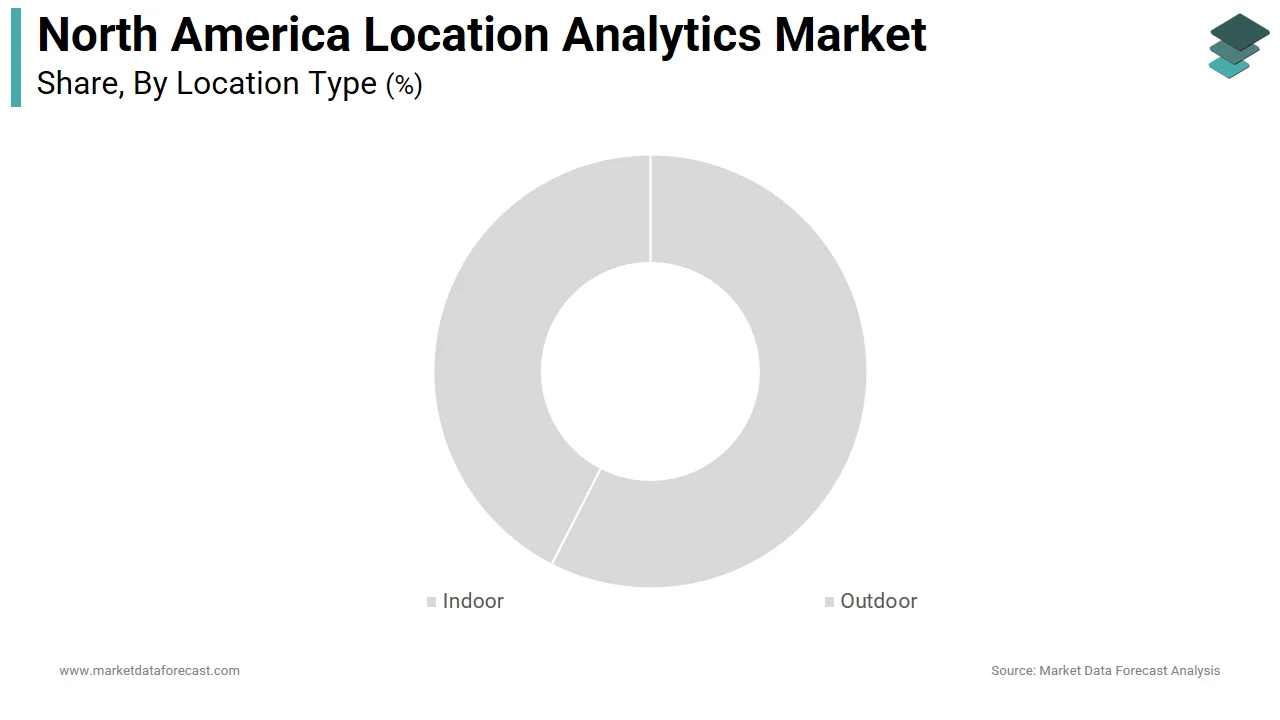
The indoor location analytics segment is likely to witness a CAGR of 17.3% from 2026 to 2034, owing to the adoption of indoor positioning systems (IPS) in commercial real estate and retail spaces. As per a 2024 report by ABI Research, over 60% of large shopping malls in the U.S. have deployed Wi-Fi and Bluetooth-based indoor navigation systems to enhance customer experience and gather behavioral insights. Moreover, the healthcare sector is increasingly leveraging indoor location analytics for asset tracking and patient flow optimization. In Canada, hospitals such as Toronto General have implemented RFID-based indoor tracking systems to monitor medical equipment movement, reducing equipment loss by over 40% and improving staff efficiency, as per a 2023 Canadian Healthcare Technology Review.
By Deployment Model Insights
The on-premises deployment segment was the largest by occupying 54.3% of the North America location analytics market in 2024. The sustained preference for on-premises systems stems largely from stringent regulatory requirements and national security concerns in the U.S. federal sector. According to a 2024 Gartner report, over 65% of U.S. defense and intelligence agencies rely on localized data processing infrastructures to comply with the Federal Risk and Authorization Management Program (FedRAMP). Additionally, industries such as utilities and energy infrastructure also favor on-premises solutions due to the need for real-time decision-making without dependence on internet connectivity. A 2023 study by Deloitte found that over 70% of oil and gas companies operating in remote North American locations use on-premises GIS platforms to manage pipeline routes, drilling sites, and maintenance logistics.
The cloud-based deployment segment is more likely to witness an expected CAGR of 19.8% during the forecast period, with the rising adoption of Software-as-a-Service (SaaS) platforms in retail and logistics. According to a 2024 IDC survey, over 75% of mid-sized retailers in North America now utilize cloud-based location analytics tools for footfall tracking, inventory optimization, and targeted marketing campaigns. Furthermore, the integration of cloud analytics with IoT and mobile applications is accelerating deployment speed.
By Technology Insights
The GPS and GNSS technologies segment held a significant share of the North America location analytics market in 2025. The continued dominance of GPS/GNSS is primarily fueled by the deep integration of satellite-based positioning systems into automotive and logistics ecosystems. According to the U.S. Department of Transportation, over 95% of commercial transport vehicles in the U.S. use GPS-based telematics systems for route optimization and compliance tracking. Companies like Geotab and Samsara serve millions of fleets nationwide by enabling real-time asset visibility and fuel efficiency improvements. As per a 2024 report by Counterpoint Research, over 280 million smartphones were sold in North America in the past year, all equipped with multi-constellation GNSS capabilities including GPS, GLONASS, Galileo, and BeiDou.
The Wi-Fi-based segment is expected to grow with a CAGR of 21.4% from 2026 to 2034, with its widespread availability in commercial and residential settings. According to Cisco’s 2024 Annual Internet Report, over 90% of households and businesses in North America have access to Wi-Fi networks, providing a ready infrastructure for indoor location tracking. Enterprises are leveraging these existing networks to deploy location-based services such as employee attendance tracking, asset monitoring, and visitor navigation. In the retail sector, for instance, brands like Walmart and Best Buy have integrated Wi-Fi fingerprinting technologies to analyze shopper behavior and optimize store layouts. Additionally, the rise of hybrid workspaces post-pandemic has spurred demand for real-time space utilization tracking. As per JLL’s 2024 Workplace Strategy Insights, over 60% of Fortune 500 companies in North America now use Wi-Fi-based presence detection to manage office capacity and hot-desking arrangements.
By End-User Vertical Insights
The retail segment was the largest by capturing 34.2% of the North America location analytics market share in 2024 due to the growing adoption of location-based marketing and foot traffic analytics. Additionally, the expansion of brick-and-click retail models is driving demand for accurate indoor and outdoor location tracking. Amazon Go stores, for instance, integrate computer vision and sensor fusion with location analytics to create cashier-less shopping experiences. Moreover, inventory and logistics optimization is another critical application. Retail giants are using geolocation data to dynamically adjust stock levels based on regional demand patterns.
The government sector is swiftly emerging with a CAGR of 18.6% throughout the forecast period due to the expansion of emergency response systems incorporating real-time location data. According to the National Emergency Number Association (NENA), over 240 million 911 calls are made annually in the U.S., yet only 60% of mobile-originated calls provide accurate indoor location information. To address this, the FCC mandated that wireless carriers achieve vertical location accuracy within three meters for 80% of indoor 911 calls by the end of 2023. Additionally, the deployment of location analytics in urban planning and environmental monitoring is gaining momentum. Municipalities are utilizing geospatial data to track air quality, manage waste collection, and optimize transportation routes.
COUNTRY-LEVEL ANALYSIS
United States Location Analytics Market Insights
The United States was the top performer of the North America location analytics market by capturing 78.3% of the share in 2024, with the rapid adoption of location analytics across multiple sectors, including retail, healthcare, logistics, and defense. According to a 2024 report by IDC, the U.S. accounted for over $9.2 billion in location analytics software spending last year alone, with a significant portion allocated to AI-integrated platforms. Major corporations such as Google, Apple, and Microsoft continue to invest heavily in location-based services, offering APIs and SDKs that power thousands of consumer and enterprise applications. Additionally, the expansion of smart city initiatives is fueling demand. Cities like San Francisco, Boston, and Atlanta are deploying real-time geospatial dashboards to manage traffic congestion, optimize public transit, and enhance emergency response systems.
Canada Location Analytics Market Insights
Canada location analytics market is expected to grow significantly in the coming years with the federal and provincial support for smart city development, particularly in urban centers like Toronto, Montreal, and Vancouver. According to Innovation, Science and Economic Development Canada (ISED), over CAD 2.3 billion has been allocated to digital infrastructure projects since 2020, many of which incorporate location analytics for transportation planning and environmental monitoring. Additionally, the healthcare sector is rapidly adopting location analytics for asset tracking and patient flow optimization. In Ontario, hospitals such as St. Michael’s Hospital have deployed RFID and BLE-based indoor positioning systems to track medical equipment and streamline emergency care pathways. Moreover, the retail and real estate sectors are increasingly using geolocation tools to understand consumer behavior and optimize store placements. According to a 2024 Retail Council of Canada survey, over 60% of large retailers now use location analytics for foot traffic measurement and hyper-localized marketing campaigns.
COMPETITIVE LANDSCAPE
The competition in the North America location analytics market is characterized by a dynamic mix of established tech giants, specialized GIS firms, and emerging startups striving to capture market share through innovation and strategic positioning. Dominant players leverage extensive resources and technological expertise to develop comprehensive geospatial platforms that cater to diverse industry verticals. Meanwhile, niche companies focus on specific use cases such as indoor navigation, asset tracking, or real-time mobility insights to differentiate themselves. The market sees frequent advancements in AI-driven location intelligence, cloud-based deployment models, and integration with Internet of Things (IoT) ecosystems, pushing firms to continuously evolve their offerings. Strategic acquisitions and partnerships are common tactics employed to expand capabilities and customer bases. Regulatory developments around data privacy and security also influence competitive dynamics, which require firms to balance innovation with compliance.
KEY MARKET PLAYERS
Noteworthy Companies dominating the North America location analytics market profiled in the report are
- Esri Inc.
- IBM Corporation
- Microsoft Corporation
- Cisco Systems Inc.
- Google LLC
TOP LEADING PLAYERS IN THE MARKET
- Google has been a dominant player in geospatial technologies by offering robust mapping and location-based services that power millions of applications worldwide. Through its Google Maps Platform, the company provides APIs for real-time location tracking, geofencing, and route optimization, which are widely used across industries such as logistics, retail, and transportation. Its integration with Android devices ensures continuous data inflow, enabling businesses to leverage mobility patterns for strategic decision-making.
- Microsoft Corporation is significantly involved through its Azure Maps and broader cloud computing infrastructure. Microsoft integrates location intelligence with enterprise solutions, offering developers and businesses scalable tools for spatial analysis, asset tracking, and IoT-enabled location monitoring. The company's strong presence in corporate IT environments allows seamless adoption of location analytics within existing workflows. Esri Inc. stands out as a global leader in geographic information system (GIS) software and plays a crucial role in the North America location analytics market. Esri’s ArcGIS platform is widely adopted by government agencies, urban planners, and environmental organizations for spatial data visualization, analysis, and decision support. The company emphasizes customizability and interoperability, allowing integration with various data sources and third-party applications.
TOP STRATEGIES USED BY KEY MARKET PARTICIPANTS
Key players in the North America location analytics market employ several strategies to maintain and strengthen their competitive edge. One of the most prominent strategies is product innovation and feature enhancement. Companies continuously invest in research and development to introduce advanced geospatial tools, integrating artificial intelligence, machine learning, and real-time analytics to improve accuracy and usability. These innovations enable deeper insights into consumer behavior, logistics optimization, and urban planning, catering to evolving business and governmental needs.
Another critical approach is strategic partnerships and collaborations. Major vendors collaborate with telecom providers, hardware manufacturers, and software developers to create integrated ecosystems that enhance data collection and processing capabilities. These alliances help expand service offerings and reach new customer segments across industries such as healthcare, retail, and smart infrastructure.
The market expansion and geographic diversification play a key role. Companies are focusing on extending their footprint beyond traditional hubs by entering emerging markets and deepening their presence in regional cities. This strategy helps them tap into new revenue streams and adapt their solutions to local regulatory and operational landscapes by ensuring sustained growth and relevance in a rapidly evolving industry.
RECENT MARKET DEVELOPMENTS
- In January 2024, Google announced an expanded partnership with a major U.S. automaker to integrate real-time traffic and location data into connected vehicle systems by enhancing navigation accuracy and driver experience.
- In March 2024, Esri launched a new version of its ArcGIS Urban platform tailored specifically for North American municipalities by enabling more efficient land-use planning and zoning analysis using location intelligence.
- In June 2024, Microsoft introduced enhanced spatial analysis capabilities within Azure Synapse Analytics, which is allowing enterprises to process and visualize geolocation data at scale without switching between multiple platforms.
- In September 2024, HERE Technologies collaborated with a leading North American logistics provider to deploy AI-powered route optimization tools that dynamically adjust delivery paths based on real-time traffic and weather conditions.
- In November 2024, TomTom partnered with a U.S.-based smart city consortium to provide high-definition mapping and geolocation services for autonomous public transit pilot programs in select metropolitan areas.
MARKET SEGMENTATION
This North America location analytics market research report is segmented and sub-segmented into the following categories.
By Location Type
- Indoor
- Outdoor
By Deployment Model
- On-premise
- Cloud
- Hybrid
- Edge (on-device)
By Component
- Solutions
- Services
By Technology
- GPS / GNSS
- Wi-Fi
- Bluetooth Low-Energy (BLE)
- Ultra-Wideband (UWB)
- Cellular (4G/5G incl. CBRS)
- RFID & NFC
- Magnetic & Other
By End-User Vertical
- Retail & E-Commerce
- Banking, Financial Services & Insurance (BFSI)
- Manufacturing
- Healthcare & Life Sciences
- Government & Defense
- Energy & Utilities
- Transportation & Logistics
- Telecom & IT
- Real Estate & Smart Buildings
- Other Verticals
By Application
- Risk Management
- Supply Chain & Inventory Optimization
- Sales & Marketing Optimization
- Facility & Asset Management
- Workforce & Field-Force Management
- Remote Monitoring & Predictive Maintenance
- Emergency & Disaster Response Management
- Customer Experience & Engagement
- Fraud & Compliance Analytics
- Others
By Country
- United States
- Canada
- Mexico
- Rest of North America
Frequently Asked Questions
1. Which factors are driving the North America Location Analytics Market?
Key drivers include the rise of omnichannel retail geo-marketing, IoT and connected devices, cloud-native geospatial analytics, and demand for precision in supply chain and customer experience management
2. Which deployment models are common in the North America Location Analytics Market?
On-premise deployments remain important due to data sovereignty, but cloud-based solutions are growing fast—at over 20% CAGR—for their scalability, collaboration, and cost benefits
3. What are the leading application areas for location analytics in North America?
Top applications include supply chain and inventory optimization, sales and marketing, facility and asset management, remote monitoring, and emergency response management
4. Which industries are the largest users of location analytics in North America?
Major verticals include retail, manufacturing, government, transportation, healthcare, energy & utilities, banking and financial services (BFSI), and telecom
5. What are the main benefits of adopting location analytics in North America?
Key benefits include improved operational efficiency, enhanced customer engagement, real-time risk management, better resource optimization, and data-driven strategic decisions
6. How do privacy and regulatory standards affect the North America Location Analytics Market?
Strict data privacy regulations and compliance needs are shaping solutions, requiring secure and privacy-preserving analytics that still deliver actionable insights
7. Who are the major vendors in the North America Location Analytics Market?
Key players include Esri, IBM, Google, Oracle, Cisco, SAP, Precisely, TomTom, Hexagon, Zebra Technologies, and HPE, with frequent partnerships and R&D investments
8. Which technological trends are impacting the North America Location Analytics Market?
Notable trends include the adoption of AI and predictive analytics, integration with IoT devices, cloud and edge computing fusion, and the use of mobile/location-based apps for business intelligence
9. What is the importance of cloud-based solutions in the North America Location Analytics Market?
Cloud-based analytics are scaling rapidly as organizations seek flexible deployment, easy integration, real-time collaboration, and reduced capex on IT infrastructure
10. How is location analytics used in smart cities and public sector initiatives?
Smart cities leverage location analytics for urban planning, infrastructure investment, traffic and energy management, public safety, and emergency response coordination
Related Reports
Access the study in MULTIPLE FORMATS
Purchase options starting from
$ 2000
Didn’t find what you’re looking for?
TALK TO OUR ANALYST TEAM
Need something within your budget?
NO WORRIES! WE GOT YOU COVERED!
Call us on: +1 888 702 9696 (U.S Toll Free)
Write to us: sales@marketdataforecast.com