Global Patient-Centric Healthcare App Market Size, Share, Trends & Growth Forecast Report By Type, Technology, Operating System, End-User and Region (North America, Europe, Asia-Pacific, Latin America, Middle East and Africa), Industry Analysis From 2026 to 2034.
Global Patient-Centric Healthcare App Market Size
The size of the global patient-centric healthcare app market was worth USD 1,456 million in 2025. The global market is anticipated to grow at a CAGR of 35.2% from 2026 to 2034 and be worth USD 21,976 million by 2034 from USD 1,968.51 million in 2026.
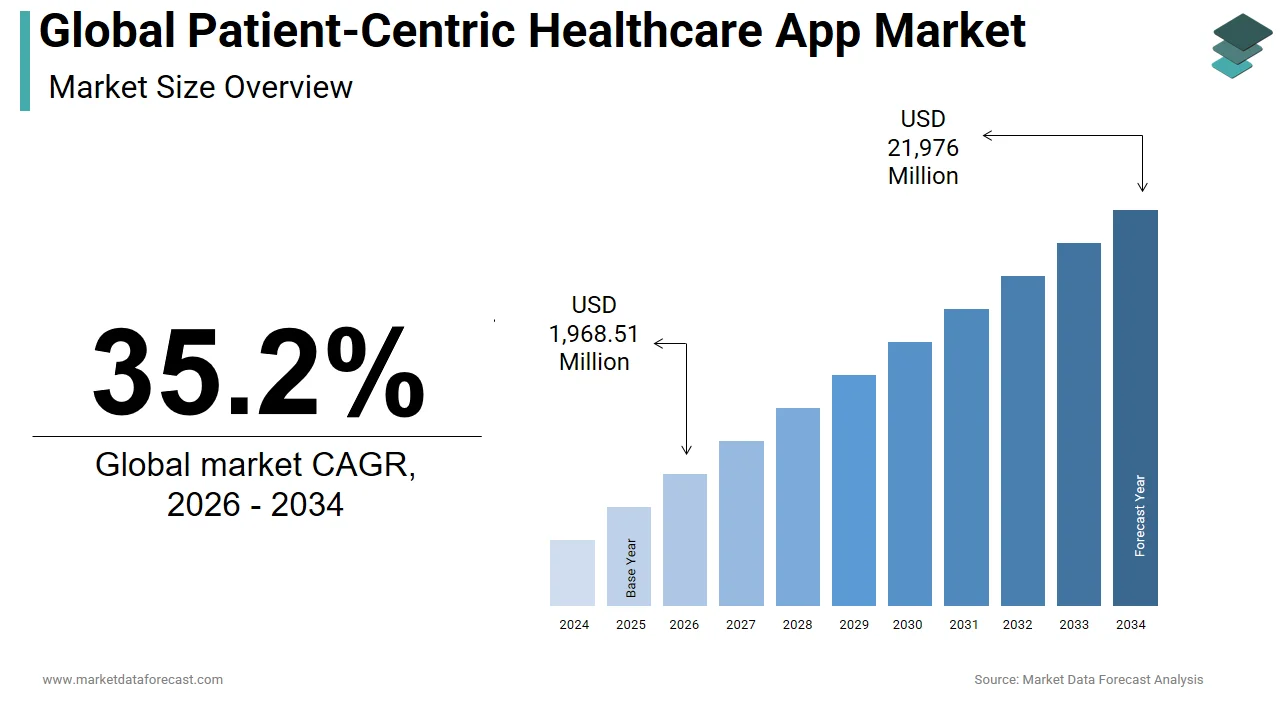
Healthcare apps are a rapidly growing technology and service industry. The global coronavirus pandemic (COVID-19) has prompted a shift to remote work in many industries to prevent the spreading of infectious diseases. Patient-centered applications are defined as systems that allow practitioners, patients, and their families (when appropriate) to collaborate to ensure that procedures and decisions respect patients' needs and preferences. These applications span the clinical and non-clinical sectors and include tools for both individual and population health. They cover various communication channels, including web-based systems, portable monitoring tools, and mobile devices.
MARKET DRIVERS
The growing awareness among people regarding healthcare apps and the increasing usage of these apps in developing and developed countries are majorly driving the growth of the global patient-centric healthcare app market.
All healthcare decisions and quality measurements in patient-centered care are driven by an individual's specific health needs and desired health outcomes. The implementation of medical digital technologies has the potential to improve public accessibility and flexibility in healthcare. It includes open information on health, treatment, complications, and recent biomedical research progress. Diagnostic and medical services are becoming more accessible and available, even in low-income countries. Patient-centered mobile healthcare applications have frequently targeted asthma, diabetes, and chronic obstructive pulmonary disease (COP). Wearable healthcare monitoring device apps are constantly improving, and home healthcare is becoming rising, driving the global patient-centric healthcare app market during the forecast period. The low-cost, high-performance wearable device apps give healthcare professionals an accurate picture of a patient's health in real time. In addition, remote patient monitoring and telehealth or telemedicine technology are growing in popularity. Home telehealth applications use telecommunications and videoconferencing technologies to connect a healthcare provider at a clinical site to patients in their homes. According to the CDC, the US has 12,200 home healthcare agencies (2016). During the year, approximately 4.5 million patients received and completed care (2015).
As the global adoption of mobile phones grows, so do healthcare apps.
Consumers can gain access to health information via the Internet. There has been an increase in the number of web-based patient education sites that provide access to information about patients' conditions. The number of smartphones in use is growing at a 7% annual rate, with more than 1 million new cell phones entering the market daily. Because smartphone penetration is still below 70% in many developed countries, such as China and India, the smartphone market has enormous potential. China, India, and the United States have the most smartphone users. The Internet and mobile phones are becoming increasingly popular. Many low- and middle-income countries have been affected. According to the most recent Ericsson data, the number of smartphone subscribers has surpassed 6 billion, accounting for over three-quarters of all mobile telephones currently in use. Additionally, factors such as the growing adoption of mobile healthcare apps across the globe, the rising prevalence of chronic diseases, the growing aging population, and rapidly expanding digitalization in the healthcare industry are further boosting the growth rate of the global patient-centric healthcare app market.
MARKET RESTRAINTS
However, the market's growth is expected to be hampered by the high cost of transitioning to a patient-centric approach, inadequate training for healthcare professionals, and an insufficient supply-to-demand ratio. In addition, factors such as lower accuracy of healthcare apps, limited reimbursement coverage, slow adoption of patient-centric healthcare apps in developing economies, a lack of technological awareness among the elderly, and uncertainty in government regulations limit the growth of the patient-centric healthcare app market.
REPORT COVERAGE
| REPORT METRIC | DETAILS |
| Market Size Available | 2024 to 2033 |
| Base Year | 2024 |
| Forecast Period | 2026 to 2034 |
| Segments Covered | By Type, Technology, Operating System, End-User, and Region. |
| Various Analyses Covered | Global, Regional, and Country-Level Analysis, Segment-Level Analysis, Drivers, Restraints, Opportunities, Challenges; PESTLE Analysis; Porter’s Five Forces Analysis, Competitive Landscape, Analyst Overview of Investment Opportunities |
| Regions Covered | North America, Europe, Asia Pacific, Latin America, Middle East & Africa |
| Market Leaders Profiled | Merck & Co Inc, Koninklijke Philips N V, Medtronic Plc, Allscripts Healthcare Solutions, Inc., Hill-Rom Holdings Inc, International Business Machines Corporation (IBM), Bayer AG, Pfizer Inc., Siemens Healthineers AG, iPatientCare, Inc., Boston Scientific Corporation, and Novartis AG. |
KEY MARKET PLAYERS
A few of the leading companies in the global patient-centric app market profiled in this report are
- Merck & Co., Inc.
- Koninklijke Philips N.V.
- Medtronic plc
- Allscripts Healthcare Solutions, Inc.
- Hill-Rom Holdings Inc.
- International Business Machines Corporation (IBM)
- Bayer AG
- Pfizer Inc.
- Siemens Healthineers AG
- iPatientCare, Inc.
- Boston Scientific Corporation
- Novartis AG
MARKET SEGMENTATION
This research report on the global patient-centric healthcare app market has been segmented and sub-segmented based on type, technology, operating system, end-user & region.
By Type
- Wellness Management
- Fitness Patient-Centric Apps
- Lifestyle & Stress Patient-Centric Apps
- Diet & Nutrition Patient-Centric Apps
- Diseases & Treatment Management
- Healthcare Providers/Insurance Patient-Centric Apps
- Medication Reminders & Information Patient-Centric Apps
- Women’s Health & Pregnancy Patient-Centric Apps
- Disease-specific patient-centric apps
By Technology
- Phone-Based Apps
- Web-Based Apps
- Wearable Patient-Centric Apps
By Operating System
- iOS
- Android
- Windows
- Others
By End User
- Hospitals
- Clinics
- Home Use
By Region
- North America
- Europe
- Asia-Pacific
- Latin America
- The Middle East and Africa
Frequently Asked Questions
1. What is the global patient-centric healthcare app market?
The global patient-centric healthcare app market includes mobile platforms that support appointments, medication reminders, health tracking, and access to medical documents in digital form.
2. What is the size of the global patient-centric healthcare app market?
The global patient-centric healthcare app market was valued at USD 1,456 million in 2025 and is estimated to reach USD 21,976 million by 2034 from USD 1,968.51 million in 2026.
3. What drives the growth of the global patient-centric healthcare app market?
High smartphone penetration, remote care demand, and self-managed treatment trends significantly fuel the global patient-centric healthcare app market.
4. Which users benefit from the global patient-centric healthcare app market?
Patients with chronic conditions, frequent medical visits, and preventive care needs actively rely on the global patient-centric healthcare app market for real-time assistance.
5. What role does telemedicine play in the global patient-centric healthcare app market?
Teleconsultation features improve access to virtual care, strengthening the global patient-centric healthcare app market as hospitals digitalize patient interaction.
6. How does wearable integration support the global patient-centric healthcare app market?
Syncing with smartwatches enables continuous monitoring, improving engagement and boosting the global patient-centric healthcare app market.
7. Why is personalization important in the global patient-centric healthcare app market?
Personal dashboards, customized alerts, and health insights enhance user adherence in the global patient-centric healthcare app market.
8. What challenges exist in the global patient-centric healthcare app market?
Privacy compliance, cybersecurity threats, and fragmented medical record access remain key barriers in the global patient-centric healthcare app market.
9. Which regions lead the global patient-centric healthcare app market?
North America and Asia-Pacific show strong demand due to rapid digital care adoption in the global patient-centric healthcare app market.
10. How is AI improving the global patient-centric healthcare app market?
AI-based symptom screening, chatbot assistance, disease prediction, and tracking strengthen value within the global patient-centric healthcare app market.
Related Reports
Access the study in MULTIPLE FORMATS
Purchase options starting from
$ 2500
Didn’t find what you’re looking for?
TALK TO OUR ANALYST TEAM
Need something within your budget?
NO WORRIES! WE GOT YOU COVERED!
Call us on: +1 888 702 9696 (U.S Toll Free)
Write to us: sales@marketdataforecast.com