Global Polyethylene Glycol Market Size, Share, Trends & Growth Forecast Report – Segmented By Grade (Pharmaceutical Grade, Industrial Grade, Cosmetic Grade, Food Grade), Application, End-User and Region (North America, Europe, Asia Pacific, Latin America, and Middle East & Africa) - Industry Analysis From 2025 to 2033
Global Polyethylene Glycol Market Size
The global polyethylene glycol market was valued at USD 4.26 billion in 2024, is estimated to reach USD 4.44 billion in 2025, and is projected to reach USD 6.13 billion by 2033, growing at a CAGR of 4.12% from 2025 to 2033.

The Polyethylene glycol is widely valued for its solubility, lubricity, and biocompatibility. PEG is extensively utilized in pharmaceuticals, cosmetics, industrial manufacturing, and food processing, due to its non-toxic and hydrophilic properties. Its importance in healthcare is expanding rapidly as it is a key excipient in oral formulations and a stabilizer in biologics.
MARKET DRIVERS
Rising Pharmaceutical and Biopharmaceutical Applications
The expanding pharmaceutical industry is a primary attribute driving the growth of the Polyethylene glycol market. PEG is widely used in drug formulations, controlled-release mechanisms, and injectable therapies. As per the International Federation of Pharmaceutical Manufacturers and Associations, global pharmaceutical production surpassed USD 1.5 trillion in 2023, with biologics contributing over 35% of the pipeline. PEGylation, a process of modifying therapeutic proteins with PEG, enhances drug stability and reduces immunogenicity, boosting the adoption of PEG in biologics manufacturing. This rising healthcare burden ensures sustained pharmaceutical reliance on PEG.
Expanding Demand in Personal Care and Cosmetics
The personal care sector is another factor prompting the growth of the Polyethylene glycol market. PEG serves as a base for creams, shampoos, and lotions due to its ability to function as a thickener, solvent, and penetration enhancer. According to the L’Oréal Global Cosmetics Report, the global cosmetics market grew by 8% in 2023, with Asia-Pacific contributing nearly 45% of consumption. The Organisation for Economic Co-operation and Development stated that urbanization now covers over 57% of the world’s population, increasing the use of personal grooming products. Rising disposable incomes in emerging economies such as India and China further drive consumer demand for high-quality skincare and haircare products, where PEG is a key formulation ingredients.
MARKET RESTRAINTS
Stringent Environmental and Safety Regulations
The regulatory scrutiny is majorly restraining the growth of the Polyethylene glycol market. PEG is generally recognized as safe, but its environmental impact, particularly in wastewater contamination, is under review. The European Chemicals Agency has tightened restrictions on polymers that demonstrate persistence in aquatic ecosystems, including PEG derivatives. According to the United Nations Environment Programme, nearly 300 million tons of plastic waste are produced annually, intensifying pressure on industries to adopt eco-friendly alternatives. Stricter compliance norms increase operational costs for PEG manufacturers and may limit large-scale expansion in regions with robust regulatory frameworks such as Europe.
Fluctuations in Raw Material Supply
The volatility in raw material supply, particularly ethylene oxide, poses a major challenge to PEG production. Ethylene oxide is derived from petroleum, making PEG prices vulnerable to oil market fluctuations. As per International Energy Agency, global crude oil prices fluctuated by more than 30% between 2022 and 2023, which is directly impacting the cost structure of downstream petrochemicals, including PEG. Moreover, geopolitical instability in key oil-exporting nations has amplified supply chain uncertainties.
MARKET OPPORTUNITIES
Growth in Biologics and Biosimilars Development
The increasing reliance on biologics and biosimilars offers lucrative opportunities for the Polyethylene glycol market expansion. PEGylation is crucial in prolonging the half-life of biologics, thereby improving therapeutic efficacy. Additionally, biosimilars are witnessing rapid acceptance that could save healthcare systems nearly USD 285 billion globally by 2030. PEG’s indispensable role in biologics production creates a strong growth pathway for suppliers in emerging pharmaceutical hubs across Asia and Latin America.
Expansion of Green Chemistry and Sustainable PEG Production
Sustainability trends for eco-friendly PEG production are greatly impacting the growth of the Polyethylene glycol market. Manufacturers are increasingly adopting bio-based ethylene oxide and renewable feedstocks to reduce environmental footprints. This shift offers companies the opportunity to differentiate through sustainable PEG offerings, especially in consumer-facing industries like cosmetics and food processing. Growing awareness of eco-labeling and government incentives for low-carbon manufacturing further strengthen the prospects for green PEG adoption.
MARKET CHALLENGES
Competition from Alternative Polymers
The availability of substitutes such as polypropylene glycol, polyvinyl alcohol, and natural biopolymers is emerging as a challenging factor for the growth of the Polyethylene glycol market. These alternatives often provide comparable performance while offering advantages in biodegradability and cost-efficiency. This surge directly competes with PEG applications in packaging, personal care, and pharmaceuticals, pressuring manufacturers to innovate or risk losing market share.
Supply Chain Disruptions and Global Trade Dependencies
Global supply chain disruptions during the COVID-19 pandemic continue to pose risks for PEG distribution. According to the World Trade Organization, global merchandise trade volume contracted by 5% in 2023 due to logistics bottlenecks and geopolitical tensions. PEG production and distribution are heavily concentrated in select regions, making it vulnerable to transportation delays and trade restrictions.
REPORT COVERAGE
| REPORT METRIC | DETAILS |
| Market Size Available | 2024 to 2033 |
| Base Year | 2024 |
| Forecast Period | 2025 to 2033 |
| Segments Covered | By Grade, Application, End Use Industry, and Region |
| Various Analyses Covered | Global, Regional, & Country Level Analysis; Segment-Level Analysis, Drivers, Restraints, Opportunities, Challenges, PESTLE Analysis, Porter’s Five Forces Analysis, Competitive Landscape, Analyst Overview of Investment Opportunities |
| Regions Covered | North America, Europe, Asia Pacific, Latin America, Middle East, and Africa |
| Key Market Players | BASF SE, The Dow Chemical Company, SABIC, INEOS Group, Clariant AG, Lotte Chemical Corporation, Croda International Plc, India Glycols Limited, Jiangsu Haian Petrochemical Plant, Liaoning Oxiranchem, Merck KGaA, AkzoNobel N.V., Huntsman Corporation, PCC SE, and Norchem. |
SEGMENTAL ANALYSIS
By Grade Insights
The pharmaceutical grade segment was accounted in holding 35.4% of the Polyethylene glycol market share in 2024 due to its indispensable role in drug formulation and delivery systems. PEGylation extends the half-life of biologics and reduces immunogenicity, a factor increasingly vital as chronic disease prevalence rises. According to the World Health Organization, non-communicable diseases cause 41 million deaths annually, driving pharmaceutical innovation. PEG is also widely used in laxatives, topical ointments, and injectable drugs, aligning with growing global drug utilization.
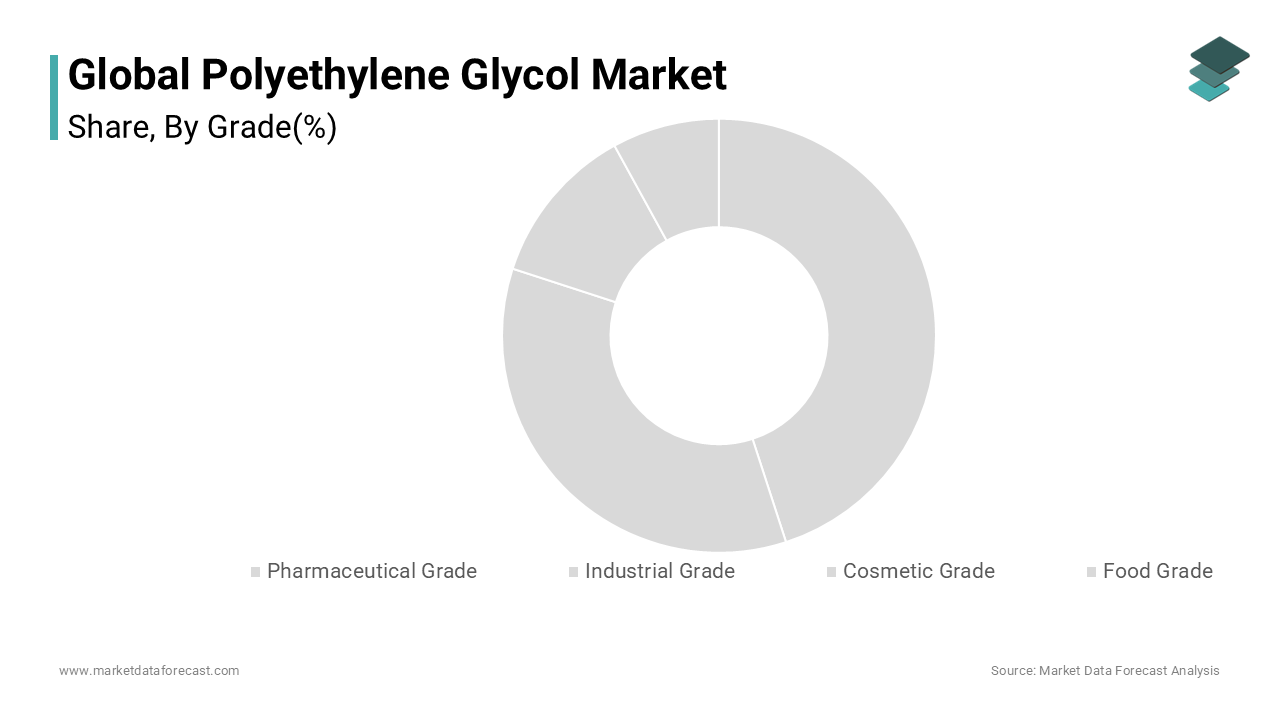
The cosmetic grade segment is likely to grow at a CAGR of 7.5% during the forecast period with the surge in skincare and haircare consumption worldwide. Its utility as a humectant, solubilizer, and thickener makes it indispensable in creams, shampoos, and lotions. Additionally, increasing spending on premium personal care products by enhancing demand for PEG as a versatile cosmetic ingredient.
By Application Insights
The pharmaceutical applications segment was the largest and held 40.1% of the Polyethylene glycol market share in 2024. PEG is integral in oral, topical, and parenteral formulations, and its compatibility with biologics ensures continuous demand. Moreover, with the global diabetic population exceeding 537 million in 2021, as per the International Diabetes Federation, demand for PEG-based formulations such as osmotic laxatives and injectable drug carriers has surged. The expanding biologics pipeline cements PEG’s dominance in pharmaceutical use.
The food and beverage segment is projected to grow at a CAGR of 6.9% throughout the forecast period with the increasing processed food consumption and additive demand. PEG acts as an emulsifier, thickener, and anti-foaming agent in confectionery, bakery, and beverage applications. According to The Food and Agriculture Organization, global processed food consumption has increased by 20% in the last decade, reflecting urban lifestyle shifts. PEG’s multifunctional role in improving texture and stability makes it an increasingly vital additive in this space.
By End-Use Industry Insights
The medical devices segment was accounted in holding 32.1% of the Polyethylene glycol market share in 2024. PEG’s lubricating properties make it in catheters, implants, and surgical instruments, where biocompatibility is essential. The World Health Organization estimated that more than 234 million surgical procedures are performed globally each year, creating steady demand for medical devices enhanced by PEG. Moreover, the rise in minimally invasive procedures increases reliance on PEG-based hydrogels and coatings for advanced devices.
The pharmaceutical packaging segment is expected to expand at a CAGR of 7.3% throughout the forecast period with the increasing drug exports and stricter regulatory frameworks for quality preservation. PEG is used in films, coatings, and as a plasticizer in blister packs and capsule shells. According to the United Nations Comtrade Database, pharmaceutical exports surpassed USD 700 billion in 2023, reflecting globalized supply chains. The rising biologics and vaccine distribution networks are also fueling rapid adoption of PEG-based packaging solutions.
REGIONAL ANALYSIS
North America Polyethylene Glycol Market Analysis
North America was the top performer of the Polyethylene glycol market with 37.4% of the share in 2024, with the advanced pharmaceutical manufacturing and extensive biologics research. The U.S. Food and Drug Administration approved 55 novel drugs in 2023, many requiring PEG as an excipient. Additionally, the Centers for Disease Control and Prevention stated that 6 in 10 Americans live with a chronic disease, boosting demand for PEG-enhanced therapies.
Europe Polyethylene Glycol Market Analysis
Europe Polyethylene glycol market growth is likely to grow its strong cosmetics and pharmaceutical industries. Germany and France serve as key hubs for biologics and personal care product development. The European Medicines Agency’s push for advanced biologics further underpins PEG demand, though environmental regulations present challenges for long-term growth.
Asia Pacific Polyethylene Glycol Market Analysis
Asia Pacific market growth is likely to grow with the industrial expansion in China, India, and Japan. The Indian Brand Equity Foundation reported that India’s pharmaceutical industry was valued at USD 65 billion in 2023, heavily reliant on PEG excipients. Rising urbanization and healthcare investments accelerate its upward momentum.
Latin America Polyethylene Glycol Market Analysis
Latin America market growth is likely to grow with Brazil and Mexico leading PEG adoption. The Pan American Health Organization observed that cardiovascular diseases account for over 2 million deaths annually in the region, driving medical PEG applications. Moreover, the rising middle class and expanding personal care markets are spurring demand.
Middle East & Africa Polyethylene Glycol Market Analysis
The Middle East & Africa market is expected to grow steadily in next coming years. Saudi Arabia and South Africa are the primary growth contributors, with investments in pharmaceuticals and food processing. Rapid population growth and expanding urbanization patterns in Africa, where over 40% of the population is projected to live in cities by 2030.
COMPETITIVE LANDSCAPE
The polyethylene glycol market is highly competitive, with both global chemical giants and regional producers actively expanding their presence. Intense rivalry is driven by the rising demand for PEG across pharmaceuticals, cosmetics, food, and industrial sectors in Asia-Pacific, where localized production has become a differentiator. Large-scale players such as Dow, BASF, and INEOS continue to focus on R&D for advanced PEG derivatives, while smaller companies leverage price competitiveness and regional networks. Sustainability trends have further intensified competition, as regulatory frameworks in Asia push producers toward eco-friendly and bio-based PEG solutions. Strategic alliances, plant expansions, and supply chain optimization are recurring themes shaping the landscape.
KEY MARKET PLAYERS
A few of the major companies in the global polyethylene glycol market include
- BASF SE
- The Dow Chemical Company
- SABIC
- INEOS Group
- Clariant AG
- Lotte Chemical Corporation
- Croda International Plc
- India Glycols Limited
- Jiangsu Haian Petrochemical Plant
- Liaoning Oxiranchem
- Merck KGaA
- AkzoNobel N.V.
- Huntsman Corporation
- PCC SE
- Norchem
Top Players in the Polyethylene Glycol Market (Asia-Pacific Focus)
Dow Inc.
Dow Inc. plays a central role in the Asia-Pacific polyethylene glycol market through its extensive chemical manufacturing capabilities and well-established distribution networks. The company supplies high-performance PEGs for applications in pharmaceuticals, cosmetics, and industrial formulations, aligning with the growing demand in China, India, and Southeast Asia. In recent years, Dow has enhanced its regional presence by investing in sustainable production practices, such as introducing bio-based and recyclable polymer initiatives.
BASF SE
BASF SE remains one of the most influential companies in the Asia-Pacific PEG market, which is providing diversified PEG solutions for pharmaceuticals, food, and personal care products. The company has strengthened its foothold in the region by expanding its research facilities and developing innovative PEG derivatives. BASF has emphasized sustainable chemistry and localized production in Asia, particularly in China and India, to meet rising regional demand. Recently, the company announced the development of advanced PEG grades for excipients and cosmetic applications to cater to evolving consumer preferences. BASF’s strong focus on technological innovation and regulatory compliance continues to bolster its market relevance.
INEOS Group Holdings
INEOS Group has emerged as a strong contender in the Asia-Pacific PEG market, leveraging its vast petrochemical portfolio to support diverse applications. The company supplies PEG for industrial use, lubricants, and packaging while increasingly expanding into pharmaceutical-grade PEG production in Asia. INEOS has recently emphasized strategic partnerships with local manufacturers in China and South Korea, ensuring steady supply chains and cost efficiencies. The company has also invested in operational efficiency improvements by modernizing its Asian chemical plants.
Top Strategies Used by Key Market Participants
Key players in the polyethylene glycol market are pursuing a blend of product innovation, regional expansion, and sustainability-driven initiatives to strengthen their market position. Companies like Dow and BASF are increasingly focusing on bio-based PEG formulations to address rising environmental regulations in Asia-Pacific. Strategic collaborations with pharmaceutical and cosmetic firms are also enabling them to adapt PEG derivatives for specialized applications. Moreover, capacity expansions in high-growth countries like India and China have become central to ensuring uninterrupted supply. Digitalization of operations, alongside compliance with evolving regional safety standards, is another priority. Simultaneously, players such as INEOS are emphasizing local partnerships and plant modernization to maintain cost efficiency and responsiveness.
MARKET SEGMENTATION
The research report on the global polyethylene glycol market has been segmented and sub-segmented based on categories.
By Grade
- Pharmaceutical Grade
- Industrial Grade
- Cosmetic Grade
- Food Grade
By Application
- Pharmaceuticals
- Cosmetics and Personal Care
- Food and Beverages
- Industrial Solvents
- Textile Finishing
By End-Use Industry
- Medical Device
- Pharmaceutical Packaging
- Lubricant Additive
- Paper Coating
By Region
- North America
- Europe
- Asia-Pacific
- Latin America
- Middle East and Africa
Frequently Asked Questions
What is Polyethylene Glycol (PEG)?
Polyethylene Glycol (PEG) is a polyether compound widely used in pharmaceuticals, personal care products, industrial applications, and food processing as a solvent, emulsifier, lubricant, and stabilizer.
What are the key applications of PEG in pharmaceuticals?
In pharmaceuticals, PEG is used as an excipient in tablets, ointments, and injectables, enhancing solubility, stability, and controlled drug release.
Who are the major players in the PEG market?
Key players include BASF SE, Dow Chemical, SABIC, INEOS Group, Clariant AG, Lotte Chemical, Croda International, India Glycols, Jiangsu Haian Petrochemical, Liaoning Oxiranchem, Merck KGaA, AkzoNobel, Huntsman Corporation, PCC SE, and Norchem.
What are the trends driving the PEG market?
Rising demand in pharmaceuticals, cosmetics, and industrial applications, increasing focus on sustainable chemicals, and expansion in emerging markets.
Which regions dominate the PEG market?
North America, Europe, and Asia-Pacific are major markets, with growing demand in India and China due to industrial and pharmaceutical growth.
What is the forecasted growth for the PEG market?
The PEG market is expected to grow steadily due to increasing use in pharmaceuticals, personal care, and industrial applications.
Related Reports
Access the study in MULTIPLE FORMATS
Purchase options starting from
$ 2500
Didn’t find what you’re looking for?
TALK TO OUR ANALYST TEAM
Need something within your budget?
NO WORRIES! WE GOT YOU COVERED!
Call us on: +1 888 702 9696 (U.S Toll Free)
Write to us: sales@marketdataforecast.com