Global Retail Automation Market Size, Share, Trends, & Growth Forecast Report, Segmented By Type (Point-of-Sale (POS), RFID & Barcode, Camera, Electronic Shelf Label, Automated Vehicles & Others), Implementation (In-Store & Warehouse), Application (Retail Pharmacies, Fuel Stations, General Stores, Supermarkets & Hypermarkets), & Region, Industry Forecast From 2026 to 2034
Global Retail Automation Market Size
The global retail automation market size was valued at USD 19.07 billion in 2025 and is anticipated to reach USD 21.16 billion in 2025 to reach USD 48.54 billion by 2034, growing at a CAGR of 10.94% from 2026 to 2034.
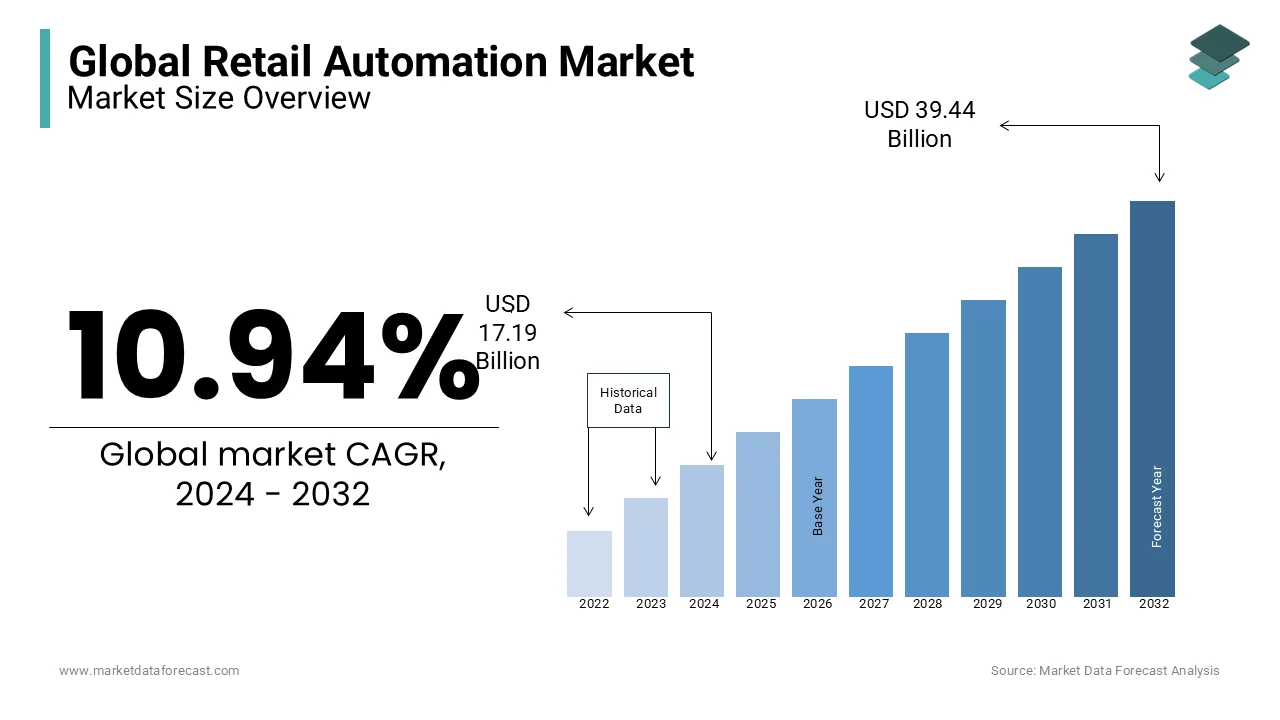
Current Scenario of the Global Retail Automation Market
Retail automation integrates software to implement automated operations in retail stores to replace manual processes in traditional stores. Retailers look for technologies that would perform specific actions to reduce cost, increase accuracy, and complete operations quickly. Retail automation does all of these by implementing kiosk machines and point-of-sale terminals, including technology, hardware, and services. Customers operate a touchscreen interface to navigate and select the product, and then make a payment, and then the product is delivered through a mechanism inside the machine. It offers the best consumer experience, delivery mechanism, and software integration, which is lacking in vending machines. Automated retail produces better results and revenues for expensive products like electronics, cosmetics, and others, but it is not suitable for lower-cost products. Automatic retailers accept both credit cards and debit cards.
MARKET DRIVERS
Retailers all around the world are streamlining workflows to improve their business processes since it provides transparency and visibility in the supply chain. As a result, more methods, such as digitalization, are being adopted to drive the global retail automation market forward during the forecast period. The introduction of automation has relieved the strain of outsmarting the competition, exceeded customer expectations, boosted revenue potential, and improved organizational efficiency.
As a result of its capacity to provide end-to-end visibility, streamline operations, eliminate redundancies, and other benefits, automation has become increasingly popular in the retail industry. In the future, the retail industry is likely to benefit greatly from the integration of analytics technology with automation technologies.
Analytical automation's ability to make judgments based on studied data is expected to help retailers achieve a competitive advantage in the market. As a result, consumer buying patterns analysis is likely to boost market expansion in the approaching years. Furthermore, the surge in data and analytics transformation operations in retail, such as recommendation systems, presents additional possibilities for global market players to considerably enhance income.
In today's market, there are numerous important prospects. The use of automation by retail automation industry participants, for example, will have a domino effect. This domino effect has a favorable impact on the market. The retail automation industry is undergoing a technological revolution. As a result, the retail automation sector has a lot of room for expansion. Market players as well as rising retail leaders can benefit from the potential.
Retailers engage with a wide range of operations daily. Departmental integration is a fundamental need that must be met to effectively manage and align departments with corporate objectives. Inappropriate storage structure, faulty in-store product mix, ineffective warehouse space usage, frequent price adjustments, rapid shifts in customer needs, and lack of control over channel partners are just a few of the primary issues that retailers confront. Furthermore, commercial businesses must meet difficult standards in the domains of e-commerce and retail, as well as the accompanying logistics, such as same-day delivery, click-and-collect, and straightforward returns processing. As a result, it is believed that organizations with superior logistics will stand out from the competition and be able to outlast the competition in the long run.
MARKET RESTRAINTS
Electricity and the Internet are required for all retail automation technologies. While all retail industry operators may desire to use retail automation, the lack of high-speed internet and reliable electrical supply may limit the business's expansion. The world's less developed regions may be late to join the new retail automation segment. As a result, the retail automation market may have an inconsistent growth tendency. As a result, the RA market may be on the receiving end of the growing trends.
REPORT COVERAGE
| REPORT METRIC | DETAILS |
| Market Size Available | 2025 to 2034 |
| Base Year | 2025 |
| Forecast Period | 2026 to 2034 |
| CAGR | 10.94% |
| Segments Covered | By Type, Implementation, End-user & Region |
|
Various Analyses Covered | Global, Regional & Country Level Analysis, Segment-Level Analysis, DROC, PESTLE Analysis, Porter’s Five Forces Analysis, Competitive Landscape, Analyst Overview on Investment Opportunities |
| Regions Covered | North America, Europe, APAC, Latin America, Middle East & Africa |
|
Market Leaders Profiled | Datalogic S.p.A., Diebold Nixdorf, Inc., Toshiba Global Commerce Solutions, Zebra Technologies, NCR Corporation, Posiflex Technology Inc., Fiserv, Inc., Fujitsu Limited, Honeywell International Inc., KUKA AG. |
SEGMENT ANALYSIS
By Type Insights
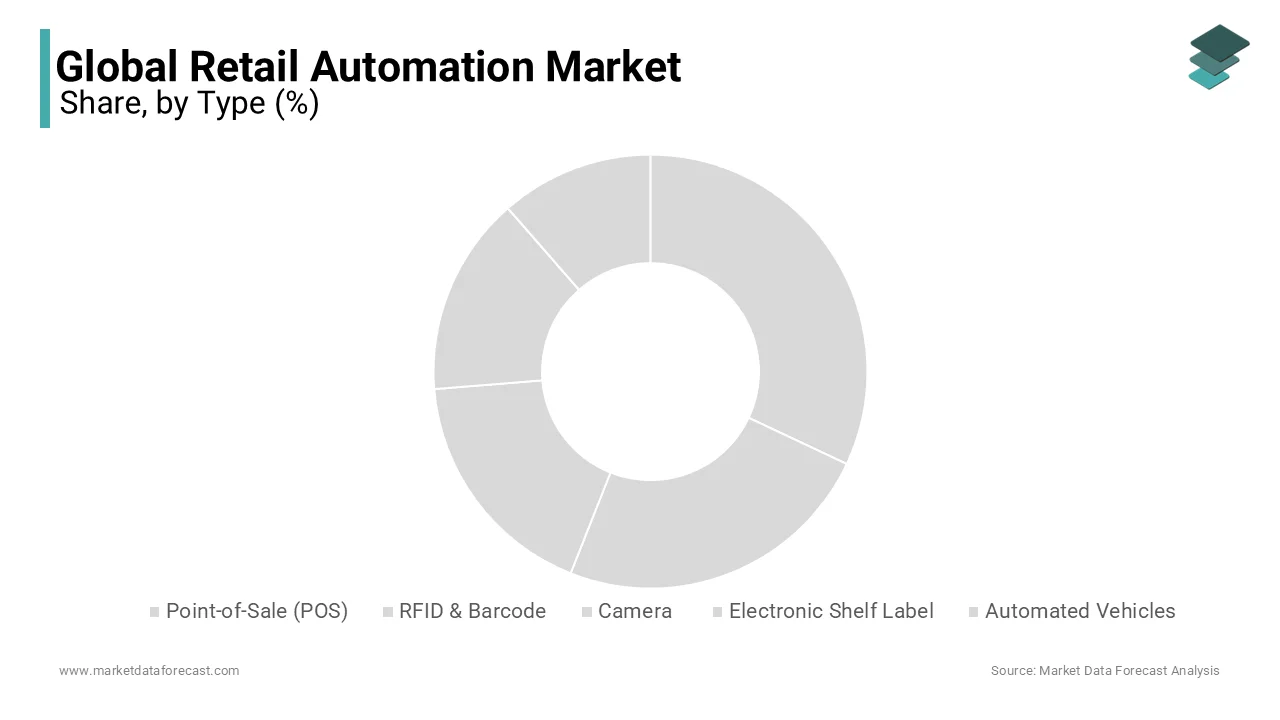
Based on the Type, Point-of-sale (POS) segment ruled the market and is likely to continue this trend during the forecast period. Within the forecast period, there will be growth in this segment due to advancements in R&D, resulting in the production of advanced systems like contactless payments, RFID transponders, and biometric-based POS systems, which offer comfortable and secure payment options to the end-user.
KEY MARKET PLAYERS
Major Key Players in the Global Retail Automation Market are
- Datalogic S.p.A.
- Diebold Nixdorf, Inc.
- Toshiba Global Commerce Solutions
- Zebra Technologies
- NCR Corporation
- Pandosiflex Technology.NC
- Fiserv, Inc.
- Fujitsu Limited
- Honeywell International Inc
- KUKA AG.
RECENT MARKET NEWS
- Data analytics plays a crucial role in forecasting by analyzing massive amounts of available data and the achievability of decision-making with the help of analytic automation, which is going to help retailers gain more productivity.
MARKET SEGMENTATION
This research report on the global retail automation market has been segmented and sub-segmented based on type, implementation, end-user, and region.
By Type
- Point-of-Sale (POS)
- RFID & Barcode
- Camera
- Electronic Shelf Label
- Automated Vehicles
- Others
By Implementation
- In-Store
- Warehouse
By End-user
- Retail Pharmacies
- Fuel Stations
- General Stores
- Supermarkets
- Hypermarkets
By Region
- North America
- Europe
- Asia-Pacific
- Latin America
- The Middle East and Africa
Frequently Asked Questions
What is currently driving growth in the global retail automation market?
Rising demand for operational efficiency and improved customer experience is driving growth.
Why are retailers adopting automation technologies worldwide?
They use automation to reduce costs and streamline store operations.
How would you explain retail automation in simple terms?
It is the use of technology to automate retail processes like billing and inventory management.
Where is retail automation most commonly used globally?
It is widely used in supermarkets, retail stores, warehouses, and e-commerce operations.
What makes retail automation important for modern retail businesses?
It improves efficiency, accuracy, and customer satisfaction.
From a business perspective, is retail automation a worthwhile investment?
Yes, it enhances productivity and reduces manual errors.
What challenges are affecting the global retail automation market?
High initial costs and integration complexity are key challenges.
How is e-commerce growth influencing retail automation adoption?
Increasing online demand is driving automation in fulfillment and logistics.
Which technologies contribute the most to retail automation?
Self-checkout systems, robotics, AI, and inventory management software are major contributors.
Is the global retail automation market growing steadily?
Yes, it is expanding with increasing adoption of digital retail solutions.
Related Reports
Access the study in MULTIPLE FORMATS
Purchase options starting from
$ 2500
Didn’t find what you’re looking for?
TALK TO OUR ANALYST TEAM
Need something within your budget?
NO WORRIES! WE GOT YOU COVERED!
Call us on: +1 888 702 9696 (U.S Toll Free)
Write to us: sales@marketdataforecast.com