U.S. Corporate Training Market Size, Share, Trends & Growth Forecast Report By Training Program (Technical Training, Soft Skills, Compliance, Quality Training, and Others), Industries, and By Country (California, Washington, Oregon, New York & Rest of the United States) – Industry Analysis and Forecast, 2026 to 2034
U.S. Corporate Training Market Report Summary
The U.S. corporate training market was valued at USD 11.79 billion in 2025, is estimated to reach USD 12.57 billion in 2026, and is projected to reach USD 20.93 billion by 2034, growing at a CAGR of 6.58% during the forecast period. Market growth is driven by increasing demand for workforce upskilling, rapid digital transformation across industries, and the need to enhance employee productivity and compliance. Organizations are investing heavily in structured learning programs to remain competitive and adapt to evolving technologies. The rise of e learning platforms and hybrid training models is further supporting steady market expansion in the United States.
Key Market Trends
- Rising demand for employee upskilling and reskilling is driving market growth.
- Increasing adoption of digital and e learning platforms is boosting demand.
- Growing focus on compliance and regulatory training is supporting market expansion.
- Expansion of hybrid and remote learning models is enhancing accessibility.
- Integration of AI driven and personalized learning solutions is improving training effectiveness.
Segmental Insights
- Based on training program, the compliance training segment held a significant share of the U.S. corporate training market in 2025. This dominance is attributed to strict regulatory requirements across industries such as finance, healthcare, and manufacturing.
- Based on industry, the healthcare and pharmaceutical segment accounted for 47.6% of the U.S. corporate training market share in 2025, driven by continuous need for skill development, regulatory adherence, and technological advancements in medical practices.
Competitive Landscape
The U.S. corporate training market is highly competitive, with key players focusing on digital platforms, content innovation, and strategic partnerships to strengthen their market position. Companies are investing in advanced learning technologies, cloud based solutions, and personalized training programs. Prominent players in the U.S. corporate training market include 2U Inc., Adobe Inc., Benesse Holdings Inc., Cisco Systems Inc., LinkedIn Learning, City and Guilds Group, D2L Corp., Development Dimensions International Inc., Franklin Covey Co., John Wiley and Sons Inc., Learning Technologies Group Plc, Coursera, NIIT Ltd., Skillsoft Corp., Stride Inc., Pluralsight, and Udemy Inc..
U.S. Corporate Training Market Size
The U.S. corporate training market was valued at USD 11.79 billion in 2025, is estimated to reach USD 12.57 billion in 2026, and is projected to reach USD 20.93 billion by 2034, growing at a CAGR of 6.58% from 2026 to 2034.
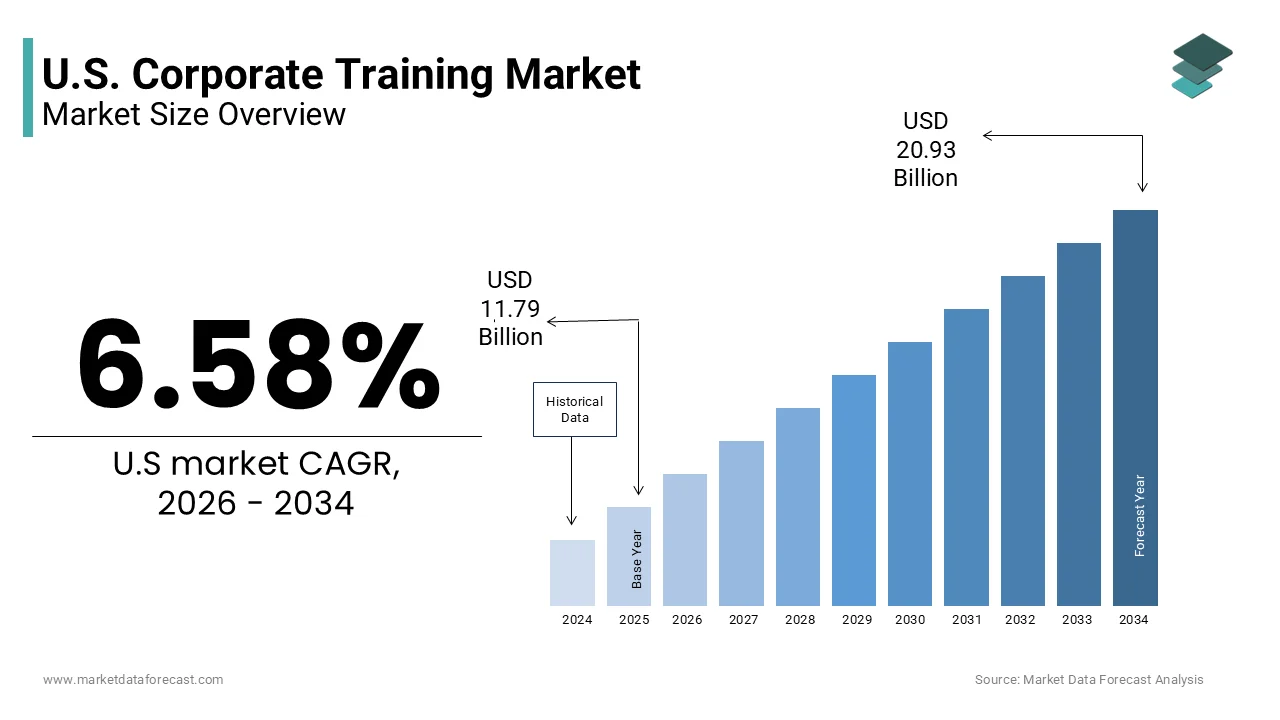
The corporate training is an ecosystem of educational programs and development initiatives designed to enhance employee skills, knowledge, and competencies within organizational settings. As per the United States Bureau of Labor Statistics, approximately 6.4 million job openings existed in recent months, highlighting the intense competition for talent and the critical importance of internal development to retain and upskill existing workforces. Furthermore, the Society for Human Resource Management indicates that organizations are increasingly prioritizing learning and development as a strategic imperative rather than a peripheral benefit. The integration of digital technologies has transformed traditional training methods, enabling personalized and scalable learning experiences that align with individual career paths and organizational goals. Regulatory requirements across industries such as healthcare finance and manufacturing also mandate specific training protocols, ensuring a baseline demand for compliance related education. This dynamic environment reflects a mature yet evolving market where the focus has shifted from mere content delivery to measurable performance improvement and return on investment.
MARKET DRIVERS
Rapid Technological Advancement Necessitates Continuous Upskilling
The accelerating pace of technological innovation by creating an urgent need for employees to acquire new digital competencies and adapt to emerging tools is propelling the growth of the United States corporate training market. Automation artificial intelligence and cloud computing are reshaping job roles across industries, rendering existing skill sets obsolete and requiring significant investment in reskilling initiatives. Companies are increasingly recognizing that hiring new talent with specialized skills is often more costly and time consuming than upskilling current employees who already understand the organizational culture and processes. This shift has led to a surge in demand for technical training programs focused on data analytics cybersecurity and software development. The rapid deployment of generative AI tools in workplace settings further amplifies this need, as workers must learn to leverage these technologies effectively while understanding their ethical implications and limitations. Organizations that fail to provide adequate training risk falling behind competitors who can operate more efficiently and innovatively. Consequently, corporate leaders are allocating larger portions of their budgets to learning and development departments to ensure their workforce remains agile and capable of navigating the digital transformation.
Regulatory Compliance Requirements Mandate Standardized Training Protocols
Stringent regulatory frameworks across various industries drive consistent demand for corporate training by mandating specific compliance education for employees to mitigate legal risks and ensure operational integrity. The regulatory compliance requirements is additionally propelling the growth of the United States corporate training market. Sectors, such as healthcare finance and energy are subject to rigorous standards enforced by agencies like the Occupational Safety and Health Administration and the Securities and Exchange Commission, which require regular training on safety protocols data privacy and ethical conduct. Thousands of workplace inspections occur annually, resulting in significant penalties for non-compliance, which motivates organizations to invest heavily in comprehensive training programs to avoid fines and reputational damage. The complexity of these regulations often necessitates specialized training content that is regularly updated to reflect legislative changes by creating a recurring revenue stream for training providers. For instance, the implementation of new data protection laws requires employees to undergo frequent cybersecurity awareness training to prevent breaches and protect sensitive information. Additionally, industries dealing with hazardous materials or heavy machinery must adhere to strict safety training mandates to protect worker health and minimize liability. These mandatory requirements ensure that corporate training is not discretionary but a fundamental operational necessity.
MARKET RESTRAINTS
Budget Constraints Limit Investment in Comprehensive Programs
The economic uncertainty and pressure to reduce operational costs often lead to budget constraints that restrict investment in comprehensive corporate training programs, particularly among small and medium sized enterprises. The budget constraints is restricting the growth of the United States corporate training market. During periods of financial volatility, learning and development budgets are frequently among the first to be cut as organizations prioritize immediate revenue generation and cost containment over long term employee development. Many companies have reported flat or declining training budgets in recent years, forcing them to seek cheaper alternatives or reduce the frequency and quality of training initiatives. This financial restraint limits the ability of organizations to adopt advanced training technologies, such as virtual reality simulations or personalized adaptive learning platforms, which require significant upfront investment. Instead, companies may rely on generic off the shelf content that fails to address specific organizational needs or skill gaps by resulting in lower engagement and reduced effectiveness. The lack of dedicated funding also hinders the hiring of skilled instructional designers and trainers, further compromising the quality of available programs. Moreover, the perceived difficulty in measuring the direct return on investment for training initiatives makes it challenging for learning leaders to justify increased spending to executive management.
Employee Resistance and Lack of Engagement Hinder Effectiveness
The employee resistance and lack of engagement by undermining the effectiveness of learning initiatives and reducing the return on investment for organizations is additionally degrading the growth of the United States corporate training market. Many employees view mandatory training as a distraction from their core responsibilities or perceive it as irrelevant to their daily tasks, leading to low participation rates and poor knowledge retention. Only a minority of employees feel strongly connected to their organization’s learning and development opportunities by indicating a widespread disconnect between training offerings and employee expectations. This disengagement is often exacerbated by outdated training methods that rely on passive lectures or lengthy online modules that fail to capture attention or provide interactive experiences. The phenomenon of learning fatigue further complicates the issue, as employees are overwhelmed by the volume of information and demands placed upon them in fast paced work environments. When training is not aligned with career aspirations or immediate job needs, employees are less likely to apply what they have learned, rendering the investment futile. Additionally, the lack of managerial support and reinforcement after training sessions contributes to low transfer of learning to the workplace. Without a culture that values continuous improvement and recognizes learning achievements, employees remain indifferent to training efforts.
MARKET OPPORTUNITIES
Integration of Artificial Intelligence Enables Personalized Learning Paths
The integration of artificial intelligence into corporate training platforms by enabling highly personalized learning paths that adapt to individual employee needs and learning styles is certainly to set up new opportunities for the growth of the United states corporate training market. AI driven systems can analyze user performance data in real time to identify skill gaps and recommend targeted content, thereby enhancing engagement and improving learning outcomes. The level of customization reduces the time required to achieve competency and increases the relevance of training materials by leading to higher satisfaction and retention rates. Furthermore, AI powered chatbots and virtual assistants can provide instant feedback and answer questions, offering a supportive learning environment that mimics one on one coaching. The ability to predict future skill needs based on industry trends and organizational goals allows companies to proactively prepare their workforce for upcoming challenges. This predictive capability transforms training from a reactive measure to a strategic tool for talent management.
Expansion of Microlearning Formats Enhances Accessibility and Retention
The expansion of microlearning formats by addressing the limited attention spans and busy schedules of modern employees, which is also to enhance the growth of the United States corporate training market. Microlearning involves delivering content in small specific bursts that are easy to consume and retain, making it ideal for just in time learning and mobile accessibility. The learners retain significantly more information, when it is presented in short focused segments compared to traditional long form courses. This approach aligns with the preferences of younger generations in the workforce who are accustomed to consuming information quickly through digital channels. Companies can utilize microlearning to reinforce key concepts provide quick updates on policy changes or offer bite sized skill building exercises that fit seamlessly into daily workflows. The flexibility of this format allows employees to access training materials on demand using smartphones or tablets, removing barriers related to time and location. Additionally, microlearning modules are easier and faster to produce and update, enabling organizations to respond rapidly to changing business needs. The use of gamification elements such as quizzes and badges further enhances engagement and motivation.
MARKET CHALLENGES
Difficulty in Measuring Return on Investment Complicates Decision Making
The difficulty in measuring the return on investment for corporate training initiatives by complicating decision making processes and limiting the ability of organizations to justify expenditures is a major challenge for the growth of the United States corporate training market. Unlike sales or production metrics, the impact of training on business performance is often indirect and difficult to quantify, making it challenging to establish a clear causal link between learning activities and financial outcomes. Many organizations struggle to demonstrate the value of their training programs due to the lack of effective measurement tools and methodologies. Traditional evaluation methods such as participant satisfaction surveys fail to capture the true impact of learning on behavior change and organizational results. Without robust data analytics and performance tracking systems, companies cannot accurately assess whether training has led to improved productivity reduced errors or increased revenue. This ambiguity often leads to skepticism among senior leadership regarding the efficacy of learning and development investments, resulting in inconsistent funding and support. Furthermore, the long timeline required to observe behavioral changes and business impacts adds another layer of complexity to measurement efforts. The absence of standardized metrics across the industry further hinders benchmarking and comparison. Consequently, the inability to provide concrete evidence of return on investment remains a persistent obstacle for training providers and corporate learning leaders seeking to expand their programs and secure necessary resources.
Rapid Obsolescence of Content Requires Continuous Updates
The rapid obsolescence of training content poses a significant challenge to the United States corporate training market by necessitating continuous updates and revisions to maintain relevance and accuracy. This factor is acting as a major challenge for the growth of the United States corporate training market. In fast changing industries such as technology and healthcare, information and best practices evolve quickly, rendering existing training materials outdated within short periods. As per Deloitte, the half life of learned professional skills is estimated to be only five years, meaning that half of what employees know today will be obsolete in that timeframe. This rapid decay of knowledge requires organizations to invest heavily in content development and maintenance to ensure that training programs reflect current standards and technologies. The cost and effort associated with frequent updates can strain resources, particularly for smaller providers who may lack the agility to respond quickly to changes. Additionally, the need to constantly refresh content can lead to learner fatigue if employees perceive that they are repeatedly covering similar topics with minor variations. The challenge is further compounded by the diverse range of roles and specialties within organizations, each requiring specialized and up to date information. Failure to keep content current can result in the dissemination of incorrect or inefficient practices, potentially leading to compliance violations or operational errors.
REPORT COVERAGE
| REPORT METRIC | DETAILS |
| Market Size Available | 2025 to 2034 |
| Base Year | 2025 |
| Forecast Period | 2026 to 2034 |
| CAGR | 6.58% |
| Segments Covered | By Training Program, Industries, and Region. |
| Various Analyses Covered | Global, Regional and Country-Level Analysis, Segment-Level Analysis, Drivers, Restraints, Opportunities, Challenges; PESTLE Analysis; Porter’s Five Forces Analysis, Competitive Landscape, Analyst Overview of Investment Opportunities |
| Countries Covered | California, Washington, Oregon, New York, United States |
| Market Leaders Profiled | 2U Inc., Adobe Inc., Benesse Holdings Inc., BYLD Group., Cisco Systems Inc., LinkedIn Learning, City and Guilds Group, D2L Corp., DEMOS, Development Dimensions International Inc., Franklin Covey Co., Interaction Associates Inc., John Wiley and Sons Inc., Learning Technologies Group Plc, Learning Tree International Inc., Mind Gym Plc, Coursera, NIIT Ltd., Skillsoft Corp., Stride Inc., Pluralsight, Udemy Inc., and Wilson Learning Worldwide Inc. |
SEGMENTAL ANALYSIS
By Training Program Insights
The compliance training segment held a prominent share of the United States corporate training market in 2025 due to the stringent regulatory environment that governs various industries across the nation. Organizations are legally mandated to ensure that their employees adhere to federal state and local laws regarding safety data privacy and ethical conduct. Furthermore, the healthcare and financial sectors face rigorous oversight from bodies such as the Health Insurance Portability and Accountability Act and the Securities and Exchange Commission, requiring regular and documented training for all staff members. The complexity of these regulations necessitates continuous updates to training materials, ensuring a recurring demand for compliance programs. Companies prioritize this segment to mitigate risk and demonstrate due diligence in legal proceedings. The universal applicability of compliance training across all employee levels, from entry level workers to executive leadership, that further amplifies its volume and market share.
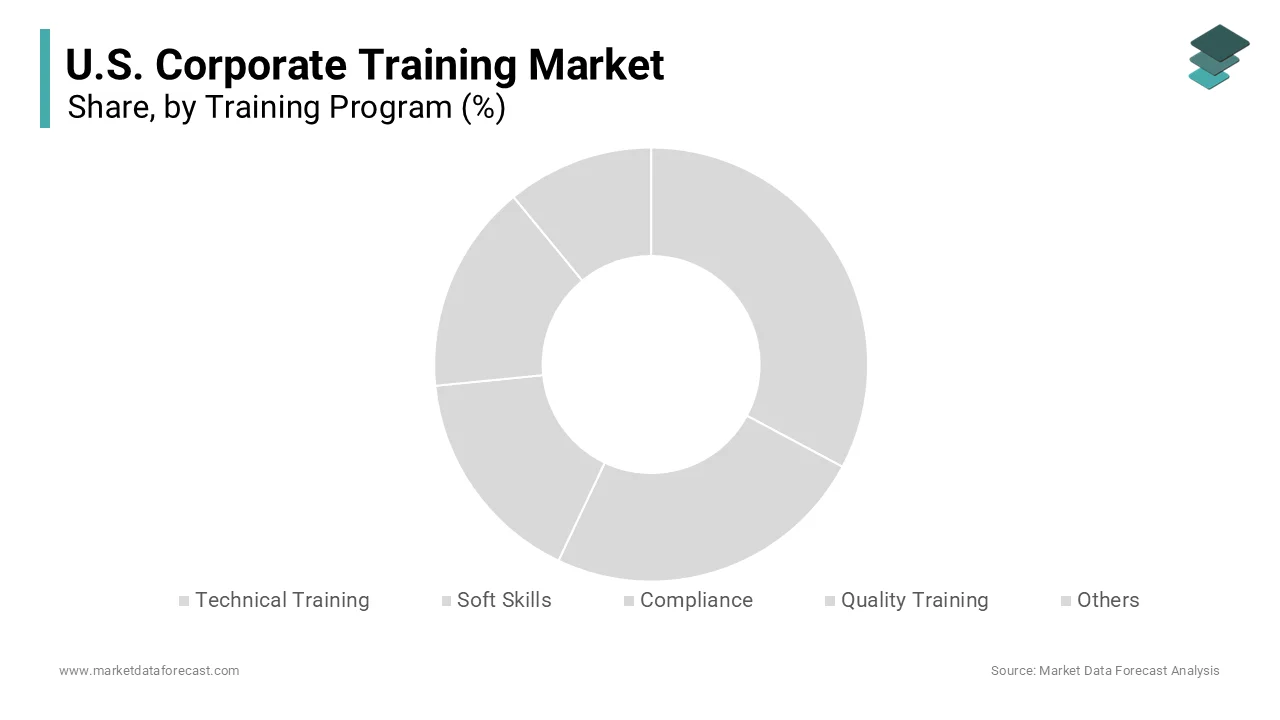
The technical training segment is projected to witness a fastest CAGR of 14.3% during the forecast period with the rapid integration of advanced technologies into business operations. The need for employees to master new software platforms programming languages and data analytics tools is accelerating as digital transformation becomes central to competitive strategy. This surge in demand for technical skills forces organizations to upskill their existing workforce rather than relying solely on external hiring, which is often costly and competitive. The adoption of artificial intelligence cloud computing and cybersecurity measures requires specialized knowledge that evolves quickly, necessitating frequent and updated training interventions. Companies are investing in bootcamps online courses and hands on workshops to bridge the skills gap effectively. The immediacy of technological change means that technical training must be continuous and adaptive, leading to higher frequency of engagement compared to other training types. Additionally, the rise of remote work has increased the reliance on digital collaboration tools, further boosting the need for technical proficiency.
By Industries Insights
The healthcare and pharmaceutical industry segment was the largest by holding 47.6% of the United States corporate training market share in 2025 owing to the need for continuous professional development regulatory compliance and patient safety standards. As per the American Hospital Association, hospitals and health systems employ millions of workers, who require ongoing education in clinical skills infection control and emergency response protocols. The implementation of electronic health records and advanced medical devices necessitates regular technical training to ensure efficient and safe usage. Furthermore, pharmaceutical companies must adhere to strict guidelines from the Food and Drug Administration regarding drug development manufacturing and marketing, requiring extensive compliance training for research and sales teams. The high turnover rates in certain healthcare roles also contribute to the constant demand for onboarding and foundational training programs. Accreditation bodies such as The Joint Commission mandate specific educational criteria for healthcare facilities, making training a fundamental operational requirement rather than an optional benefit. The complexity of medical knowledge and the rapid pace of scientific advancement ensure that learning is a perpetual necessity in this industry.
The information technology industry segment is esteemed to grow at an anticipated CAGR of 12.3% during the forecast period with the relentless pace of innovation and the urgent need to address the global skills shortage in tech roles. The technology industry added hundreds of thousands of net new jobs in recent years, yet the demand for skilled professionals continues to outstrip supply, forcing companies to invest heavily in internal upskilling initiatives. The rapid evolution of technologies such as artificial intelligence machine learning and blockchain requires IT professionals to continuously update their knowledge to remain relevant. Companies are increasingly adopting agile learning methodologies and microlearning platforms to deliver timely and targeted technical training. The shift toward cloud based infrastructure and cybersecurity threats further amplifies the need for specialized training programs that can respond to emerging challenges quickly. Moreover, the competitive nature of the tech sector means that organizations must foster a culture of continuous learning to attract and retain top talent. Employee retention is closely linked to opportunities for professional growth, making training a key strategic priority.
COMPETITIVE LANDSCAPE
The competition in the United States corporate training market is intense and characterized by a diverse mix of established educational institutions technology driven platforms and specialized niche providers. Major players compete on content quality technological innovation and the ability to demonstrate measurable return on investment for corporate clients. Differentiation is achieved through personalized learning experiences powered by artificial intelligence and adaptive learning algorithms that cater to individual employee needs. The market sees continuous entry of new startups offering innovative solutions such as virtual reality simulations and gamified learning modules. Price competition is moderate as organizations prioritize value and effectiveness over cost alone. Strategic acquisitions and partnerships are common as companies seek to expand their content libraries and technological capabilities. Customer retention relies heavily on user engagement and the relevance of offered skills to current job market demands. Regulatory compliance requirements create a stable demand for specific training segments while technological advancements drive growth in others.
KEY MARKET PLAYERS
Some of the companies that are playing a dominating role in the U.S. corporate training market include
- 2U Inc.
- Adobe Inc.
- Benesse Holdings Inc.
- BYLD Group.
- Cisco Systems Inc.
- LinkedIn Learning
- City and Guilds Group
- D2L Corp.
- DEMOS
- Development Dimensions International Inc.
- Franklin Covey Co.
- Interaction Associates Inc.
- John Wiley and Sons Inc.
- Learning Technologies Group Plc
- Learning Tree International Inc.
- Mind Gym Plc
- Coursera
- NIIT Ltd.
- Skillsoft Corp.
- Stride Inc.
- Pluralsight
- Udemy Inc.
- Wilson Learning Worldwide Inc.
Top Players in the Market
- LinkedIn Learning maintains a prominent position in the United States corporate training market by leveraging its extensive professional network to deliver relevant and personalized learning content. The platform offers thousands of courses covering business technology and creative skills, tailored to individual career goals and organizational needs. Recent actions include the integration of advanced artificial intelligence features that recommend specific courses based on user profiles and job market trends. This personalization enhances engagement and ensures that employees acquire skills that are directly applicable to their roles. The company has also expanded its library with expert led content from industry leaders, ensuring high quality and up to date information. Its seamless integration with existing human resources systems allows organizations to track progress and measure impact effectively. These strategic initiatives strengthen its market presence by providing a comprehensive and data driven approach to employee development that aligns with modern workforce expectations.
- Coursera for Business contributes significantly to the United States corporate training market by partnering with top universities and companies to offer accredited and high quality online courses. The platform provides access to degree programs certificates and specialized training in fields such as data science business and technology. Recent actions include the expansion of its enterprise offerings with guided projects and hands on labs that enhance practical skill acquisition. Coursera has also integrated generative artificial intelligence tools to help learners navigate content more efficiently and personalize their learning paths. Its partnerships with leading technology firms ensure that course content remains relevant to current market demands.
- Pluralsight serves as a key player in the United States corporate training market by specializing in technology skills development for software developers IT administrators and creative professionals. The platform offers a vast library of expert authored courses assessments and hands on labs designed to build and validate technical competencies. Recent actions include the enhancement of its skills assessment tools using artificial intelligence to provide accurate insights into employee capabilities and identify knowledge gaps. Pluralsight has also expanded its content to cover emerging technologies such as cloud computing cybersecurity and artificial intelligence. The company focuses on helping organizations build resilient tech teams by providing data driven insights into skill development progress. Its integration with popular development tools allows for seamless learning within the workflow.
Top Strategies Used by Key Market Participants
Key players in the United States corporate training market primarily focus on integrating artificial intelligence to personalize learning experiences and improve engagement rates. Companies are increasingly adopting microlearning formats to accommodate busy schedules and enhance knowledge retention among employees. Strategic partnerships with universities and industry leaders help providers offer accredited and high quality content that meets specific skill demands. Investment in advanced analytics allows organizations to measure training effectiveness and demonstrate return on investment to stakeholders. Providers are also expanding their mobile capabilities to ensure accessibility and flexibility for remote and hybrid workforces. Content diversification into emerging technologies such as cybersecurity and data science addresses critical skills gaps in the labor market. Subscription based models are widely utilized to provide cost effective and scalable access to extensive course libraries. These strategies collectively enable providers to deliver value driven and adaptable training solutions that align with evolving organizational needs and workforce dynamics.
MARKET SEGMENTATION
This research report on the U.S. corporate training market is segmented and sub-segmented into the following categories.
By Training Program
- Technical Training
- Soft Skills
- Compliance
- Quality Training
- Others
By Industries
- Financial Services
- Pharmaceutical & Healthcare
- Information Technology
- Professional Services
- Retail
- Public Enterprises
- Others
By Country
- California
- Washington
- Oregon
- New York
- Rest of the United States
Frequently Asked Questions
1.What is the current size of the U.S. corporate training market?
The market is experiencing steady growth driven by increasing demand for employee upskilling, digital learning adoption, and workforce transformation initiatives.
2.What factors are driving growth in the U.S. corporate training market?
Key drivers include rapid digitalization, skill gaps in the workforce, demand for continuous learning, and increased corporate investment in employee development.
3.What types of corporate training are most in demand in the U.S.?
Technical training, soft skills training, compliance training, and quality training are among the most in demand segments.
4.Who are the major players in the U.S. corporate training market?
Leading companies include Coursera, Udemy Inc., Skillsoft Corp., NIIT Ltd., and Pluralsight.
5.What role does digital learning play in corporate training?
Digital learning platforms enable flexible, scalable, and cost effective training solutions, making them essential for modern workforce development.
6.How is artificial intelligence influencing corporate training?
Artificial intelligence is enabling personalized learning paths, adaptive content delivery, and performance analytics to enhance training effectiveness.
7.What is the impact of remote work on corporate training?
Remote work has accelerated the adoption of virtual training programs and e learning platforms to support distributed teams.
8.Which industries invest the most in corporate training in the U.S.?
Industries such as IT, healthcare, finance, and manufacturing are among the largest investors in corporate training programs.
9.What challenges does the U.S. corporate training market face?
Challenges include high implementation costs, measuring return on investment, employee engagement issues, and rapidly changing skill requirements.
10.What is the future outlook for the U.S. corporate training market?
The market is expected to grow steadily, supported by continuous skill development needs, technological advancements, and increasing focus on employee productivity and retention.
Related Reports
Access the study in MULTIPLE FORMATS
Purchase options starting from
$ 1200
Didn’t find what you’re looking for?
TALK TO OUR ANALYST TEAM
Need something within your budget?
NO WORRIES! WE GOT YOU COVERED!
Call us on: +1 888 702 9696 (U.S Toll Free)
Write to us: sales@marketdataforecast.com