U.S. White Spirits Market Size, Share, Trends & Growth Forecast Report By Type, By Distribution Channel, By Category, By End User, and By Country (United States) – Industry Analysis and Forecast, 2026 to 2034
U.S. White Spirits Market Size
The U.S. White spirits market was valued at USD 17.66 billion in 2025, is estimated to reach USD 18.89 billion in 2026, and is projected to reach USD 32.46 billion by 2034, growing at a CAGR of 7% from 2026 to 2034.

The white spirits refer to the commercial ecosystem surrounding the production, distribution, and consumption of colorless, unaged distilled spirits, which are primarily vodka, gin, and white rum within the continental United States and its territories. Unlike darker spirits like whiskey or rum, they are typically unaged or filtered after a short aging period to remove any color and maintain a crisp, clean flavor profile. This makes them highly versatile for cocktails, allowing the flavors of mixers to shine. According to the 2022 report, the total domestic withdrawals for consumption, which includes both unaged spirits (like vodka and gin) and aged spirits (like whiskey and rum), were substantially higher than 92 million proof gallons. Consumer preference for neutral profiles and mixability continues to shape formulation and branding strategies across the value chain.
MARKET DRIVERS
Premiumization and Craft Distillery Proliferation
The structural shift toward premium and super-premium offerings, particularly within the craft distilling sector, is significantly propelling the growth of the U.S. White Spirits Market. As per the American Craft Spirits Association, the number of active craft distilleries continued to grow. There was an 11.5% increase in the number of distilleries in 2025, reaching a total of 3,069, with an average per-bottle price increase. According to NielsenIQ’s Beverage Alcohol Consumer Segmentation Study 2023, consumers aged 25–44, who constitute half of the premium spirit purchasers, prioritize transparency in sourcing and distillation methods. This cohort’s willingness to pay more for small-batch, locally distilled white spirits has incentivized over 400 new micro-distilleries to enter the market since 2021. The trend reflects not merely indulgence but an experiential alignment with artisanal authenticity.
Cocktail Culture and On-Premise Revival
The resurgence of cocktail-centric consumption, particularly in urban metropolitan venues, has reinvigorated demand for versatile white spirits, which is enhancing the growth of the U.S. White Spirits Market. According to a CNBC report based on data from the Distilled Spirits Council (DISCUS), vodka was still the top-selling spirit by revenue in the U.S. in 2023, though its growth was minimal. Other reports also indicate continued consumer interest in vodka, especially for ready-to-drink (RTD) cocktails. Post-pandemic, on-premise alcohol sales rebounded to the highest of pre-2020 levels by Q4 2023, with white spirits leading volume recovery due to their adaptability in low-sugar, botanical-forward, and global-inspired mixes. Bartenders in cities like Austin and Portland now source nearly half of their white spirits from regional producers, which indicates a symbiotic relationship between mixology innovation and localized spirit production that continues to expand the category’s relevance.
MARKET RESTRAINTS
Regulatory Complexity and Compliance Burden
The stringent regulatory framework that varies significantly across state jurisdictions is imposing operational friction and cost inefficiencies, which are primarily restraining the U.S. White Spirits Market growth. According to the Tax Foundation’s 2023 State Alcohol Policy Index, 17 states maintain control over wholesale distribution by requiring distillers to navigate state-specific licensing, pricing controls, and reporting protocols. As per the Alcohol and Tobacco Tax and Trade Bureau estimates for total licensing and legal costs, including federal, state, and local permits, range from approximately $25,000 to $75,000 for a micro-distillery. These structural barriers delay market entry by an average of 14 weeks, stifling innovation and regional scalability.
Ingredient Volatility and Supply Chain Fragility
White spirits, despite their minimalist profiles, rely heavily on consistent access to agricultural inputs, primarily corn, wheat, and botanicals, whose pricing and availability are increasingly erratic, which is limiting the expansion of the U.S. White Spirits Market. According to the U.S. Department of Agriculture’s Economic Research Service, corn prices surged 29% year-over-year in 2022, which directly impacts neutral grain spirit production costs. Simultaneously, the American Botanical Council reported an increase in the price of key gin botanicals like juniper berries and coriander seeds between 2021 and 2023, which is attributed to climate disruptions in Mediterranean and Central Asian growing regions. Freight logistics remain a pressure point: for instance, the Bureau of Transportation Statistics recorded a rise in inland freight costs for beverage alcohol in 2023 compared to 2021. These compounding pressures compress margins, particularly for craft producers lacking hedging mechanisms or bulk procurement leverage.
MARKET OPPORTUNITIES
Functional and Wellness-Aligned Formulations
The rapid expansion of reformulating white spirits to align with functional wellness trends, including low-calorie, adaptogen-infused, or nootropically enhanced variants, is creating growth opportunities in the U.S. White Spirits Market. According to the International Food Information Council’s 2023 Food & Health Survey, more than half of the adult consumers actively seek alcoholic beverages with “added functional benefits,” and nearly half are willing to switch brands for cleaner labels. Distilleries like Colorado’s Flying Embers and California’s Kin Euphorics have pioneered this space, with Kin reporting year-over-year growth in 2023 for its adaptogen-infused botanical spirit. As per the Global Wellness Institute estimate, the functional alcohol segment will reach billions in U.S. retail value by 2027. This pivot not only captures health-conscious millennials but also opens white spirits to non-traditional occasions, such as daytime socializing, mindfulness rituals, and hybrid work-life integration.
Direct-to-Consumer E-Commerce Expansion
The dismantling of antiquated alcohol shipping laws presents a transformative channel for white spirits, particularly for regional and craft brands seeking national reach without distributor dependency is enhancing the opportunities for U.S. White Spirits Market growth. According to Sovos ShipCompliant’s 2023 Direct-to-Consumer Alcohol Shipping Report, 8 states now permit some form of distiller-to-consumer shipment, up from 2020. Online alcohol sales grew year-over-year in 2023, with white spirits accounting for 58% of volume in the spirits category. Brands leveraging this channel report 40% higher customer retention and 2.3x greater lifetime value compared to traditional retail. This model enables hyper-personalized engagement, subscription innovation, and real-time feedback loops that refine product development and brand loyalty.
MARKET CHALLENGES
Sustainability Credibility and Greenwashing Accusations
As environmental accountability intensifies, white spirit producers face mounting pressure to substantiate sustainability claims amid rising consumer skepticism, which is posing significant challenges in the growth of the U.S. White Spirits Market. According to the Yale Program on Climate Change Communication, most U.S. consumers distrust “eco-friendly” labeling on alcoholic beverages unless verified by third parties. Water usage remains a critical vulnerability: the U.S. Geological Survey estimates that producing one liter of neutral grain spirit consumes 8.7 liters of process water, far exceeding category averages. As per the Sustainable Spirits Initiative’s 2023 Operational Audit, Distilleries are attempting circular production models such as spent grain repurposing or renewable energy adoption, which struggle with certification costs; the average expense for B Corp or SBTi validation exceeds $28,000. Without transparent, audited metrics, brands risk reputational erosion despite genuine efforts.
Generational Palate Fragmentation and Category Loyalty Erosion
The retaining relevance amid rapidly diverging generational taste preferences and declining category allegiance is creating challenges in the growth of the U.S. White Spirits Market. According to the Beverage Information Group’s 2023 Consumption Trends Report, Gen Z consumers exhibit 43% lower brand loyalty than millennials did at the same age, with 67% rotating between spirit categories monthly. Simultaneously, the Hartman Group’s 2023 Occasion-Based Drinking Study reveals that only 29% of consumers under 30 consider “spirit type” a primary selection criterion, which prioritizes occasion, mood, or influencer endorsement. This fluidity fragments demand signals by forcing producers to chase micro-trends such as TikTok-viral ready-to-drink formats or celebrity collaborations rather than building enduring brand equity. The result is increased marketing spend with diminishing returns: distilleries now allocate one-third of revenue to digital engagement, yet conversion rates have declined since 2021.
Diageo, Bacardi Limited, Pernod Ricard, Suntory Holdings Limited, Brown-Forman Corporation, Sazerac Company Inc., Constellation Brands Inc., William Grant & Sons, Rémy Cointreau, Proximo Spirits, ExxonMobil Corporation, Shell plc, TotalEnergies SE, BP p.l.c., Sherwin-Williams Company, PPG Industries, RPM International Inc., Idemitsu Kosan Co., Ltd., Neste Oyj, DHC Solvent Chemie GmbH
REPORT COVERAGE
| REPORT METRIC | DETAILS |
| Market Size Available | 2025 to 2034 |
| Base Year | 2025 |
| Forecast Period | 2026 to 2034 |
| Segments Covered | By Type, Distribution Channel, Category, End User and Region. |
| Various Analyses Covered | Global, Regional and Country-Level Analysis, Segment-Level Analysis, Drivers, Restraints, Opportunities, Challenges; PESTLE Analysis; Porter’s Five Forces Analysis, Competitive Landscape, Analyst Overview of Investment Opportunities |
| Countries Covered | United States |
| Market Leaders Profiled | Diageo, Bacardi Limited, Pernod Ricard, Suntory Holdings Limited, Brown-Forman Corporation, Sazerac Company Inc., Constellation Brands Inc., William Grant & Sons, Rémy Cointreau, Proximo Spirits, ExxonMobil Corporation, Shell plc, TotalEnergies SE, BP p.l.c., Sherwin-Williams Company, PPG Industries, RPM International Inc., Idemitsu Kosan Co., Ltd., Neste Oyj, DHC Solvent Chemie GmbH |
SEGMENTAL ANALYSIS
By Type Insights
The vodka segment led the U.S. White Spirits Market by capturing 58.3% of share in 2025. This segment growth stems from unparalleled versatility: vodka serves as the foundational spirit in more than half of America’s top-selling cocktails. As per NielsenIQ’s 2023 Beverage Alcohol Path-to-Purchase Study, its neutrality appeals to flavor-experimental Gen Z and millennial consumers, who constitute more than half of new spirit trialists. As reported by the Distilled Spirits Council of the United States, Premiumization further entrenches its lead. Super-premium vodka sales surged year-over-year in 2023, which is driven by craft distilleries offering single-origin grain and glacier-water variants. Vodka’s adaptability to functionally low-calorie, infused, and CBD-compatibility escalates its structural advantage.
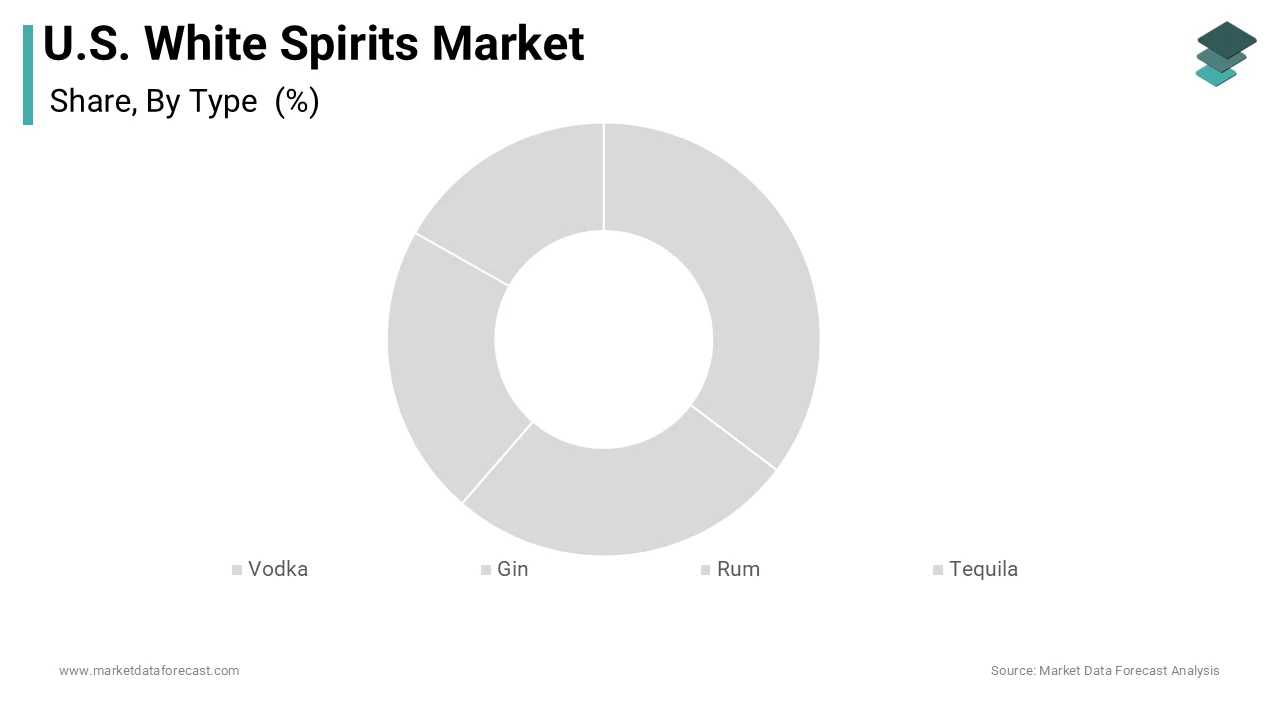
The gin segment is expanding at a CAGR of 12.7% between 2025 and 2023 in the U.S. White Spirits Market. This acceleration is propelled by the botanical renaissance sweeping American mixology, with most of the craft cocktail bars now featuring house-made gin infusions. According to the American Craft Spirits Association, consumer curiosity in terroir-driven spirits has surged; the sales of American dry gins with locally foraged botanicals grew in 2023 alone. The RTD gin & tonic category exploded, with retail volume up year-over-year, by appealing to convenience-seeking urban professionals. Gin’s narrative, such as artisanal, transparent, and Instagrammable, which resonates deeply with digitally native consumers, is transforming it from a heritage spirit into a cultural phenomenon.
By Distribution Channel Insights
Off-trade segment, including liquor stores, supermarkets, and e-commerce, dominated the U.S. White Spirits Market with h prominent share in 2025. This segment supremacy is anchored in habitual at-home consumption: more than half of white spirit purchasers buy primarily for home use. Bulk purchasing behavior amplifies off-trade dominance as the households now average 3.2 spirit bottles per transaction, up from 2.1 in 2019. Retailer innovation further entrenches this: total store count for specialized liquor retailers grew in 2023, with curated “white spirit discovery aisles” driving basket expansion. Off-trade also benefits from loyalty programs, with enrolled households spending 37% more annually.
The direct-to-consumer e-commerce segment is estimated to expand at a CAGR of 28.4% from 2025 to 2033 in the U.S. White Spirits Market. The rise is fueled by regulatory liberalization, where 47 states now permit distiller-to-consumer shipping, up from 32 in 2020. Digital-native purchasing habits accelerate adoption: according to Distill Ventures’ 2023 DTC Benchmark, more than half of the consumers under 35 now prefer buying spirits online for home delivery. Subscription models amplify retention, where brands offering recurring deliveries report 3.1x higher customer lifetime value. E-commerce also enables hyper-personalization: 71% of distillers using AI-driven recommendation engines saw conversion lifts exceeding.
COUNTRY LEVEL ANALYSIS
United States White Spirits Market Analysis
The United States stands as the world’s largest and most influential white spirits market, accounting for 39.6% of global white spirit consumption volume in 2023. Unlike markets tethered to tradition, the U.S. thrives on fragmentation and reinvention, with over 2,100 active distilleries, compete not on heritage but on innovation velocity. This dynamism is underwritten by demographic plurality: no single ethnic or cultural group dominates consumption, which is allowing vodka, gin, and rum to coexist without category cannibalization. The market’s maturity is deceptive; it absorbs disruption seamlessly, which is evidenced by year-over-year growth in “non-traditional white spirits” (e.g., shochu, baijiu-style clear spirits). Regulatory tolerance for experimentation, such as FDA-approved functional additives and state-level DTC shipping, is creating a sandbox unmatched globally by making the U.S. not just a market, but a laboratory for the future of white spirits.
COMPETITIVE LANDSCAPE
The U.S. White Spirits Market is a high-velocity battleground where global conglomerates, regional craft innovators, and celebrity-backed startups vie for shelf space and cultural mindshare. Unlike mature markets bound by tradition, competition here thrives on disruption,n with limited releases, TikTok-driven flavor drops, and blockchain-tracked provenance now table stakes. Giants leverage scale for distribution muscle while micro-distillers weaponize authenticity and locality. Regulatory arbitrage, which is exploiting state-level DTC loopholes, fuels guerrilla growth. No player is safe; consumer allegiance shifts monthly, which is forcing even category leaders to behave like insurgents. Victory hinges not on heritage, but on velocity: who can prototype, validate, and scale new expressions fastest without diluting brand ethos.
KEY MARKET PLAYERS
Here are the key market players in the U.S. White Spirits Market
- Diageo
- Bacardi Limited
- Pernod Ricard
- Suntory Holdings Limited
- Brown-Forman Corporation
- Sazerac Company Inc.
- Constellation Brands Inc.
- William Grant & Sons
- Rémy Cointreau
- Proximo Spirits
- ExxonMobil Corporation
- Shell plc
- TotalEnergies SE
- BP p.l.c.
- Sherwin-Williams Company
- PPG Industries
- RPM International Inc.
- Idemitsu Kosan Co., Ltd.
- Neste Oyj
- DHC Solvent Chemie GmbH
TOP LEADING PLAYERS IN THE MARKET
- Diageo plc operates a formidable portfolio of white spirits, including Smirnoff vodka and Tanqueray gin, which is leveraging its U.S. manufacturing footprint in Kentucky and Indiana. The company has intensified regional marketing for the Asian-American community by launching limited-edition Asian-inspired botanical vodkas in California and Texas. In 2023, Diageo partnered with Asian hotel chains and premium lounges to introduce U.S.-crafted white spirits in duty-free and experiential pop-ups across Singapore, Japan, and South Korea, which is embedding American mixology culture into Asia-Pacific nightlife.
- Pernod Ricard USA, through brands like Absolut Vodka and Beefeater Gin, anchors its strategy in premium craftsmanship and sustainability storytelling. The company recently inaugurated a carbon-neutral distillation line in Kentucky by aligning with regional rising ESG expectations. Pernod Ricard launched “American Artisan Collective” in late 2023, which is a curated export program placing small-batch U.S. white spirits in Tokyo, Seoul, and Sydney boutiques. It also co-hosted bartender exchange programs to transplant U.S. cocktail innovation into metropolitan bars.
- Bacardi Limited, steward of Grey Goose vodka and Bombay Sapphire gin, aggressively expands its U.S.-origin premium white spirits in the region through localized influencer campaigns and RTD collaborations. In early 2025, Bacardi launched a U.S.-distilled, lychee-infused vodka exclusively for Southeast Asian markets, which is produced in Puerto Rico but branded as American-crafted. The company activated immersive “Stateside Sips” pop-up bars in Bangkok and Manila, is blending American music, mixology, and digital engagement to position U.S. white spirits as culturally fluid yet premium lifestyle symbols.
TOP STRATEGIES USED BY KEY MARKET PARTICIPANTS
Key players deploy hyper-localized innovation, which is embedding regional botanicals and cultural motifs into white spirit formulations to resonate with diverse American sub-markets while retaining export versatility. They aggressively pursue direct-to-consumer e-commercewhichchiss circumvents traditional three-tier distribution to capture margin and data. Strategic co-branding with celebrity chefs, musicians, and wellness influencers amplifies relevance among digitally native cohorts. Sustainability is operationalized, which is not marketed with water-neutral distillation and regenerative agriculture sourcing becoming baseline requirements. Lastly, experiential retail via branded tasting rooms and cocktail labs transforms passive consumption into participatory brand immersion, which is fostering emotional loyalty beyond price or flavor.
UNITED STATES WHITE SPIRITS MARKET NEWS
- In March 2022, Diageo announced the opening of a new $110 million canning facility in Plainfield. This plant was built to produce malt-based and spirits-based RTD cocktails, including Smirnoff seltzers and Ketel One Botanical vodka spritz.
- In 2025, Beam Suntory finalized the sale of its Courvoisier cognac brand to the Campari Group. This move allowed the company to sharpen its focus on key growth categories like premium American, Japanese, and tequila spirits.
- In June 2025, Constellation Brands relocated its headquarters to a new campus in Rochester, New York. The company also uses partnerships to drive innovation, such as its minority investment in the non-alcoholic brand Hiyoo,o announced in March 2025.
MARKET SEGMENTATION
This research report on the U.S. white spirits market is segmented and sub-segmented into the following categories:
By Type
- Vodka
- Gin
- Rum
- Tequila
By Distribution Channel
- On-Trade (Bars, Restaurants, Clubs)
- Off-Trade (Liquor Stores, Supermarkets, Convenience Stores)
- Direct-to-Consumer (DTC) E-commerce
- Online Marketplaces
By Category
- Premium
- Standard
- Economy
By End User
- Residential / Home Consumption
- Commercial (Hotels, Bars, Restaurants, Events)
By Country
- United States
Frequently Asked Questions
1. What factors are driving growth in the U.S. White Spirits Market?
Industrial use in paints, cleaning, construction, and a demand spike from the cocktail culture are boosting the market. Ongoing construction development maintains robust market demand in the U.S. White Spirits Market.
2. Which are the main applications of white spirits in the U.S. White Spirits Market?
The primary applications include paint thinning, surface preparation, degreasing, industrial cleaning, and as solvents in manufacturing—vital for both DIY and professional sectors throughout the U.S. White Spirits Market.
3. Who are the key players in the U.S. White Spirits Market?
Prominent players in the U.S. White Spirits Market include Sherwin-Williams, PPG Industries, RPM International (Rust-Oleum), and ExxonMobil Chemical, all serving industrial and consumer segments.
4. How is sustainability shaping the U.S. White Spirits Market?
Sustainability trends are pushing companies in the U.S. White Spirits Market toward eco-friendly packaging and low-VOC (volatile organic compound) formulations to meet regulatory and consumer preferences.
5. What are the current trends affecting the U.S. White Spirits Market?
Trends include premiumization of spirits, growing cocktail culture, sustainability adoption, and the integration of digital distribution channels within the U.S. White Spirits Market.
6. What is the importance of white spirits in the U.S. paint and coatings industry?
The U.S. White Spirits Market serves as a vital solvent resource for the paint and coatings industry, enabling efficient thinning, surface preparation, and cleanup for many contractors and manufacturers.
7. How is consumer preference influencing the U.S. White Spirits Market?
Consumers in the U.S. White Spirits Market increasingly prefer premium, craft, and organic spirits, which drives innovation in distilled spirits like gin and vodka, and impacts product offerings.
8. Which regulatory aspects affect the U.S. White Spirits Market?
Stricter environmental and safety regulations regarding VOC emissions and solvent disposal shape product choices and innovation in the U.S. White Spirits Market.
9. What role does construction activity play in the U.S. White Spirits Market?
Construction sector growth boosts demand for white spirits, essential for paint thinning, cleaning, and coatings solutions used throughout the U.S. White Spirits Market.
10. How significant is the craft spirits segment in the U.S. White Spirits Market?
The craft and artisanal spirits niche is growing in the U.S. White Spirits Market, reflecting consumer demand for unique, small-batch, and high-quality white spirit products.
Related Reports
Access the study in MULTIPLE FORMATS
Purchase options starting from
$ 2500
Didn’t find what you’re looking for?
TALK TO OUR ANALYST TEAM
Need something within your budget?
NO WORRIES! WE GOT YOU COVERED!
Call us on: +1 888 702 9696 (U.S Toll Free)
Write to us: sales@marketdataforecast.com