Global Urban Air Mobility Market Size, Share, Trends, & Growth Forecast Report, Segmented By Solution (Infrastructures, & Platforms), Mobility Type (Air Taxis, Air Shuttles and & Air Metros, Personal Air Vehicles, Cargo Air Vehicles, and Air Ambulances & Medical Emergency Vehicles), Range (Intercity (> 100 km), and Intracity (< 100 km)), Platform Operation (Piloted, and Autonomous(Remotely Piloted, Fully Autonomous)), Platform Architecture(Rotary-wing, Fixed-wing Hybrid, and Fixed-wing ), End User(Ridesharing Companies, Scheduled Operators, E-commerce Companies, Hospitals & Medical Agencies, and Private Operators), & Region, Industry Forecast From 2026 to 2034
Global Urban Air Mobility Market Size
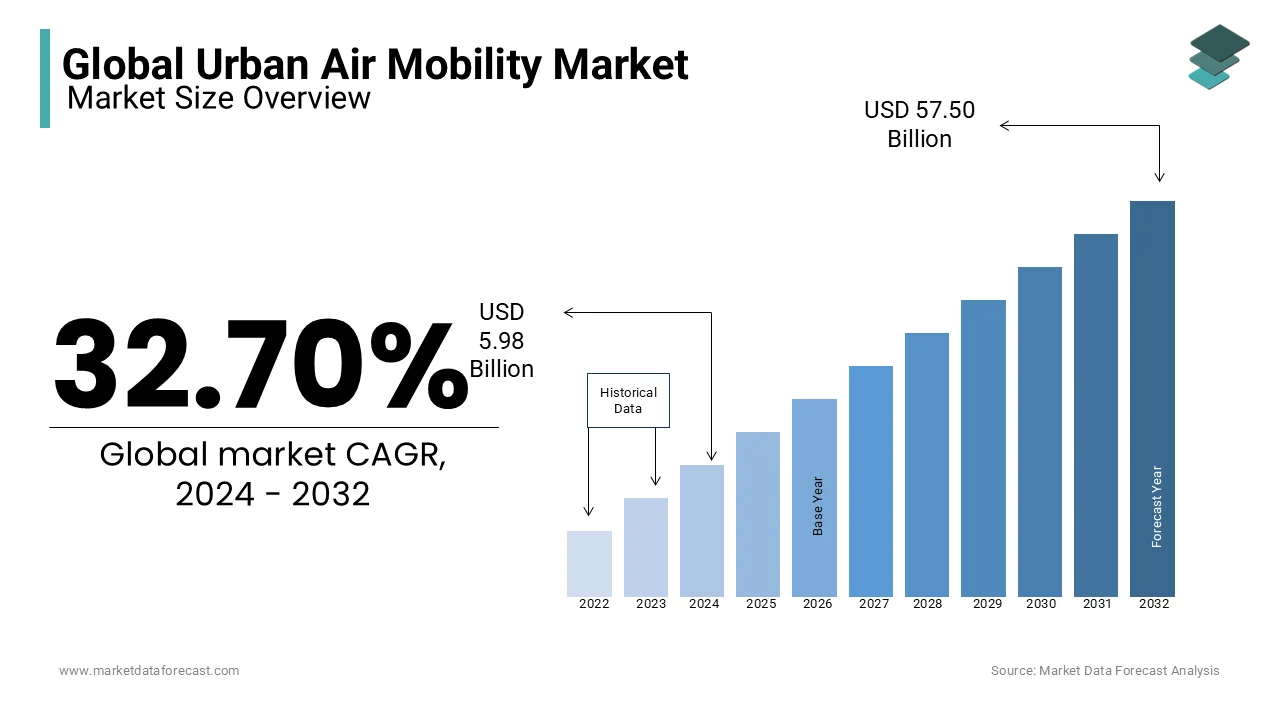
The global urban air mobility market was valued at USD 7.94 billion in 2025 and is anticipated to reach USD 10.54 billion in 2026 and USD 101.31 billion by 2034, growing at a CAGR of 32.70% during the forecast period from 2026 to 2034.
MARKET DRIVERS
The increasing urban population and rising prominence are reducing traffic congestion in the cities, which is escalating the growth rate of the market.
With the rising population, traffic congestion is becoming worse in urban areas, where the need to adopt urban air mobility is becoming popular. Urban air mobility demand is increasing at a higher rate from both businesses and individuals for faster and more efficient ways to transport goods and services. The increasing demand for ground-based alternatives like aerial transportation to reduce travel time is increasing day by day. In metropolitan cities, traffic congestion causes severe losses for companies as productivity is reduced proportionally. Also, when people are caught in traffic, the fuel gets wasted, which is becoming a concern with the rising crisis around the world.
Focus on the development of new intelligent aerial vehicles using advanced technologies for mobility is likely to fuel the urban air mobility market. Wisk, one of the most advanced air mobility companies in the world, secured USD 450 million from Boeing Compa6th-generation generation eVTOL aircraft, the first to get certified as autonomous. It is an electric aircraft that can accommodate passengers and can be a self-flying air taxi in the US if it receives FAA certification. The eVTOL is manufactured with several advanced features that enable it to operate in urban areas without the need for specialized infrastructure. The eVTOL is an alternative to traditional ground-based transportation that is efficient and reliable in routing and scheduling.
The UAM will become a means of transport in the coming years with the increasing demand for eco-friendly transportation. It is estimated that 60% of the world’s population will live in urban areas by 2029, which amplifies the need to reduce carbon emissions and adopt new mobility solutions. Major companies are focusing on the development of commercial urban air services that are anticipated to propel the market share.
The launch of electric vertical takeoff and landing aircraft is one of the key opportunities for the market to grow eventually in the foreseeable future.
These aircraft present significant opportunities to adopt sustainable development in urban transportation. Also, stringent government regulations to lower carbon emissions by reducing the use of fossil fuels and increasing prominence for electric-powered vehicles are enhancing the growth rate of the UAM market. Increasing R&D activities and growing investments in the development of aerial vehicles contribute to the market value. Hyundai agreed to launch Uber air taxis by the end of 2030. Urban mobility will rely on air taxis in the future, and this partnership will enhance urban air mobility.
MARKET RESTRAINTS
The high cost of the UAM for installation and maintenance is restricting the market growth rate. In addition, the difficulty in getting certifications from government organizations is impeding the market share. Lack of complete knowledge of the innovative features of the traditional aviation process of certification is also a factor that is hampering the growth rate of the urban air mobility market. The need to establish new standards and procedures is increasing day by day, which promotes the rigorous testing, evaluation, and validation of newly launched aerial vehicles. These new standards and protocols will elevate the production rate of aerial vehicles in the coming years.
MARKET CHALLENGES
The lack of skilled people to operate urban air mobility, as it is featured with highly technological developments, is inhibiting the growth rate of the urban air mobility market. Urban air mobility devices need high-quality support from people with high knowledge in various technological fields. Hence, finding skilled personnel in the military forces is a big challenge for the key players.
REPORT COVERAGE
| REPORT METRIC | DETAILS |
| Market Size Available | 2025 to 2034 |
| Base Year | 2025 |
| Forecast Period | 2026 to 2034 |
| CAGR | 32.70% |
| Segments Covered | By Solution, Mobility Type, Range, Platform Operation, Platform Architecture, End User, & Region |
| Various Analyses Covered | Global, Regional & Country Level Analysis, Segment-Level Analysis, DROC, PESTLE Analysis, Porter’s Five Forces Analysis, Competitive Landscape, Analyst Overview on Investment Opportunities |
| Regions Covered | North America, Europe, APAC, Latin America, Middle East & Africa |
| Market Leaders Profiled | Pipistrel Group, EHang, Lilium, Workhorse Group Inc., Kitty Hawk, Volocopter GmbH, Neva Aerospace, Airbus, The Boeing Company, Opener |
SEGMENTAL ANALYSIS
By Solution Insights
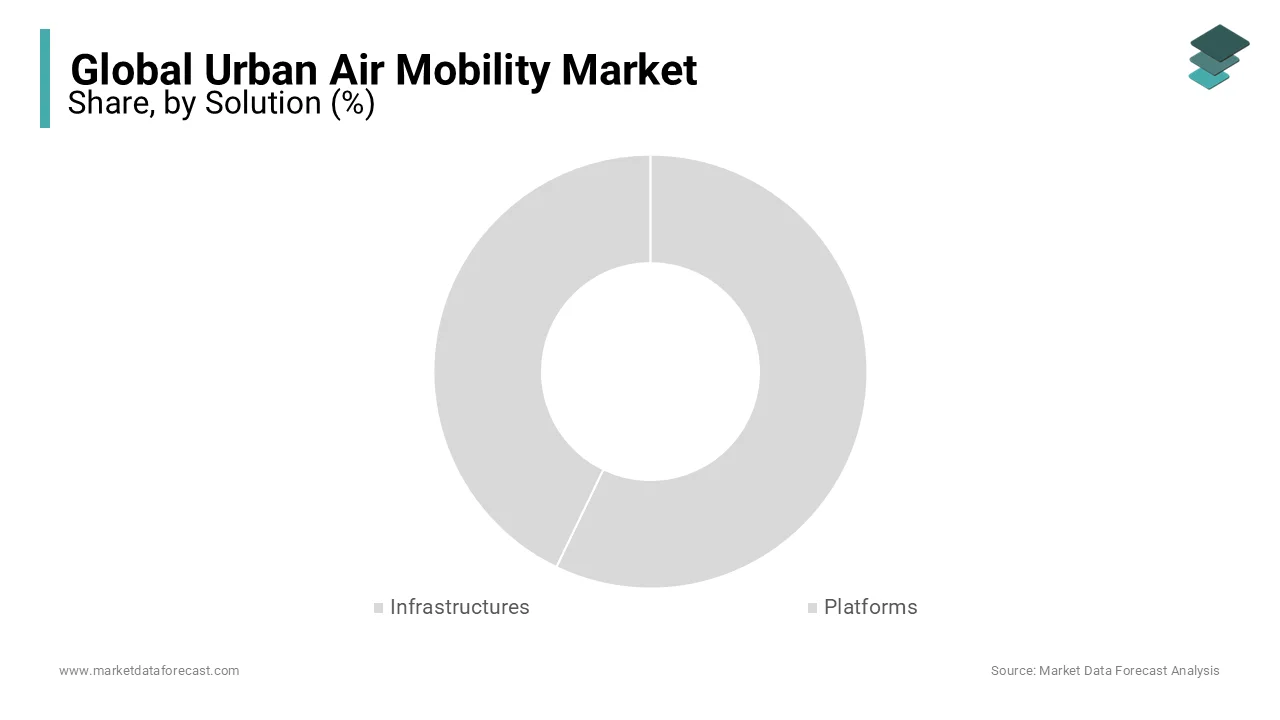
The infrastructure segment is leading with the dominant share of the market with the rising need to adopt various technological developments in developed and developing countries. Investments from the government authorities to improve the infrastructure, along with the traffic management regulations, are escalating the growth rate of this segment.
By Mobility Insights
Air ambulances & medical emergency vehicles are gaining traction in the market share. Traffic congestion in urban areas is becoming a concern, and the demand to adopt air ambulances has been growing at a high rate in recent years. The air taxi segment is likely to have the strongest growth opportunities in the coming years as key players are focusing on adopting new technologies.
The intercity Insights
Intercity(>100 Km) segment is likely to hit the highest CAGR during the forecast period. Increasing disposable income and growing expenditure are expected to bolster the growth rate of the market. Intracity (<100 km) is expected to have significant growth opportunities in the near future.
By Platform Operation Insights
The pilot segment is greatly inclined to have a positive growth rate during the foreseen period, whereas the autonomous segment is expected to have significant growth opportunities. The increasingly convenient and efficient transportation techniques are likely to leverage the segment’s growth.
By Platform Architecture Insights
The rotary wing segment is leading with the dominant share of the market. Rotary wings play a major role in providing stability while taking off and landing vertically. The growing prominence of eVTOL is enhancing the demand for rotary wings. It also provides safety for the passenger to enable a smooth travel experience. Thus, the growth rate of the rotary wing segment is increasing enormously.
By End User Insights
The scheduled operators segment has the prominent growth rate in the market, whereas the hospitals & medical agencies segment is likely to have a prominent growth rate throughout the forecast period.
REGIONAL ANALYSIS
North America Market Analysis
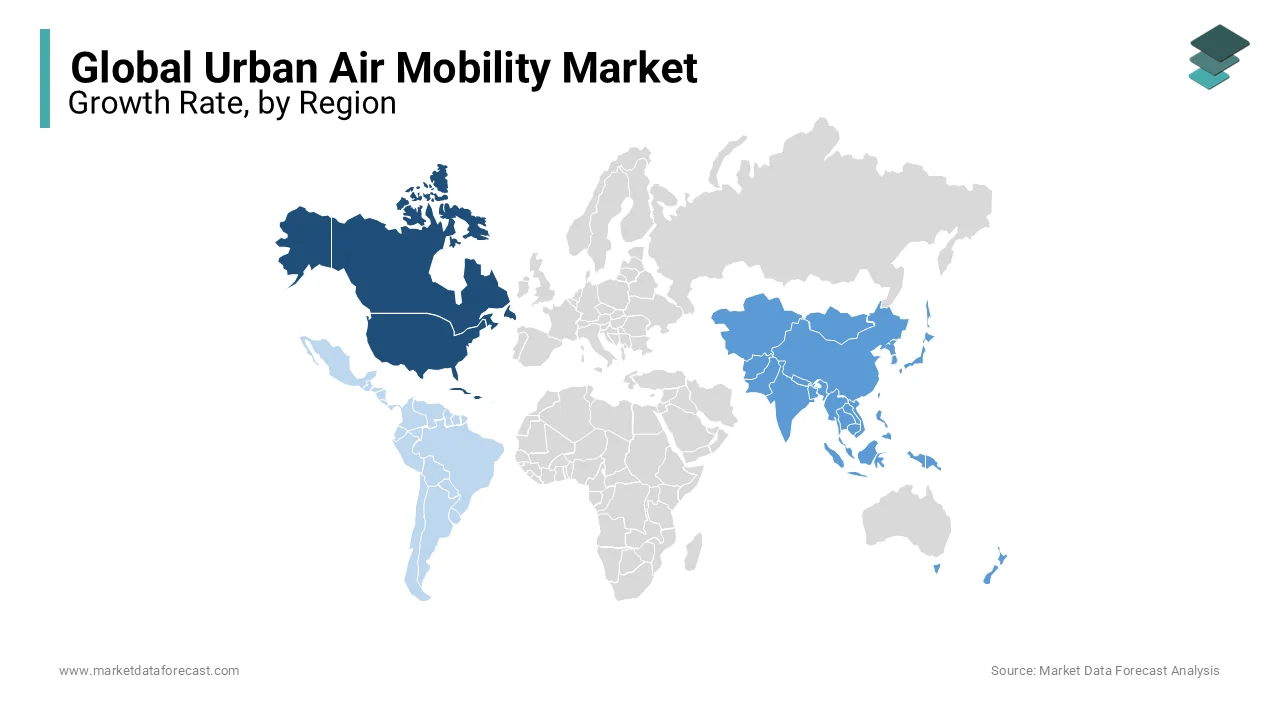
North America is leading with the largest share of the urban air mobility market. The US is a highly developed country with an increasing urban population every year. Traffic congestion is a major concern for people in the US. On average, an American commuter will waste time and fuel, which costs around $1377 per year. In addition, Americans waste 8 billion hours every year due to traffic congestion. These statistics imply that urban air mobility is at a faster rate. The rapid adoption of innovative technological advancements is amplifying the growth rate of the market in the US, as UAM can reduce traffic congestion and is a better way to commute in small electric aircraft.
Asia Pacific Market Analysis
Asia Pacific is next in holding a prominent share of the market. The increasing population in urban areas is a major factor that has caused the market to grow enormously in this region. China has been leading with the highest market share in the past few years. China is the top country in adopting highly advanced technology, especially in launching unmanned aerial vehicles. This country plans to accelerate the applications of drones and increase air mobility in urban areas. Advanced technologies are replacing traditional means of transportation.
Europe Market Analysis
Europe is deemed to have the highest CAGR throughout the forecast period, due to the rising per capita income. The Civil Aviation Authority’s future air mobility regulatory sandbox was organized in the UK to meet sustainable transportation needs. The organization is working closely with top companies to bring a clean, safe, practical electric air taxi ecosystem.
Latin America Market Analysis
Latin America and the Middle East & Africa are set to have huge growth opportunities in the foreseeable years.
KEY MARKET PLAYERS
A dominating market players that are in the global urban air mobility market are
- Pipistrel Group
- EHang
- Lilium
- Workhorse Group Inc.
- Kitty Hawk
- Volocopter GmbH
- Neva Aerospace
- Airbus
- The Boeing Company
- Opener
RECENT MARKET NEWS
-
On May 30, 2023, CityAirBus NextGen was developed by Airbus SE, which is a realistic idea to promote efficient air transport, especially in urban areas. This will be an alternative to the existing means of transportation with the advanced technology that can be moved into the sky to reach their destination in less time.
-
On January 02, 2024, Ehang, a global leader in urban air mobility, completed the demonstration of EHang’s EH216-s passenger aerial vehicle in China. This demonstration is paving the way to integrate air mobility in urban areas. This vehicle is a pilotless passenger-carrying vehicle that has received certification from the Civil Aviation Administration of China (CAAC).
MARKET SEGMENTATION
This research report on the global urban air mobility market has been segmented and sub-segmented based on the solution, mobility type, range, platform operation, platform architecture, end user, and region.
By Solution
-
Infrastructures
-
Charging Stations
-
Vertiports
-
Air Traffic Management Facilities
-
Maintenance Facilities
-
Platforms
-
Aerostructures
-
Avionics
-
Electrical Systems
-
Propulsion Systems
-
Software
By Mobility Type
-
Air Taxis
-
Air Shuttles and & Air Metros
-
Personal Air Vehicles
-
Cargo Air Vehicles
-
Air Ambulances & Medical Emergency Vehicles
By Range
-
Intercity (> 100 km)
-
Intracity (< 100 km)
By Platform Operation
-
Piloted
-
Autonomous
-
Remotely Piloted
-
Fully Autonomous
By Platform Architecture
- Rotary-wing
- Fixed-wing Hybrid
- Fixed-wing
By End User
- Ridesharing Companies
- Scheduled Operators
- E-commerce Companies
- Hospitals & Medical Agencies
- Private Operators
By Region
- North America
- Europe
- Asia-Pacific
- South America
- Middle East & Africa
Frequently Asked Questions
Why are cities seriously considering urban air mobility right now?
Because ground transport is reaching its limits, pushing cities to explore faster and more efficient aerial alternatives.
How would you describe urban air mobility in simple terms?
It is a next-generation transport system that uses small aircraft to move people and goods within cities.
What makes eVTOL aircraft so central to this market’s growth?
Their ability to take off vertically and run on electricity makes them ideal for dense urban environments.
Is urban air mobility just a futuristic idea or something already happening?
It is already in pilot and testing phases across multiple cities, moving steadily toward commercialization.
Who are the main players shaping this industry’s direction?
A mix of aerospace manufacturers, tech firms, and mobility startups are collectively driving innovation.
How does this market align with global sustainability goals?
It supports cleaner transportation by reducing reliance on fuel-based vehicles and lowering emissions.
What kind of passengers are most likely to use air taxis first?
Early adoption is expected among business travelers and premium commuters seeking time efficiency.
Could urban air mobility reduce traffic congestion meaningfully?
Yes, by shifting a portion of short-distance travel to the air, it can ease pressure on road networks.
What is the biggest technical barrier facing this industry today?
Ensuring safe, reliable, and scalable flight systems in crowded urban airspace remains a major challenge.
How important is regulation in shaping the future of this market?
Extremely important, as clear safety and airspace rules are essential for public trust and deployment.
Related Reports
Access the study in MULTIPLE FORMATS
Purchase options starting from
$ 2500
Didn’t find what you’re looking for?
TALK TO OUR ANALYST TEAM
Need something within your budget?
NO WORRIES! WE GOT YOU COVERED!
Call us on: +1 888 702 9696 (U.S Toll Free)
Write to us: sales@marketdataforecast.com