Europe Sports Car Market Size, Share, Trends & Growth Forecast Report Segmented By Vehicle Type (Coupe Sports Cars, Convertible Sports Cars, Limited Edition/Supercars/Hypercars, Roadsters/Targa/2-Seat Open Sports Cars), And Country (UK, France, Spain, Germany, Italy, Russia, Sweden, Denmark, Switzerland, Netherlands, Turkey, Czech Republic & Rest Of Europe), Industry Analysis From 2026 To 2034
Europe Sports Car Market Report Summary
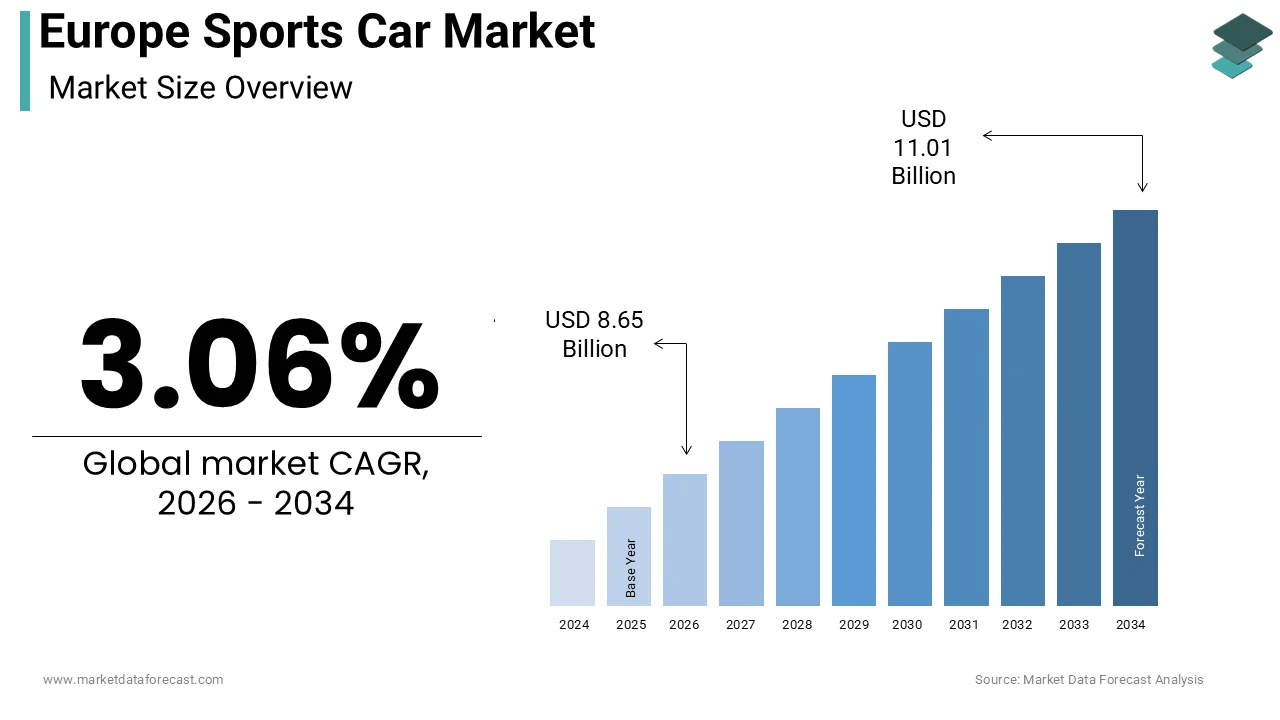
The Europe sports car market was valued at USD 8.39 billion in 2025 and is projected to reach USD 11.01 billion by 2034, growing from USD 8.65 billion in 2026 at a CAGR of 3.06% during the forecast period. Market growth is driven by strong demand for high-performance vehicles, rising disposable incomes among affluent consumers, and the region’s deep-rooted automotive heritage. Increasing innovation in electric sports cars, advanced performance technologies, and luxury customization is further supporting the growth of the Europe sports car market.
Key Market Trends
- Growing demand for high-performance and luxury vehicles
- Rising adoption of electric and hybrid sports cars
- Increasing customization and personalization options
- Strong influence of automotive heritage and brand legacy
- Expansion of premium automotive technologies and lightweight materials
Segmental Insights
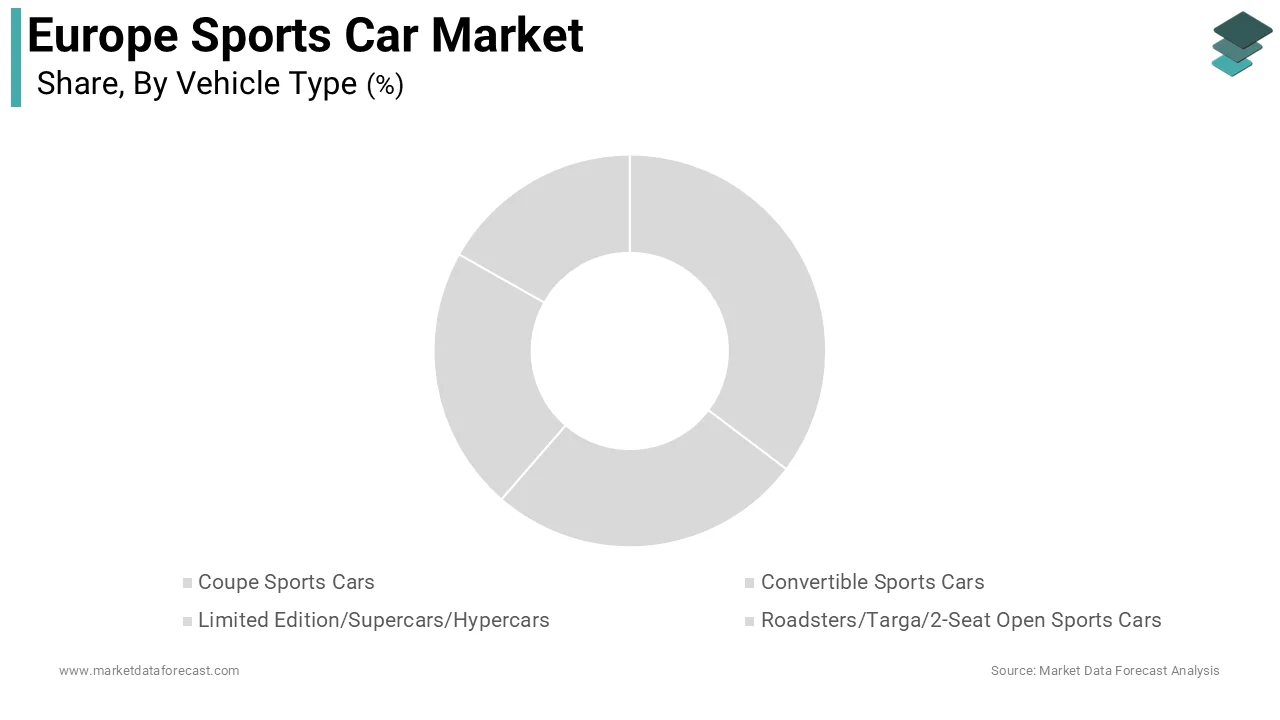
- Based on vehicle type, the coupe sports cars segment dominated the Europe sports car market in 2025 by accounting for 46.4% of the regional market share, driven by their design appeal, performance, and brand positioning.
Regional Insights
- Germany led the Europe sports car market in 2025 by holding 29.1% of the regional market share, supported by strong automotive manufacturing and engineering excellence.e
- United Kingdom ranked second in 2025, driven by its luxury automotive heritage and strong demand for premium sports vehicles
- Italy is expected to account for a prominent share during the forecast period, supported by its legacy in supercar manufacturing and design.
- France is projected to witness a healthy CAGR, driven by increasing interest in premium and electric sports vehicles.
- Switzerland is anticipated to grow steadily, supported by high purchasing power and favorable regulatory conditions.s
Competitive Landscape
- The Europe sports car market is highly competitive, with leading automotive brands focusing on performance innovation, electrification, and luxury customization. Companies are investing in lightweight materials, aerodynamics, and hybrid powertrains to enhance vehicle performance and sustainability.
- Prominent players in the Europe sports car market include Ferrari N.V, Lamborghini, Porsche AG, Aston Martin Lagonda Global Holdings plc, McLaren Group, BMW AG, Mercedes-Benz Group AG, and Audi AG.
Europe Sports Car Market Size
The Europe sports car market size was calculated to be USD 8.39 billion in 2025 and is anticipated to be worth USD 11.01 billion by 2034, from USD 8.65 billion in 2026, growing at a CAGR of 3.06% during the forecast period.
Sports cars represent a specialized segment of the automotive industry characterized by high-performance vehicles designed for superior handling, acceleration, and aesthetic appeal. These vehicles often feature powerful engines, advanced aerodynamics, and lightweight materials to deliver an exhilarating driving experience. The region is home to some of the most prestigious automotive brands in the world, including Ferrari, Porsche, and Lamborghini, which contribute significantly to the global prestige of European engineering. According to the European Automobile Manufacturers Association, the automotive sector remains a cornerstone of the European economy, employing over 13 million people directly and indirectly. This industrial base provides a robust supply chain and skilled workforce essential for the intricate manufacturing processes required for sports cars. As per Eurostat, the average disposable income in Western European countries has remained resilient, supporting the purchasing power of affluent consumers who constitute the primary demographic for luxury performance vehicles. The cultural affinity for motorsport and automotive heritage in countries like Italy, Germany, and the United Kingdom further sustains demand. Regulatory frameworks are increasingly influencing design parameters, with stringent emissions standards pushing manufacturers towards electrification. The integration of digital technologies and connectivity features is also becoming standard, enhancing the user experience. This market operates at the intersection of luxury lifestyle and technological innovation, reflecting broader trends in consumer preferences and regulatory landscapes across the continent.
MARKET DRIVERS
Rising Disposable Income and Wealth Accumulation among Affluent Consumers
The accumulation of wealth among high-net-worth individuals is majorly propelling the growth of the Europe sports car market. Despite economic fluctuations, the upper echelon of society has seen consistent growth in assets, enabling increased expenditure on luxury goods, including high-performance vehicles. According to Credit Suisse, the number of millionaires in Europe reached 17 million in 2023, representing a significant portion of global wealth. This demographic prioritizes exclusivity and brand prestige, making sports cars a symbol of status and success. As per a study by Bain and Company, the personal luxury goods market in Europe grew by 8% in 2023, driven by strong demand from local consumers. Within this affluent consumer segment, ethnic and racial representation among buyers is gradually shifting; according to industry reports on luxury consumer demographics, approximately 12% of high-net-worth individuals in major European hubs such as London and Paris identify as belonging to minority ethnic groups, including those of South Asian, East Asian, and Middle Eastern descent. Sports cars often serve as tangible investments with limited-edition models appreciating over time. The availability of flexible financing options and leasing programs further facilitates access for affluent buyers who prefer to manage liquidity. Additionally, the rise of young entrepreneurs and tech innovators has expanded the customer base beyond traditional demographics. These new buyers seek modern designs and advanced technological features, aligning with contemporary tastes. The psychological aspect of ownership, including the thrill of driving and social recognition, also plays a crucial role. Manufacturers cater to this demand by offering personalized customization options, enhancing the emotional connection between the buyer and the vehicle. This sustained financial capacity ensures a steady demand for premium sports cars across the region.
Strong Cultural Heritage and Motorsport Enthusiasm
The deep-rooted cultural heritage and passion for motorsport in Europe significantly drive the demand for sports cars, which is further contributing to the expansion of the Europe sports car market. The continent is the birthplace of many iconic racing series and automotive brands, which creates a lasting emotional connection with consumers. According to the Fédération Internationale de l'Automobile, Europe hosts the majority of Formula 1 races, attracting millions of spectators and viewers annually. This exposure fosters a desire among enthusiasts to own vehicles that reflect the performance and aesthetics of their racing heroes. As per data from the Royal Automobile Club, membership in automotive clubs dedicated to classic and performance cars has increased by 5% in recent years. Events such as the Goodwood Festival of Speed and the Mille Miglia celebrate automotive history and innovation, drawing large crowds and media attention. These gatherings reinforce the community aspect of car ownership and inspire new generations of enthusiasts. The presence of legendary circuits like Monaco, Silverstone, and the Nürburgring provides venues for track days and driving experiences, enhancing the practical appeal of sports cars. Manufacturers leverage this heritage by releasing special editions and collaborating with racing teams to boost brand loyalty. The narrative of engineering excellence and racing pedigree adds intangible value to sports cars, making them more than just modes of transport. This cultural ecosystem sustains long-term interest and demand in the European market.
MARKET RESTRAINTS
Stringent Emissions Regulations and Environmental Policies
Stringent emissions regulations and environmental policies act as major restraints on the Europe sports car market by imposing rigorous compliance standards on manufacturers. The European Union’s Euro 7 emission norms aim to drastically reduce nitrogen oxide and particulate matter emissions from all road vehicles, including high-performance models. According to the European Commission, these regulations require advanced after-treatment systems that can increase vehicle weight and complexity, potentially compromising performance characteristics. As per the International Council on Clean Transportation, the cost of complying with these standards can add thousands of euros to the production cost of each vehicle. Manufacturers face challenges in maintaining the power and sound profiles that define sports cars while meeting these limits. The push towards zero-emission zones in major cities like London, Paris, and Berlin restricts the usability of traditional internal combustion engine sports cars. As per the European Environment Agency, over 300 low-emission zones are currently operational in Europe, with expansion plans. This limits the environments where owners can fully enjoy their vehicles. The transition to electric powertrains requires significant investment in research and development, which may delay new model launches. Additionally, the loss of engine noise, a key sensory element of the sports car experience, may alienate traditional enthusiasts. These regulatory pressures force manufacturers to rethink design philosophies and may reduce the variety of models available in the short term.
High Ownership Costs and Economic Volatility
High ownership costs and economic volatility pose significant restraints on the Europe sports car market, which is affecting both initial purchase decisions and long-term retention. Sports cars typically incur higher insurance premiums, maintenance fees, and fuel costs compared to standard vehicles. According to the Association of British Insurers, insurance costs for high-performance vehicles can be up to 50% higher than average due to increased risk profiles. As per data from ADAC, the German automobile club, annual maintenance and repair costs for premium sports cars can exceed 3,000 euros, depending on usage and model complexity. Economic uncertainties such as inflation and fluctuating interest rates impact consumer confidence and discretionary spending. During periods of economic downturn, affluent consumers may postpone luxury purchases or opt for more practical investments. The depreciation rate of sports cars, although slower for limited editions, can still be substantial for mainstream models, affecting resale value. Fuel price volatility further exacerbates operating costs, particularly for models with large-displacement engines. Taxation policies in various European countries, including luxury taxes and higher registration fees, add to the financial burden. For instance, in Norway, high import duties on luxury vehicles significantly reduce affordability. These financial factors create barriers to entry and may discourage potential buyers from entering the market. Manufacturers must balance performance with efficiency to mitigate these costs, but the inherent expense of high-end engineering remains a persistent challenge.
MARKET OPPORTUNITIES
Expansion of Electric and Hybrid Powertrain Technologies
The expansion of electric and hybrid powertrain technologies presents a significant opportunity for the Europe sports car market by aligning with sustainability goals and enhancing performance capabilities. Electric motors offer instant torque and rapid acceleration, which can surpass traditional internal combustion engines in certain metrics. According to the European Alternative Fuels Observatory, sales of plug-in hybrid and battery-electric sports cars have increased by 25% in the last two years. Manufacturers like Porsche with the Taycan and Ferrari with the SF90 Stradale have successfully demonstrated that electrification can coexist with high performance. As per a report by McKinsey and Company, 60% of luxury car buyers in Europe are interested in electric vehicles, provided they meet performance expectations. This shift allows brands to comply with emissions regulations while offering innovative driving dynamics. The development of solid-state batteries and improved charging infrastructure further enhances the viability of electric sports cars. Governments provide incentives such as tax exemptions and access to low-emission zones, which encourage adoption. The novelty of electric powertrains attracts tech-savvy consumers and younger demographics who prioritize sustainability. Manufacturers can leverage this transition to redefine brand identity and explore new design possibilities freed from traditional engine constraints. This technological evolution opens new market segments and revenue streams, ensuring long-term relevance in a changing automotive landscape.
Growth of Luxury Tourism and Experiential Driving Services
The growth of luxury tourism and experiential driving services offers a promising opportunity for the Europe sports car market by creating alternative revenue streams and enhancing brand engagement. High-net-worth tourists increasingly seek unique and memorable experiences during their travels, including supercar rentals and guided driving tours. According to the World Tourism Organization, luxury travel spending in Europe has rebounded strongly, with experiential activities being a key driver. Companies offering exotic car rentals in popular destinations like the French Riviera and the Italian Alps report annual growth rates of 10%. As per data from major rental agencies, the demand for high-performance vehicles for short-term use exceeds supply during peak seasons. This trend allows manufacturers to reach customers who may not be ready to purchase but wish to experience the brand. Partnerships with luxury hotels and travel agencies facilitate integrated packages that include accommodation and driving experiences. Track day events and driving schools provide safe environments for enthusiasts to explore vehicle capabilities, fostering brand loyalty. These services also serve as marketing tools, generating social media content and word-of-mouth promotion. The flexibility of rental models appeals to urban dwellers with limited storage space who desire occasional access to sports cars. By embracing the experience economy, manufacturers and service providers can expand their customer base and enhance brand visibility without relying solely on unit sales.
MARKET CHALLENGES
Supply Chain Disruptions and Raw Material Scarcity
Supply chain disruptions and raw material scarcity present major challenges to the Europe sports car market by affecting production timelines and cost stability. The industry relies on specialized components such as carbon fiber, aluminum, and semiconductors, which are subject to global supply fluctuations. According to the European Automobile Manufacturers Association, the automotive sector faced significant delays in 2023 due to shortages of electronic chips and raw materials. As per a report by KPMG, the cost of aluminum and lithium has increased by 20% in the past year, impacting manufacturing budgets. Sports car manufacturers often require custom parts with low-volume production, making them more vulnerable to supply chain bottlenecks. Geopolitical tensions and trade restrictions further complicate sourcing strategies, particularly for materials from Asia and Russia. The reliance on just-in-time manufacturing principles exacerbates the impact of any disruption, leading to production halts. Delays in vehicle delivery can result in order cancellations and customer dissatisfaction. Manufacturers are attempting to diversify suppliers and increase inventory buffers, but this requires significant capital investment. The complexity of integrating new technologies such as electric powertrains adds another layer of supply chain risk. Ensuring a stable flow of high-quality materials is critical for maintaining production schedules and meeting demand. Addressing these vulnerabilities requires strategic partnerships and enhanced supply chain visibility to mitigate risks and ensure operational continuity.
Changing Consumer Preferences towards Sustainability and Practicality
Changing consumer preferences towards sustainability and practicality pose a significant challenge to the Europe sports car market as societal values shift away from conspicuous consumption. Younger generations, including Millennials and Gen Z, prioritize environmental responsibility and ethical consumption, which may conflict with the image of gas-guzzling sports cars. According to a survey by Deloitte, 40% of young consumers consider sustainability a key factor in purchasing decisions. As per the European Environment Agency, awareness of climate change has led to increased scrutiny of high-emission vehicles. This shift in attitude may reduce the aspirational value of traditional sports cars among future buyers. The rise of remote work and urbanization also favors practical and compact vehicles over large performance cars with limited utility. Storage space and daily usability become more important than top speed and acceleration for many users. Manufacturers face the dilemma of preserving brand heritage while adapting to these new values. Greenwashing accusations can damage brand reputation if sustainability efforts are perceived as superficial. The transition to electric vehicles helps address environmental concerns but may not fully satisfy the emotional desires of traditional enthusiasts. Balancing these conflicting demands requires careful branding and product strategy. Failure to adapt to evolving consumer values could lead to a decline in market relevance and sales volume in the long term.
REPORT COVERAGE
| REPORT METRIC | DETAILS |
| Market Size Available | 2025 to 2034 |
| Base Year | 2025 |
| Forecast Period | 2026 to 2034 |
| CAGR | 3.06% |
| Segments Covered | By Vehicle Type, And Region |
| Various Analyses Covered | Global, Regional & Country Level Analysis; Segment-Level Analysis; DROC, PESTLE Analysis; Porter’s Five Forces Analysis; Competitive Landscape; Analyst Overview of Investment Opportunities |
| Regions Covered | UK, France, Spain, Germany, Italy, Russia, Sweden, Denmark, Switzerland, Netherlands, Turkey, and the Czech Republic |
| Market Leaders Profiled | Ferrari N.V., Lamborghini, Porsche AG, Aston Martin Lagonda Global Holdings plc, McLaren Group, BMW AG, Mercedes-Benz Group AG, Audi AG |
SEGMENTAL ANALYSIS
By Vehicle Type Insights
The coupe sports cars segment held the dominant position in the Europe sports car market by accounting for 46.4% of the regional market share in 2025. The dominance of the coup sports cars segment is majorly driven by the superior structural rigidity and aerodynamic efficiency that coupe body styles offer, which are critical for high-performance driving dynamics. According to the Society of Motor Manufacturers and Traders, coupes represent the most popular configuration for performance vehicles in Europe due to their balance of practicality and sportiness. As per data from major manufacturers like Porsche and BMW, the fixed-roof design allows for enhanced torsional stiffness, which improves handling precision and safety ratings. The coupe segment also benefits from lower production costs compared to convertible mechanisms, enabling more competitive pricing for entry-level sports cars. Consumer preference for all-weather usability further supports this dominance, as coupes provide better insulation and security than open-top variants. The aesthetic appeal of sleek rooflines continues to attract buyers seeking a classic sports car silhouette. Additionally, the resale value of coupe models tends to be higher due to their perceived durability and timeless design. The availability of diverse powertrain options, ranging from efficient four-cylinders to powerful V8 engines within the coupe format, caters to a broad spectrum of performance enthusiasts. This versatility ensures that coupes remain the cornerstone of the European sports car market, satisfying both daily drivers and track-focused users.
However, the limited edition supercars and hypercars segment is projected to register a promising CAGR of 10.9% over the forecast period, owing to the increasing wealth concentration and the investment potential of exclusive automotive assets. High-net-worth individuals view these vehicles not merely as transportation but as alternative investments that often appreciate. According to Knight Frank, the Luxury Investment Index indicated that rare cars outperformed many traditional asset classes, with values increasing by 15% annually in recent years. As per reports from auction houses like RM Sotheby's, demand for limited-production runs from brands such as Ferrari, McLaren, and Bugatti has surged among collectors in Europe. Manufacturers strategically limit production volumes to create scarcity, which drives up desirability and secondary market prices. The integration of hybrid technology in hypercars has also attracted tech-savvy billionaires who appreciate the engineering innovation alongside exclusivity. Social media amplification of these rare vehicles enhances their status symbol value, encouraging new entrants into the collector market. The customization options offered by manufacturers allow buyers to create unique specimens, further boosting their investment appeal. This segment benefits from a resilient customer base that is less sensitive to economic downturns. The combination of financial appreciation potential and unparalleled performance ensures rapid growth in this niche but highly lucrative sector of the market.
REGIONAL ANALYSIS
Germany Sports Car Market Analysis
Germany dominated the market with 29.1% of the regional market share in 2025. The dominance of Germany in the European market is attributed to its strong automotive heritage and the presence of iconic manufacturers such as Porsche, BMW, and Mercedes-AMG. According to the Kraftfahrt-Bundesamt, new registrations of high-performance vehicles in Germany remained robust, with over 40,000 units sold in the premium sports segment in 2023. As per the German Automotive Industry Association, the domestic demand for sports cars is fueled by a culture that values engineering excellence and driving dynamics. The extensive network of Autobahns with unrestricted speed sections provides a unique environment for testing and enjoying high-performance vehicles. Government incentives for electric sports cars, such as tax benefits for plug-in hybrids, have accelerated the adoption of electrified performance models. The presence of renowned racing circuits like the Nürburgring fosters a vibrant motorsport community that influences consumer preferences. High disposable income levels among German consumers support the purchase of luxury performance vehicles. The country serves as a key export hub for European sports car manufacturers, leveraging its central location and logistical infrastructure. Germany’s commitment to innovation ensures it remains at the forefront of sports car technology and consumption in the region.
United Kingdom Sports Car Market Analysis
The United Kingdom had the second largest share of the Europe sports car market in 2025 due to a deep-rooted passion for automotive heritage and luxury brands. The UK is home to prestigious marques such as Aston Martin, McLaren, and Lotus, which contribute significantly to domestic interest and production. According to the Society of Motor Manufacturers and Traders, the UK luxury car market, including sports models, showed resilience with steady growth despite broader economic challenges. As per data from the Driver and Vehicle Licensing Agency, the number of licensed sports cars has increased by 5% annually, reflecting sustained enthusiasm among enthusiasts. The presence of iconic tracks like Silverstone and Goodwood promotes a culture of performance driving and car clubs. High-net-worth individuals in London and the South East drive demand for exclusive and limited-edition models. The UK’s favorable tax structures for company cars have historically influenced fleet purchases of high-end sports vehicles, although recent changes are shifting focus towards private ownership. The strong second-hand market facilitates entry for younger buyers. The UK’s influence on global automotive trends through media and events ensures its prominent position in the European sports car landscape.
Italy Sports Car Market Analysis
Italy is anticipated to account for a prominent share of the Europe sports car market during the forecast period, owing to its unparalleled legacy in supercar manufacturing and design. The country is the birthplace of Ferrari, Lamborghini, and Maserati brands that define the pinnacle of automotive performance and style. According to the Italian Automobile Federation, domestic sales of sports cars are supported by a strong cultural affinity for automotive excellence and racing. As per data from Confindustria, the automotive sector contributes significantly to the national economy, with sports cars representing a high-value export category. The scenic roads of regions like Tuscany and the Amalfi Coast provide ideal settings for sports car usage, enhancing their appeal to local owners. Tourism also plays a role, as visitors often rent or purchase sports cars during their stay. The Italian government’s support for industrial innovation helps manufacturers maintain technological leadership. The presence of historic events like the Mille Miglia keeps the passion for classic and modern sports cars alive. Italy’s design prowess attracts global attention, making it a trendsetter in the industry. The combination of manufacturing strength and cultural passion ensures Italy remains a key player in the regional market.
France Sports Car Market Analysis
France is estimated to showcase a healthy CAGR in the Europe sports car market during the forecast period due to a growing interest in premium performance vehicles and electric sports cars. The country is home to manufacturers like Alpine and Bugatti, which cater to niche but influential segments. According to the French Automobile Manufacturers Committee, the market for sports cars has seen a shift towards electrification, with models like the Alpine A110 gaining popularity. As per data from the French Ministry of Ecological Transition, incentives for low-emission vehicles have boosted sales of hybrid and electric sports cars. The diverse geography of France, from coastal routes to mountain passes, offers varied driving experiences that appeal to enthusiasts. Paris and other major cities host exclusive automotive events that stimulate interest and demand. The French consumer’s appreciation for design and aesthetics aligns well with the artistic nature of sports car manufacturing. Government policies promoting sustainable mobility are shaping the future product lineup of French brands. The presence of high-net-worth individuals in regions like the French Riviera supports the luxury segment. France’s strategic focus on innovation and design ensures its continued relevance in the European sports car market.
Switzerland Sports Car Market Analysis
Switzerland is expected to exhibit a notable CAGR in the Europe sports car market during the forecast period due to its high wealth density and favorable regulatory environment. The country has one of the highest concentrations of millionaires per capita in the world, driving demand for luxury and high-performance vehicles. According to the Swiss Federal Statistical Office, imports of luxury cars, including sports models, have remained consistently high, reflecting strong purchasing power. As per data from the Swiss Automobile Importers Association, the demand for exclusive and limited-edition sports cars is particularly strong among affluent residents. The absence of strict speed limits on certain highway sections and the presence of scenic alpine roads make sports cars practical and enjoyable for daily use. Switzerland’s neutral stance and stability attract international buyers who may register vehicles there. The country serves as a showcase for new models due to its discerning customer base. High import duties are offset by the lack of annual road taxes in some cantons, making ownership relatively attractive. The strong presence of luxury dealerships and service centers supports the high-end market. Switzerland’s unique economic and geographical factors sustain its significant role in the regional sports car landscape.
COMPETITION OVERVIEW
The competition in the Europe sports car market is intense, characterized by established luxury brands and emerging electric vehicle manufacturers. Legacy automakers leverage their heritage and engineering expertise to maintain brand loyalty among traditional enthusiasts. New entrants challenge this dominance with innovative electric powertrains and advanced digital features. Price competition is less significant than differentiation through performance design and exclusivity. Manufacturers compete on technological advancements such as hybrid systems and autonomous driving aids. Brand prestige plays a crucial role in purchasing decisions, with consumers valuing status and heritage. Customization options allow buyers to personalize vehicles enhancing emotional connections. Motorsport success serves as a powerful marketing tool, demonstrating technical superiority. Regulatory pressures force all participants to invest in sustainable technologies, accelerating innovation. The market sees frequent launches of limited edition models creating scarcity and demand. Digital engagement through social media and virtual experiences expands brand reach. Collaborations with luxury lifestyle brands enhance appeal beyond automotive circles. Overall, the landscape is dynamic with continuous adaptation to consumer preferences and regulatory changes, driving competitive strategies.
KEY MARKET PLAYERS
A few major players of the Europe sports car market include
- Ferrari N.V
- Lamborghini
- Porsche AG
- Aston Martin Lagonda Global Holdings plc
- McLaren Group
- BMW AG
- Mercedes-Benz Group AG
- Audi AG
Top Strategies Used by Key Market Participants
Key players in the Europe sports car market primarily focus on product diversification and electrification to comply with regulatory standards. Manufacturers invest heavily in hybrid and electric powertrains to reduce emissions while maintaining performance levels. Brand exclusivity is maintained through limited production runs and personalized customization options for affluent buyers. Strategic partnerships with technology firms enhance digital connectivity and autonomous driving capabilities. Companies leverage motorsport heritage to reinforce brand prestige and attract enthusiasts. Expansion into emerging markets and digital sales channels broadens customer reach. After-sales services and exclusive driving experiences foster long-term customer loyalty. Sustainability initiatives, including synthetic fuels and carbon-neutral manufacturing, align with environmental goals. These strategies collectively drive growth and ensure competitiveness in a rapidly evolving automotive landscape.
Leading Players in the Market
- Porsche AG stands as a benchmark in the Europe sports car market, renowned for blending daily usability with high performance. The company consistently delivers innovative models like the 911 and Tayca,n which appeal to both traditionalists and modern buyers. Porsche recently expanded its electric vehicle lineup to meet stringent European emissions standards while maintaining brand heritage. The manufacturer invests heavily in synthetic fuel research to preserve internal combustion engines for future generations. Strategic partnerships with technology firms enhance digital connectivity and autonomous driving features. Porsche also strengthens customer loyalty through exclusive driving experiences and personalized customization programs. Their robust financial performance allows sustained investment in motorsport activities, which reinforces brand prestige. By balancing electrification with traditional engineering excellence, Porsche maintains its leadership position. The company’s focus on sustainability and innovation ensures long-term relevance in the evolving automotive landscape.
- Ferrari NV represents the pinnacle of luxury and performance in the Europe sports car market with an unmatched brand legacy. The Italian manufacturer focuses on exclusivity and limited production volumes to maintain high demand and resale values. Ferrari recently introduced hybrid powertrains in models like the SF90 Stradale, aligning with environmental regulations without compromising performance. The company leverages its Formula 1 success to enhance brand allure and technological credibility. Ferrari expands its personalization option,s allowing clients to create unique vehicles that reflect individual tastes. Strategic investments in manufacturing facilities increase production capacity while preserving artisanal quality. The brand also engages enthusiasts through dedicated clubs and exclusive events, fostering a strong community. Ferrari’s ability to blend heritage with cutting-edge technology ensures its status as a global icon. This approach secures its position among the most desirable automotive brands worldwide.
- McLaren Automotive is a key player in the Europe sports car market known for its lightweight engineering and aerodynamic innovation. The British manufacturer utilizes carbon fiber technology to create high-performance vehicles with superior handling characteristics. McLaren recently launched hybrid models such as the Artura to transition towards sustainable mobility solutions. The company focuses on direct customer engagement through bespoke customization programs and track day events. McLaren strengthens its market position by expanding its dealership network across major European cities. Strategic collaborations with technical partners drive advancements in powertrain efficiency and digital interfaces. The brand’s racing heritage in Formula 1 and GT competitions enhances its reputation for performance excellence. McLaren adapts to changing consumer preferences by offering versatile grand tourers alongside track-focused supercars. This diversified product portfolio ensures resilience in a competitive market. The commitment to innovation and driver engagement solidifies McLaren’s standing in the global sports car industry.
MARKET SEGMENTATION
This research report on the Europe sports car market has been segmented and sub-segmented based on vehicle type & region.
By Vehicle Type
- Coupe Sports Cars
- Convertible Sports Cars
- Limited Edition/Supercars/Hypercars
- Roadsters/Targa/2-Seat Open Sports Cars
By Region
- UK
- France
- Spain
- Germany
- Italy
- Russia
- Sweden
- Denmark
- Switzerland
- Netherlands
- Turkey
- Czech Republic
- Rest of Europe
Frequently Asked Questions
1. What is driving the growth of the Europe sports car market?
Growth is driven by rising disposable income, demand for luxury vehicles, technological advancements, and strong brand appeal.
2. Who are the major players in the market?
Leading companies include Ferrari N.V., Porsche AG, and Lamborghini.
3. What types of sports cars are popular in Europe?
Coupe, convertible, and high-performance electric sports cars are popular segments.
4. How is electrification impacting the sports car market?
Electric sports cars are gaining traction due to emission regulations and advancements in battery technology.
5. What role does brand heritage play in purchasing decisions?
Brand legacy and performance reputation strongly influence customer preferences.
6. What are the key technological trends in the market?
Advanced aerodynamics, lightweight materials, hybrid powertrains, and AI-based driving systems are key trends.
7. How do regulations affect the sports car market?
Strict emission and safety regulations in Europe are pushing manufacturers toward cleaner and more efficient technologies.
8. What is the average price range of sports cars in Europe?
Prices typically range from premium to ultra-luxury levels depending on brand and specifications.
9. What challenges does the market face?
High costs, strict emission norms, and economic fluctuations are key challenges.
10. What is the future outlook for the Europe sports car market?
The market is expected to grow steadily with innovations in electric mobility, hybrid technologies, and sustainable performance vehicles.
Related Reports
Access the study in MULTIPLE FORMATS
Purchase options starting from
$ 2000
Didn’t find what you’re looking for?
TALK TO OUR ANALYST TEAM
Need something within your budget?
NO WORRIES! WE GOT YOU COVERED!
Call us on: +1 888 702 9696 (U.S Toll Free)
Write to us: sales@marketdataforecast.com